Humanoid robots are coming to Japanese airports to help with luggage

midian182

Posts: 11,726   +177
Staff member
In brief: It's not just the factory floor where humanoid robots are starting to appear next to flesh-and-blood employees. Air travelers in Japan will soon see the machines moving luggage and cargo – a response to the country's labor shortage and booming tourism.
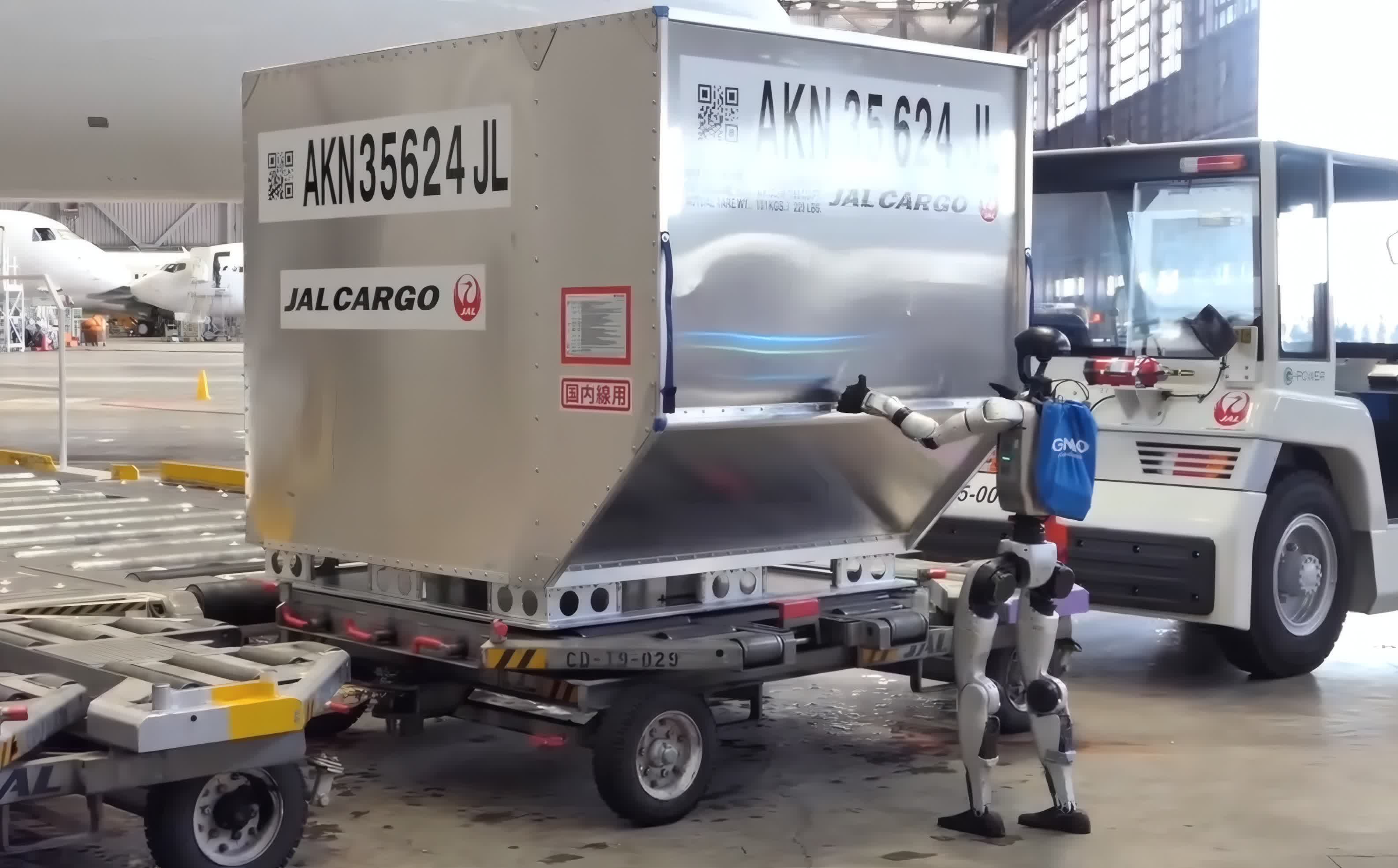
The robots will be introduced at the start of May by Japan Airlines on a trial basis, though the ultimate goal is to deploy them permanently. If you're one of the 60 million people passing through Haneda airport every year, keep a lookout for one.

JAL and its partner in the initiative, Japan Airlines GMO Internet Group, hope that the experiment, which is scheduled to end in 2028, will ease the strain on human workers as tourism surges and Japan's severe labor shortages continue to impact industries.

GMO is providing the robots and developing their movement programming, while JAL will contribute its operational expertise and evaluate safety standards.

Yoshiteru Suzuki, president of JAL Ground Service, said the robots can perform physically demanding work, thereby reducing the burden on workers and providing significant benefits to employees.

Suzuki added that some tasks, including safety management, would continue to be performed by humans.

One of the robots, a 130cm (4.2-foot) model manufactured by Hangzhou-based Unitree, was shown pushing cargo on a conveyor belt next to a JAL passenger plane while waving to a colleague. The robots can operate continuously for two to three hours and will be used for other tasks, such as cleaning cabins.

JAL said that previous attempts to automate airport operations have run into issues. More traditional robots and fixed automation systems have struggled to adapt to ground handling work. It's hoped that the human-like design of these new machines will overcome those obstacles.

The robots will be rolled out in phases. The first step is to analyze current operations to find the safest areas to place the machines. There will then be numerous tests in simulated airport environments.

While the appearance of humanoid robots on factory or warehouse floors for the likes of Amazon regularly leads to fears of job losses, Japan's demographics mean those concerns are less applicable in this case. The country is dealing with a shrinking, aging workforce at the same time visitor numbers are climbing sharply. More than 7 million overseas travelers arrived in the first two months of 2026, following a record 42.7 million in 2025.

One estimate suggests Japan will need more than 6.5 million foreign workers by 2040 to maintain its growth targets, which means machines that can take on repetitive and physically demanding airport jobs are becoming a necessity.

Permalink to story:

 
I grew up in the '60s and '70s, surrounded by dire media stories of impending world overpopulation. Groups like the Zero Population Growth Society were common. Yet today, most industrialized nations are, sans immigration, losing population rapidly, as evidence by this story from Japan, where the current birthrate has dropped to a new low of 1.15 -- half what's required to maintain a stable population level.
 
I'm confused. Very confused. The video doesn't show the robot doing anything of use. Why is it programmed to do a "thumbs-up" and not actually moving luggage?
 
I grew up in the '60s and '70s, surrounded by dire media stories of impending world overpopulation. Groups like the Zero Population Growth Society were common. Yet today, most industrialized nations are, sans immigration, losing population rapidly, as evidence by this story from Japan, where the current birthrate has dropped to a new low of 1.15 -- half what's required to maintain a stable population level.

That's because most people do jobs that aren't required. My company has some hundreds of employees and when I ask a question, nobody knows. "The people who built that are long gone", I sometimes get as a reply. Other times just silence.

The last time I worked in a sane environment was with a 6 people crew at another company. We were building things like a storm. But once we got to about 10 people, things started to fall apart.

I'm sure Japan has a lot of people moving papers and writing Excel reports that hate their 12-hour shifts and required bar-time after.
 
I grew up in the '60s and '70s, surrounded by dire media stories of impending world overpopulation. Groups like the Zero Population Growth Society were common. Yet today, most industrialized nations are, sans immigration, losing population rapidly, as evidence by this story from Japan, where the current birthrate has dropped to a new low of 1.15 -- half what's required to maintain a stable population level.

All their predictions were a fake ploy on the masses. That includes the Ice Age of 1970s, Global Warming and the Ozone hole in the 90s, Y2K, Climate Change, and just about everything else you can think off.

THEY thrive off the negativity, it proliferates their agenda and plans. Evil travels on frequencies of negativity.
 
To be honest, if they had robots actually doing something useful around the airport, then I'd be tempted to go back to Japan just to see them.
 
Japan is one of the few places where introducing robots to the workforce is genuinely a relief rather than a threat. The labor math is just broken — not enough people, too many tourists, physically brutal jobs nobody wants. When your alternative is "we literally don't have enough humans," a 4-foot robot waving at its coworker on the tarmac starts looking pretty reasonable.
 
I want one to carry my groceries so I can walk more instead of taking the bus or an Uber. And it shouldn't cost thousands of dollars...
 
A cart/wagon is pretty inexpensive.
But it gets pretty hot here in summertime and they aren't very practical for longer distances. I have a cart but I can only go about a block with one fully loaded. I like to do a week of grocery shopping for one person once a week and it can get heavy.
 
All their predictions were a fake ploy on the masses. That includes the Ice Age of 1970s, Global Warming and the Ozone hole in the 90s, Y2K, Climate Change, and just about everything else you can think off.

THEY thrive off the negativity, it proliferates their agenda and plans. Evil travels on frequencies of negativity.
Global warming and the Ozone hole are both real. I don't recall any predictions of ice ages in the 1970's, I think that might have been for much further out in time. Y2K was a false alarm, but mostly because computer programmers took care of most of the problems by issuing patches.
 
I don't recall any predictions of ice ages in the 1970's,
It was the cover story of Time Magazine April 28, 1975:

The Cooling Earth:


“There are ominous signs that the Earth’s weather patterns have begun to change dramatically and that these changes may portend a drastic decline in food production – with serious political implications for just about every nation on Earth. The drop in food output could begin quite soon, perhaps only 10 years from now. The regions destined to feel its impact are the great wheat-producing lands of Canada and the U.S.S.R. in the North, along with a number of marginally self-sufficient tropical areas – parts of India, Pakistan, Bangladesh, Indochina and Indonesia – where the growing season is dependent upon the rains brought by the monsoon.”

“The evidence in support of these predictions has now begun to accumulate so massively that meteorologists are hard-pressed to keep up with it. In England, farmers have seen their growing season decline by about two weeks since 1950, with a resultant overall loss in grain production estimated at up to 100,000 tons annually....."
 
It was the cover story of Time Magazine April 28, 1975:

The Cooling Earth:

“There are ominous signs that the Earth’s weather patterns have begun to change dramatically and that these changes may portend a drastic decline in food production – with serious political implications for just about every nation on Earth. The drop in food output could begin quite soon, perhaps only 10 years from now. The regions destined to feel its impact are the great wheat-producing lands of Canada and the U.S.S.R. in the North, along with a number of marginally self-sufficient tropical areas – parts of India, Pakistan, Bangladesh, Indochina and Indonesia – where the growing season is dependent upon the rains brought by the monsoon.”

“The evidence in support of these predictions has now begun to accumulate so massively that meteorologists are hard-pressed to keep up with it. In England, farmers have seen their growing season decline by about two weeks since 1950, with a resultant overall loss in grain production estimated at up to 100,000 tons annually....."
Well obviously we didn't know as much about the weather back then as we do now. Doesn't mean they were being malicious as you implied. Plus, reporters aren't scientists. They just pass on what they read in science journals and most scientists don't simply state what will happen. They give predictions with degrees of uncertainty, which of course drives regular people up the wall because they want more certainty and evidence-based science doesn't work that way.
 
reporters aren't scientists. They just pass on what they read in science journals
Yes. And they passed on what they read about global cooling then. And yes, the science was less certain then ... but that didn't stop the media from scaring people senseless.

As for global warming, there's a far higher degree of certainty about it. However, what the media fails to report is that the overall effects of that warming are almost certainly going to be more positive than negative. As just one of literally hundreds of examples, the increased atmospheric CO2 alone is already increasing food crop production by some 7 - 25%, depending on species -- enough extra food to feed one billion additional people.

We live on a planet where still many more people die each year from cold than from heat. A 1.5 degree rise -- most of it in the coldest areas of the planet already -- isn't an existential crisis.
 
Japan is one of the few places where introducing robots to the workforce is genuinely a relief rather than a threat. The labor math is just broken — not enough people, too many tourists, physically brutal jobs nobody wants. When your alternative is "we literally don't have enough humans," a 4-foot robot waving at its coworker on the tarmac starts looking pretty reasonable.
O.k., but if you annoy the robot, can it tug down its lower eyelid, stick out its tongue, and give you the finger? :D
 
Yes. And they passed on what they read about global cooling then. And yes, the science was less certain then ... but that didn't stop the media from scaring people senseless.

As for global warming, there's a far higher degree of certainty about it. However, what the media fails to report is that the overall effects of that warming are almost certainly going to be more positive than negative. As just one of literally hundreds of examples, the increased atmospheric CO2 alone is already increasing food crop production by some 7 - 25%, depending on species -- enough extra food to feed one billion additional people.

We live on a planet where still many more people die each year from cold than from heat. A 1.5 degree rise -- most of it in the coldest areas of the planet already -- isn't an existential crisis.
That's a myth. See "Climate change cuts global crop yields, even when farmers adapt" https://sustainability.stanford.edu...ts-global-crop-yields-even-when-farmers-adapt
 
That's a myth. See "Climate change cuts global crop yields, even when farmers adapt" https://sustainability.stanford.edu...ts-global-crop-yields-even-when-farmers-adapt
Oops! That's just another fear-mongering prediction for the year 2100. What we've seen so far is a dramatic increase in global crop yields, thanks to longer growing seasons and increased atmospheric CO2 alone. This isn't a hypothetical or a prediction, but cold, hard, irrefutable facts.

w=1350
 
Oops! That's just another fear-mongering prediction for the year 2100. What we've seen so far is a dramatic increase in global crop yields, thanks to longer growing seasons and increased atmospheric CO2 alone. This isn't a hypothetical or a prediction, but cold, hard, irrefutable facts.

w=1350
You're not reading. "With the planet already about 1.5 degrees Celsius hotter than pre-industrial levels, farmers in many areas are experiencing longer dry spells, unseasonable heat waves, and erratic weather that undermines yields, even when inputs like fertilizer and water improve. " I have two examples: Coffee, and Cocoa. They are being affected by droughts and floods. Nothing can grow without water, and plants need air for their roots to breath which is why too much water all at once is also a problem. Potable water is becoming scarce as a lot of ground water supplies are being contaminated with encroaching oceans so it's too saline for many crops, as well as humans. And even if a crop can grow in salty water, it may not be healthy for humans to eat because of the high salt content. And don't forget, all adaptation has a cost which not every farmer can afford to pay. So in my estimation, we'll be paying much higher costs for food from fewer suppliers in the future, and we won't need a war for it to happen.
 
You're not reading. "With the planet already about 1.5 degrees Celsius hotter than pre-industrial levels, farmers in many areas are experiencing longer dry spells, unseasonable heat waves, and erratic weather that undermines yields, even when inputs like fertilizer and water improve. " I have two examples: Coffee, and Cocoa. They are being affected by droughts and floods. Nothing can grow without water....
You're not paying attention. Hundreds of studies have shown increased crop yields from higher atmospheric CO2. These are not "predictions" or "future estimates" like you're quoting. This is real world data: every single decade has seen increased crop yields. There is no debating this issue.

"Global crop production has increased dramatically, nearly quadrupling between 1961 and 2020, driven primarily by higher yields. Total primary crop production reached 9.9 billion tonnes in 2023, a 27% increase since 2010. Key staples like maize, wheat, and rice dominate, with production frequently setting new records, including a 27% increase in global cereal production between 2010 and 2024....."
 
Droughts and floods keep getting more extreme, and in order for crops to grow, more and more pesticides have to be used, consequently those pesticides poison the groundwater.
And also meanwhile VC's are buying up farm land to build housing and apartment high rises priced out of the reach of the average person, because they're bought and sold as a circular investment scheme instead. Replacing everyone with robots simply doesn't work when the bots would put everyone out of work and crash the economy, but perhaps that's the goal, the richest elites hate the normal working class, killing them off to have a fictional utopia where bots do everything for them is probably what they want.
 
Droughts and floods keep getting more extreme
This is by the meteorological definition of "droughts" and "floods". In a dry desert region with a historical average rainfall of just one inch per year, an increase to 1.5 inches is a flood condition -- though that "flood" isn't harmful or dangerous in any way. In fact, by the inexorable laws of statistics, nearly half of these meteorological 'drought and flood' conditions are actually beneficial to man, since few areas on earth are already at the perfect hydrologic level for our purposes.

Again: global warming is contributing to increased crop production. And, on a world where more people die each year from cold than from heat, less human deaths as well. The sky is not falling, Chicken Little.

...And also meanwhile VC's are buying up farm land to build housing and apartment high rises priced out of the reach of the average person
Ah yes, the usual "evil corporations are destroying everything" claptrap. Farmland is one thing the US is not in short supply of -- today, we feed 350 million people on much LESS farmland than the US used in the year 1900 to feed just 100 million .... thanks, in part, to "global warming".
 
You're not paying attention. Hundreds of studies have shown increased crop yields from higher atmospheric CO2. These are not "predictions" or "future estimates" like you're quoting. This is real world data: every single decade has seen increased crop yields. There is no debating this issue.

"Global crop production has increased dramatically, nearly quadrupling between 1961 and 2020, driven primarily by higher yields. Total primary crop production reached 9.9 billion tonnes in 2023, a 27% increase since 2010. Key staples like maize, wheat, and rice dominate, with production frequently setting new records, including a 27% increase in global cereal production between 2010 and 2024....."
At least I included a source. What's yours?
 
Back