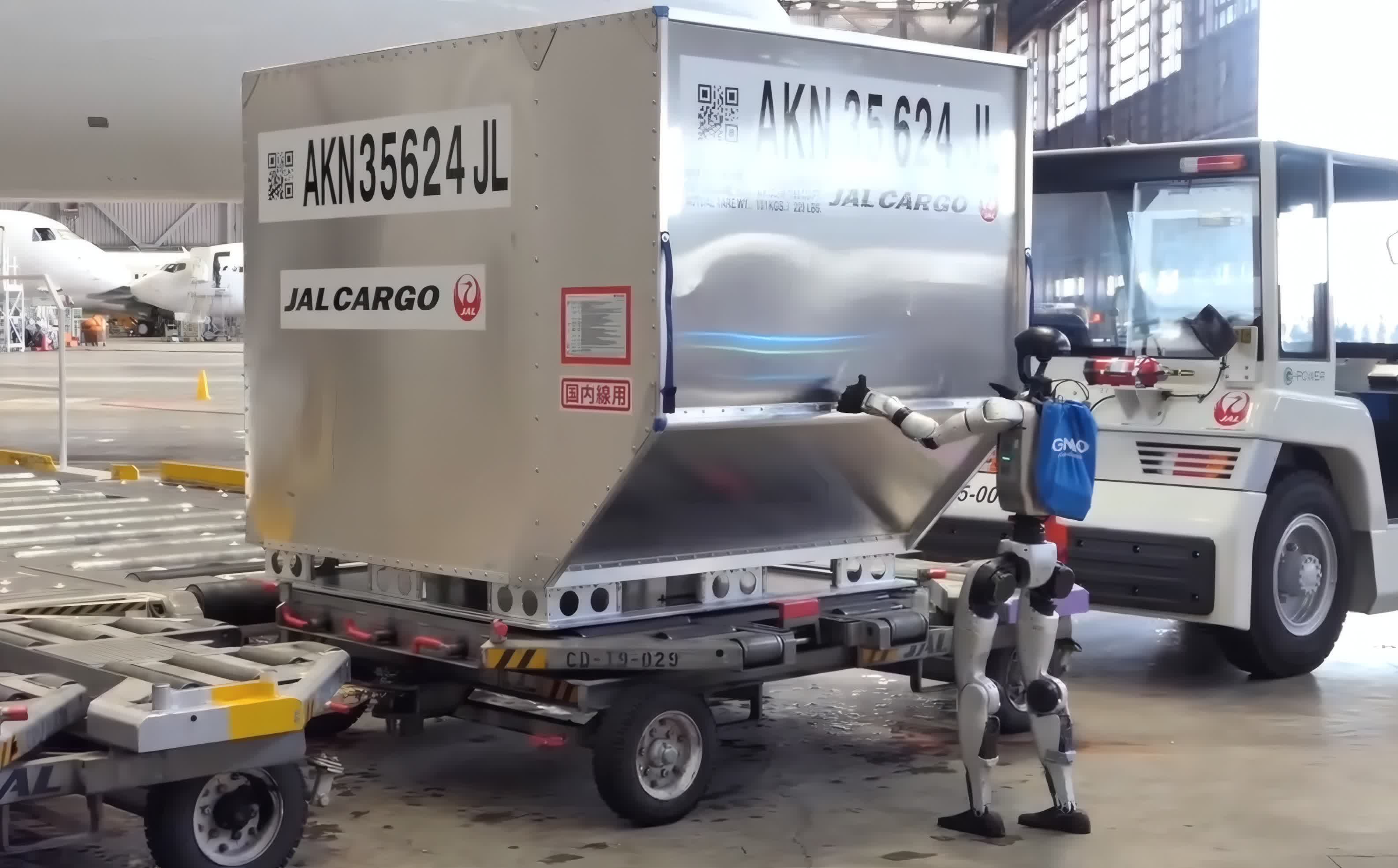
In brief: It's not just the factory floor where humanoid robots are starting to appear next to flesh-and-blood employees. Air travelers in Japan will soon see the machines moving luggage and cargo – a response to the country's labor shortage and booming tourism.
The robots will be introduced at the start of May by Japan Airlines on a trial basis, though the ultimate goal is to deploy them permanently. If you're one of the 60 million people passing through Haneda airport every year, keep a lookout for one.
JAL and its partner in the initiative, Japan Airlines GMO Internet Group, hope that the experiment, which is scheduled to end in 2028, will ease the strain on human workers as tourism surges and Japan's severe labor shortages continue to impact industries.
GMO is providing the robots and developing their movement programming, while JAL will contribute its operational expertise and evaluate safety standards.
Yoshiteru Suzuki, president of JAL Ground Service, said the robots can perform physically demanding work, thereby reducing the burden on workers and providing significant benefits to employees.
Suzuki added that some tasks, including safety management, would continue to be performed by humans.
One of the robots, a 130cm (4.2-foot) model manufactured by Hangzhou-based Unitree, was shown pushing cargo on a conveyor belt next to a JAL passenger plane while waving to a colleague. The robots can operate continuously for two to three hours and will be used for other tasks, such as cleaning cabins.
JAL said that previous attempts to automate airport operations have run into issues. More traditional robots and fixed automation systems have struggled to adapt to ground handling work. It's hoped that the human-like design of these new machines will overcome those obstacles.
The robots will be rolled out in phases. The first step is to analyze current operations to find the safest areas to place the machines. There will then be numerous tests in simulated airport environments.
While the appearance of humanoid robots on factory or warehouse floors for the likes of Amazon regularly leads to fears of job losses, Japan's demographics mean those concerns are less applicable in this case. The country is dealing with a shrinking, aging workforce at the same time visitor numbers are climbing sharply. More than 7 million overseas travelers arrived in the first two months of 2026, following a record 42.7 million in 2025.
One estimate suggests Japan will need more than 6.5 million foreign workers by 2040 to maintain its growth targets, which means machines that can take on repetitive and physically demanding airport jobs are becoming a necessity.