Inside Mississippi's new virtual teaching experiment to fix its teacher shortage

Skye Jacobs

Posts: 1,918   +58
Staff
TL;DR: With nearly 3,000 teaching vacancies and over half of its school districts classified as critical shortage areas, Mississippi is taking a technological leap to address its long-standing teacher shortage. A new initiative launched this fall is placing certified teachers in classrooms across the state – not in person, but through live-streamed instruction powered by cutting-edge technology.
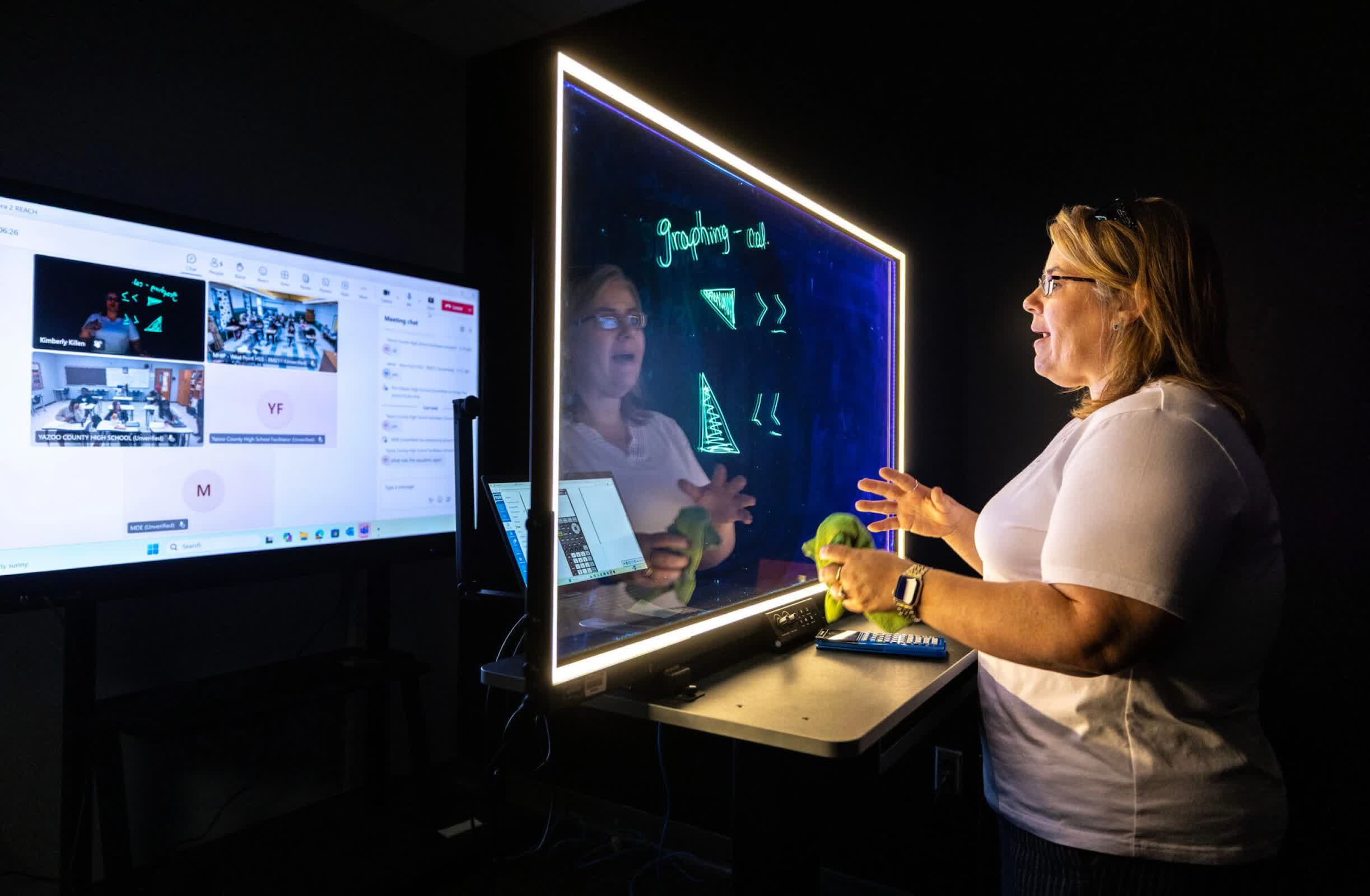
The initiative, officially named the Mississippi Virtual Synchronous Learning Initiative, or REACH MS, is a joint effort between the Mississippi Department of Education and Mississippi Public Broadcasting. It is currently in its pilot phase, supported by a $2.2 million appropriation from the Mississippi Legislature.

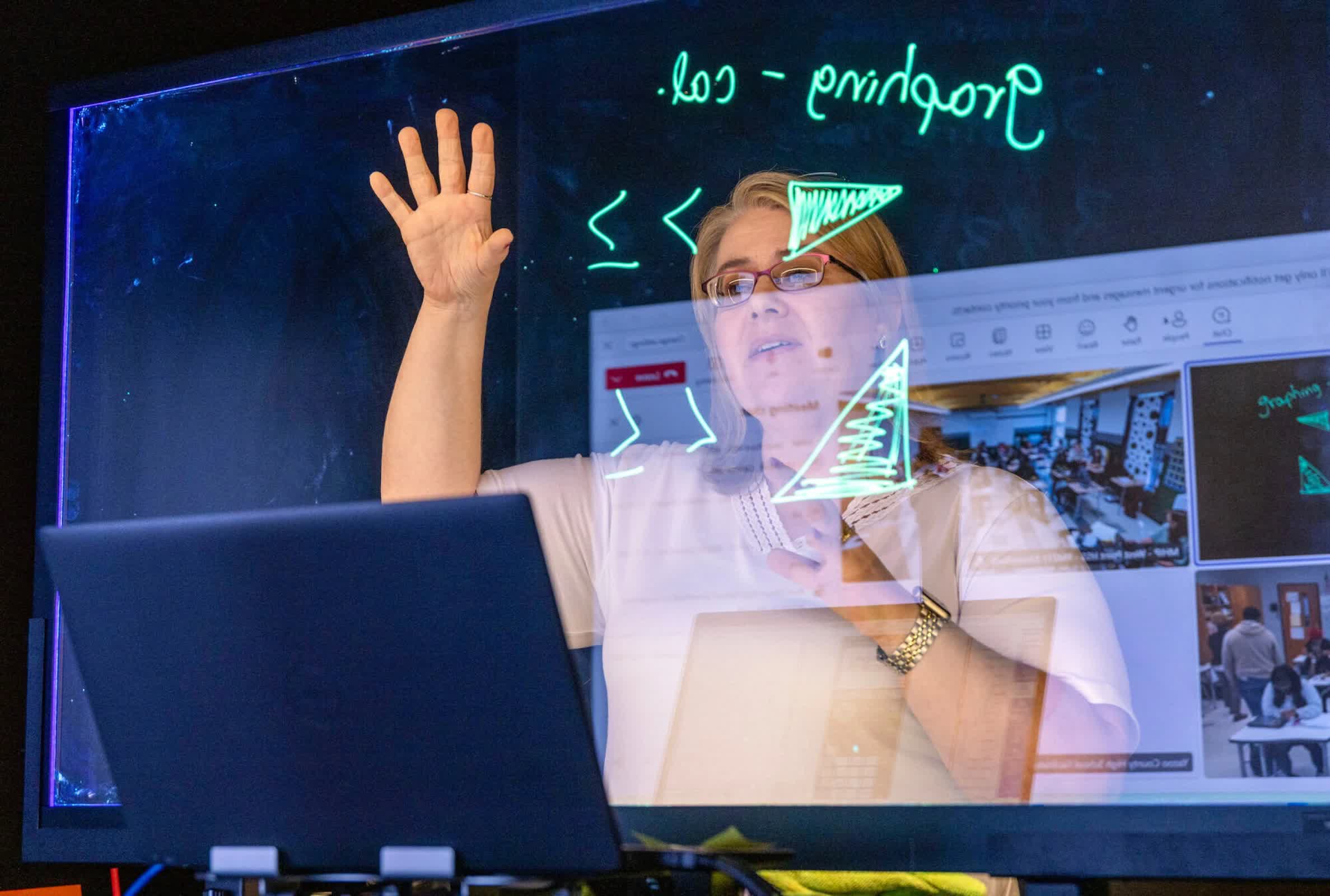
Unlike pre-recorded or independent online courses, REACH MS provides real-time instruction from certified teachers using an advanced setup known as eGlass. These interactive transparent lightboards allow educators to teach as if they're writing on a traditional whiteboard, while a camera captures their lessons and broadcasts them live to classrooms miles away.

Five districts – Hinds County, Yazoo County, Yazoo City, Claiborne, and West Point – are participating in the initial rollout. The program currently includes three certified teachers and three teaching assistants who are education majors nearing graduation. Districts provide physical classrooms, in-person facilitators, and reliable internet access, while the virtual teachers handle instruction.
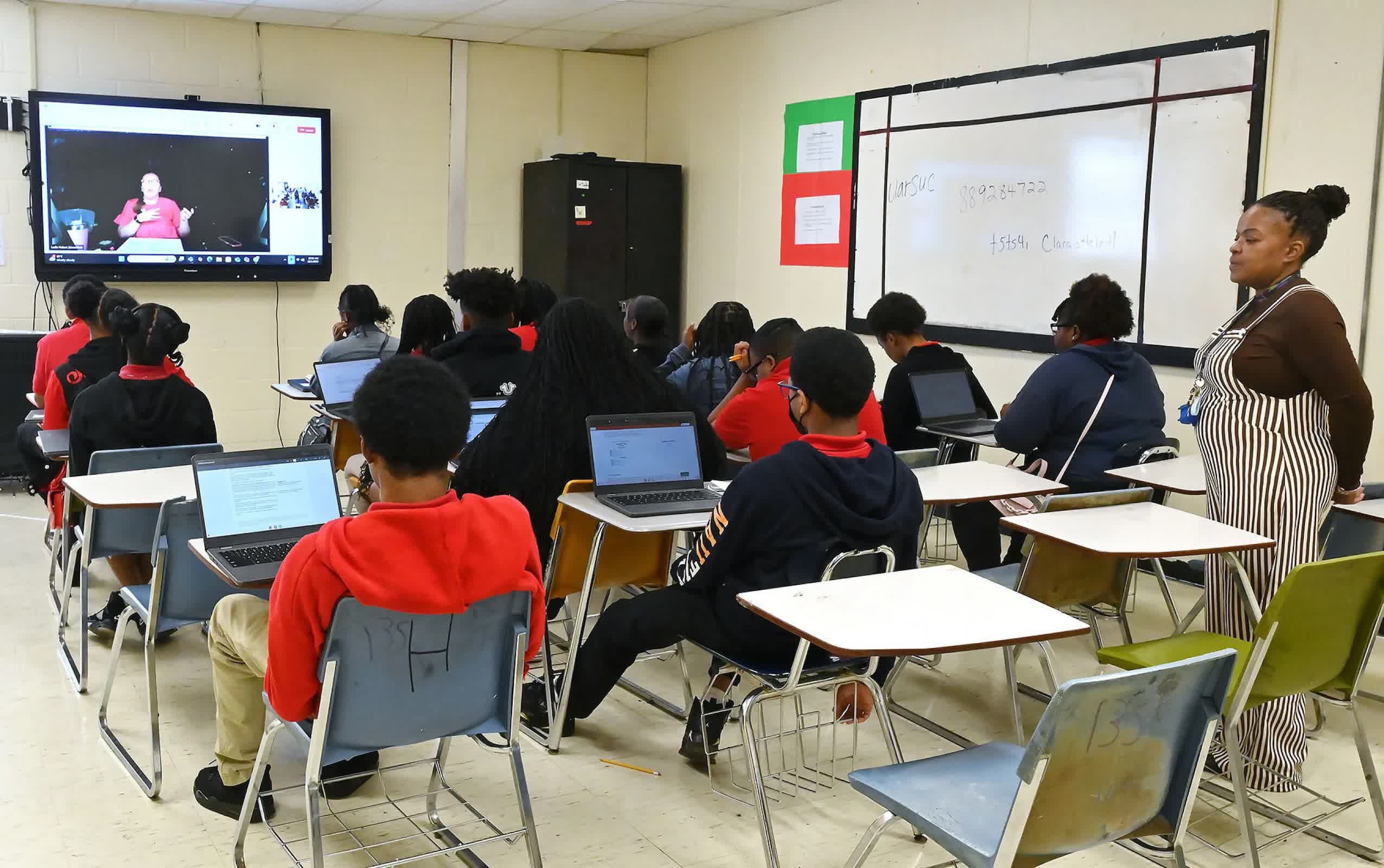
On a recent school day in Yazoo City High School, students in Caitlin Perkins' ninth-grade English class worked through a lesson on thesis writing. Perkins, though not physically in the room, appeared on a large screen at the front of the class, broadcasting live from MPB's Jackson studios. Her lesson played out in real time, with students watching attentively, participating in discussions, and responding aloud.

A certified teaching assistant walked the aisles, distributing worksheets and helping students stay on track. The classroom setting – desks, uniforms, face-to-face interaction – remained traditional, but the instructional delivery had changed.

Perkins is among the program's student teachers, completing her final training while simultaneously leading a virtual classroom. For students like 14-year-olds Rodrianna Drain, Mikeria Brown, and Devin Gibbs, the experience was initially unexpected, but it has become a preferred part of their school day.

Brown said she finds it easier to think through her answers when she types rather than responds on the spot. "It gives me more time to process," she said. The students praised Perkins' storytelling style and said they felt connected to her, despite the digital distance. "She talks to us like she's one of us," Drain said.
The move to virtual instruction may trigger comparisons to pandemic-era remote learning, a time when engagement and academic performance often plummeted. However, education officials are quick to draw a distinction.

"This is not your normal sit-and-get-lectured style of teaching," Bryan Marshall, associate state superintendent of career and technical education at the Mississippi Department of Education, told The Associated Press. "When the pandemic was here, the teachers talked and the kids listened – and that was it. This is almost like having a real person in the classroom."

A key element is the eGlass system. The $3,000 system includes a transparent lightboard that allows teachers to write and draw while maintaining eye contact with students through a forward-facing camera. This helps bridge the visual gap often found in video-based instruction. Only two such systems are currently in use, though 12 more are on order as the program prepares to expand.

At present, REACH MS offers courses in Algebra I, Algebra II, English I, and English III. About 150 students are enrolled, but the infrastructure is designed to support up to 5,400 students with six full-time teachers and six assistants.

The program isn't without challenges. Students have reported occasional issues with Wi-Fi or lagging video feeds. On one recent day, Perkins' lesson buffered briefly, her image freezing mid-sentence. But students waited patiently, and the issue was resolved within minutes.

These hiccups are familiar remnants of remote learning, but in the current structured, supervised classroom setting, they are easier to manage. Facilitators are present to ensure continuity and maintain student focus – a contrast to the often-isolated learning environments many students faced during the pandemic.

With promising early results and a strong legislative push, REACH MS could become a permanent fixture in Mississippi's education strategy. State Superintendent Lance Evans has advocated publicly for continued investment and is seeking renewed funding to expand the program in 2026.

Image credit: The Associated Press

Permalink to story:

 
Yeah that wont work.

Kids in these classrooms are out of control. That's why teachers keep leaving. Making it virtual only ensures that the class wont be paying attention. We already tried this with virtual classrooms 5 years ago and it didnt work.
 
Yeah that wont work.

Kids in these classrooms are out of control. That's why teachers keep leaving. Making it virtual only ensures that the class wont be paying attention. We already tried this with virtual classrooms 5 years ago and it didnt work.

Sounds like you neither live in MS nor read the article. I do live in MS and read the article. I would be willing to bet that those counties mentioned are up in the Delta. Sooooo, the poorest part of the poorest state in the union.

Edit: Surprisingly they aren’t in the Delta, although the part about being the poorest state in the union remains unfortunately true…

There has been good progress here on the education front from what I understand. Perhaps programs like this will continue that forward progress.

I have a friend who used to teach here, he works as a security guard now. It was too difficult to work and get his Master’s degree to continue teaching.

Edit 2: I would also argue the state working towards eliminating the income tax here when it is already low won’t boost growth and instead they should have focused on eliminating the sales tax instead. Especially the grocery tax, which remains among the highest in the country. Then we could get into the mismanagement of TANF funds although that was more of a collegiate level scandal.

I’m just saying, blaming kids is a weird take when there are obvious other causes for teacher shortages.
 
Last edited:
In 2024 Mississippi was ranked 30th in education, in 2025 under Linda McMahon Mississippi was ranked 16th in education. I doubt this is an accurate ranking jump in 1 yr (as standards of measure radically reduced in 2025), but the bottom line is that Mississippi needs in class teachers, online teaching is only going to put them farther behind. For kids that are undisciplined and/or unsupervised they won't get the directed attention they need and it will follow them for the rest of their lives, I saw this happen to some kids during the pandemic.
 
Sounds like you neither live in MS nor read the article. I do live in MS and read the article. I would be willing to bet that those counties mentioned are up in the Delta. Sooooo, the poorest part of the poorest state in the union.
Unless there is some mutation in MS that creates abnormally well behaved children, there is no reason to believe MS is any different than students in any other US state. "Virtual learning" was proven to lower test scores during the Red Lung.


It also is detrimental to attendance, which has direct corralation with performance in education.

I’m just saying, blaming kids is a weird take when there are obvious other causes for teacher shortages.
Maybe try speaking to younger teachers on why they are quitting? Student behavior is the most common reason they quit and go to other professions.

The only reason you'd think this was a "weird" take is if you are totally ignorant on the going on in education.
 
Unless there is some mutation in MS that creates abnormally well behaved children, there is no reason to believe MS is any different than students in any other US state. "Virtual learning" was proven to lower test scores during the Red Lung.


It also is detrimental to attendance, which has direct corralation with performance in education.


Maybe try speaking to younger teachers on why they are quitting? Student behavior is the most common reason they quit and go to other professions.

The only reason you'd think this was a "weird" take is if you are totally ignorant on the going on in education.
Administrators believe this method is sufficiently different from virtual learning to not be subject to those deleterious effects. Time (and data) will tell if that hypothesis is true. I say it’s a weird take because juvenile truancy/delinquency is a symptom, not a cause. Perhaps targeting underlying causes would be more effective, hmmm?
 
In 2024 Mississippi was ranked 30th in education, in 2025 under Linda McMahon Mississippi was ranked 16th in education. I doubt this is an accurate ranking jump in 1 yr (as standards of measure radically reduced in 2025), but the bottom line is that Mississippi needs in class teachers, online teaching is only going to put them farther behind. For kids that are undisciplined and/or unsupervised they won't get the directed attention they need and it will follow them for the rest of their lives, I saw this happen to some kids during the pandemic.
Let’s put those numbers in context. It seems the rise is largely due to improved graduation rates.

Furthermore, the students *are* supervised in this case. They are in class with a TA. The instructor is not in person in class but this is not like a zoom call with a bunch of students in their homes.

I agree in person teachers is best and that virtual learning has downsides but this is different. Maybe not different enough, we shall see.

 
Back