Intel and AMD clash over who will power the next wave of handheld gaming PCs

Daniel Sims

Posts: 2,481   +76
Staff
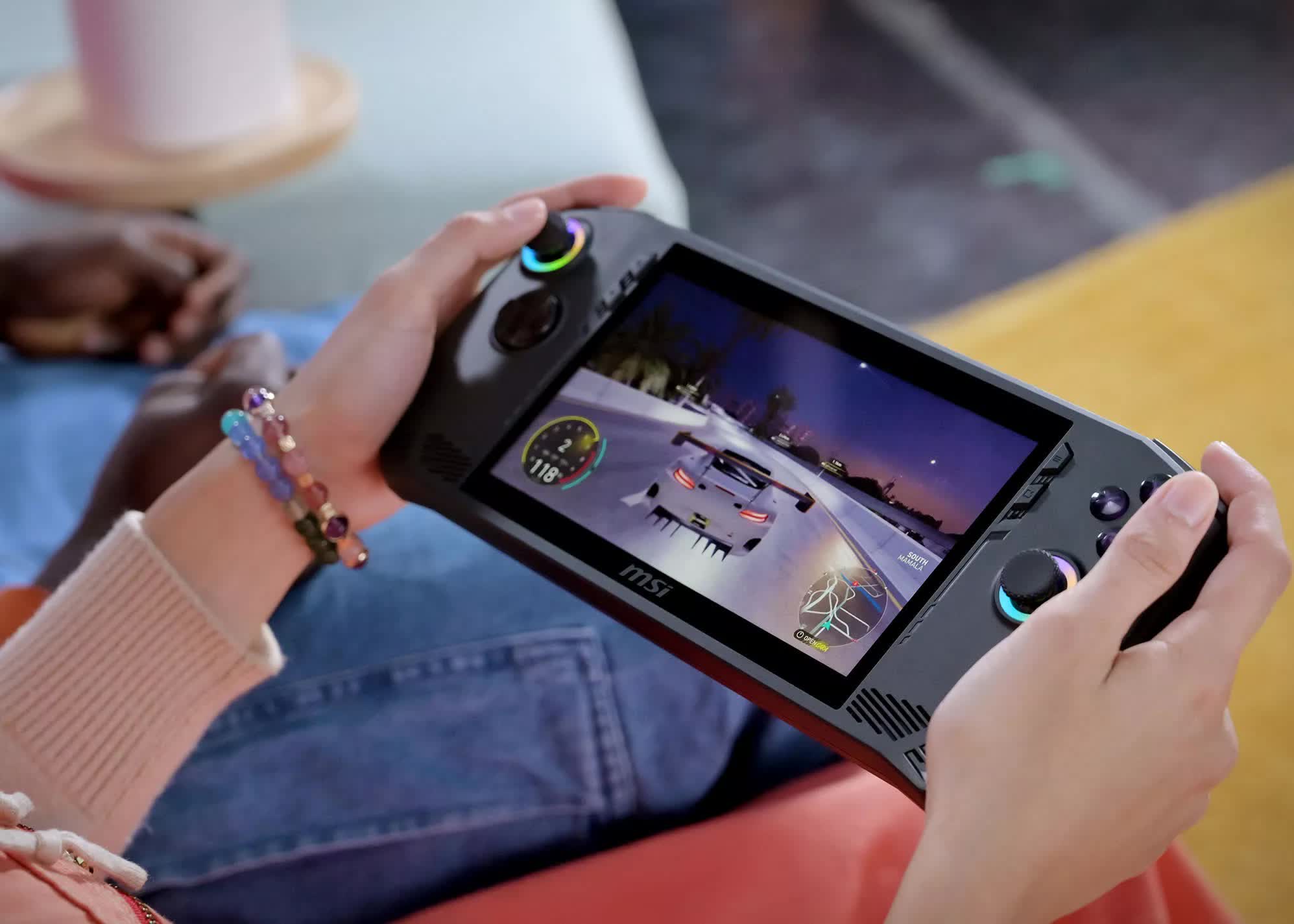
Head 2 Head: AMD's chips have powered nearly all handheld gaming PCs over the past few years, but Intel has pledged to challenge the company in the emerging segment in 2026. Intel argues that its low-power CPU cores and machine-learning capabilities give it a competitive edge, while AMD counters by pointing to its long experience designing console-class hardware.

Intel executive Nish Neelalojanan accused AMD of using "ancient silicon" in its handheld gaming PC APUs during an interview at CES this week. He also argued that when Intel eventually introduces handheld APUs based on Panther Lake processors with Xe3 Arc integrated graphics, the company's low-power E-cores will deliver superior battery life compared to AMD's Ryzen AI 300 and 400 series processors.

The remarks followed Intel's unveiling of its Core Ultra Series 3 laptop processors, codenamed Panther Lake. Intel claims that Panther Lake's flagship integrated GPU, the Arc B390, significantly outperforms AMD's Radeon 890M in thin-and-light laptops. However, it remains unclear whether the B390 – or a derivative – can achieve similar gains in the lower-wattage power envelopes typical of handheld devices.

Neelalojanan's "ancient silicon" jab likely refers to the Radeon 890M's RDNA 3.5 architecture, which lacks dedicated machine-learning acceleration. Machine learning is a key reason why Intel's XeSS and Nvidia's DLSS upscaling technologies generally appear cleaner than AMD's FSR 3. While AMD's latest RDNA 4 architecture adds machine-learning support to enable the improved FSR 4, that technology is currently limited to the company's newest desktop GPUs.
Responding to Neelalojanan's comments, AMD's Rahul Tikoo told PC World that Intel's E-core efficiency comes at the expense of performance. "The Core i7 performs like a Core i3," he said.

Tikoo also highlighted AMD's extensive experience designing chips with gaming-specific optimizations. Over the past two generations of PlayStation consoles and three generations of Xbox, AMD has delivered custom APUs tailored for gaming workloads. The company also designed the APU for Valve's Steam Deck, and other recent handheld gaming PCs rely on AMD's Z1 and Z2 processors, which are optimized for high-performance gaming.

While Intel has not yet revealed how its Panther Lake handheld APUs will differ from the CES demo parts, Tikoo predicts the company may simply repurpose netbook components without special tuning for compute or I/O performance. Intel has also not confirmed rumors that it is developing a response to AMD's Strix Halo, a high-end iGPU that nearly reaches console-level performance.

Looking further ahead, Intel's $5 billion partnership with Nvidia could eventually produce APUs that combine Core Ultra CPUs with RTX-class iGPU cores. Such chips would likely compete directly with AMD's upcoming RDNA 5 architecture, which promises significant improvements in machine learning, ray tracing, and path-tracing performance.

Permalink to story:

 
That's a competition we need. Now, just lets wait for ai bubble to burst to get the cheap ram again.
 
Intel is right here. It's ungodly stupid that AMD doesn't update the GPU architecture of their mobile chips. They used Vega for years when they already had RDNA, then used RDNA 2 when they already had RDNA 3, and now they have RDNA 4 with FSR 4, which is a huge step up in quality, but they are still going to be launching mobile chips with RDNA 3 ("3.5", lol) for over a year, which can't benefit from FSR 4.

In comparison, Intel, which is a company in shambles, uses their latest architecture on their mobile chips. They just need to do the driver legwork to capitalize on it.
 
While I keep hearing about Intel's latest graphics, I understood that only the top 4 sku's have this wonderful chip. Everything else is not it. While were at it, why is every publications except Gamers Nexus taking Intel's benchmarks like Intel is understating the performance? Just a few years ago, everyone was agreed to "wait of independent benchmarks, don't take their word for it."

Last, is this an SOC or a graphics chip? Or do you not need a good CPU if you have Intel graphics? Or are we just taking Intel's word on that part too?

It's not like they've ever exaggerated or lied, have they?
 
I see that Intel has learned nothing and their company culture is still ****. Nothing to show for themselves while bashing the opponent. Good luck with that strategy! I currently have 0 Intel chips in my household.
 
While I keep hearing about Intel's latest graphics, I understood that only the top 4 sku's have this wonderful chip. Everything else is not it. While were at it, why is every publications except Gamers Nexus taking Intel's benchmarks like Intel is understating the performance? Just a few years ago, everyone was agreed to "wait of independent benchmarks, don't take their word for it."

Last, is this an SOC or a graphics chip? Or do you not need a good CPU if you have Intel graphics? Or are we just taking Intel's word on that part too?

It's not like they've ever exaggerated or lied, have they?
But isn't it the same for AMD? The fastest iGPU is reserved for top tier chips. I do think it is factual that AMD is using aging iGPU in their chips. From what I see, the jump from RDNA 2 to 3 is a minor upgrade. RDNA 3 basically supports higher clockspeed (mostly due to the switch from 7nm to 5nm) and higher memory speed, that gave it the bump in performance. And AMD have been just re-releasing RDNA 3.x iGPUs for at least 3 generations of APUs now, and that does not include the incoming Gorgon Point. Intel on the other hand have been putting their best foot forward for their iGPU each year, and we can already see that they are catching up with Lunar Lake.
 
Last edited:
AMD needs to release mobile CPUs and APUs capable of FSR 4 ASAP.

When AMD makes an APU with Zen5/6 + RDNA4/5 we will see a Steam Deck 2.

Z2 series changed nothing really. Still dated RDNA2.x/3.x in most AMD chips, with no FSR 4 support.
 
I realize it's performance versus energy efficiency. So... just slap a 5 pound battery on that bad-boy Intel handheld and Wham! A handheld that lasts for days.
(Note: For Body Builders only.)
 
Back