Intel claims Panther Lake's new Arc B390 iGPU crushes AMD's best mobile graphics

Daniel Sims

Posts: 2,415   +72
Staff
Big quote: According to Intel's benchmarks, the new Core Ultra X9 388H equipped with the Arc B390 iGPU is ~73% faster than the Ryzen AI HX 370 on average. AMD's Strix Point SoC is powered by Radeon 890M integrated graphics. Intel also claims its new chips surpass AMD in ray tracing, frame generation, and other graphics workloads.
While unveiling the Core Ultra 3 Series processors at CES 2026, Intel spent several minutes outlining its latest work in integrated graphics. The company claims its new flagship iGPU, the Arc B390, significantly outperforms AMD's best low-wattage competitor and confirmed plans to build a new handheld platform alongside several manufacturers.

Intel's benchmark results represent an average across 45 games at 1080p, upscaled from 540p, with the AMD chip drawing 53W and Intel's processor capped at 45W.
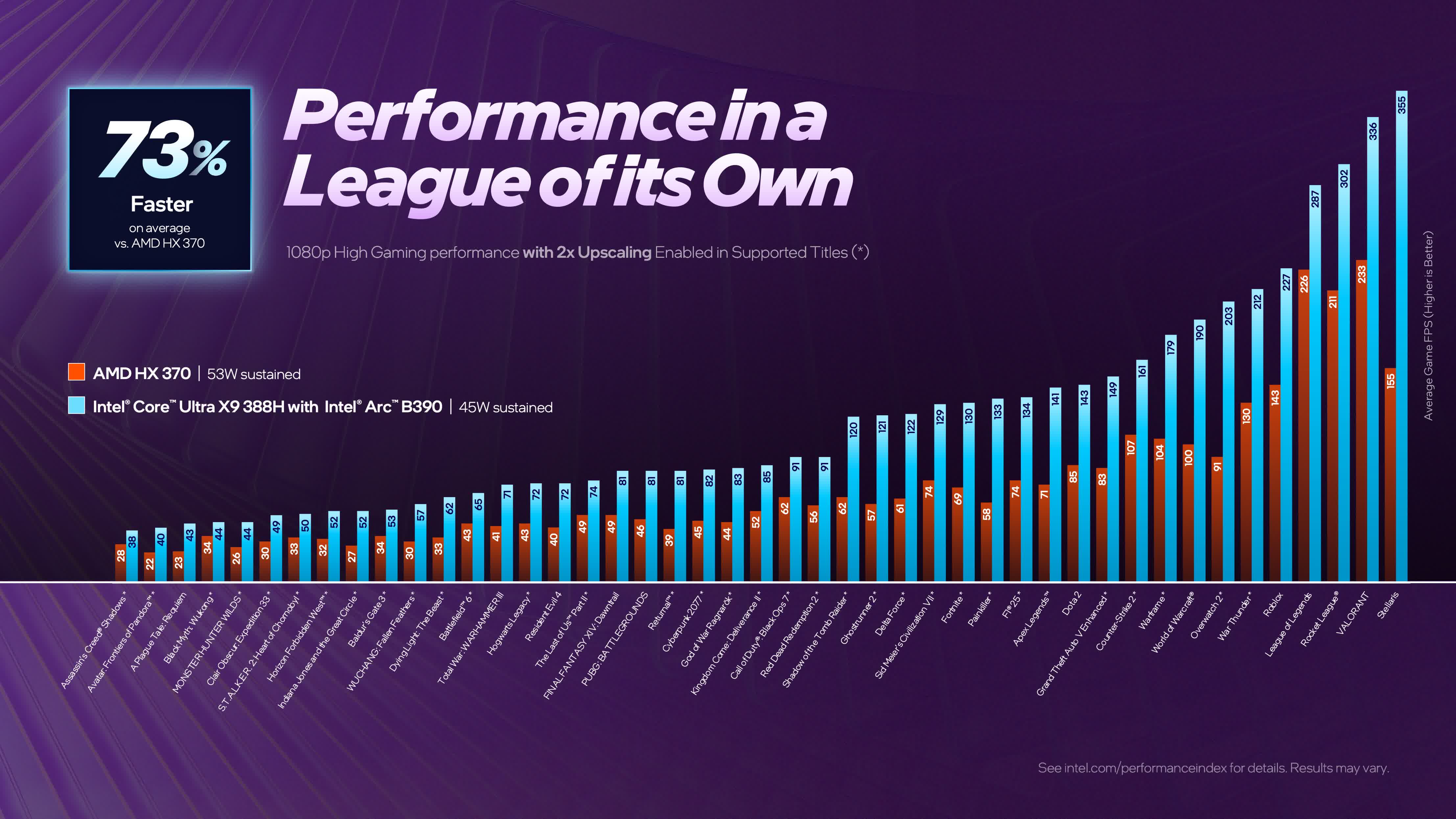
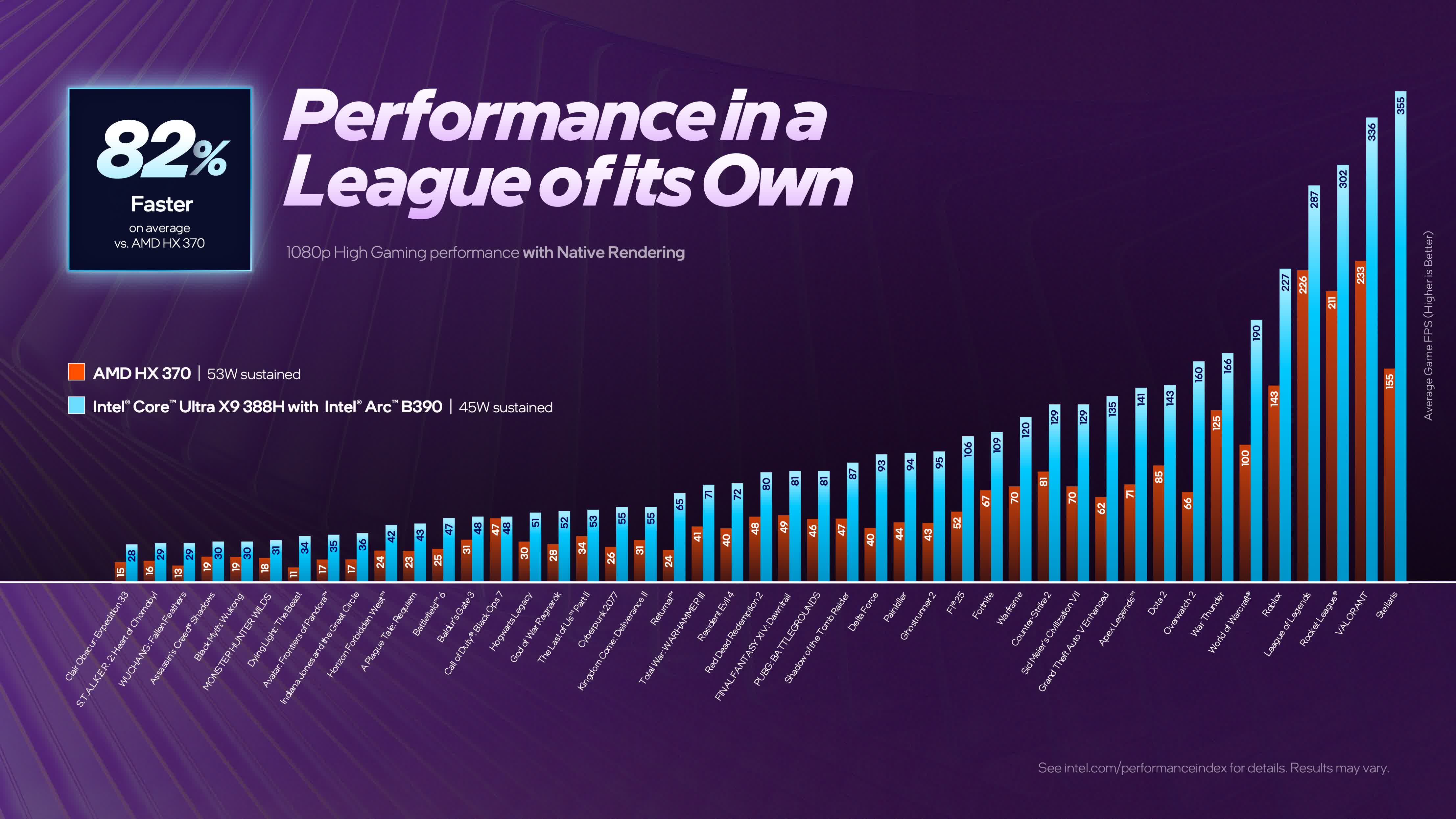
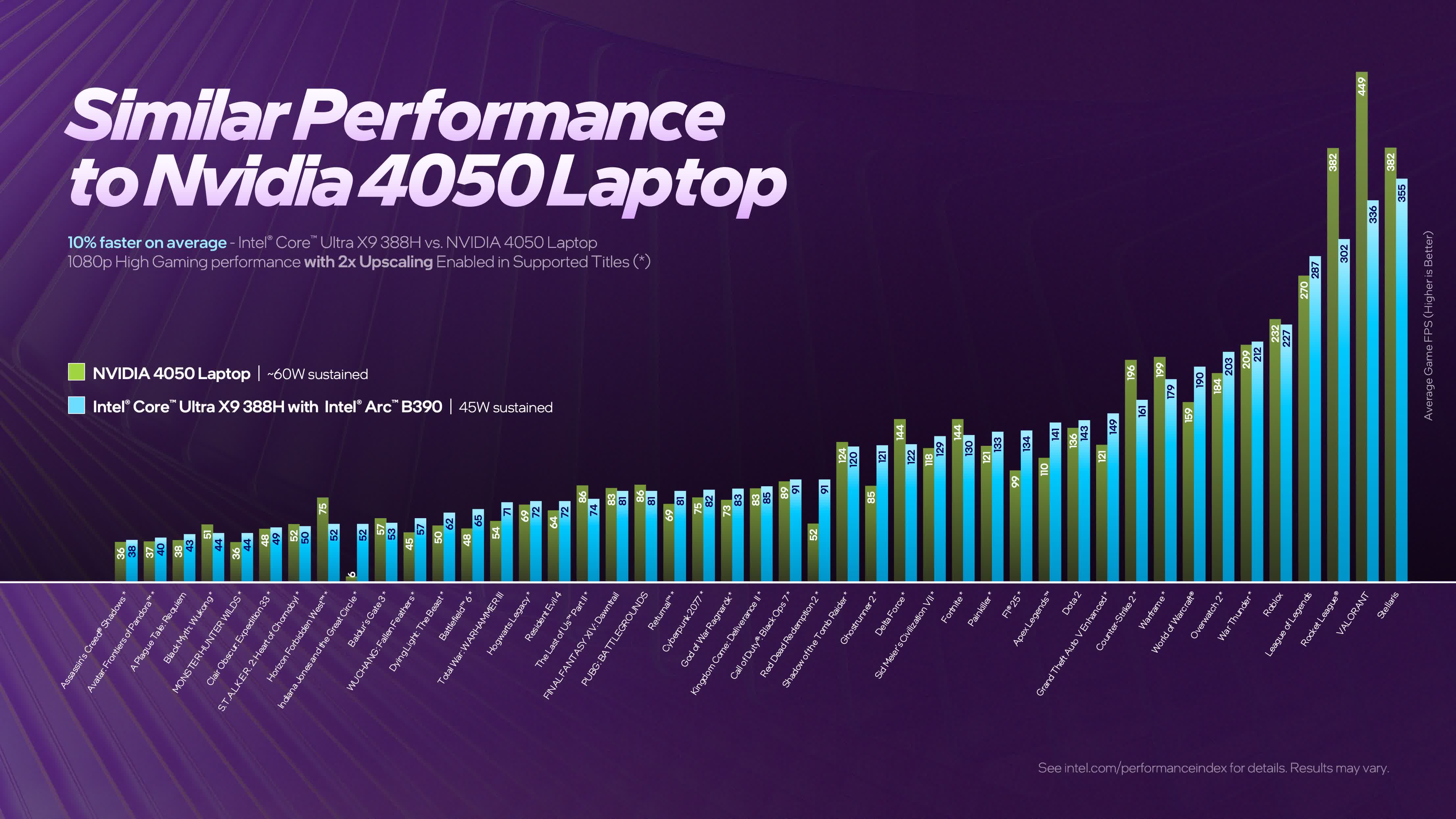
Demanding titles such as Assassin's Creed Shadows and Black Myth: Wukong achieve playable frame rates in the 30s and 40s, while League of Legends and Rocket League approach the 300 fps mark without relying on frame generation. At native 1080p, the average performance gap reportedly increases to 82%.

Intel also highlighted its XeSS upscaling technology, which is already available in current laptops and select MSI Claw models, claiming it outperforms the 890M's FSR3 implementation. While AMD has no plans to bring the more advanced FSR4 to mobile chips, Intel says its upcoming XeSS 3 will further improve AI-based upscaling on laptops and handhelds, while introducing multi-frame generation to mobile hardware for the first time.
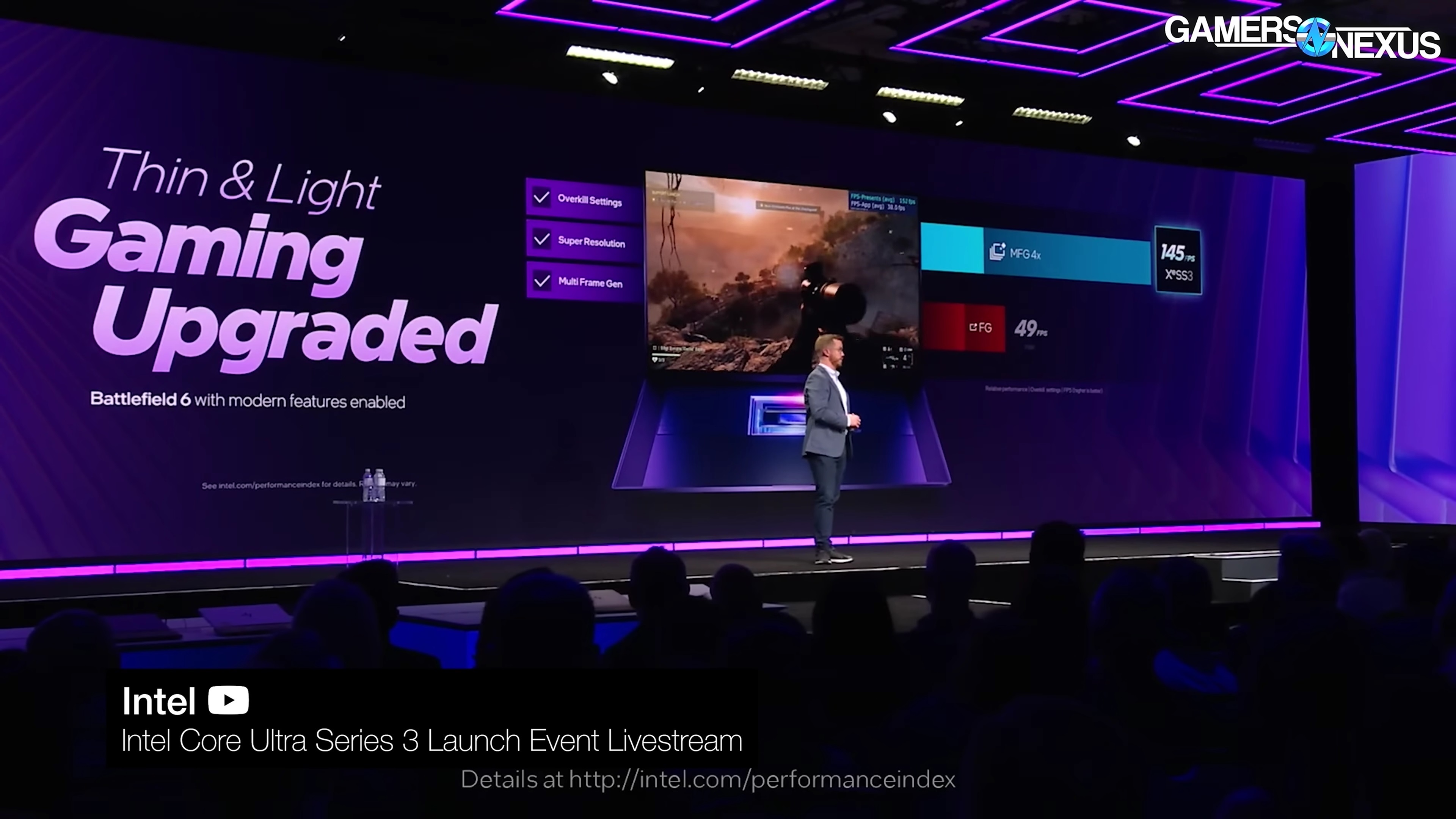
Much like DLSS 4 on Nvidia's RTX 50 desktop GPUs, XeSS 3 aims to boost perceived frame rates by using AI to insert up to three generated frames between traditionally rendered ones.

Intel shared additional benchmarks comparing the technology favorably to FSR and DLSS, though the company stopped short of detailing its impact on input latency – an ongoing concern with frame generation.

Previous independent testing also suggests that multi-frame generation offers meaningful benefits primarily on displays with refresh rates of 240Hz or higher.

The Arc B390 features 12 Xe cores based on Intel's Xe3 Arc Battlemage architecture. Not to be one-upped, AMD unveiled the Ryzen AI 400 series at CES this week, but its new mobile chips utilize the same iGPUs as Ryzen AI 300.

The company also previewed the next generation of Strix Halo, its large-scale APUs that push mobile CPUs and GPUs into a new weight class. While Strix Halo can reportedly approach PlayStation 5-class performance, the only handheld device currently using it, the GPD Win 5, can cost as much as $2,000.
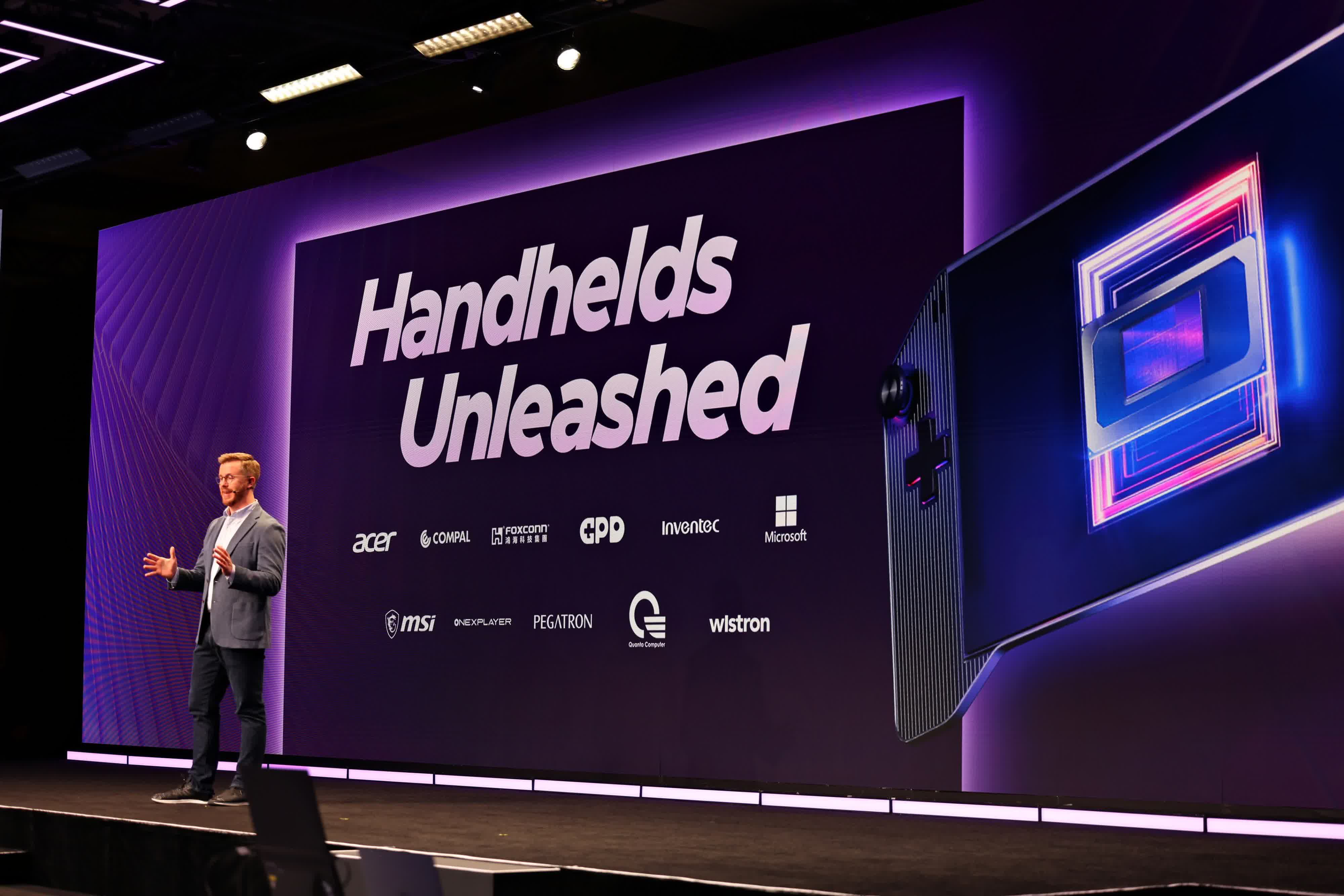
Although Intel's gaming-focused presentation largely centered on laptops, the company also signaled broader ambitions for the handheld PC market. A presentation slide confirmed partnerships with Microsoft, MSI, Acer, GPD, OneXPlayer, and other companies. Asus's logo was conspicuously absent.
Intel's benchmarks appear to have been aimed squarely at the Radeon 890M, which powers recent handheld gaming PCs such as the Asus ROG Xbox Ally X, MSI's Claw A8, and the 2025 revision of the GPD Win 4. But it still remains unclear how the Arc B390 or a similar Xe3-based iGPU will perform in handheld form factors, which typically operate within a 15-30W power envelope.

Permalink to story:

 
890M is a bit unimpressive, constrained by poor bandwidth and memory for sure, but a still disappointing update from 780M given it has 33% more cores on newer RDNA3.5. They really need a Halo with say 24CU's, say 8040s, and say just 8 Zen 5 cores as an affordable higher end offering.

I have a very old laptop that needs replacing and at this stage (reviews pending) I would take Panther Lake over Gorgon Point. Zen 6 laptops won't be out until probably next year and then we'll have Nova Lake laptops too.
 
If the claims hold up, this is nice to see, but still, Celestial can't come soon enough.
 
AMD also announced Strix Halo with just 8 CPU cores and still 40 CUs for handhelds: Ryzen AI Max+ 388.

The future of handhelds looks bright if we can keep them below $1K (as prices were creeping up before the RAM apocalypse).
 
890M is a bit unimpressive, constrained by poor bandwidth and memory for sure, but a still disappointing update from 780M given it has 33% more cores on newer RDNA3.5. They really need a Halo with say 24CU's, say 8040s, and say just 8 Zen 5 cores as an affordable higher end offering.
But which 890m are you looking at? 890m PCs with LPDDR5x memory are easily 40%+ faster then models saddled with SODIMM setups. Even the 780m was bandwidth restricted.

It also begs the question of what 890m Intel is using for comparison here.
I have a very old laptop that needs replacing and at this stage (reviews pending) I would take Panther Lake over Gorgon Point. Zen 6 laptops won't be out until probably next year and then we'll have Nova Lake laptops too.
Given how atrociously bad Intel's support has been, I would never shell out for one brand new. Anyone who bought intel's 14th gen CPUs with Xe cores got a full YEAR of support before getting thrown on the security maintenance branch. The 12th gen only got 3 years, which is actually pathetic. Based on my laptop, the final driver was also buggy, claiming there were updates where none existed and causing issues with Zoom and legacy applications.
 
I'm glad Intel stepped up while AMD is slacking. I wonder for how long will AMD continue to milk RDNA 3.x when they do not officially allow FSR 4 to run on it.
 
I'm glad to see Intel finally getting its act together. It's been disconcerting to see Intel lying motionless on the floor for the last couple of years.
 
Did anyone read the fine print on the slides? "1080p with 2x upscaling". So no one knows what the actual raster performance will be. Sounds very much like Nvidia. "With a 5060, you'll be getting 4080 performance at half the price"

Marketing strikes again.
 
I'll wait for the gazillion reviews and comparisons to AMD when it actually is released. The charts look a bit too apple-and-oranges at this time.
 
Strix Halo is on a completely different class of product, in many ways. Panther lake is a Strix Point competitor, not Strix Halo.
Is it? Even though Strix Halo is probably bigger, it is manufactured on a cheaper node. Hence AMD would be able to offer competitive prices. Both chips target thin and light devices.
 
I'm glad Intel stepped up while AMD is slacking. I wonder for how long will AMD continue to milk RDNA 3.x when they do not officially allow FSR 4 to run on it.
AMD is playing ball with FSR4, it works even on RX 6000 series, the upscaler code was released with MIT licensing and removed quickly after, so be 100% sure that FSR4 works just fine with RDNA 3.5, probably without the workarounds required for RDNA2 and 3.
 
This is huge - we need more affordable GPU competition. Intel is hungry and desperate in the way that AMD used to be.

Hopefully they will get the drivers right.
 
Did anyone read the fine print on the slides? "1080p with 2x upscaling". So no one knows what the actual raster performance will be. Sounds very much like Nvidia. "With a 5060, you'll be getting 4080 performance at half the price"

Marketing strikes again.
Why wouldn't you use upscaling on mobile or any other gpu-limited scenario?

Raster-only performance without upscaling is the rea of luddites. Even if you have a massive GPU for overkill DLAA or DLSS Quality is an IQ improvement over native.
 
Did anyone read the fine print on the slides? "1080p with 2x upscaling". So no one knows what the actual raster performance will be. Sounds very much like Nvidia. "With a 5060, you'll be getting 4080 performance at half the price"

Marketing strikes again.
Nobody listened to Steve about it? Intel did the same thing as Nvidia with their dumb DLSS benchmarks.


MFG4.jpg
 
Strix Halo is on a completely different class of product, in many ways. Panther lake is a Strix Point competitor, not Strix Halo.
Core 9 Ultra 388h is a 16 cores CPU. They are in the same category. Matter of fact, the 386h will be the flagship for going into gaming laptops with the top Nvidia mobile GPUs.

Listen, in their press conference, they mentioned AMD, as in their "BEST". AMD could literally annihilate Intel in iGPU, and Intel knows it since they had to partner with Nvidia for their future SOCs.

Lastly, would you take a Xe GPU over a Radeon one for playing games? I sure would not for obvious reasons beside performances. Ironically, it was even mentioned in the CES press conference by Intel themselves...
 
Last edited:
...AMD could literally annihilate Intel in iGPU, and Intel knows it since they had to partner with Nvidia for their future SOCs.


Not in this power/thermal class or market segment, apparently. Whether we will see any of this materialize with DRAM prices remains to be seen though.
 
Why wouldn't you use upscaling on mobile or any other gpu-limited scenario?

Raster-only performance without upscaling is the rea of luddites. Even if you have a massive GPU for overkill DLAA or DLSS Quality is an IQ improvement over native.

Too bad neither of the 2 iGPUs mentioned here can use DLSS. Yes they have their own upscaling and yes both work but neither look as good as DLSS. AMD needs to get FSR4 working with RDNA 3.5 iGPUs and Intel needs to keep improving XeSS.
 
Back