What just happened? Intel used this year's Hot Chips conference in Cupertino to showcase a redesign of its flagship data center CPUs, unveiling its first all-E-core Xeon called Clearwater Forest. The processor, expected to ship in 2026, stands out for its unprecedented scale: 288 efficiency cores per socket, support for dual-socket systems that total 576 cores, and more than 1,152 megabytes of combined last-level cache.
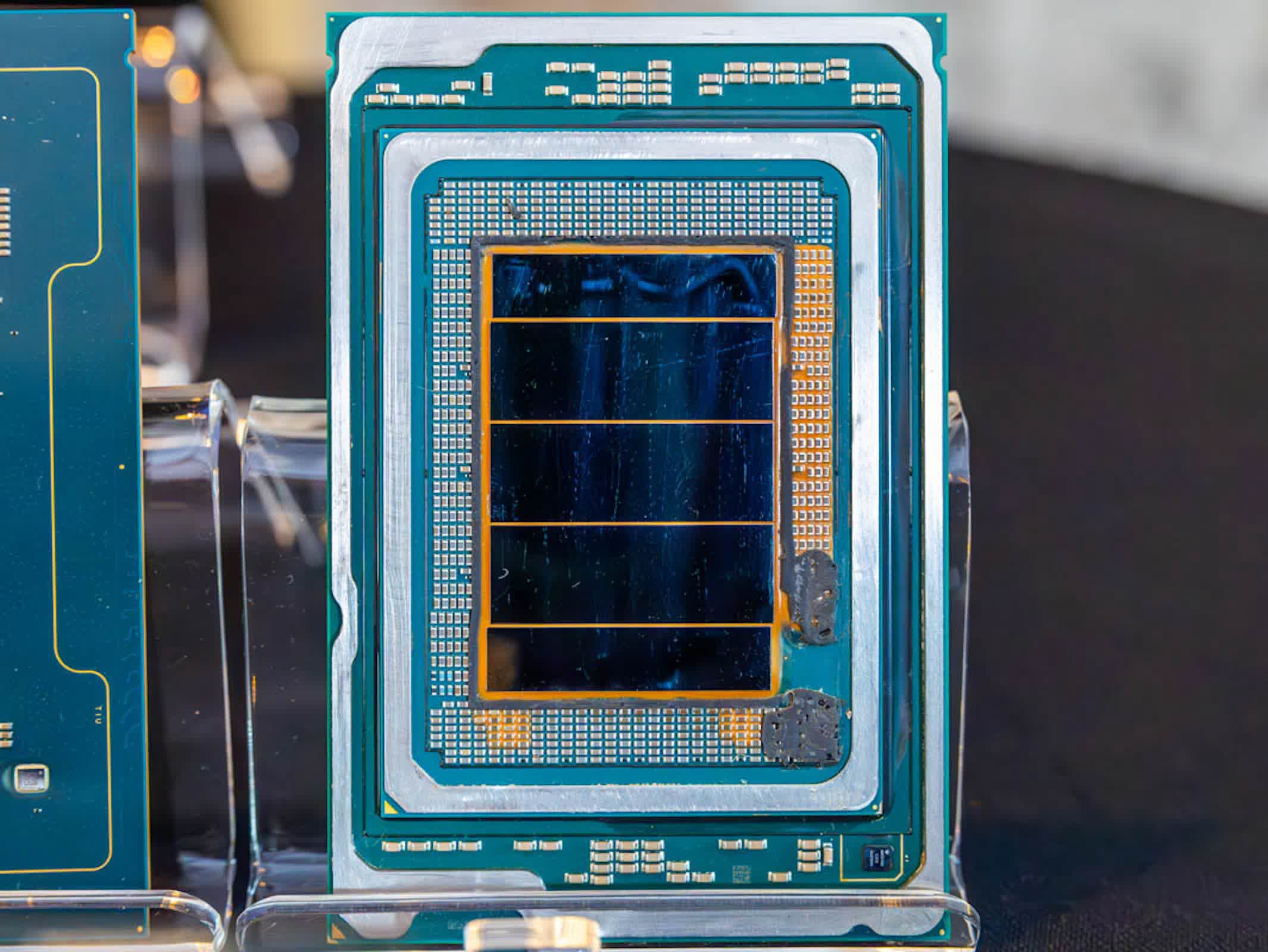
The announcement marks a turning point in Intel's server roadmap. Rather than chasing raw single-thread performance, Clearwater Forest is aimed at high-density, scale-out workloads where throughput and power efficiency decide real-world performance.
Clearwater Forest is the successor to the recently launched 144-core Xeon Sierra Forest, but it relies on a new generation of E-cores known as Darkmont. Intel says the updated design provides roughly 17 percent higher instructions-per-cycle compared to the previous Crestmont E-cores. The gains come from a wider 3x3 instruction decode engine, deeper out-of-order windows, and broader execution units.
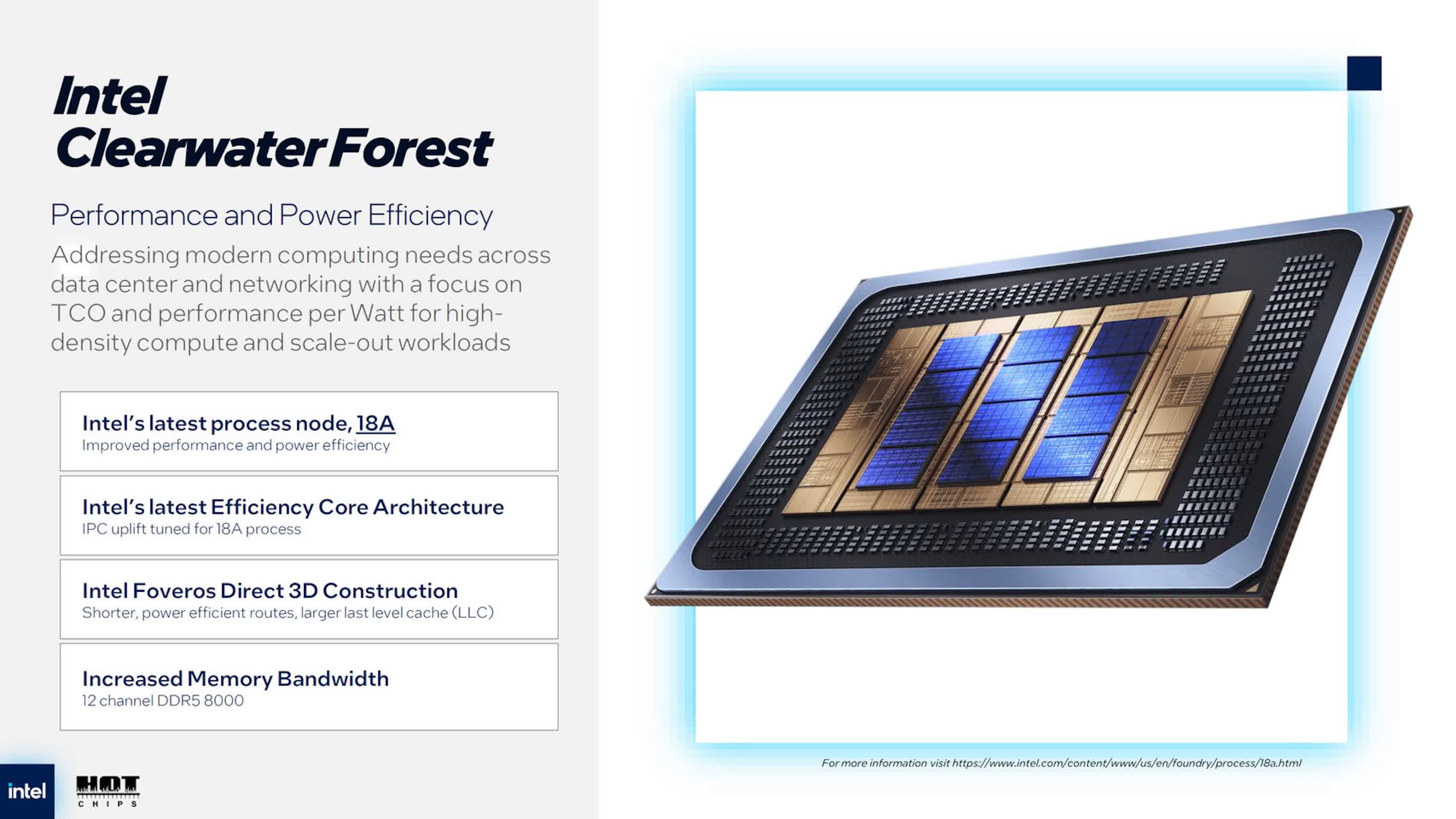
Each group of four cores shares 4 megabytes of L2 cache, and total bandwidth has doubled over Sierra Forest to approximately 400 GB per second. Taken together, Intel is positioning Clearwater Forest as a throughput-focused processor for tasks such as web services and AI inference.
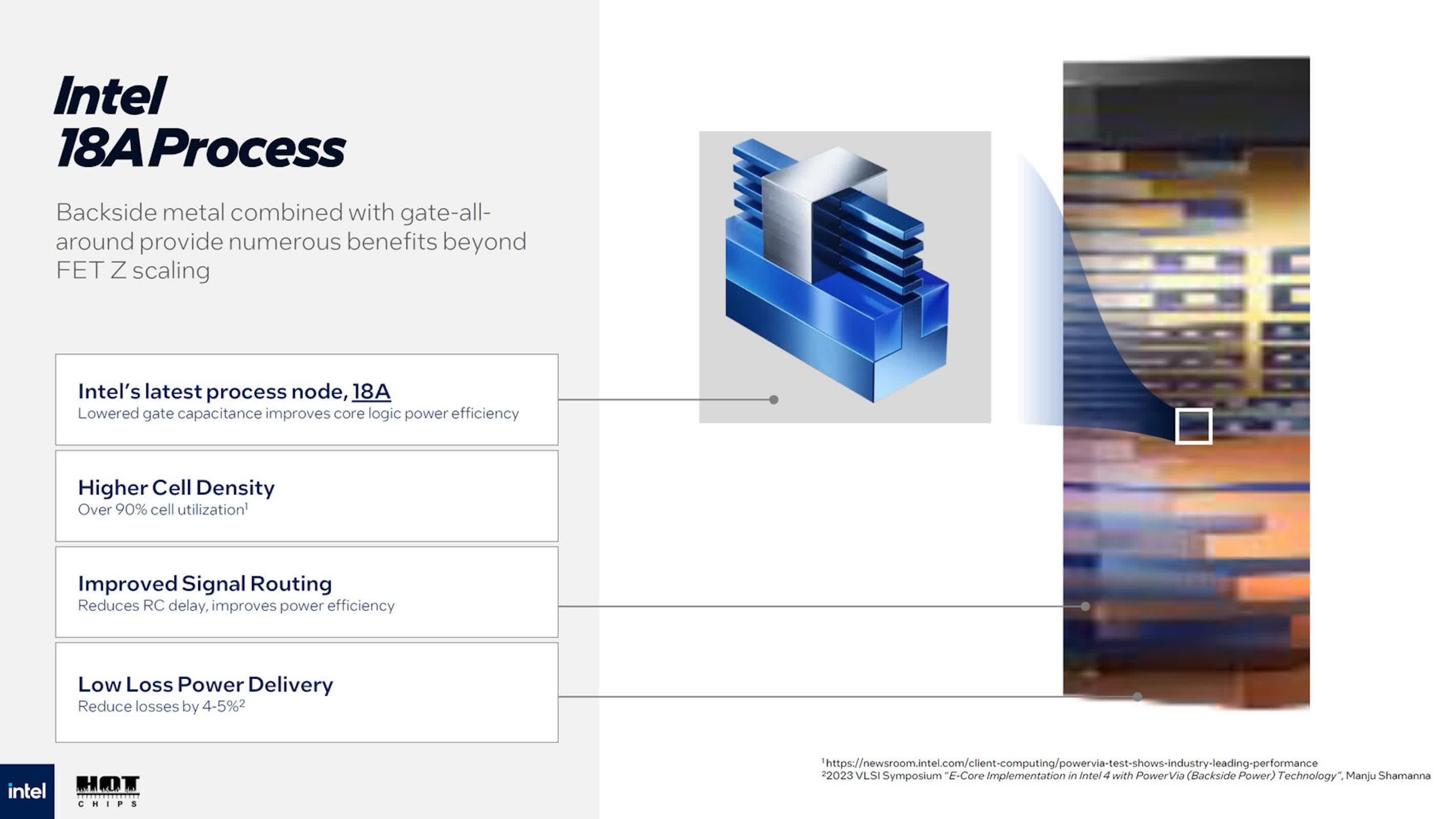
The chip is manufactured on Intel's long-awaited 18A node, which introduces RibbonFET transistors alongside backside power delivery. Those design changes are intended to address efficiency and voltage drop challenges while allowing higher density. For Intel, which has struggled to keep up with TSMC's process advances, Clearwater Forest is one of the first large-scale demonstrations of its planned manufacturing comeback.
Unlike prior Xeon generations, Clearwater Forest adopts a chiplet configuration to reach its core count. The CPU combines 12 compute chiplets on Intel 18A with three base tiles fabricated on Intel 3 and two I/O chiplets built on Intel 7. The components are tied together using the company's Foveros Direct 3D stacking and EMIB interconnect technologies.
This modular approach reduces the cost and complexity compared with a massive monolithic die, while an internal mesh fabric links compute and memory resources across the package. Each processor includes a 12-channel DDR5 memory controller, supports DDR5-8000 memory speeds, and provides 96 lanes of PCIe 5.0 connectivity. In dual-socket systems, this expands to 24 memory channels across 576 cores.
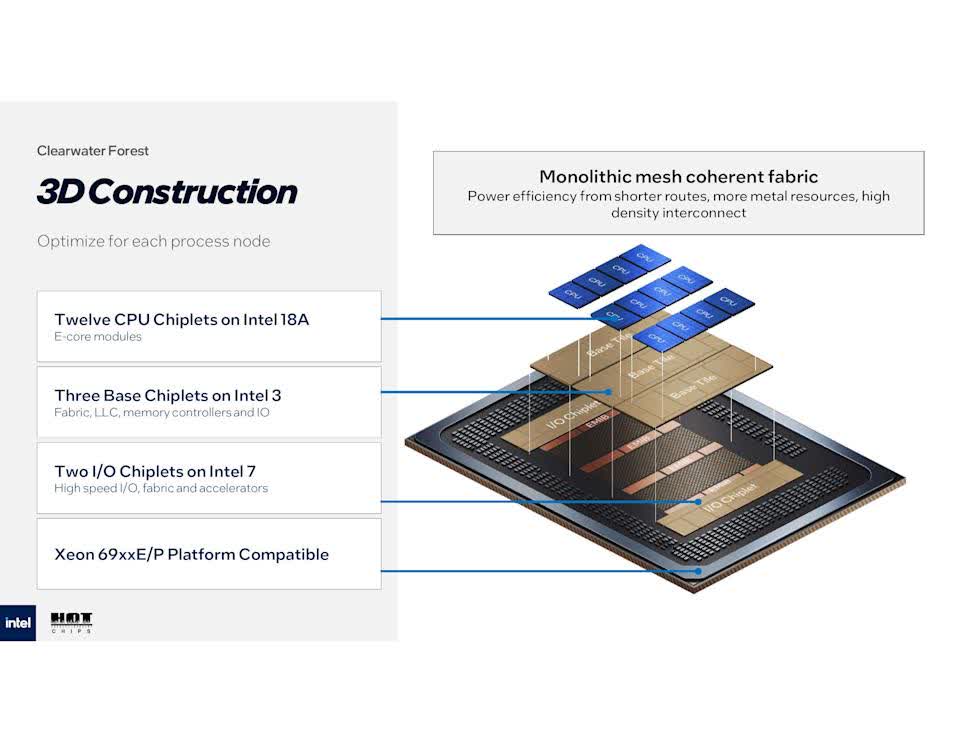
Intel has also confirmed that Clearwater Forest will work with the Xeon 9600E platform.
Clearwater Forest enters the market alongside AMD's Epyc Bergamo, a 128-core processor based on Zen 4c cores. While AMD's design emphasizes higher per-core performance, simultaneous multithreading, and wider vector capabilities, Intel has chosen to prioritize raw scale. A two-socket Clearwater Forest configuration can theoretically support more than 1,000 virtual CPUs per server rack.
Performance-per-watt is another target. Intel claims Clearwater Forest will deliver about 3.5 times better efficiency than its prior-generation Xeons. If validated in practice, that metric could help offset the competitive advantage AMD has gained in hyperscale and cloud markets.
Manufactured entirely in the United States, Clearwater Forest is also being positioned as proof of Intel's strategy to reestablish domestic foundry leadership and reclaim market share lost to competitors. Whether the new design reshapes Xeon's place in data centers will become clearer when systems reach customers in 2026.
Intel Clearwater Forest: 288-core all-E-core Xeon CPU debuts on 18A process


