Intel says integrating RAM into Lunar Lake SoC was a mistake, might abandon desktop GPUs again

Daniel Sims

Posts: 2,469   +74
Staff
In brief: Intel Lunar Lake mobile CPUs controversially integrated system memory onto the SoC, preventing users from installing additional RAM. The company now partially blames the decision for its latest disastrous earnings report. Furthermore, Intel's restructuring plans might involve downsizing or ceasing development Arc desktop GPUs.

During the company's third-quarter 2024 earnings call, Intel confirmed that its future laptop chips will return to the traditional use of RAM sticks, reversing Lunar Lake's radical shift to baked-in system memory. The company is also reassessing GPU development over the coming years.

The recently introduced Lunar Lake Core Ultra 200V light mobile CPUs come with either 16GB or 32GB of memory built into the package. Intel claims that forgoing SODIMM sticks reduces power consumption during memory transfers by 40 percent, but users are stuck with the RAM that ships with the device.
When asked whether the company would continue using this design, CEO Pat Gelsinger confirmed that future architectures such as Panther Lake and Nova Lake won't use on-package memory. Moreover, Gelsinger described Lunar Lake as a one-off project initially intended for a niche market before it grew in response to the emerging AI PC market.

Intel CFO David Zinsner admitted that integrating system memory significantly impacted Lunar Lake's gross margins. The comments were made during an earnings call following the company's Q3 2024 financial report, which showed a $16.6 billion net loss – 10 times the previous quarter's loss of $1.6 billion. Analysts expect Intel to post billions in losses for 2024 overall, Chipzilla's first annual net loss since 1986.

When discussing the future, Gelsinger mentioned plans to streamline the company's product stack to simplify development. This means fewer SKUs, with discrete graphics on the chopping block. Gelsinger said the market will have less demand for dedicated graphics cards in the future.

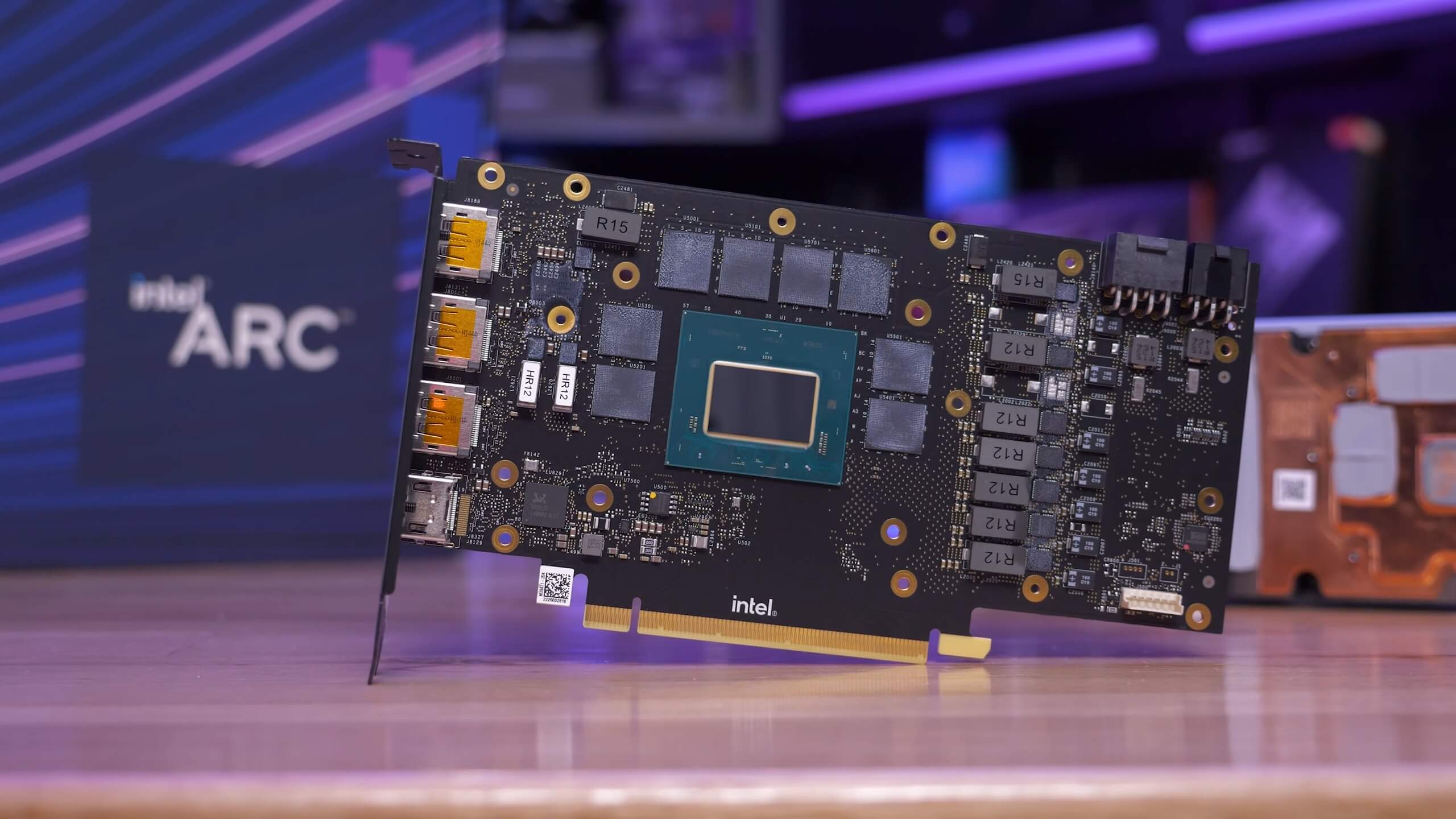
Intel launched its first line of discrete GPUs, Arc Alchemist, in 2022, but delays put the components behind the curve compared to competing products from Nvidia and AMD. Intel gained only a few percentage points of market share over the last couple of years, and that thin slice had completely evaporated by the second half of 2024.

As Team Red and Team Green plan to launch new GPU lineups in Q1 2025, Intel's second generation of discrete graphics, Arc Battlemage, remains on track to beat them to the market in late 2024. However, expected performance profiles remain unclear, and Battlemage's market performance might decide the fate of the third planned lineup, Arc Celestial.

Permalink to story:

 
Why would you cut your discrete graphics card now? You’ve finally got the drivers in a good place, it’s a growing market, there’s plenty of opportunities to take some market share off Nvidia / AMD, XeSS is regarded as better upscaling than FSR.

Don’t give up on it after releasing a single generation, at least give it 3-5 generations before making that sort of decision.

You regretted not buying Nvidia 20 years ago, why just give an entire market to them now?
 
Why would you cut your discrete graphics card now? You’ve finally got the drivers in a good place, it’s a growing market, there’s plenty of opportunities to take some market share off Nvidia / AMD, XeSS is regarded as better upscaling than FSR.

Don’t give up on it after releasing a single generation, at least give it 3-5 generations before making that sort of decision.

You regretted not buying Nvidia 20 years ago, why just give an entire market to them now?
It's just click bait.
 
Why would you cut your discrete graphics card now? You’ve finally got the drivers in a good place, it’s a growing market, there’s plenty of opportunities to take some market share off Nvidia / AMD, XeSS is regarded as better upscaling than FSR.

Don’t give up on it after releasing a single generation, at least give it 3-5 generations before making that sort of decision.

You regretted not buying Nvidia 20 years ago, why just give an entire market to them now?


Why? Financial hardships. Difficult decisions are coming soon at Intel.
 
Why would you cut your discrete graphics card now? You’ve finally got the drivers in a good place, it’s a growing market, there’s plenty of opportunities to take some market share off Nvidia / AMD, XeSS is regarded as better upscaling than FSR.

Don’t give up on it after releasing a single generation, at least give it 3-5 generations before making that sort of decision.

You regretted not buying Nvidia 20 years ago, why just give an entire market to them now?
So Intel still needs a good integrated graphics solution. Iris Xe was OKAY, but it could have been a lot better. I think Intel might try to go the way AMD is going with their Z series chips. Intel could make a very compelling SoCs with what they've done with ARC so far.

The other thing is that many people just really care that much about chasing highend performance in competitive games. There is an outspoken part of the gaming community that things everyone needs to have 4090's and play at 40k240 with raytracing. These people are wrong.

Most people want to relax for a few hours after work with a game the comforts them. I'm not going to tell people to not be interested in competitive gaming. If that's what people like to do, great, but they are a minority of gamers. My wife likes to play the sims on her laptop a few hours a week, it has an i5-11300h with Intel Integrated graphics on it, the game runs fine.

Since we are part of a community of tech enthusiasts it's easy to forget those people exist, but there are plenty of people who play games that don't even identify as gamers. There are a lot of people who have been playing the same 2-3 games for years that probably don't even have Steam installed.

The reason I'm trying to drive home this point home so hard is that people who like playing those same 2-3 games, they probably notice that Intel badge on their laptop without having any idea what it means. However, when they need to go buy a new laptop they'll think "hey, I had a great ownership experience with my last computer and it it had *insert brand* sticker on it, I should buy that one." Intel is looking to create brand recognition and brand loyality. Moving ARC from a dedicated GPU to an integrated solution, especially with AMD having a difficult time providing enough mobile parts, is a good move. It allows them to keep developing the architecture while not having to completely write everything off as a loss. On top of that, integrated graphics have been getting really good these last few years. Intel's Iris XE and AMD's 680/780M chips are VERY capable. With the price of graphics cards these last few generations, you are going to have to REALLY want to be gaming in order to get a dGPU over anything with a competent iGPU. I've already decided that my next laptop isn't going to have a dGPU. AMD's 780m or 890M would be fantastic for anything I'd do away from my PC. If I'm on a business trip for a week or two, a 780m or 890m would be fantastic. Intel can already match that level of performance with ARC and they've made some really significant improvements to ARC's drivers.

Saying all that, I doubt Intel will drop Desktop GPUs. This sounds like some short sighted idea their CEO had after spending the last several years running the company into the ground. There is absolutely no reason intel should be in this position. They are filled with tons of talented people and I think they'll come back from the last few years just fine if they get rid of Pat Gelsinger
 
This means fewer SKUs, with discrete graphics on the chopping block. Gelsinger said the market will have less demand for dedicated graphics cards in the future.

Ofc we are not on the inside so we can't possibly know what Gelsinger has in mind or the data he has got on hand, but to an outsider tech enthusiast giving your GPU division the axe seems like a very bad idea.

All that money and effort down the drain. That sounds like the ship that's about to sink jettison cargo in a desperate effort to stay afloat.

In the era of AI revolution and GPU increasing importance all that sounds like suicide for Intel unless ofc things are so bad that they have to chop off almost everything in order to survive.
 
When Nvidia first began (as seen in old interviews on YouTube), its mission was to bring capabilities previously available only in professional solutions to the general public. And that's precisely what it did (until a few years ago), which helped it gain significant market share. Now, Intel should follow a similar recipe. Of course, Intel is nearly 60 years old, while Nvidia was a startup. As companies grow, they tend to become more rigid, and it becomes increasingly challenging for them to change and adapt.
 
Do low power mobile users even need more than 32GB ??! Not many people would upgrade if they already have 32GB
But did Intel really put 32GB of RAM in low powered laptops, and if by some bizarre move they did, was the price low enough? Otherwise it wouldn't make sense for a low powered laptop.
 
Intel can barely pull itself together now in staying relevant in the CPU market, so, I bet they'll soon scrap making any discrete GPUs. This guy's comments are just some prelude of lame excuses. And you can't blame them, really, I mean look at AMD, they gave up challenging Nvidia and they have decades of development.
 
So they learned nothing from the broadwell-c SOC. DRAM as L4 cache then was not a great idea, so why would it any different today? This is why AMD went with 3d Cache stacks and why we dont see HBM CPU SOCs still.

IMHO Intel needs to take a page from AMD's low-mid market segment on GPUs. Just because Intel cant get a foot hold in the datacenter GPU market does not mean they should vapor that segment. The ARC line is very compelling for the low to mid segment on the current market prices. Hell in some deployments you want ARC over AMD or Nvidia due to quicksync (like ARC in the x4 PCIE slot on Synology for Plex, because the AMD Embedded has no graphics for the encoding).

As for against Nvidia, there are plenty of us not buying the 4090/5090, 4080/5080 range of GPUs because we simply do not need to. Lots of room for competition under that and through the entry market.

Hell, By now Intel should have the edge on the iGPU, their HD graphics moving to the Iris XGE, and now ARC should have merged and gone way of AMD's Hybrid approach. Look how long it has taken AMD to do anything great with embedded graphics since the release of Zen. These RDNA powered APUs are the first time in a long time that AMD has had anything even comparable to modern dGPUs. The Z1E show casing what is current gen with the Z2E/8840 with RDNA3.5 being where APU should have been 3-4 years ago. Why has Intel done nothing but continue to release trash in this segment?
 
"When discussing the future, Gelsinger mentioned plans to streamline the company's product stack to simplify development."

Finally Pat is seeing the light. Their gaming GPU venture was one of their biggest mistake, as was their 5G modem venture.

Intel should focus on CPUs and Fabs, or they are going to go bust.
 
Why would you cut your discrete graphics card now? You’ve finally got the drivers in a good place, it’s a growing market, there’s plenty of opportunities to take some market share off Nvidia / AMD, XeSS is regarded as better upscaling than FSR.

Don’t give up on it after releasing a single generation, at least give it 3-5 generations before making that sort of decision.

You regretted not buying Nvidia 20 years ago, why just give an entire market to them now?
Because it is a money pit, it is a luxury that Intel cannot afford anymore.
 
It's just click bait.

No, making money developing GPUs is considerably more complex than with CPUs. Tons of money to develop, tons of money to get software support throughout the lifetime of the current architecture, plus, the next ones.
You have to share your profits with AIBs, and a lot of other players who get a slice of the pie along the way.

Intel has so far only made a loss on the GPU market.
 
If it's eating into their margins they should source the RAM cheaper or charge more for the SOC. Imo it's the right thing to do, latency advantages, power savings all good stuff and instead of the RAM margin going to Samsung or whoever it can go to Intel. If anything I'd like to see AMD do the same, betcha that the GPU part would greatly benefit from it.
 
If it's eating into their margins they should source the RAM cheaper or charge more for the SOC. Imo it's the right thing to do, latency advantages, power savings all good stuff and instead of the RAM margin going to Samsung or whoever it can go to Intel. If anything I'd like to see AMD do the same, betcha that the GPU part would greatly benefit from it.
Bad for us. I am sure we would pay double or triple for that on CPU ram.
A two stick kit used to cost a 100? Double it. Then they could also space their CPU versions
to make sure people buy more than they need.
It is bad all around. And considering Intel is sinking, they would exploit this
more than Apple.
 
Why would you cut your discrete graphics card now? You’ve finally got the drivers in a good place, it’s a growing market, there’s plenty of opportunities to take some market share off Nvidia / AMD, XeSS is regarded as better upscaling than FSR.

Don’t give up on it after releasing a single generation, at least give it 3-5 generations before making that sort of decision.

You regretted not buying Nvidia 20 years ago, why just give an entire market to them now?
Desktop gpu has lower profit margin compared to desktop and laptop cpu.
More over, Intel arc has low market share
 
This shortsightedness and lack of commitment to their products is why intel is suffering now. We do foundry, we don't do foundry, then foundry 2.0. We make GPUs then we don't then we do them again and after one generation we drop them again. we make power efficient CPUs with integrated memory, then we don't because users cant upgrade the ram. FFS, a lot of the thin and light laptops have soldered ram anyway. I thought the chiplet approach gave them more flexibility, so why not build a version of cpu with integrated LPDDR memory and one without. probably they wouldn't even need to buld a different cpu, ony a different substrate and package.
 
If Intel give up on discrete GPU's they give up on having a long-term future, as this technology is not just for building triangle renderers.
 
Do low power mobile users even need more than 32GB ??! Not many people would upgrade if they already have 32GB
32 GB is minimum for me. Outlook, Edge with cca 15 tabs, Chrome with cca 30 tabs, Excel, ADUC, DHCP, DNS, Audacity, SAP, Siebel etc. I was not able to work normaly with 16GB only. I am considering an update to 64GB DDR4 3200, max of my DELL Optiplex 3000...
 
Why would you cut your discrete graphics card now?

In theory gaming GPUs is a large market, but in practice it will be hard to win any part of it unless Intel is willing to undercut its competitors in a major way. Consumer GPUs have lower margins than other products. They are big chips, and if Intel is behind in performance/mm2 (as was the case with Alchemist) then the margins are even lower.

Until its GPUs are successful, Intel will lose money on them, and if it takes several generations to get to break even, then it will be quite a few years of losses. Intel is already losing money. Adding more loss isn't what it wants right now.
 
In theory gaming GPUs is a large market, but in practice it will be hard to win any part of it unless Intel is willing to undercut its competitors in a major way. Consumer GPUs have lower margins than other products. They are big chips, and if Intel is behind in performance/mm2 (as was the case with Alchemist) then the margins are even lower.

Until its GPUs are successful, Intel will lose money on them, and if it takes several generations to get to break even, then it will be quite a few years of losses. Intel is already losing money. Adding more loss isn't what it wants right now.
Intel lost a lot of money on GPU department already. The only way to make it back is to keep pushing. Nvidia might be making the best GPUs, but I do not believe another company cannot make decent ones.
The only problem is if their financial situation gets so worse that they would literally have to sell everything that does not generate money right now. That would be regretful.
 
Intel can barely pull itself together now in staying relevant in the CPU market
Obviously incorrect since Intel is the one with largest market share in all markets where they use x86.
Sure they been loosing market share to AMD, but even at this rate it will take several years before AMD could gain majority of the market share.
 
Do low power mobile users even need more than 32GB ??! Not many people would upgrade if they already have 32GB
It's more about the ability to buy a cheap 16GB laptop and upgrade it later on. We all know just how expensive these "upgrades" are when you buy them directly from the laptop manufacturer.
 
No, making money developing GPUs is considerably more complex than with CPUs. Tons of money to develop, tons of money to get software support throughout the lifetime of the current architecture, plus, the next ones.
You have to share your profits with AIBs, and a lot of other players who get a slice of the pie along the way.

Intel has so far only made a loss on the GPU market.
No. It's just a rumor based on speculation. It's all a bunch of "what ifs". There's nothing concrete about it, the true example of bait and you're hooked hard.

At one point the writer says the gpu division is on the chopping block with no quote to back that up or anything. Then they say battlemage is coming late 2024 before Nvidia and AMD release anything and that it's success or failure "might" decide the fate of Celestial.
It's really just "what if all this different stuff happens then Intel might do this or that".
 
Back