Intel will respond to AMD's 3D V-Cache with server-bound Clearwater Forest, not desktop CPUs

Daniel Sims

Posts: 2,459   +74
Staff
In context: AMD's 3D V-Cache technology has significantly enhanced gaming performance in the company's last three generations of processors, with rival Intel yet to respond. In a recent interview, Intel revealed that while it has similar technology in development, gaming performance is not its primary focus.
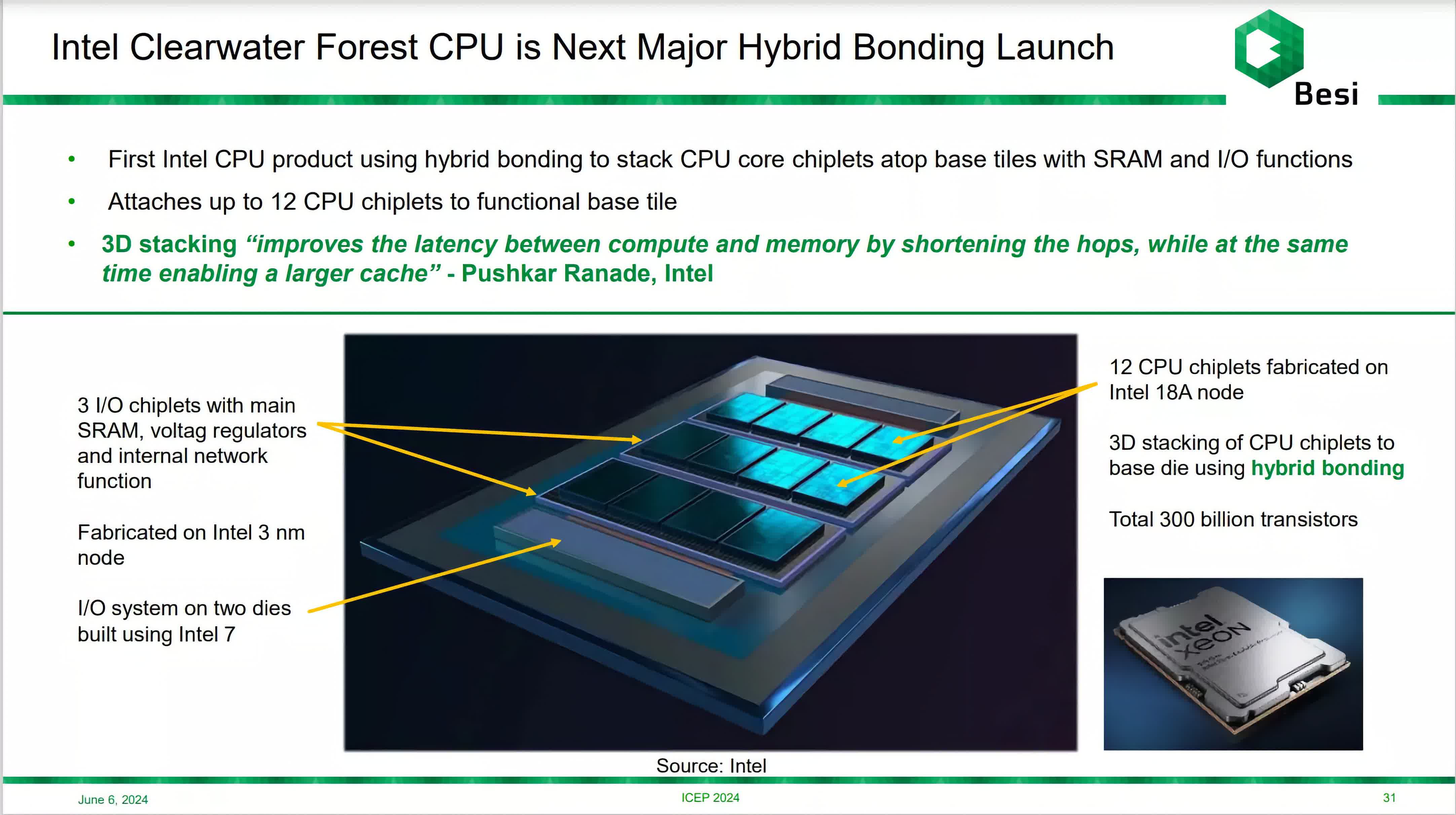
Intel apparently has no plans to produce consumer desktop CPUs featuring 3D-stacked cache to compete with AMD's technology. Instead, the company is focusing on enhancing the cache configuration for its next-generation server CPUs, which it considers a more critical market segment.

Over the past few years, stacking die configurations to expand L3 cache has become a key advantage for AMD. The addition of 3D V-Cache to the Ryzen 5 5800X3D made it arguably the best-value gaming CPU upon its launch in 2022. Its newly released successor, the 9800X3D, has undisputedly claimed the title of the best overall gaming CPU, as confirmed in our review.

However, Intel Tech Communications Manager Florian Mailslinger recently told YouTubers der8auer and Bens Hardware that the company's equivalent to 3D V-cache won't debut in desktops. Around the 1-hour and 19-minute mark in the interview below, he confirmed that Clearwater Forest, a lineup of Xeon server CPUs set to arrive in 2025, will feature a technology called Local Cache, which uses vertically stacked tiles.

Evidence of the technology first surfaced in an ICEP 2024 presentation slide from Intel last June. The slide described how Clearwater Forest will employ 3D stacking to increase overall cache capacity and reduce latency between compute and memory – similar to how AMD's X3D chips boost gaming performance.

Mailslinger defended Intel's decision by acknowledging that gaming is not a significant mass-market focus for the company. While AMD's 3D V-Cache gives its processors a clear edge over Intel's in gaming scenarios, Mailslinger pointed out that this advantage does not extend to productivity applications – a sentiment echoed in our review of the 9800X3D.

Additionally, Mailslinger downplayed the impact of Intel's gaming performance gap. Prior testing by TechSpot showed that enhanced cache would not yield a substantial improvement in gaming performance for Intel's 14th-gen Core CPUs.
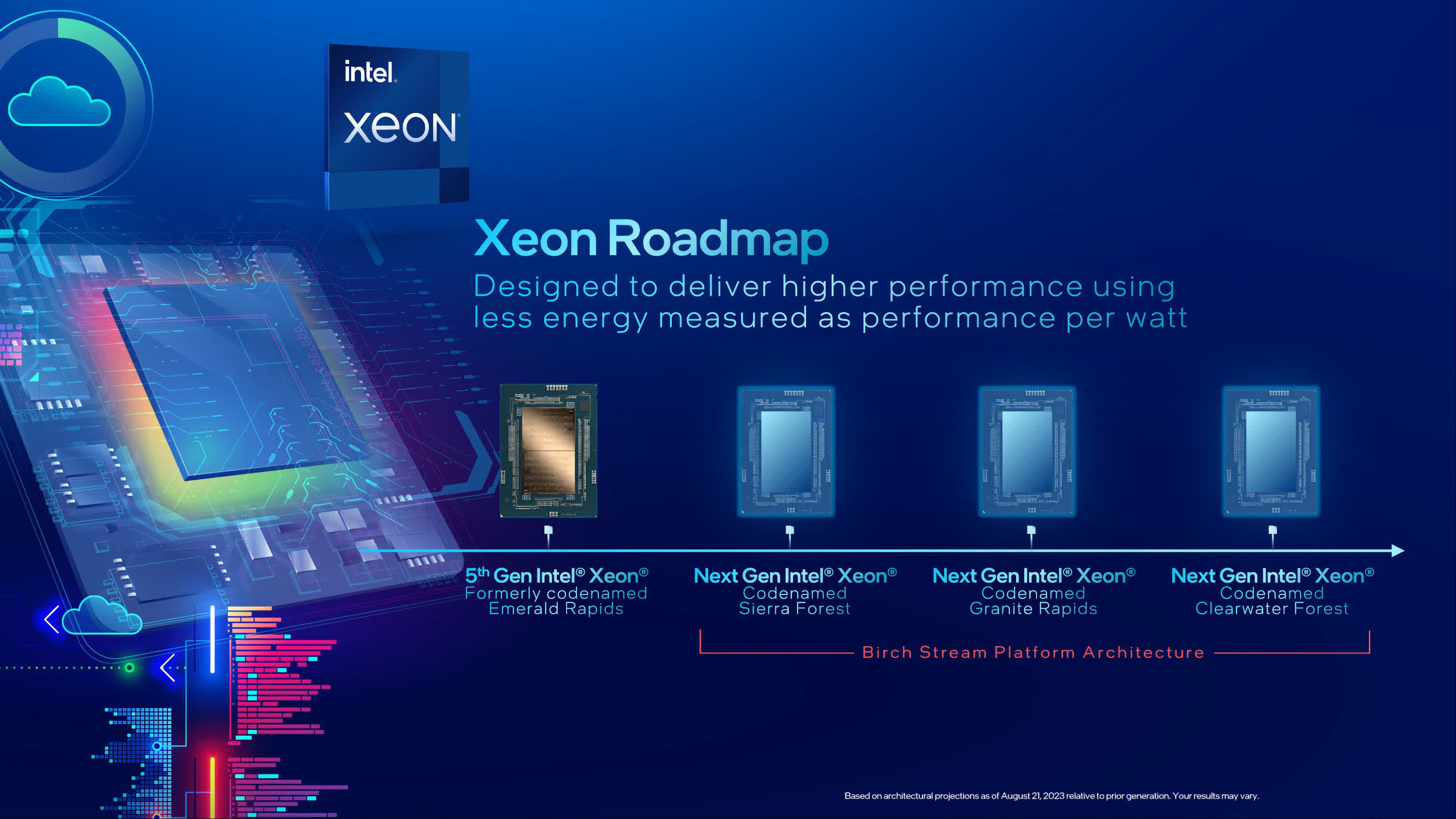
The success of Clearwater Forest may play a pivotal role in Intel's future. Production challenges and recent financial struggles have put CEO Pat Gelsinger's efforts to revitalize the company under intense scrutiny. The new server CPUs will introduce Intel's 18A process node, which will determine whether Intel's foundry business can return to competitiveness with industry leader TSMC.

Meanwhile, AMD continues to promise further performance gains with future X3D processors, potentially including the 9900X3D and 9950X3D. While details remain scarce, possible improvements could involve varying SRAM stack sizes or increasing cache capacity on high-end models.

Permalink to story:

 
Doesn't entirely make sense when AMD launched 3d stacking on desktop parts and added it to epyc as a later introduction when some server customers were asking "hey, I run computational workloads that need mega fast access to memory while working with things like avx512 for my cfd simulations, got anything like your desktop x3d stuff?", and its definitely not like its a common thing across their range - may well be they can't get a good cost per wafer and that their cpu's still aren't efficient enough to run the cores at full potential with cache on top along with the whole p+e core nonsense complicating things (interesting they mention the base of the stacks having io functions as well as sram, and then two seperate io dies outside of that, sounds more complicated than AMD's solution) - may well be their "oh we don't think gaming is the core of our corporate strategy" but neither will it be corporate servers for a good while, lots of businesses have bought up Epyc and the ones coming to having to replace their servers will probably pick epyc for efficiency and performance unless they are extremely risk averse and hell bent on having intel, and plenty of businesses will not care about cpu performance currently, as gpu is all the rage (and we know how Intel's doing in that segment, even with their accelerators), so all it needs it tons of cores for vm's and the occasional specialised setup, not anything to spend tons on, but having smart strategic solutions has not been intel's strong suit recently...
 
Doesn't entirely make sense when AMD launched 3d stacking on desktop parts and added it to epyc as a later introduction when some server customers were asking "hey, I run computational workloads that need mega fast access to memory while working with things like avx512 for my cfd simulations, got anything like your desktop x3d stuff?", and its definitely not like its a common thing across their range - may well be they can't get a good cost per wafer and that their cpu's still aren't efficient enough to run the cores at full potential with cache on top along with the whole p+e core nonsense complicating things (interesting they mention the base of the stacks having io functions as well as sram, and then two seperate io dies outside of that, sounds more complicated than AMD's solution) - may well be their "oh we don't think gaming is the core of our corporate strategy" but neither will it be corporate servers for a good while, lots of businesses have bought up Epyc and the ones coming to having to replace their servers will probably pick epyc for efficiency and performance unless they are extremely risk averse and hell bent on having intel, and plenty of businesses will not care about cpu performance currently, as gpu is all the rage (and we know how Intel's doing in that segment, even with their accelerators), so all it needs it tons of cores for vm's and the occasional specialised setup, not anything to spend tons on, but having smart strategic solutions has not been intel's strong suit recently...
You ever heard of a paragraph, specifically how to use them correctly?
 
Intel had large cache before with Broadwell. It wasn't stacked, but I remember the i7 5775C at 3.3Ghz in most games at the time would pull out a lead especially in the lows over a i7 4790K at 4.4Ghz.

I bet they regret not following that idea through in 2014 with further R & D. Just look at the gaming performance of any of the 3 generations of 3D cache CPU available from AMD using the same idea.
 
Doesn't entirely make sense when AMD launched 3d stacking on desktop parts and added it to epyc as a later introduction when some server customers were asking "hey, I run computational workloads that need mega fast access to memory while working with things like avx512 for my cfd simulations

It was EPYC first with additional cache. It was the hardware team of AMD who got told, here's a Ryzen with additional cache, find us a workload that it would suit the best. It happened to be games.


Gamernexus has a video on the exact above; where they speak to a AMD hardware engineer.
 
Back