Intel says software, not more cache, is key to beating AMD in gaming

DragonSlayer101

Posts: 974   +14
Staff
The big picture: A senior Intel executive has revealed that the company is making sweeping changes to its product roadmap over the next five years to better compete with AMD, especially in the client CPU segment across desktops, laptops, and handheld gaming devices. He also seemingly confirmed that the company is working on the rumored Arc G3 series of chips for next-generation gaming handhelds.

Speaking to the German media outlet PC Games Hardware about Intel's plans to compete with AMD's X3D line of gaming CPUs, Vice President Robert Hallock said that hardcore PC enthusiasts are "significantly underestimating" the importance of software to the PC experience, and that no amount of cores or cache can maximize gaming performance without optimized software.

He added that Intel is focused on delivering a strong gaming experience and is making several changes to its upcoming products to reduce latency. Hallock did not detail the specific changes, but noted that in chips with a high core count, "a thread director would be very, very helpful."

Addressing Intel's 3D V-Cache strategy, Hallock claimed that additional cache is only useful in applications that make a high number of random memory requests, such as older games built on DirectX 9 and DirectX 11. Newer APIs, he added, typically do not see as large a performance uplift from increased cache sizes, but instead benefit more from optimized software.

To that end, Intel is developing the Binary Optimization Tool (BOT), which reportedly delivers up to a 30% performance gain in modern games and other workloads, regardless of cache capacity. Hallock reiterated that the company is fully committed to improving gaming performance through software optimization, and is treating BOT and similar tools as a critical part of its future roadmap.

Hallock's comments suggest that Intel is prioritizing software over what he described as a "brute force hammer" approach to boosting gaming performance. However, the company is also expected to debut its 3D V-Cache competitor, dubbed Big Last Level Cache, with Nova Lake later this year, so it is not entirely abandoning hardware-based approaches either.

Hallock also briefly mentioned the Arc G3 series while answering a question about the company's plans for PC gaming handhelds. When asked about Arc G3 and G3 Extreme, Hallock said, "I actually don't work on Arc G3 all the time," seemingly confirming the existence of the rumored chips.

Permalink to story:

 
Forgetting for the moment whatever CPU performance may or not help "gaming" given the costs & availability of DGPU's for ANY platform Intel has a chance opening here to deliver a low cost i5/i7 (6-8C/12-16T) with a DECENT Arc iGPU tile in the package specifically for < $1000 laptops and handhelds.
While AMD's "hands are tied" due to deals to provide "Gaming APU's" with Sony & Microsoft's dedicated Gaming Consoles, Intel might be able to compete directly with them.
 
Someone tell this yapping suit to just make the chips instead of teeing up another weak shot. Intel won't be coding their way out of this particular corner, they'll need to make and sell a competitive product to justify their continued existence.

 
Intel processors consume too much power. This cannot be fixed with software.
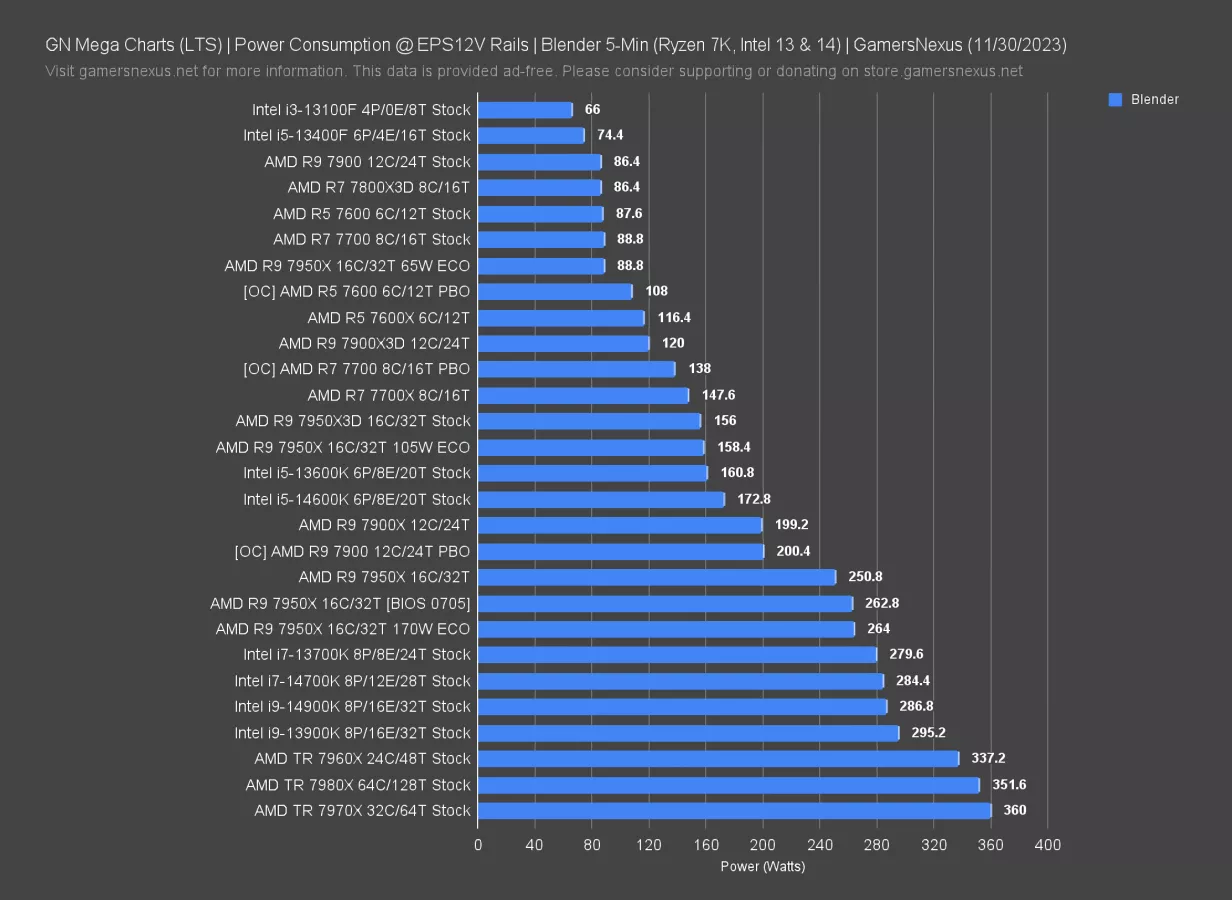
Remind me again which chips top this power consumption list? I can't quite read the series markers:

GN%20Mega%20Charts%20%28LTS%29%20Power%20Consumption%20%40%20EPS12V%20Rails%20Blender%205-Min%20%28Ryzen%207K%2C%20Intel%2013%20%26%2014%29%20GamersNexus%20%2811_30_2023%29_0.png.webp


(to avoid the inevitable firestorm, yes I realize that averaged across the entire product line, AMD beats Intel. But those wailing the loudest about power consumption are suspiciously quiet when it comes to AMD's 250W chips, higher than anything in Intel's arsenal.)
 
Remind me again which chips top this power consumption list? I can't quite read the series markers:

GN%20Mega%20Charts%20%28LTS%29%20Power%20Consumption%20%40%20EPS12V%20Rails%20Blender%205-Min%20%28Ryzen%207K%2C%20Intel%2013%20%26%2014%29%20GamersNexus%20%2811_30_2023%29_0.png.webp


(to avoid the inevitable firestorm, yes I realize that averaged across the entire product line, AMD beats Intel. But those wailing the loudest about power consumption are suspiciously quiet when it comes to AMD's 250W chips, higher than anything in Intel's arsenal.)

Lets look at proper results, done by a site you can trust:

https://www.techpowerup.com/review/intel-core-i9-14900ks/22.html

power-multithread.png


No power limits, north of 500 watts with only 8 p-cores


Conclusion

  • Very high power usage
  • Demanding cooling requirements / high temperatures

If you think Intel is not having heat issues on 13th and 14th series you can't have much experience with them

 
Lets look at proper results, done by a site you can trust:

https://www.techpowerup.com/review/intel-core-i9-14900ks/22.html

power-multithread.png


No power limits, north of 500 watts with only 8 p-cores


Conclusion

  • Very high power usage
  • Demanding cooling requirements / high temperatures
Let me fix that conclusion for you:

"Conclusion, I didnt like your point, so I cherry picked my own that conveniently dont have the TR 7000 series in them because that would prove you correct, and claimed your results cannot be trusted based on nothing. I'll also judge not based on stock behavior but on an all P core OC with power limits removed then pretend like that is the normal result.

Therefore I win".
He never claimed intel didnt have heat issues. What he pointed out is that people pearl clutching about "muh heat; muh power" get very quiet when you look at AMD's high draw parts. Almost like they are biased.

Also why are we digging up raptor lake when arrow lake exists? That gap is looking awfully small now....

power-multithread.png
 
Remind me again which chips top this power consumption list? I can't quite read the series markers:

GN%20Mega%20Charts%20%28LTS%29%20Power%20Consumption%20%40%20EPS12V%20Rails%20Blender%205-Min%20%28Ryzen%207K%2C%20Intel%2013%20%26%2014%29%20GamersNexus%20%2811_30_2023%29_0.png.webp


(to avoid the inevitable firestorm, yes I realize that averaged across the entire product line, AMD beats Intel. But those wailing the loudest about power consumption are suspiciously quiet when it comes to AMD's 250W chips, higher than anything in Intel's arsenal.)

Such a disingenuous comparison you draw from that chart, the 250w AMD chips are Threadripper 64C/128T Workstation class processors.

A comparison of the power draw of the i7 14700k vs Ryzen 7 7800X3D Desktop class chips would the sincere comparison for you to make, as you certainly know.

Intels Workstation Class processors would be the more appropriate for a comparison with TR7000 series, but there weren't any, imagine what the power draw on a 64P core Raptor Lake would have been like?
 
Last edited:
Let me fix that conclusion for you:

"Conclusion, I didnt like your point, so I cherry picked my own that conveniently dont have the TR 7000 series in them because that would prove you correct, and claimed your results cannot be trusted based on nothing. I'll also judge not based on stock behavior but on an all P core OC with power limits removed then pretend like that is the normal result.

Therefore I win".

He never claimed intel didnt have heat issues. What he pointed out is that people pearl clutching about "muh heat; muh power" get very quiet when you look at AMD's high draw parts. Almost like they are biased.

Also why are we digging up raptor lake when arrow lake exists? That gap is looking awfully small now....

View attachment 90852
Good point why did Endymio bring up Raptor Lake?
 
Let me fix that conclusion for you:

"Conclusion, I didnt like your point, so I cherry picked my own that conveniently dont have the TR 7000 series in them because that would prove you correct, and claimed your results cannot be trusted based on nothing. I'll also judge not based on stock behavior but on an all P core OC with power limits removed then pretend like that is the normal result.

Therefore I win".

He never claimed intel didnt have heat issues. What he pointed out is that people pearl clutching about "muh heat; muh power" get very quiet when you look at AMD's high draw parts. Almost like they are biased.

Also why are we digging up raptor lake when arrow lake exists? That gap is looking awfully small now....

View attachment 90852

Because Raptor lake and refresh is what Intel still sells the most. Arrow Lake changed nothing and failed miserably and Intel is leaving the platform fast (Nova Lake new socket).

Intel makes Raptor lake chips on own fabs but Arrow Lake has TSMC as the middle man. Intel earns vastly less on Arrow Lake, hence little/no focus - Intel don't really want to sell it and people don't really want to buy it either (bad gen to gen uplift, however the crazy power usage improved)

AMDs high power parts have 16 p-cores
Intels high power raptor lake parts have 8 p-cores, and a bunch of weak e-cores

Reason for e-cores was improving MT perf without CPU pulling 600+ watts


You see many Arrow Lake parts in top CPU sellers at Amazon?


AMD dominate the list, Intel has a few 12, 13 and 14th gen, no Arrow Lake in top 25-30 pretty much

Intel became the small player. Nova Lake is their way back, new socket required again, but if you are lucky, they will now use the same socket for 4 generations like AMD
 
Last edited:
Such a disingenuous comparison you draw from that chart, the 250w AMD chips are Threadripper 64C/128T Workstation class processors.

A comparison of the power draw of the i7 14700k vs Ryzen 7 7800X3D Desktop class chips would the sincere comparison for you to make, as you certainly know.

Intels Workstation Class processors would be the more appropriate for a comparison with TR7000 series, but there weren't any, imagine what the power draw on a 64P core Raptor Lake would have been like?

True, every single person knows Intels performance per watt has been terrible for years and generations, Intel using TSMC tech fixed the power draw but side effect was lower clockspeeds, hence why gaming performance dropped on Arrow Lake

Arrow Lake has terrible sales numbers and Intel don't even want to sell them, due to TSMC taking a big cut, hence why they still push 14th generation mostly

Intel 14A hopefully will fix Intels crazy power draw, we will see when Nova Lake hits next year

My last 2 systems have been AMD, after using Intel for decades, they fell off the wagon and got knocked out - Nova Lake is the last chance after years and years disappointing people

I hope Intel won't fail too much, as we need competition
 
Last edited:
Such a disingenuous comparison you draw from that chart, the 250w AMD chips are Threadripper 64C/128T Workstation class processors.
Oops! You forgot the two Intel chips at the bottom of the power draw list, or that the AMD 7950X is effectively tied with the Intel chips at top.

And again: you miss the point. As I already said, across the entire product line, AMD wins on power draw ... but by a far smaller margin than you people are willing to admit.
 
Oops! You forgot the two Intel chips at the bottom of the power draw list, or that the AMD 7950X is effectively tied with the Intel chips at top.

And again: you miss the point. As I already said, across the entire product line, AMD wins on power draw ... but by a far smaller margin than you people are willing to admit.
You people, whats that supposed to mean? Now what are you accusing me of?

I did not miss any points you claim to make. I'm not entirely sure what point you were trying to make, other than to start yet another argument.

I am curious as to why you chose a comparison graph of the previous generation of processors over a comparison of the current generation of desktop processors?

I do think it would have been fun if Intel had produced a 64 P core competitor to Threadripper 7000. Just to see a repeat of the time they used a chiller to cool a 28 core beast to 5ghz.

 
Comparing a Threadripper HEDT chip to Intel mainstream desktop parts is hilariously disingenuous.
AMD still has the most efficient desktop CPU's, notably with the X3D versions, Intel only gets close with a more advanced node.
 
Comparing a Threadripper HEDT chip to Intel mainstream desktop parts is hilariously disingenuous.
Absolutely! In fact, it's almost as bad as comparing an overclocked Intel CPU with all its power limits removed to a stock AMD chip, eh?
 
Back