
In a nutshell: Inspired by Iron Man, South Korean researchers have developed a lightweight wearable robot designed to help wheelchair users walk. Known as the WalkON Suit F1, this advanced exoskeleton attaches to individuals with paraplegia, providing powered leg mobility to enable them to navigate their surroundings on foot.
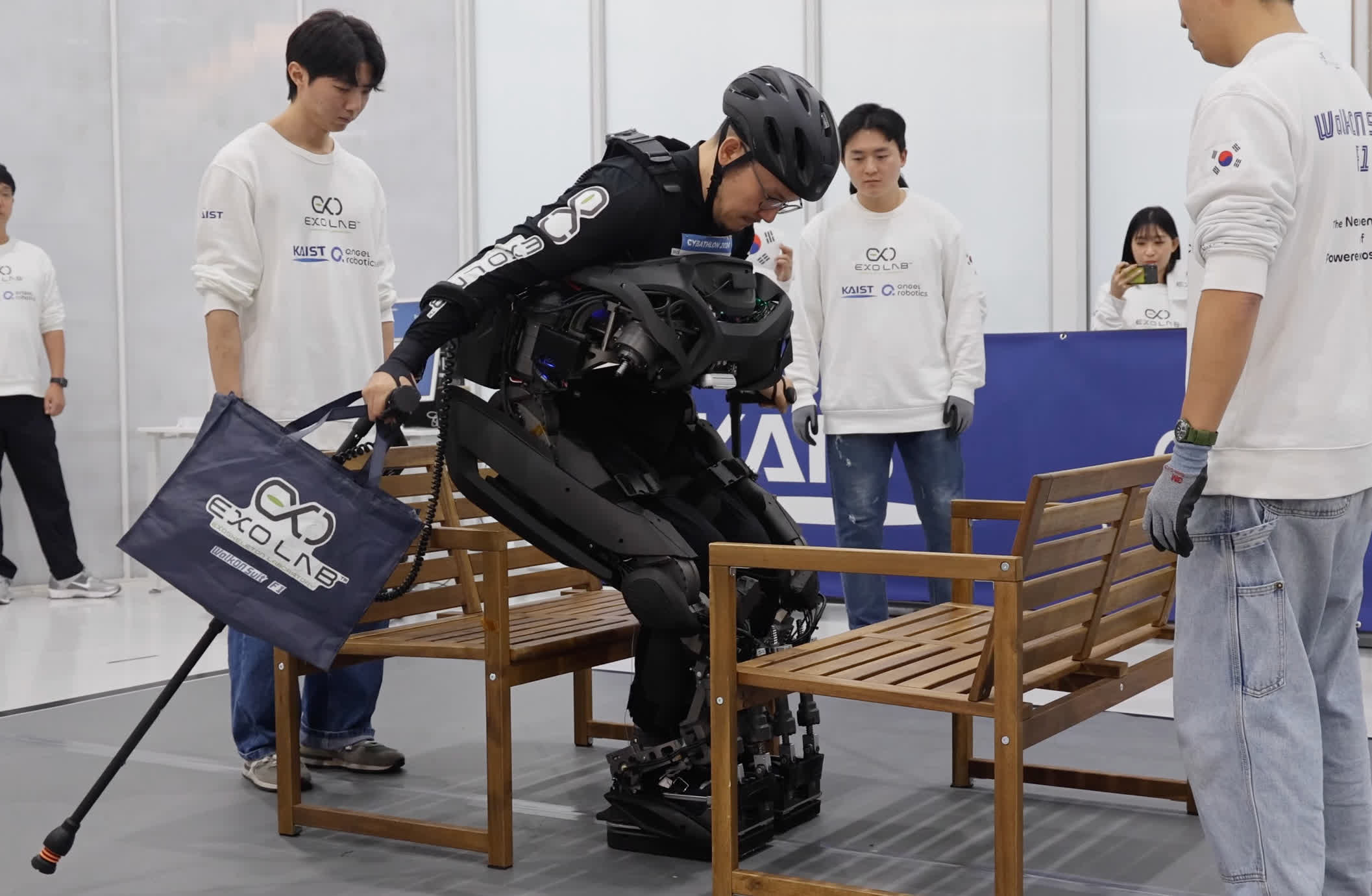
The researchers are from the Korea Advanced Institute of Science and Technology's (KAIST) Exoskeleton Lab. Kim Seung-hwan, a team member who uses a wheelchair himself, demonstrated the prototype's capabilities to Reuters.
The 110-pound suit is powered by a dozen motors that replicate natural joint movements during walking. Sensors embedded throughout the suit monitor over 1,000 data points per second, allowing it to anticipate the user's intended motion and maintain proper balance. It also features camera vision that scans the environment, identifies obstacles and elevation changes, and compensates for the user's limited environmental awareness.
One standout feature Kim highlighted is the suit's ability to locate and attach itself to the user while they are still seated in their wheelchair.

Using the suit, Kim was able to walk at approximately 2 mph, climb stairs, and even perform complex maneuvers, such as sidestepping onto a bench.
The researchers aimed to design an assistive robot that seamlessly integrates into the daily lives of individuals with disabilities. Team member Park Jeong-su shared that he drew inspiration from the Iron Man superhero, envisioning technology as a tool to empower and assist people.
Their efforts culminated in success when Kim won gold in the exoskeleton category at Cybathlon 2024 while using the WalkON Suit. The competition, held from October 25 to 27, showcased a variety of assistive robotic technologies across eight categories, operated by developers with diverse disabilities.
Meanwhile, the silver medal was awarded to Switzerland's VariLeg Enhanced exoskeleton, which features an innovative hybrid design capable of transforming between a self-propelled wheelchair and a walking assistance robot. Taking third place went to Thailand's ChiangMaiU EXO 2, a suit with an impressive 10 degrees of freedom, enabling lateral movements such as sidestepping alongside forward locomotion.
Although exoskeletons have been studied since the 1960s, integrating them into daily life for paraplegics remains a significant challenge. Current designs often struggle with adaptability, cumbersome fitting processes, and cognitive demands that limit their usability. Competitions like Cybathlon aim to address these hurdles by incentivizing the development of more advanced and user-friendly exoskeletons.


