JavaScript turns 30: From 10-day prototype to the backbone of the modern web

Alfonso Maruccia

Posts: 2,511   +934
Staff
Why it matters: JavaScript was officially unveiled in 1995 and now powers the overwhelming majority of the modern web, as well as countless server and desktop projects. The language is one of the core standards for web programming, although some trademark issues remain unresolved.

Thirty years ago, Netscape and Sun Microsystems introduced JavaScript as a new, cross-platform scripting language for building internet applications. Brendan Eich, the language's original designer, hacked together the technology in a 10-day marathon while working at Netscape. Today, JavaScript is used by an estimated 98.9% of all websites – although things could have turned out very differently.

JavaScript is used by an estimated 98.9% of all websites

Eich designed JavaScript to bring a new level of interactivity to web pages while remaining approachable for both programmers and amateurs. He drew inspiration from several sources, including the Lisp dialect Scheme, Self, and others. Meanwhile, Sun succeeded in tying JavaScript to Java, despite the two languages being vastly different. As Benj Edwards reminds us on Ars Technica, JavaScript and Java have about as much in common as "car" and "carpet."

Sun touted Java as a powerful tool for building enterprise applications, while JavaScript was meant to complement it, handling smaller, client-side tasks. Thirty years later, Java "applets" have mostly – and thankfully – vanished from the web, while JavaScript persists everywhere. Meanwhile, Java remains among the top programming languages overall – not so much for websites, but for enterprise software, backend services, and large-scale systems.
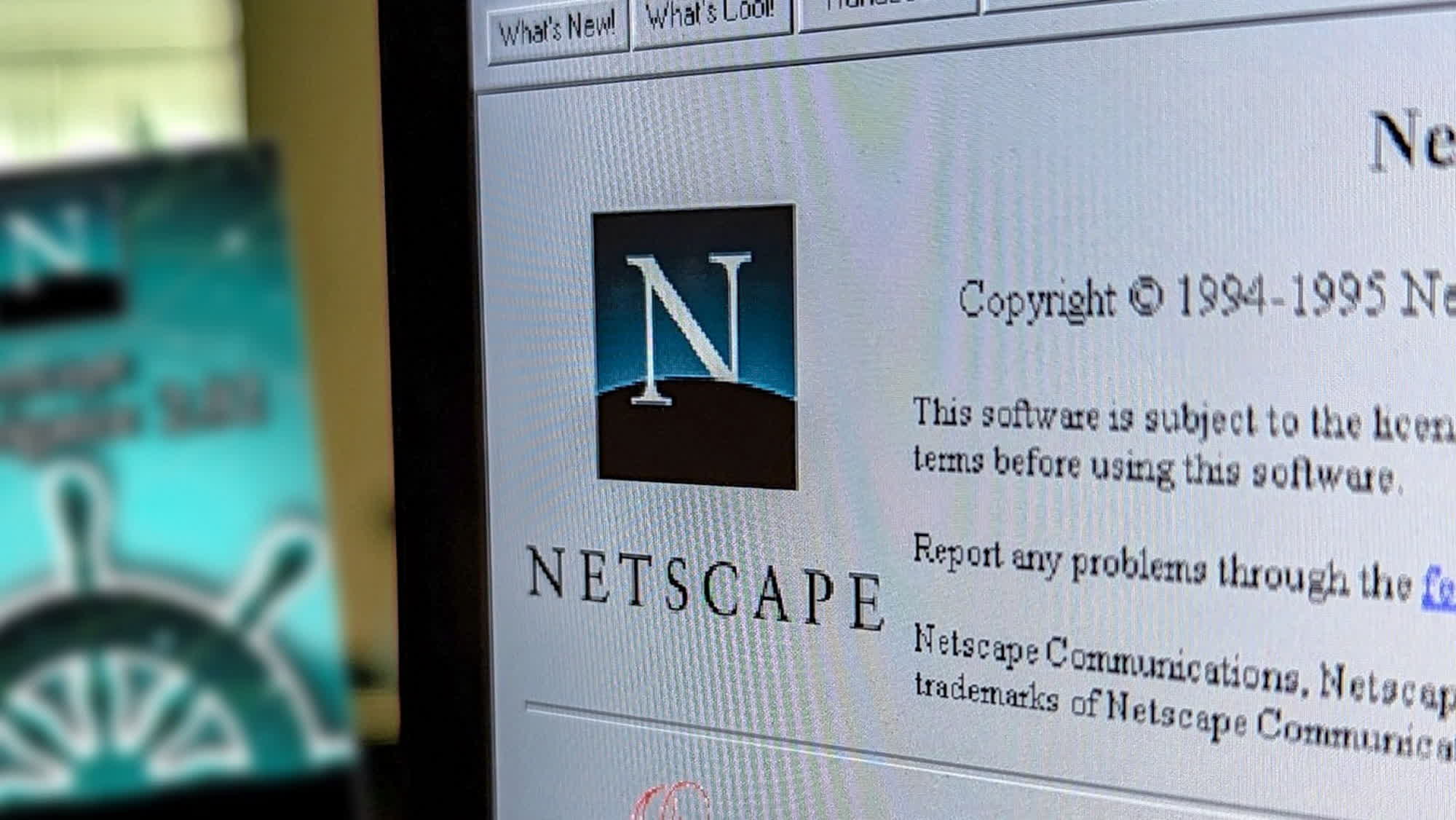
Eich initially wanted to name the language "Mocha," while Netscape briefly rebranded it "LiveScript" before settling on JavaScript. It was first announced in December 1995 and reached its initial 1.0 release in March 1996. Netscape engineers continued refining JS over time, and users got their first taste of JavaScript features through Netscape Navigator.

Also read: What Ever Happened to Netscape?

Before Microsoft embedded Internet Explorer into Windows 9x in an attempt to dominate the web, Netscape's proprietary browser was the de facto standard for surfing the early internet on Pentium-era PCs. Netscape and Navigator are long gone, but JavaScript now powers browsers, development platforms, and server-side frameworks for modern cloud applications.

JavaScript eventually became an industry standard through the ECMAScript specifications, with ECMA standing for the European Computer Manufacturers Association. Meanwhile, the JavaScript trademark has sparked ongoing legal conflict between Oracle and the wider community of JS developers.

Oracle is said to have acquired the rights to the JavaScript name after purchasing Sun Microsystems in 1997, yet has made no meaningful contribution to the language itself. The JS community wants to reclaim the right to freely use the "JavaScript" name, but Oracle has shown no intention of granting it.

Permalink to story:

 
More naming fun facts: Microsoft simply named their version of JavaScript JScript in IE, and it was one of the two supported languages for the server-sided web technology Classic ASP (simply called ASP at the time). You could either use JScript or VBScript (not the same thing as VB). Classic ASP was eventually superseded by ASP.NET (with .NET running on C# and VB) and more recently .NET Core (or dotnet).

Anyways, JavaScript is widely used with Node.js (or node) which is a server-sided technology that runs JavaScript like any other language. It doesn’t use a browser at all. Meanwhile, client-side JS is the backbone of every interactive web page. ECMA sets standards for JS which has modernized it greatly. Some of the best features of Python, C#, and other languages have been borrowed to benefit developers.
 
The 10-day prototype is the greatest technical misfortune probably of all time.
Ah yes, slowing down computing since 1995 (c)

Just compare VS Code performance vs Notepad++. And all that sluggishness is still hardware accelerated. Get it? A hardware accelerated text editor. And still slow af.
 
As for JavaScript, well 1 day long ago I was enjoying a fast, smooth and blissful experience using the internets, then someone decided to use too much JavaScript, now we have libraries and when I view a website I gotta load the entire State of New York to enjoy what experience again... - and this is why I don't like libraries, back in the day, I'd use some small snippets of jQuery and I gotta load the entire fu#$ing library. What should have happened instead is that all the browsers should've implemented the exact same rendering models and interpretations for HTML and CSS. What's changed - nothing!

And don't start please 🙏 - my background was web design for many years, sh#$ just got way too complex and browsers just pi$$ed me off!
 
Last edited:
As for JavaScript, well 1 day long ago I was enjoying a fast, smooth and blissful experience using the internets, then someone decided to use too much JavaScript, now we have libraries and when I view a website I gotta load the entire State of New York to enjoy what experience again... - and this is why I don't like libraries, back in the day, I'd use some small snippets of jQuery and I gotta load the entire fu#$ing library. What should have happened instead is that all the browsers should've implemented the exact same rendering models and interpretations for HTML and CSS. What's changed - nothing!

And don't start please 🙏 - my background was web design for many years, sh#$ just got way too complex and browsers just pi$$ed me off!
I have a hotspot I use for work on the road when I don't have access to WiFi and it's capped at 200KB/s which is essentially DSL speeds. I remember DSL loading pages almost instantly for many years. Now it feels like basic pages can take upwards of a minute, sometimes over a minute, at these speeds. I'm just stuck sitting there thinking, "what are these pages trying to load that's taking so long?". It's just just several paragraphs of text and a couple images. I watch my network traffic and I see it pegged at 200KB/s for upwards of a minute while the page I'm loading is really just a couple megabytes. It's all the libraries in the background that's taking up all the bandwidth. Most people don't notice because 99% of us are in highspeed broadband connections, but the lunacy of it all is really apparent when your on a slow connection.

We're getting starlink hotspots in January to help with this, but it seems just seems wildly unnecessary that the Internet has turned into this unoptimized mess after being very well optimized until widespread adoption of broadband.
 
When you look at the inner workings of libraries like Angular and React running on JS, it's a miracle websites run at all. So many hoops to get sensible performance, virtual DOM's, Lazy Loading, Minifying, Bundling etc etc. It really is a convoluted shambles internally. Unfortunately this is the reality of modern development. The elegance of coding is a thing of the past on the client now. It's a cobbled together load of technologies built on the shakiest and most unsuitable of foundations - I.e. JavaScript and HTML.
 
Ah yes, slowing down computing since 1995 (c)

Just compare VS Code performance vs Notepad++. And all that sluggishness is still hardware accelerated. Get it? A hardware accelerated text editor. And still slow af.
Isn't the hardware acceleration in vs code only for the font rendering?
I don't think the auto complete uses hardware acceleration
 
As for JavaScript, well 1 day long ago I was enjoying a fast, smooth and blissful experience using the internets, then someone decided to use too much JavaScript, now we have libraries and when I view a website I gotta load the entire State of New York to enjoy what experience again... - and this is why I don't like libraries, back in the day, I'd use some small snippets of jQuery and I gotta load the entire fu#$ing library. What should have happened instead is that all the browsers should've implemented the exact same rendering models and interpretations for HTML and CSS. What's changed - nothing!

And don't start please 🙏 - my background was web design for many years, sh#$ just got way too complex and browsers just pi$$ed me off!
Many websites now only sends json and xml data to be processed into gui by client side javascript
 
When you look at the inner workings of libraries like Angular and React running on JS, it's a miracle websites run at all. So many hoops to get sensible performance, virtual DOM's, Lazy Loading, Minifying, Bundling etc etc. It really is a convoluted shambles internally. Unfortunately this is the reality of modern development. The elegance of coding is a thing of the past on the client now. It's a cobbled together load of technologies built on the shakiest and most unsuitable of foundations - I.e. JavaScript and HTML.
Without javascript, we won't have dynamic webpage.
 
Without javascript, we won't have dynamic webpage.
Yes I know. It's just a shame such a motley crew of totally inappropriate and technically poor technologies ended up being the bedrock of the web and therefore of so much development.
 
Back