In a nutshell: The computational capabilities of AI accelerators and GPUs are now limited by how much high-bandwidth memory the processors can access at any given time. According to Kioxia, enterprise SSDs can serve as a viable alternative to HBM when they are embedded directly in the server rack system.
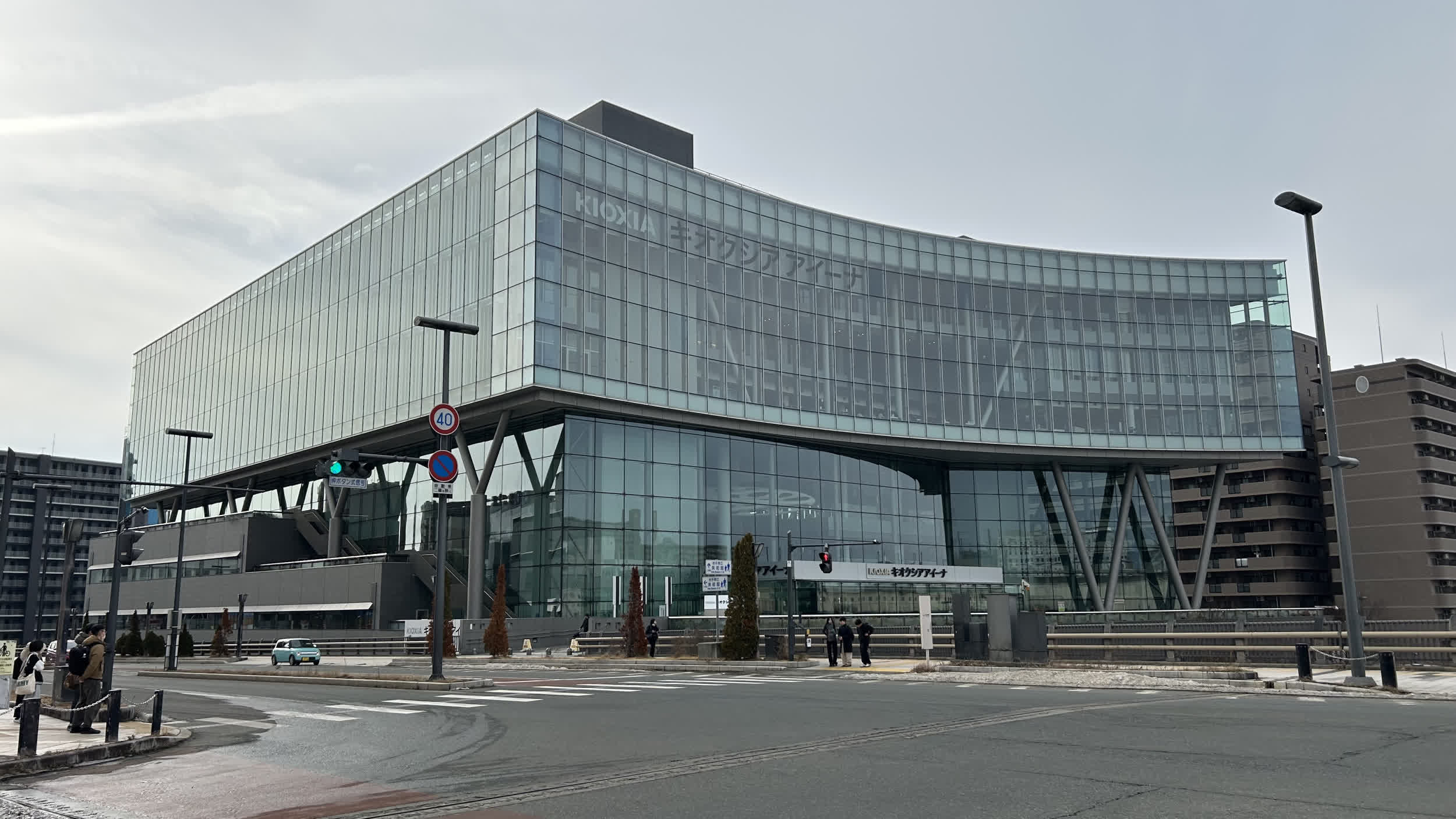
Kioxia is working with Nvidia to significantly expand memory capacity in AI data centers by exploiting its spacious, enterprise-grade SSDs. The Japanese memory manufacturer, credited with inventing flash memory back when it was part of Toshiba, recently unveiled a new proof-of-concept solution. The company linked terabytes upon terabytes of SSD storage to "effectively" expand GPU memory capacity to 1 petabyte and beyond.
The new test employed 144 Kioxia 7.68 TB NVMe SSDs belonging to the XD8 Series line, which were installed in an Nvidia GB200 NVL72 system. The rack included 18 server nodes, with each node supporting eight E1.S SSDs. All in all, the configuration supported around 60 terabytes of flash-based memory per node, which was available directly to the GB200 GPUs thanks to Nvidia's SCADA software stack.
Kioxia's XD8 Series includes six different PCIe 5.0 SSDs ranging between 1.9 TB and 7.68 TB. The drives support the Open Compute Project initiative, and employ Kioxia's all-proprietary hardware and software architecture. According to Kioxia data, the new experimental setup was able to provide around 1.1 petabytes of "raw" SSD capacity. The system supports 512-byte data access, potentially going up to 2 trillion 512-byte vectors.
The new system would be useful for storing, managing, and processing large-scale vector databases, including the massive datasets used in graph neural networks. To put it simply, this novel approach would make increasingly massive AI models readily available to GPUs and other hardware accelerators, going beyond the limits of traditional on-board HBM solutions both in terms of costs and supply chain availability.
Like other hardware makers caught up in chip manufacturing these days, Kioxia is now mostly focused on serving the needs of data center customers and other AI hyperscalers. Earlier this year, the managing director of Kioxia's memory division said the era of cheap 1 TB consumer SSDs is over.
Kioxia and Nvidia described the XD8-based system as a PoC still going through testing, but the Japanese manufacturer is already working on some brand-new storage units to expand memory capacity beyond costly HBM chips. The recently introduced GP1 Series is designed to exploit the PCIe 6.0 standard to further optimize direct GPU access, while Kioxia and Nvidia keep evaluating novel solutions based on SCADA and the Storage-Next architecture.
Kioxia and Nvidia demo 144 SSDs that expand GPU memory past 1 petabyte in a GB200 NVL72 rack


