Winners & losers: While a growing number of users are waiting for the AI bubble to finally burst, manufacturers are dealing with increasingly harsh constraints. The "traditional" supply chain is gone, and customers will likely pay the ultimate price for the whole mess, starting with mainstream laptop computers.

A recent analysis by TrendForce casts a dark shadow over the future of the most popular machines in the portable PC market. According to the consulting firm, "mainstream" notebooks may soon cost as much as 40% more. Growing challenges in CPU manufacturing are adding yet another layer of uncertainty to an already volatile memory chip market.
In TrendForce's definition, a mainstream notebook has a suggested retail price of $900. The baseline scenario modeled by the company assigns that price to a laptop PC sold during the first quarter of 2025. In the pre-AI bubble scenario, memory components such as DRAM and SSDs accounted for around 15% of the total bill of materials (BOM) required to manufacture a single notebook.
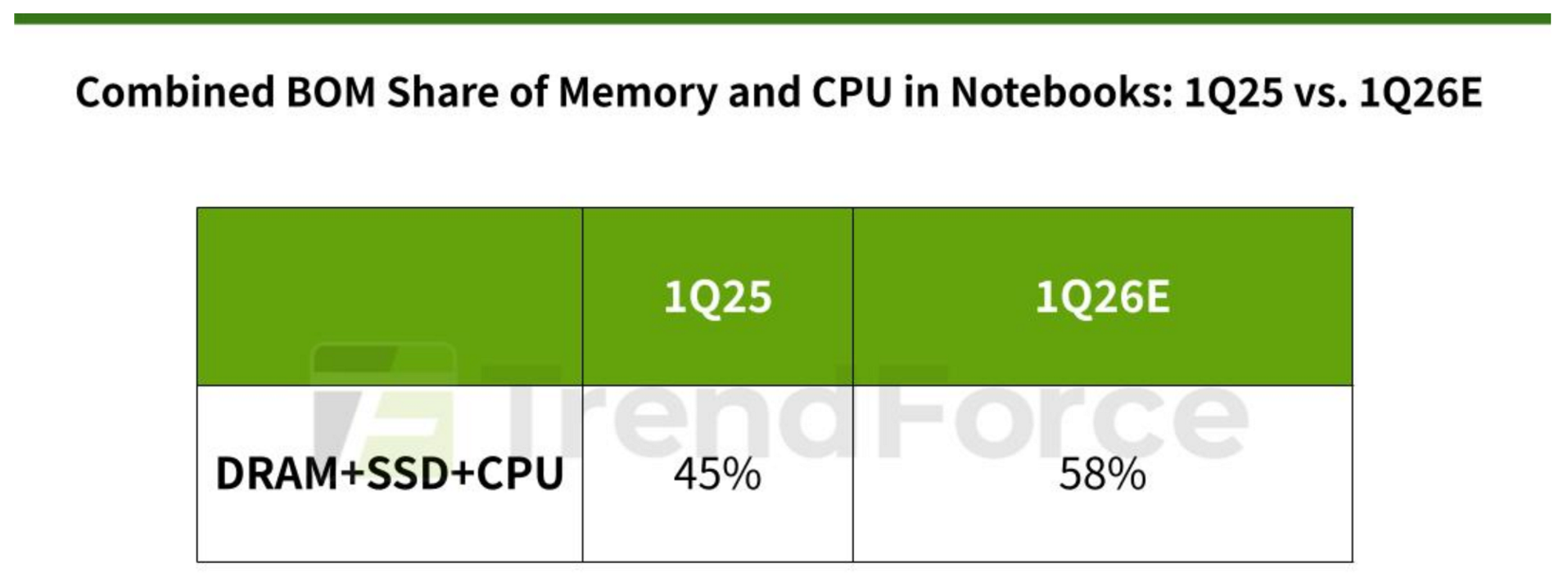
Just one year later, the memory-related share of the BOM is now expected to exceed 30%. If chipmakers and OEMs want to maintain their existing profit margins, a $900 mainstream laptop could soon carry a price tag roughly 30% higher than the 2025 baseline.
HP recently explained that RAM now accounts for about 35% of the cost required to build a brand-new PC. One of the world's largest OEM manufacturers plans to protect its margins by adopting a predefined optimization strategy. In the long run, customers will have to bear the supply chain burden as well. But the situation may get even worse.
Also read: The MacBook Neo is a $500 Wake-Up Call for the Entire PC Industry
TrendForce said that Intel has already raised prices on a few older, entry-level CPUs by more than 15%. The US chipmaker is also expected to increase prices for midrange and high-end computing platforms in the second quarter of the year. CPUs were already one of the largest cost factors in a notebook's BOM, and these increases could push manufacturers to raise final MSRPs even further.

But wait, there's more. TrendForce also highlights growing strain in CPU manufacturing ventures such as Intel and AMD. The supply chain is becoming unstable there as well, because corporations across the industry are prioritizing their business around Nvidia and Big Tech's plans to build massive AI data centers.
If both memory and CPU prices rise at the same time, TrendForce says a mainstream laptop could soon cost up to 40% more at retail. The question is whether CPU manufacturers will experience a boom similar to what memory makers are seeing, while many PC enthusiasts find themselves priced out of new hardware.