Steam could soon show estimated FPS based on crowd-sourced player data

Skye Jacobs

Posts: 2,030   +59
Staff
The takeaway: Valve appears to be preparing a new feature that could make one of PC gaming's biggest uncertainties – performance – more transparent. Newly uncovered code in the Steam client suggests players may soon see estimated frame rate data for each game derived from real-world gameplay metrics shared by other users.

The feature would represent a significant step toward bridging the gap between official system requirements and actual in-game performance. Even as studios release recommended hardware specs, the experience on diverse PC setups often differs sharply from expectations.

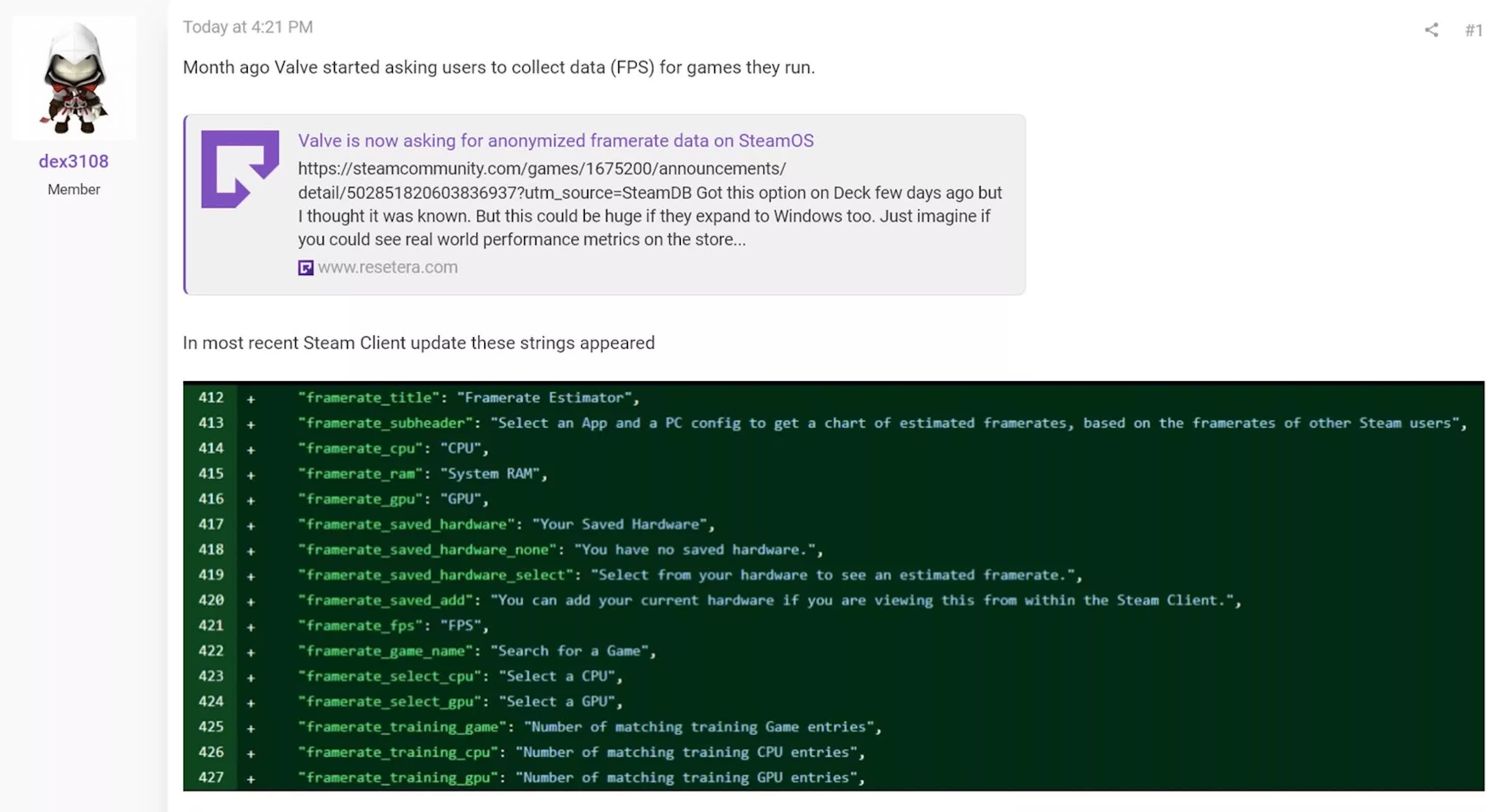
The discovery surfaced on the ResetEra forums, where user Dex3108 spotted a new line in the latest Steam client code: "Select an App and a PC config to get a chart of estimated frame rates, based on the frame rates of other users."

That wording points to a potential Steam Store tool allowing users to input their CPU, GPU, and memory to preview expected performance before buying a game.
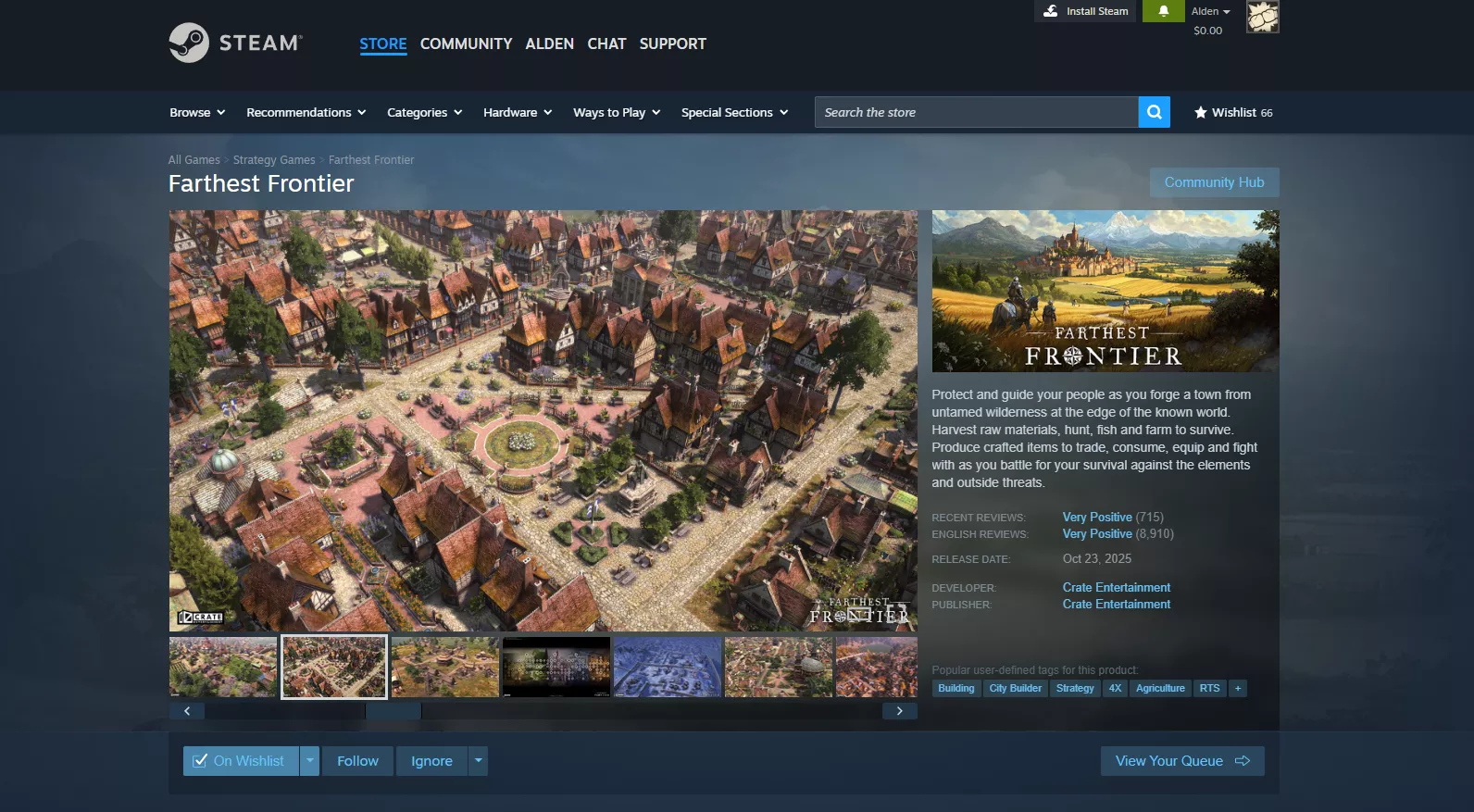
The idea builds on Valve's broader push to collect gameplay metrics anonymously. The company previously introduced a beta feature on SteamOS devices that logs frame rates and system configurations in the background. Valve says the effort is meant "to learn about game compatibility and improve Steam," with all collected data remaining detached from user identities.
Valve has also started prompting SteamOS users – such as the Steam Deck and the upcoming Steam Machine – if they are willing to allow anonymous FPS tracking. This data-gathering effort extends the company's push to enhance store information with user-generated insights.

In parallel, Valve recently enabled reviewers to attach their hardware specifications directly to user reviews, removing the need to manually list system details when describing performance.

It's still unclear whether estimated FPS data will extend to the Windows version of Steam. So far, Valve's telemetry efforts have centered on its own ecosystem. For SteamOS users, particularly on the Steam Deck, more granular performance data could complement the existing "Verified" program, which currently offers only broad compatibility labels.
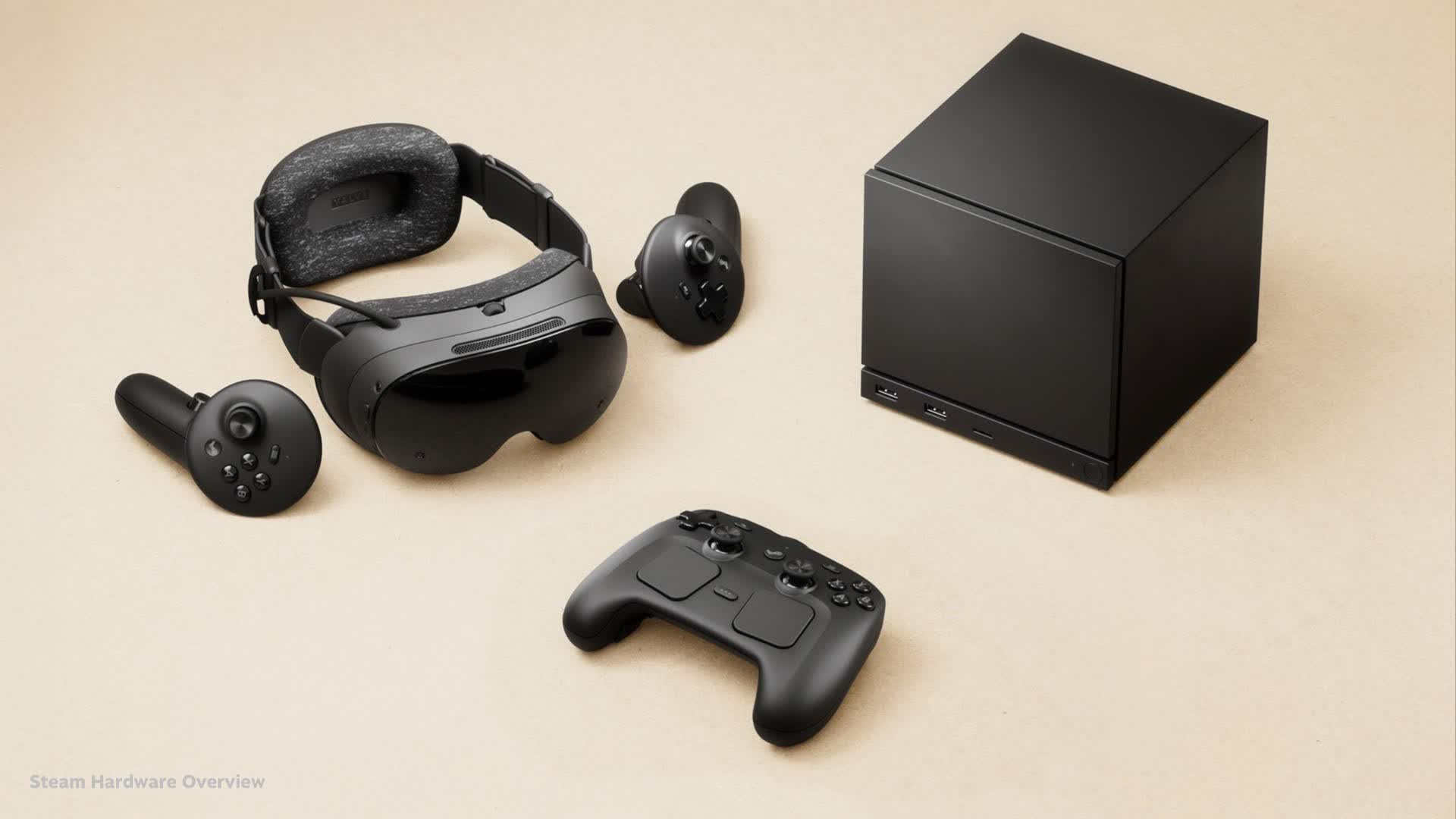
The upcoming Steam Machine, with its higher power envelope, could benefit even more, giving users a clearer sense of how demanding titles scale on compact hardware.

There are challenges, however. PC performance can depend on a wide mix of variables: graphics settings and resolution, mods, and upscaling technologies like DLSS and FSR, which can boost frame rates while affecting image quality. Aggregating data across those conditions will require careful normalization to keep estimates reliable.

Despite those hurdles, many fans appear receptive to Valve's push for more community-sourced performance insights. If implemented, the feature could make the world's largest PC game storefront a more trustworthy guide for buyers navigating an increasingly fragmented hardware landscape.

Permalink to story:

 
Cool idea. Maybe while they are at it they can improve the sampling methodology of their Steam Survey so it doesn't fluctuate so much month to month.
 
F*cking FANTASTIC.
Far too easy to exploit. If you dislike a game, upload your frame rates while running some utilities in the background.

I won't even mention the banality of trying to compare frame rates across different games that are...of course different games. Game B has much more detailed models, larger worlds, better lighting, more realistic physics, more immersive game mechanics ... but it's 9 FPS less than Game A, so you pass on it? What's that into actually worth, anyway? If the title's just too slow for your system, you'll know within minutes of launching it, at which point you can (presumably) get a full refund.
 
Far too easy to exploit. If you dislike a game, upload your frame rates while running some utilities in the background.

I won't even mention the banality of trying to compare frame rates across different games that are...of course different games. Game B has much more detailed models, larger worlds, better lighting, more realistic physics, more immersive game mechanics ... but it's 9 FPS less than Game A, so you pass on it? What's that into actually worth, anyway? If the title's just too slow for your system, you'll know within minutes of launching it, at which point you can (presumably) get a full refund.
It can't be abused that way, if they collect general data from everyone to show ranges on the store page, then a single user trying to affect it won't make a dent in that data.

Your 9 fps comparison will obviously not matter, it's more about people that can't stand when a game runs at less than X fps, like for instance games that run at less than 60 are unplayable for me and first person games that run at less than like 90 are also off the table. In general I don't want a game that has performance issues and has stuttering, so these kinds of metrics are great. A big portion of refunds stem from performance issues, this will help mitigate that.
 
Far too easy to exploit. If you dislike a game, upload your frame rates while running some utilities in the background.
Uh, no. That's too much work for a game someone dislikes. Even if they absolutely despise it, I don't see the average person doing anything more than trying to review bomb it (a far simpler task). Which means the normalized average will be fine.

I won't even mention the banality of trying to compare frame rates across different games that are...of course different games. Game B has much more detailed models, larger worlds, better lighting, more realistic physics, more immersive game mechanics ... but it's 9 FPS less than Game A, so you pass on it? What's that into actually worth, anyway? If the title's just too slow for your system, you'll know within minutes of launching it, at which point you can (presumably) get a full refund.
It's just supposed to be an estimate, you're overthinking it. I'm sure it will give a good enough idea as to what to expect so you don't neeeeeed to waste time buying, downloading, playing, refunding every game.

And if it doesn't? Just ignore it. I won't complain about a feature that's meant to help where it can.
 
Last edited:
It can't be abused that way, if they collect general data from everyone to show ranges on the store page, then a single user trying to affect it won't make a dent in that data.
A single person, no. But when a game site runs a rumor that "GAME X USED GEN AI!", I can see a few hundred or even a few thousand zealots doing so.

Your 9 fps comparison will obviously not matter, it's more about people that can't stand when a game runs at less than X fps, like for instance games that run at less than 60 are unplayable for me
With due respect, I'm curious about this. Every Hollywood film you've ever watched has been at 30 fps, and even the worst is more realistic than the best videogame at 60fps. I strongly suspect that if games randomly added (or subtracted) 10 or 20 fps to their reported figures, the average gamer would never notice.

In general I don't want a game that has performance issues and has stuttering...
But an overall average frame rate won't reveal stuttering issues, will it?

Uh, no. That's too much work for a game someone dislikes.
I think you strongly overestimate how much work it takes to start up one program before launching a specific game. In fact, I predict if this feature goes live, within 30 days free utilities to bomb a game down to any specific framerate desired will be commonly available.
 
If that is going to work well it will be great for those with old gpu considering that many games still play fine with gpu inferior to minum requirements
 
1% Low
DLSS, FSR, XeSS and in general, games have many settings that affect FPS.
 
Last edited:
With due respect, I'm curious about this. Every Hollywood film you've ever watched has been at 30 fps, and even the worst is more realistic than the best videogame at 60fps. I strongly suspect that if games randomly added (or subtracted) 10 or 20 fps to their reported figures, the average gamer would never notice.

Watching something even at 8 frames per second is something that you can adapt to, you don't control it, it's just there.

When you control things in a video game, response time matters a lot. Especially in first person shooters. It's also the main reason why I don't give a **** about frame generation, it's basically running the game at 40 frames per second while showing you 120.

You're right that average gamers wouldn't notice, not everyone cares about this, and yet even my girlfriend who barely plays video games will complain if sims is running at 40fps instead of 60. It's annoying when you move the camera and it starts to move choppily, when everything on the screen flickers because it's not as smooth as it usually is. When the performance drops, your control over the game drops too, it affects different games differently, but in many games it feels horrible.

Eitherway we still don't know what form this fps metric will take, you assume that it will just be a static number, but I think they'll do something smarter with it, either adapt it to your hardware or show various ranges, highs and lows based on various hardware. I'm guessing they'll at the very least introduce it for Steam Deck compatibility purposes, to show players how well the game runs on Steam Deck.
 
I think you strongly overestimate how much work it takes to start up one program before launching a specific game. In fact, I predict if this feature goes live, within 30 days free utilities to bomb a game down to any specific framerate desired will be commonly available.
I think you strongly overestimate how lazy the average person is. And how easy it is to filter out outliers (like you're suggesting) on a multitude of different hardware configurations.

But then, have you even thought about how ridiculous what you're suggesting sounds like? Not only do you need to co-ordinate with tens of thousands of people, but then most of you need to coincidentally have the same (similar enough) hardware to even affect a particular dataset enough to corrupt it. AND you need to assume that such outliers aren't immediately ignored, that there is no level of filtering applied, or there is no minimum dataset expected before showing it. And that the tool won't improve with time.

If what you're suggesting was as easy as you want it to seem, then review bombing would've broken their review feature a long time ago.
 
I think you strongly overestimate how lazy the average person is. And how easy it is to filter out outliers (like you're suggesting) on a multitude of different hardware configurations.

But then, have you even thought about how ridiculous what you're suggesting sounds like? Not only do you need to co-ordinate with tens of thousands of people....
LOL, what? It would take no more "coordinated effort" than review bombing does -- exactly zero. Your statement is like claiming the hordes of shoplifters -- who cumulatively are able to impact the bottom line of the entire US retail sector, and often are able to bankrupt certain inner-city stores -- are somehow "coordinating their efforts" to work together.

...but then most of you need to coincidentally have the same (similar enough) hardware to even affect a particular dataset enough to corrupt it.
Again your logic has failed you. Outside the Top 100 most popular games, a title may have 5-10 thousand players active. Most video cards are in the 1-2% range, meaning if you and even 3 or 4 other people have the same card, you can significantly sway results for that bracket.

...AND you need to assume that such outliers aren't immediately ignored, that there is no level of filtering applied, or there is no minimum dataset expected before showing it.
No matter how you choose to define "outlier", you'll either wind up discarding most good data, or allowing bad. And that of course presupposed the bombing isn't to the level that the good data itself becomes the "outlier". There have already been several examples where the number of review-bombers significantly outnumbered the total of actual players.

If what you're suggesting was as easy as you want it to seem, then review bombing would've broken their review feature a long time ago.
For titles targeted for such review bombing, it already has broken that feature.

 
For titles targeted for such review bombing, it already has broken that feature.
......Steam's review system filters out detected review bombs 🤦‍♂️

But still, here you are arguing that people are going to go out of their way to try and poison FPS averages by spending potentially HOURS to do so? Instead of leave an easy and quick negative review in under a minute?
As I said, you're overthinking this. And overestimating how far the average annoyed person will go. And way overestimating how much of an impact an invisible slight might make.
 
......Steam's review system filters out detected review bombs 🤦‍♂️
Their system filters out only the most blatant coordinated review bombing campaigns. In fact, the presence of this filtering system disproves your original thesis that gamers would not "coordinate their efforts", as the criteria works by detecting sudden high-volume spikes in reviews.

But still, here you are arguing that people are going to go out of their way to try and poison FPS averages by spending potentially HOURS to do so?
Hours? Three seconds to pre-launch an app, then play the game you already intended to play.

I don't have a dog in this fight, so if you remain unconvinced, I'll leave you the field ... until of course, the event comes to pass. :)
 
Their system filters out only the most blatant coordinated review bombing campaigns. In fact, the presence of this filtering system disproves your original thesis that gamers would not "coordinate their efforts", as the criteria works by detecting sudden high-volume spikes in reviews.
No, it proves that such a thing can be accounted for if needed. It's almost like it would be a feature that gets improved over time....

Hours? Three seconds to pre-launch an app, then play the game you already intended to play.
And play a now low FPS game you already intended to play? For how long again..? Exactly.

I don't have a dog in this fight, so if you remain unconvinced, I'll leave you the field ... until of course, the event comes to pass. :)
This won't be some system that you see instant feedback like reviews, that's the only reason why review bombing can work (tangibility). Again, you way overestimate how much of an impact an invisible slight might make.
But if you think you're the first one to come up with a way to exploit the system, and that Valve can't do anything against your genius exploit, good for you!
 
Back