Microsoft's Satya Nadella says power, not chips, is now the biggest barrier to AI growth

Skye Jacobs

Posts: 1,916   +58
Staff
Big quote: Energy supply has become the defining challenge in AI infrastructure, shaping innovation faster than hardware availability. Microsoft CEO Satya Nadella highlighted this shift during a joint interview with OpenAI CEO Sam Altman, explaining that the main obstacle to deploying large-scale AI today is the lack of power needed to run advanced GPUs. "The biggest issue we are now having is not a compute glut, but it's power – it's sort of the ability to get the builds done fast enough close to power," he said.
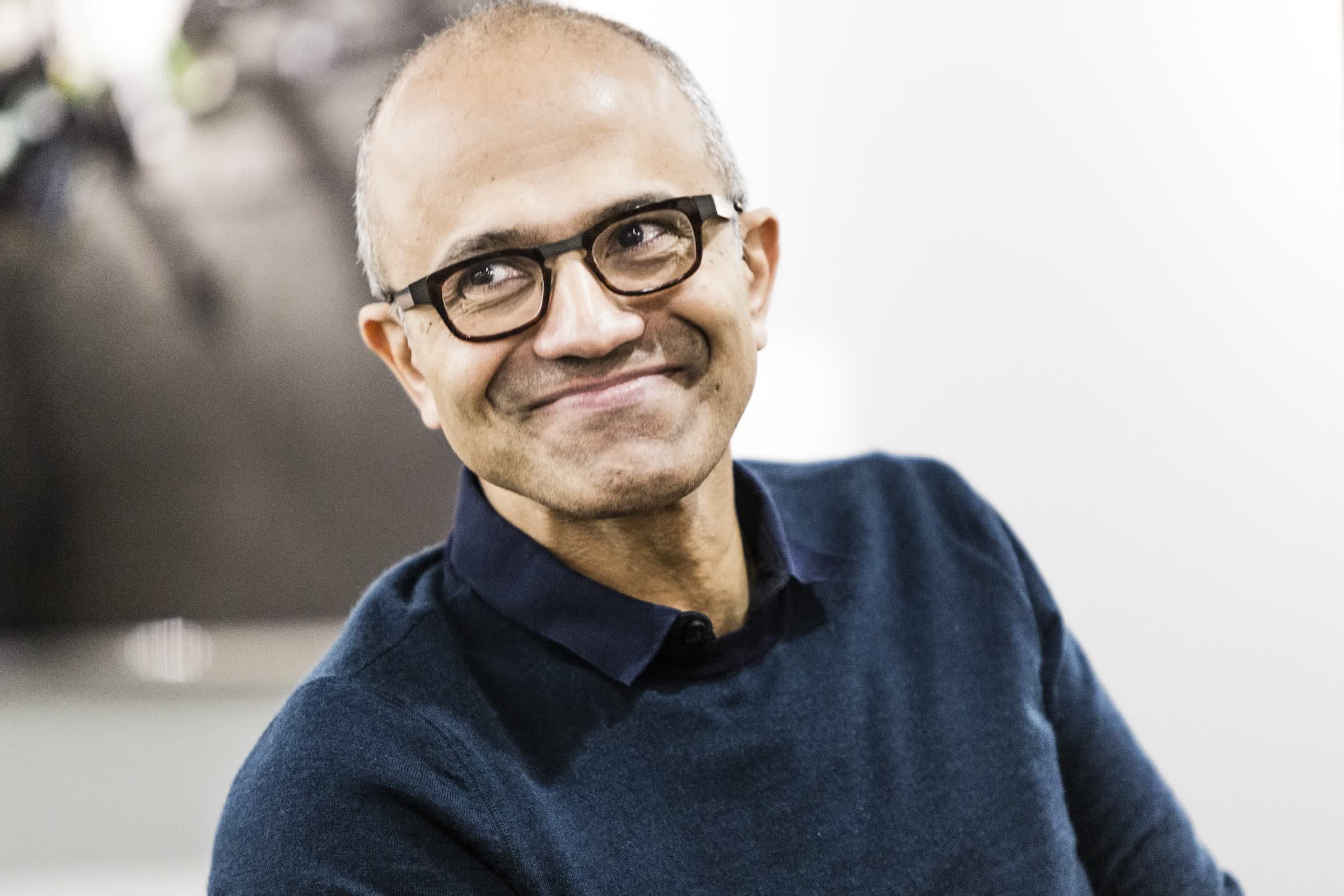
Nadella, who shared these insights on the Bg2 Pod YouTube channel, revealed that Microsoft has encountered situations in which hardware inventory exceeds what its data centers can actively support, naming electricity as the critical missing link.

The ripple effects of AI's energy demand are now visible at multiple levels. Modern data centers supporting large AI models can require as much electricity as a small city. Some hyperscalers under construction will use 20 times more power than existing sites, with individual campuses projected to need up to 2 gigawatts – a figure that rivals the total power demand of some US states.

According to recent estimates, US data centers consumed 183 terawatt-hours of electricity in 2024, equal to over 4% of total national power use, and this is expected to more than double by 2030. By 2028, AI-specific tasks alone could use as much energy as 22% of US households.

Data center operators now face increasing pressure to secure so-called warm shells – facilities equipped with the necessary utilities for immediate hardware installation. Because these sites must have adequate electricity and cooling capacity in place before new compute resources can go online, cloud providers and AI firms are often left with servers sitting idle for months as they wait for regional power constraints to be resolved.

Nadella described the issue bluntly: "[Y]ou may actually have a bunch of chips sitting in inventory that I can't plug in. In fact, that is my problem today. It's not a supply issue of chips; it's actually the fact that I don't have warm shells to plug into."

Since the resolution of the global GPU shortage, commercial operations have contributed to upticks in residential power bills, with some US states reporting increases of up to 36%. OpenAI has publicly called for federal investments in new power generation, arguing that energy has become a strategic asset in the global race for artificial intelligence. Altman and others regard China's investments in hydropower and nuclear energy as a significant advantage in scaling AI infrastructure, warning that current US capacity lags behind future requirements.

The intense power draw of AI also drives surging water demand, as many facilities rely on water-intensive or advanced liquid-cooling systems to keep servers and GPUs operating efficiently. In regions already struggling with water shortages, this has forced some data center operators to relocate projects to areas with naturally cooler climates to mitigate both environmental and cost risks.

Additionally, as data centers chase faster, more reliable energy, tech companies are moving aggressively to secure deals with utilities for priority access, resulting in overlapping projects and further strains on local grids.

Now, speculation is mounting that consumer hardware could soon run advanced AI models like GPT-5 or GPT-6 locally at very low power. Nadella and Altman suggested that as semiconductor technology improves, these low-power devices could eventually reduce the demand for ever-larger centralized data centers. That prospect has prompted questions among investors weighing the risks of multi-billion-dollar infrastructure projects against the pace of chip and device advancements.

Permalink to story:

 
Training the model is the data intensive part. Once it is made, actually running it isn't very hard. This problem has been developing for awhile and MS is far from the only one. Meta, xAI, OpenAI are likely having this problem, too.
 
Microsoft's Satya Nadella says power, not chips, is now the biggest barrier to AI growth

US is killing renewable energy projects across the US and that would delay AI growth in US... Meanwhile China has plenty of power for their AI and 10 years ahead in producing it...!
 
Yeah, and it's us citizens footing the bill for their power use. Trump killing green energy project is going to make America come in dead last. China is making Trump look like a fool.
 
Microsoft's Satya Nadella says power, not chips, is now the biggest barrier to AI growth

US is killing renewable energy projects across the US and that would delay AI growth in US... Meanwhile China has plenty of power for their AI and 10 years ahead in producing it...!
What exactly is your point? Because this reads like another brain-dead anti-US, pro-China propaganda post that collapses under its own nonsense.

China is an authoritarian surveillance state—that’s not opinion, that’s a cold, hard fact. Pretending it’s some shining model of progress is delusional at best. “Oh, but they’ve got the tech!” Yeah, whoop-de-friggin’-do. They steal OUR tech and culture because we innovate and create—with a fraction of their population—what they can’t. Like it or not, China is jealous of the USA, and it shows.

The U.S., for all its dysfunction and chaos, is still one of the freest large nations on Earth. Go ahead, trash it openly, right here, right now, without ending up in a cell. Try pulling that in Tiananmen Square.

And before you haters reach for that tired “you must love this administration” strawman quip—get bent and increase your learning comprehension. Nobody’s defending Dump Truck, or anyone in power here.

The point stands on its own: freedom beats tyranny. Period.
 
What exactly is your point? Because this reads like another brain-dead anti-US, pro-China propaganda post that collapses under its own nonsense.

China is an authoritarian surveillance state—that’s not opinion, that’s a cold, hard fact. Pretending it’s some shining model of progress is delusional at best. “Oh, but they’ve got the tech!” Yeah, whoop-de-friggin’-do. They steal OUR tech and culture because we innovate and create—with a fraction of their population—what they can’t. Like it or not, China is jealous of the USA, and it shows.

The U.S., for all its dysfunction and chaos, is still one of the freest large nations on Earth. Go ahead, trash it openly, right here, right now, without ending up in a cell. Try pulling that in Tiananmen Square.

And before you haters reach for that tired “you must love this administration” strawman quip—get bent and increase your learning comprehension. Nobody’s defending Dump Truck, or anyone in power here.

The point stands on its own: freedom beats tyranny. Period.
I mean, that's great and all, but you didnt refute his point at all. China is rolling out green energy and nuclear power in spades, as fast as they can build them, while the US is primarily putting up gas peaker plants. When was the last successful nuclear build in the US? MS got in the news for reactivating Three Mile Island, from the 60s.

Freedom is getting it's arse kicked by Tyranny, but refuses to admit it. I remember being in high school, having arguments with people on how the US "environmentalism" movement was a crock of garbage since they were blocking nuclear power at every turn, while China was reportedly rolling out dozens of them. Almost 2 decades later, nothing has changed, the US could have had a full nuclear grid by now, completely retiring fossil fuels from power generation and paving the way to cheap EV ownership.

Also LOL at all the foaming about "surveillance" when the West is rapidly pushing out Digital ID systems and keeps trying to ban VPNs, while arresting people for mean words.
 
China isn't dropping down electricity generation for useless LLM farms though. They've been modernising their population and growing manufacturing.
 
So use some of those billions to build wind and solar to power your own equipment. Begging the government to subsidize development while they roll around in piles of money is gross.
 
Microsoft's Satya Nadella says power, not chips, is now the biggest barrier to AI growth

US is killing renewable energy projects across the US and that would delay AI growth in US... Meanwhile China has plenty of power for their AI and 10 years ahead in producing it...!

Renewable is pretty much a farse. Nuclear is more sustainable. In China, they have this MASSIVE deserts that they are covering with solar. Plus, the amount of material needed to make the solar panels, batteries to store the power which need to be replaced pails in comparison to the amount of material needed to keep a nuclear reactor going. Also, solar/wind cannot run 24/7 per se. So when you need extra power, if the batteries are low, you have no extra power. With a nuclear plant, you just crank it up a notch.
 
They should allocate roughly $1 billion to a focused scientific program that engineers the quantum environment around water-splitting catalysts, enabling highly efficient electrolysis. Unlike decades-long, low-yield investments in quantum computing, this effort targets a concrete goal for a specific chemical reaction. Hydrogen is the cleanest fuel and by extracting both hydrogen and oxygen from the same water source, we maintain overall mass balance neutrality.

Although super-efficient hydrolysis may appear to conflict with the second law of thermodynamics from classical physics—since water is the combustion product of hydrogen and oxygen—the reverse process requires energy input. Therefore, a quantum-engineered water-splitting system is needed to avoid violating thermodynamics. Instead, it could dramatically reduce entropy production by lowering activation barriers and enhancing charge transfer, pushing electrolyzer efficiency from today’s ~60% to approaching 100% or even exceeding it. This is achievable only through targeted manipulation of the local quantum environment (ex coulomb barrier). The result is a strategically compelling, low-carbon solution offering clear competitive advantage and economic upside.

In short, target the hydrogen in water and throw 1 billion to fight the second law of thermodynamics(the strongest law of classical physics).
 
Last edited:
Back