
Forward-looking: A couple of upcoming mobile PCs will be among the first devices to utilize a type of SSD that condenses the performance of a typical NVMe drive into a form factor only slightly larger than a microSD card. Pricing details remain unclear, but the new SSDs could become a promising option for expanding storage on laptops and portable devices.
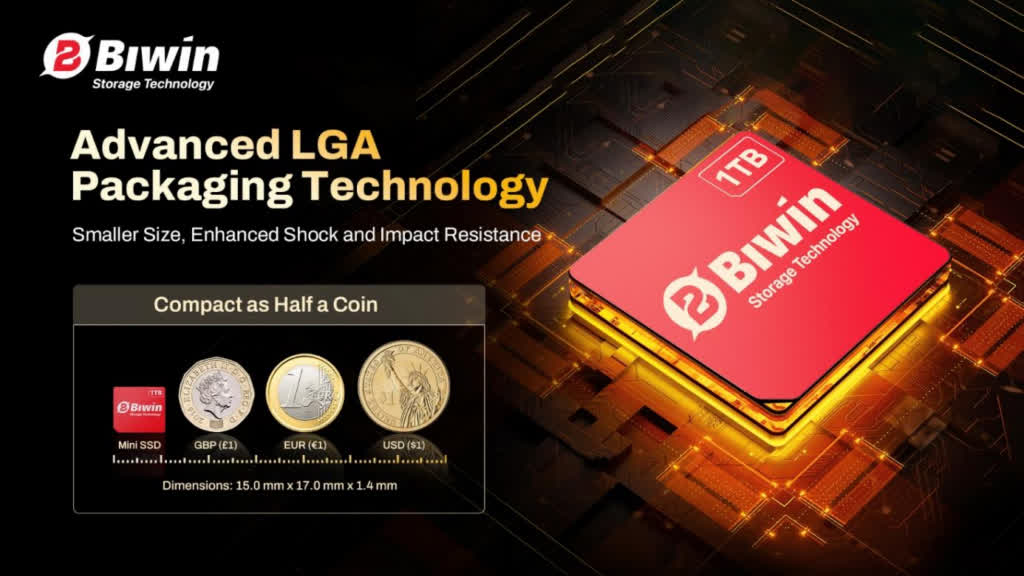
Chinese flash storage supplier Biwin, which provides SSDs for HP, Acer, and other manufacturers, initially unveiled what it dubbed mini SSDs at the Embedded World 2025 event in March. However, they appeared to receive little attention until GPD and One-Netbook announced that their upcoming portable gaming PCs would support the format.
According to The Verge, another manufacturer refers to the SSDs as "1517," referencing their dimensions: 15mm long by 17mm wide by 1.4mm tall. In comparison, most PCs utilize 2280 NVMe SSDs, which measure 22mm x 80mm, and smaller devices such as the Steam Deck support 2230 drives measuring 22mm x 30mm.
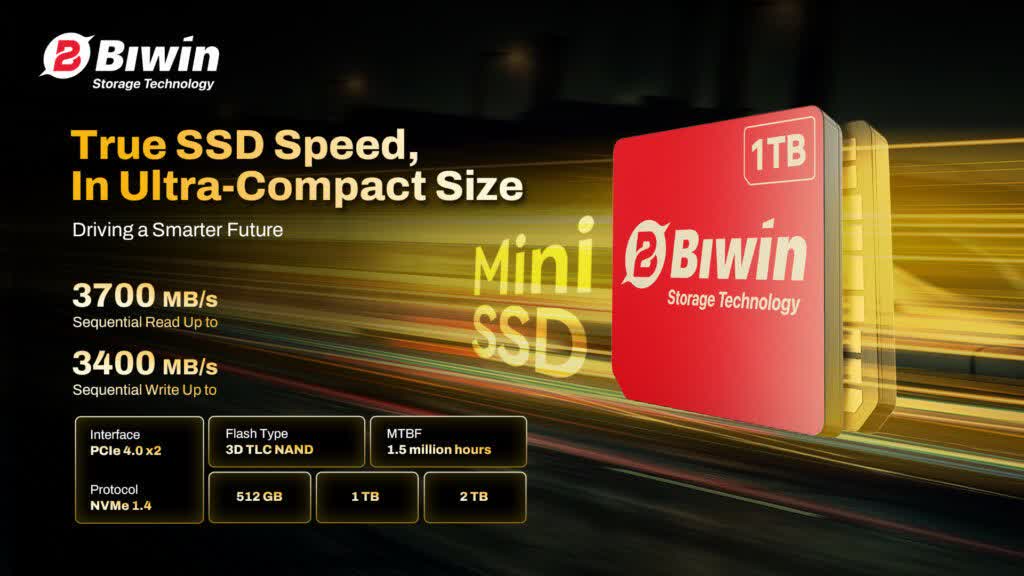
Biwin's mini SSDs can achieve read speeds of up to 3.7 GB/s and write speeds of up to 3.4 GB/s using a PCIe 4.0 interface and NVMe 1.4 protocol. Although many traditional PCIe 4.0 and 5.0 SSDs are much faster, 1517 drives are likely to still provide an experience resembling typical PCIe 3.0 and 4.0 SSDs, which are still fast enough for most tasks.
More importantly, they easily outperform 11mm by 15mm microSD cards. Standard memory cards never reach 100 MB/s read speeds, and even the more expensive microSD cards required by the Nintendo Switch 2 only achieve 900 MB/s. Furthermore, mini SSDs support storage capacities up to 2TB, while microSD cards currently only reach 1TB.
Given these specs, it's unsurprising that GPD and One-Netbook will include them in high-end mobile gaming PCs. Our analysis suggests they can likely provide quick load times in demanding titles such as Black Myth Wukong and F1 25.
One-Netbook recently unveiled the OneXPlayer Super X, which uses an AMD Ryzen AI Max+ 395 APU and a 2.8K AMOLED screen, drawing up to 120W. The tablet-style 2-in-1 is designed to achieve performance resembling current-generation game consoles.
Meanwhile, GPD's upcoming Win 5 handheld utilizes the same processor and TDP with a 1080p IPS screen and up to 128GB of RAM. The company's benchmark indicates that it outperforms the laptop RTX 4070 but employs an external battery pack.
Mini SSDs pack NVMe performance into a microSD-sized form factor


