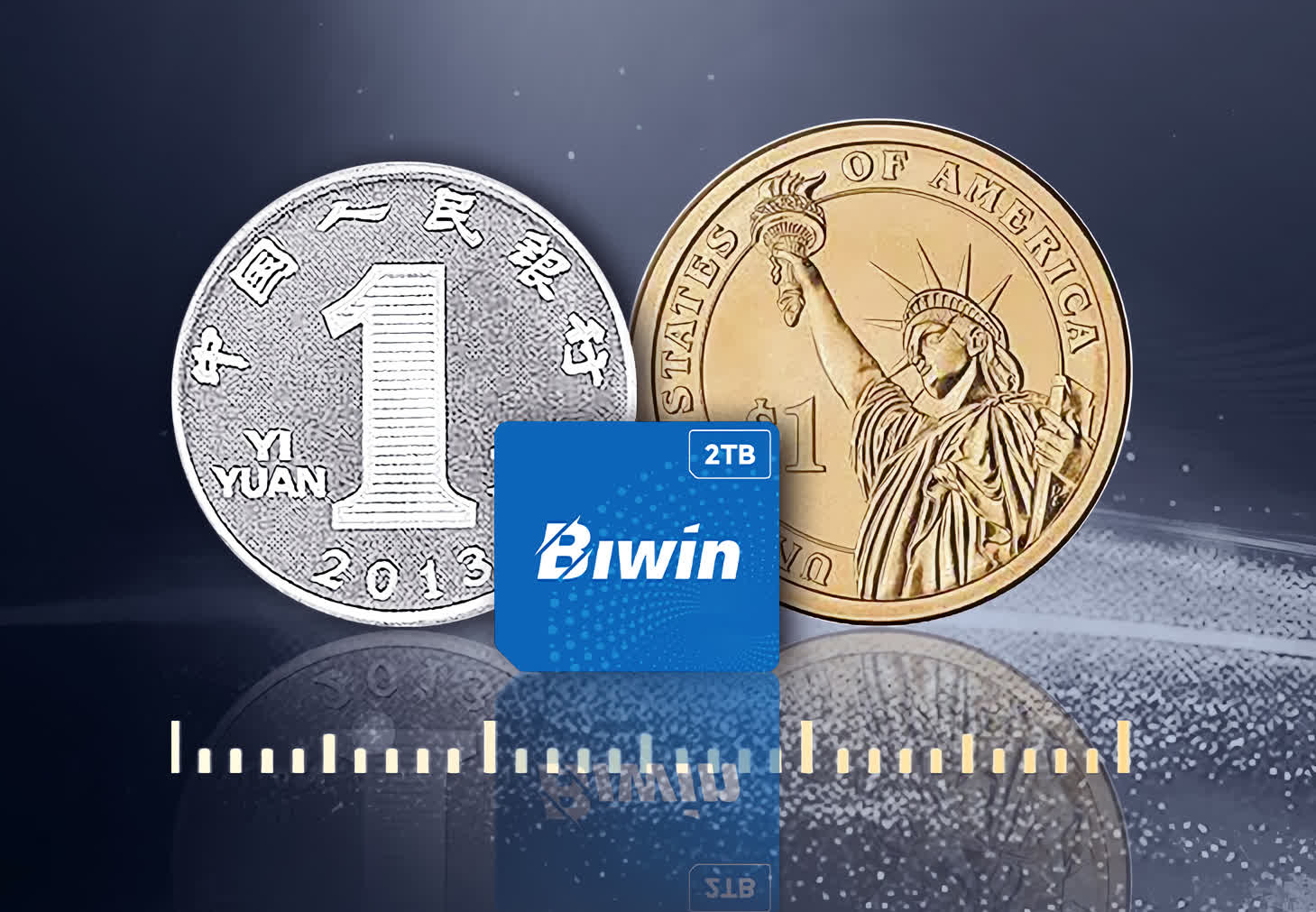
Biwin's ultra-compact 2TB SSD is smaller than the coins in your pocket

Shawn Knight

Posts: 15,818   +202
Staff member
In a nutshell: Chinese storage specialist Biwin has introduced an ultra-compact solid-state drive that's no larger than a micro SD card. The PCIe 4.0 and NVMe 1.4-equipped CL100 Mini SSD measures just 15 mm x 17 mm x 1.4 mm (about the size of a small coin), but boasts impressive read / write speeds of up to 3,700 MB/s and 3,400 MB/s, respectively. It was constructed using advanced LGA packaging technology, features an IP68 durability rating, and is offered in capacities ranging from 512 GB to 2 TB.
Biwin says the new drive leverages technologies found in other SSDs including dynamic SLC cache, garbage collection, thermal throttling, wear leveling, HMB, and S.M.A.R.T. for improved speed, durability, and efficiency. It is said to be ideal for demanding tasks like 4K video editing, AI model training, and gaming.

We first caught wind of Biwin's new 1517 form factor back in March, but it wasn't until the summer when GPD and One-Netbook announced support for the standard that it started to gain traction. Mainstream adoption is still a ways off, so in the meantime you will likely need additional hardware to make use of the new drive.
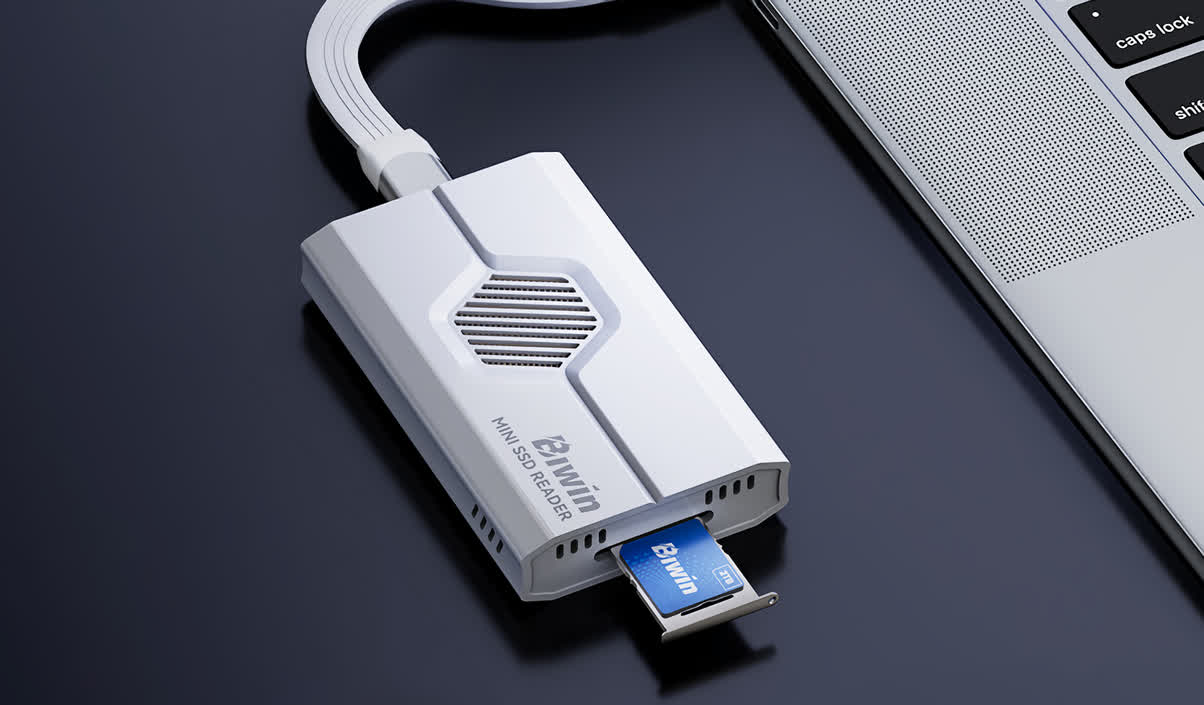
Enter the Biwin RD510 Mini SSD Reader, a plug-and-play solution that'll allow you to access the new drive on desktops, laptops, and mobile devices. The reader features a built-in cooling fan to help prevent overheating and maintain consistent, high speeds during prolonged transfers.

It is compatible with a range of operating systems and platforms including Windows 10/11, PlayStation 5, macOS 11, Android 11 and later, and iOS 17. The drive ships with a USB 4.0 Type-C to Type-C cable that supports data transfer speeds up to 40 Gbps.

The Biwin CL100 reportedly starts around $85 for the 512 GB model and scales to north of $300 for the largest 2 TB model over on JD.com. No word yet on whether or not Biwin plans to bring its new mini SSDs and card reader to regions outside of its home country.

Permalink to story:

 
Wow.. a really small drive that needs a large adapter in order to actually work… so excited /s
It's intended for use in devices instead of a micro SD card. The adapter is only to interface it with a desktop/laptop for data recovery or transfer.

But I'm sure you already knew that....
 
It's intended for use in devices instead of a micro SD card. The adapter is only to interface it with a desktop/laptop for data recovery or transfer.

But I'm sure you already knew that....
It’s in a form factor the SAME SIZE as a micro-SD… but it isn’t actually a microsd…
You need the adapter…
 
It’s in a form factor the SAME SIZE as a micro-SD… but it isn’t actually a microsd…
You need the adapter…
GPD and One-Netbook have actual products out there with it in, you don't need an adaptor if the device already supports it. There's even a picture in the article of the GPD handheld with it equipped.

This how all memory card standards started, a few devices support it, so adaptors are required everywhere else, then overtime, as more devices adopt it, less adaptors are needed.

The adaptor in this case is larger because the performance jump is probably the biggest we've ever seen for a memory card standard.
Even the latest and greatest MicroSD Express Cards top out at 600Mb/s, While this new standard is over 3000Mb/s.
 
GPD and One-Netbook have actual products out there with it in, you don't need an adaptor if the device already supports it. There's even a picture in the article of the GPD handheld with it equipped.

This how all memory card standards started, a few devices support it, so adaptors are required everywhere else, then overtime, as more devices adopt it, less adaptors are needed.

The adaptor in this case is larger because the performance jump is probably the biggest we've ever seen for a memory card standard.
Even the latest and greatest MicroSD Express Cards top out at 600Mb/s, While this new standard is over 3000Mb/s.
Yep - and I’m not excited over paying an early adopter tax - or requiring an adaptor that makes its small size useless… once its mainstream in a year or two (or more), I’ll be far more excited.
 
Back