MIT scientists develop transistor with nanosecond switching and billion-cycle durability

zohaibahd

Posts: 976   +19
Staff
In a nutshell: Back in 2021, a team from the Massachusetts Institute of Technology made waves by creating an entirely new type of ferroelectric material. Now, those same researchers have one-upped themselves by using that substance to build a transistor that utterly smokes the conventional chips powering today's gadgets – with nanosecond switching speeds and incredible durability.
The transistor's killer performance stems from the unique properties of the 2021 ferroelectric material, which is composed of razor-thin layers of boron nitride stacked parallel to each other.

The broad definition of a ferroelectric material is that it's a special crystal that can spontaneously generate positive and negative charges within itself, and these charges can be flipped by applying an electric field.

However, the new material seems to behave a bit differently. When an electric field is applied to it, the parallel layers slightly shift positions, nudging the boron and nitrogen atoms just a hair's breadth. That leads to an extreme makeover in the material's electronic properties. The researchers explain it's like pressing your hands together, then sliding one above the other.

"So the miracle is that by sliding the two layers a few angstroms, you end up with radically different electronics," lead co-author of the paper Raymond Ashoori said, putting the tiny displacement into perspective – an angstrom is just one-billionth of a meter.
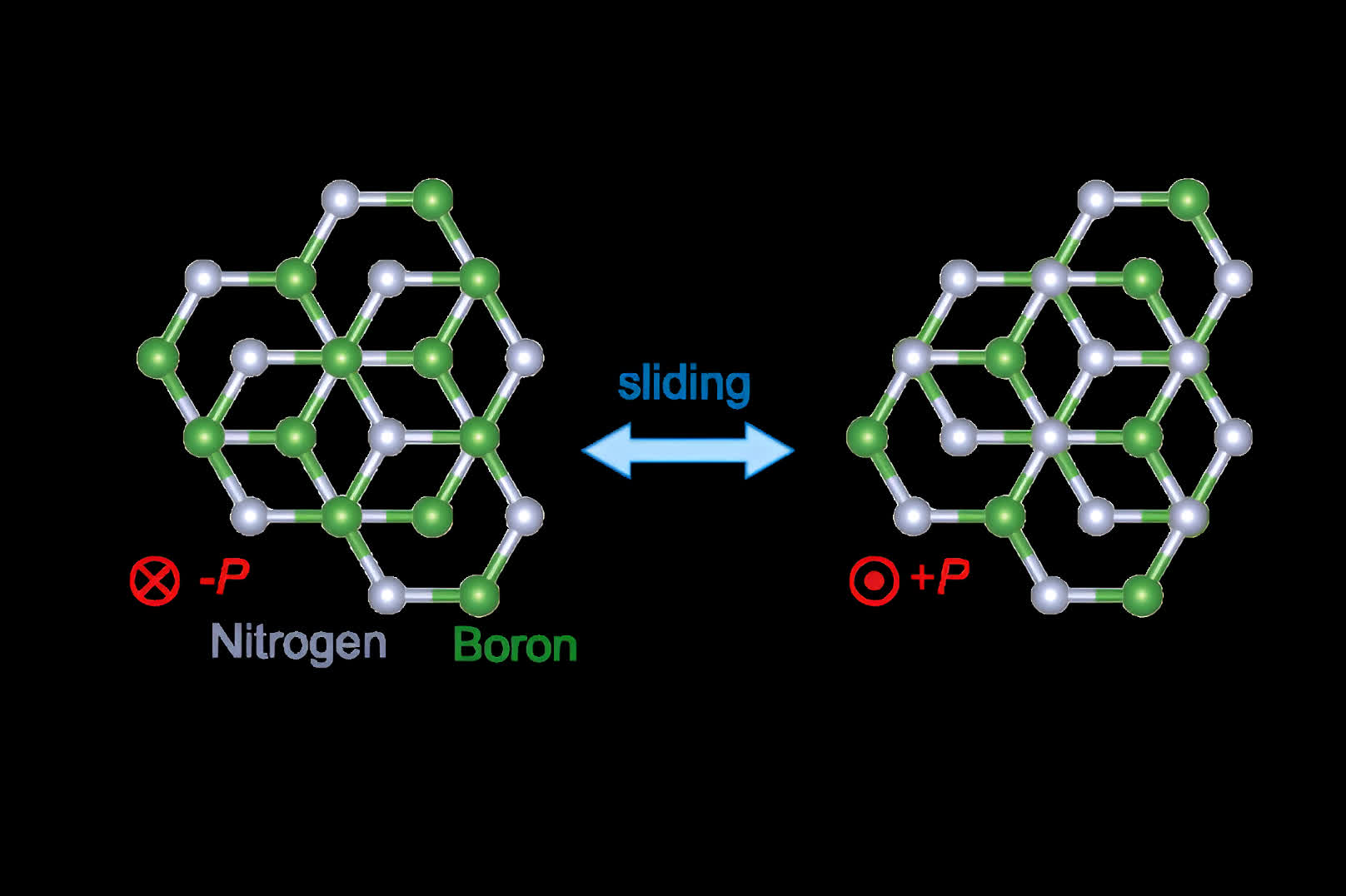
The resultant transistor exhibits several game-changing properties. For starters, it can rapidly flip between positive and negative charges (the 1s and 0s of digital data) at nanosecond speeds. Rapid switching is key for high-performance computing and data processing. Moreover, because "nothing wears out in the sliding," Ashoori notes the transistor could theoretically switch over 100 billion times without degrading. That's unlike conventional flash memory, which slowly degrades from repetitive write/erase cycles.

Since the ferroelectric material is remarkably thin (measuring just billionths of a meter), it could enable much denser computer memory storage. This characteristic also means that the transistors require lower operating voltages since the switching voltage scales with thickness, enabling more energy-efficient transistors overall.

The team has only developed a single prototype transistor in the lab so far. But according to Pablo Jarillo-Herrero, a co-lead of the research, "in several aspects, its properties already meet or exceed industry standards" for current ferroelectric transistors.

Ashoori appears to be quite enthusiastic about the breakthrough, telling MIT News, "When I think of my whole career in physics, this is the work that I think 10 to 20 years from now could change the world."

That's a bold claim, but if this transistor lives up to the massive potential they're touting, he may be onto something. The full paper can be found in a recent issue of Science.

Permalink to story:

 
It's good that they saw little wear after 100 billion cycles, though I'm concerned that isn't enough. If it can switch in a nanosecond, then it could hit 100 billion cycles in about 100 seconds. I suppose for non-volatile memory this would be okay due to relatively infrequent rewrites, but not sure about volatile memory uses. This article doesn't make it clear the type of memory use case for this transistor, and the paper is behind a paywall.

In any case, it's always fun to read about these breakthroughs. Would be neat to hear about it coming to the market, as so many technologies promise but few make it into production (or aren't widely reported on when they do).
 
It's good that they saw little wear after 100 billion cycles, though I'm concerned that isn't enough. If it can switch in a nanosecond, then it could hit 100 billion cycles in about 100 seconds. I suppose for non-volatile memory this would be okay due to relatively infrequent rewrites, but not sure about volatile memory uses. This article doesn't make it clear the type of memory use case for this transistor, and the paper is behind a paywall.


I don’t think every cycle contributes to a change in charge. If that were the case, today’s SSDs would wear out within microseconds.
 
It's good that they saw little wear after 100 billion cycles, though I'm concerned that isn't enough. If it can switch in a nanosecond, then it could hit 100 billion cycles in about 100 seconds. I suppose for non-volatile memory this would be okay due to relatively infrequent rewrites, but not sure about volatile memory uses. This article doesn't make it clear the type of memory use case for this transistor, and the paper is behind a paywall.

In any case, it's always fun to read about these breakthroughs. Would be neat to hear about it coming to the market, as so many technologies promise but few make it into production (or aren't widely reported on when they do).
The article does not mention it nor does the article on the MIT site mention it https://news.mit.edu/2024/new-trans...ould-have-broad-electronics-applications-0726 however, at least one form of boron nitride is used as a lubricant. https://en.wikipedia.org/wiki/Boron_nitride Hexagonal boron nitride, specifically. Boron nitride coated blades are using in machining other metals, and I know that Claus Co makes scissors that are boron nitride coated and are quite impressive, IMO from personal experience, in their ability to cut.

I suspect that this property contributes to the effectiveness of these transistors, and, as I see it, one has to consider that the movements are extremely small. I don't think they mention how far the layers move relative to eachother, but from the diagram in the article, I bet it is on the order of a few angstroms or a few widths of a BN molecule. Therefore, we are not talking huge distances that would be more subject to wear.
 
I don't think they mention how far the layers move relative to eachother, but from the diagram in the article, I bet it is on the order of a few angstroms or a few widths of a BN molecule. Therefore, we are not talking huge distances that would be more subject to wear.
The article does mention the distance the layers move.

"So the miracle is that by sliding the two layers a few angstroms, you end up with radically different electronics," lead co-author of the paper Raymond Ashoori said, putting the tiny displacement into perspective – an angstrom is just one-billionth of a meter.
 
An angstrom is one-TEN-billionth of a meter (0.1 nanometers).

Try to get the basic facts right in your educational article Zo.
From the article -
"So the miracle is that by sliding the two layers a few angstroms, you end up with radically different electronics," lead co-author of the paper Raymond Ashoori said, putting the tiny displacement into perspective – an angstrom is just one-billionth of a meter.
Wikipedia -
I'm not sure what you are PAMing about. The article has not been changed.
 
What bothers me most about this is that the difference between a single transistor and multiple transistors is massive. It's easy to envision two layers moving in comparison to each other, but harder to envision how different parts of the same layer might move in different directions.

It's good that they saw little wear after 100 billion cycles, though I'm concerned that isn't enough. If it can switch in a nanosecond, then it could hit 100 billion cycles in about 100 seconds.

The MIT press release said "After 100 billion switches it still worked with no signs of degradation", so I assume that 100 billion is simply the number they got to, and the transistor won't degrade even after orders of magnitude more switches.

Besides, I think that there are very few instances in which the same memory cell is written over and over.
 
From the article -
– an angstrom is just one-billionth of a meter.
Wikipedia -
I'm not sure what you are PAMing about. The article has not been changed.
Did you misread? An angstrom is ten times smaller than the article's figure. A billionth of a meter (1E-9) is a nanometer, not an angstrom.
 
That's how new inovative research is done, it might be 1 out of 1000 researches that are worth it, but we it's still valuable to our development
My comment was intended to be humorous, while also being true. Stay in their face and the checks flow more freely
 
Back