Monster Hunter Wilds recommends frame generation to reach 60fps at 1080p, requires 140 GB storage

Daniel Sims

Posts: 2,469   +74
Staff
Something to look forward to: Capcom recently confirmed that the next main entry in its Monster Hunter series will be the first to launch simultaneously on PC and consoles. However, its system requirements might set a worrying precedent for the rising prevalence of frame generation.

Pre-orders are now open for Monster Hunter Wilds. At Sony's September 2024 State of Play presentation, Capcom confirmed that the game will be available on February 28, 2025, on Steam, PlayStation 5, and Xbox Series consoles.

The company also revealed the official system requirements, which are quite demanding in some areas. Graphics card requirements initially appear modest, but Capcom's performance estimates are unusual.
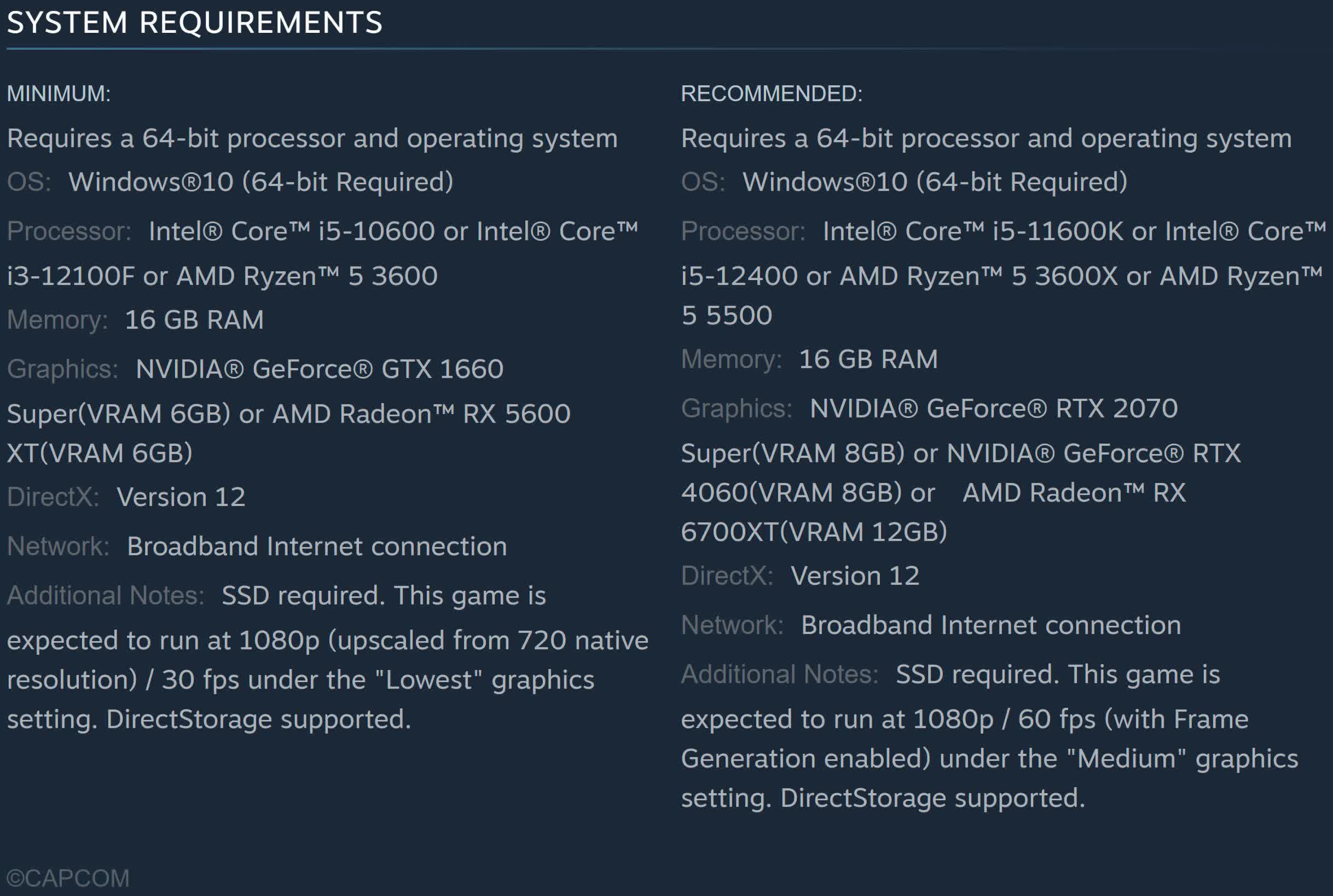
Click to enlarge

A minimum of an Nvidia GeForce GTX 1660 Super or an AMD Radeon RX 5600 XT, each with 6 GB of VRAM, is required. However, those GPUs might only achieve 30 frames per second at 1080p with the lowest graphics settings, upscaled from an internal resolution of 720p.

Meanwhile, a GeForce RTX 2070 Super, RTX 4060, or RX 6700 XT with 8 GB of VRAM might reach 60fps at 1080p with medium graphics settings, but only with frame generation enabled. Thus, the game would render 30 traditional frames and generate the other 30, which could significantly increase input lag.

Accounting for upscaling solutions like DLSS and FSR in system requirements was once considered controversial but is no longer uncommon. However, requiring frame generation for mainstream cards to achieve 1080p 60fps is unheard of, even as the feature gains popularity on PC and consoles (the PlayStation 5 version of Black Myth: Wukong requires it to reach 60fps).

Overall, the system requirements for Monster Hunter Wilds represent a slight increase over Dragon's Dogma 2, which is notoriously demanding due to its heavy reliance on ray-traced global illumination (modders even discovered a hidden path-traced renderer) and high NPC crowd density. Whether Monster Hunter Wilds features such technology remains unclear, but the game likely employs the same engine as Dragon's Dogma 2.

Other notable details include the game's 140 GB storage requirement and 16 GB system RAM minimum. However, Monster Hunter Wilds is one of a few titles that supports DirectStorage, likely enabling GPU-based decompression to shorten load times significantly. The feature debuted in early 2023 but hasn't seen widespread adoption.

Permalink to story:

 
The point of PC is to not have a crappy upscaled, laggy frame doubled, mess that I can get on a much cheaper console.

The weird thing is that consoles are basically PCs now, so making better visuals for PC is not nearly the lift it used to be.
But a lot of console games only run at 30fps in the first place so there must be a reason the devs don't design to run 60 fps or more.
 
Meanwhile green man is sitting on his yacht having a discussion with his leather jacket about how the invention of DLSS and FG are the reason this is happening.
 
Not sure if I am missing anything, but what is the point of making a game look good but 90% of gamers won’t get to enjoy it when the hardware requirements are too high? It’s counter intuitive and lacks any common sense. Generally, they try to mask mediocre game play and story with fancy graphics. In the end, they complain that sales is poor. Isn’t it expected?
 
Meanwhile green man is sitting on his yacht having a discussion with his leather jacket about how the invention of DLSS and FG are the reason this is happening.
He is more like patting himself on his back saying he did gamers a favor. I do expect more of such AI software trickery to appear with the next gen GPU. Frame gen sounds great, but the artificially generated frames is just to bump up the FPS numbers because everyone focuses on this metric to gauge performance. But the fake frames don't improve latency as compared to having real high FPS. So I suspect Nvidia is going to implement some AI feature to improve latency to complement the perception of high FPS.
 
He is more like patting himself on his back saying he did gamers a favor. I do expect more of such AI software trickery to appear with the next gen GPU. Frame gen sounds great, but the artificially generated frames is just to bump up the FPS numbers because everyone focuses on this metric to gauge performance. But the fake frames don't improve latency as compared to having real high FPS. So I suspect Nvidia is going to implement some AI feature to improve latency to complement the perception of high FPS.

He did do gamers a favor. DLSS/DLAA/DLDSR is amazing tech that replaces any other AA solution in game.

The only people screaming here, are people that can't use the features. Mostly AMD GPU owners, that hate upscaling because FSR is mediocre at best, and mostly work well for 4K/UHD. FSR is terrible at 1080p and 1440p. DLSS beats FSR with ease.

I use DLAA in every single DLSS game, which is pretty much all games released these days, and it looks far better than native ever will. Even DLSS can beat native, seen it in tons of games, all while increasing performance by 50-75% on Quality preset.

When do people realize that AMD GPUs are cheaper for a resaon? AMD loses marketshare quarter for quarter and their next launch, RDNA4, is already a failure targetting current gen mid-end, while Nvidia is prepairing to release next gen GPUs. RDNA4 will be fighting 5060 series.

Best RDNA4 SKU will deliver 7900GRE performance or close.

AMD is years behind on features, RT, PT, pretty much everything. Left high-end GPU market for a reason. No-one is splashing 800+ dollars on an AMD GPU.

AMDs best selling cards of all time, have been 200-300 dollar SKUs like RX580/570/480/470.

This was in the days of raster only.

If you buy a GPU only looking at raster performance in 2024, soon 2025, then you already failed.
 
Last edited:
If you buy a GPU only looking at raster performance in 2024, soon 2025, then you already failed.
I own one maybe two games from 2024. None from 2025 (yet) and have a library of games now sitting at one thousand nine hundread and eighty two (according to GOG galaxy - doesn't include my older disk games like Freelancer or Battlefield 2142). Supporting DLSS is not required if I can natively play at high FPS at 1440p (most games I need to limit the FPS to play properly). Why would I pay more for a GPU that supports features I do not use in most games? If you only play the latest games then yes pay that nVidia tax but don't confuse that with "winning".
 
I own one maybe two games from 2024. None from 2025 (yet) and have a library of games now sitting at one thousand nine hundread and eighty two (according to GOG galaxy - doesn't include my older disk games like Freelancer or Battlefield 2142). Supporting DLSS is not required if I can natively play at high FPS at 1440p (most games I need to limit the FPS to play properly). Why would I pay more for a GPU that supports features I do not use in most games? If you only play the latest games then yes pay that nVidia tax but don't confuse that with "winning".

I don't think you are in the target group then! If you play old games, then old hardware will do just fine, most of the time.

DLSS and DLAA has been amazing for me personally and Frame Gen is very awesome too. Unless fps is low to begin with!

If AMD keeps underdelivering, where do you think they are heading? I build PCs for friends, family and customers, barely anyone wants an AMD GPU at this point! Even if they can save some money, it is a big no thanks!

At this rate, AMD will be fighting with Intel over low-end GPU market in a few years and we need competition so personally I hope AMD is able to improve their upscaling, downsampling and frame gen! The future of gaming. Developers already embraced it. You might hate it but does not change this.
 
Last edited:
For proper framegen both Nvidia and AMD suggest 60fps native. But like I suspected developers - especially lazy Asian PC port developers will use it a crutch. I play one game where my native fps is at 60 and with framegen it's around 90. It's smoother but even with Nvidia Reflex activated the input delay is noticeable. I cant imagine what a mess 30fps native to 60fps FG is. It might not even reach 60 because FG does not double you framerate.
 
Hate all you want, but you all know you only hate them because you're jealous of not having them. If you have the tech that can do Frame Generation than you're happier than a pig in mud, because it is easily the best tech to come to gaming in the history of gaming, with DLSS second.

***Also, there is zero perceivable input lag, this is all just jargon the whiners are spouting that have no valid backing, they just wanna hate to hate, just like everyone blindly hates everything things days, it's pathetic.
 
Hate all you want, but you all know you only hate them because you're jealous of not having them. If you have the tech that can do Frame Generation than you're happier than a pig in mud, because it is easily the best tech to come to gaming in the history of gaming, with DLSS second.

***Also, there is zero perceivable input lag, this is all just jargon the whiners are spouting that have no valid backing, they just wanna hate to hate, just like everyone blindly hates everything things days, it's pathetic.

True. DLSS FG works just as well as DLSS, if your fps is 60 fps to begin with, the smoothness will go up massively, not down.

I use 1440p 360 Hz and I use DLSS FG to go from 100-200 fps in AAA games, to 250-300+ and believe me, input lag is not a problem, smoothness goes up for sure.
If it was bad, I would simply not be using it.

People will always deny that features like this work, when they can't use them. It is in the human nature. People called DLSS fake frames as well in the beginning, haha.

People who ramble about input lag, smearing etc, must have been trying AMD FG or Loseless Scaling. This is simple frame interpolation like TVs do and you will feel the input lag here.

AMDs AFMF is down-right horrible. FG in all games but it look and feels terrible.

AMDs FSR FG is better than AFMF for sure but DLSS FG is clearly better and there's tons of comparisons claiming Nvidia the winner too.

Just like DLSS/DLAA beats FSR with ease in all games as well.
 
AMDs AFMF is down-right horrible. FG in all games but it look and feels terrible.

AMDs FSR FG is better than AFMF for sure but DLSS FG is clearly better and there's tons of comparisons claiming Nvidia the winner too.

Just like DLSS/DLAA beats FSR with ease in all games as well.
DLSS 1.0 was pretty bad - hence the initial reluctance to recommend it. AMD are a generation behind on RT and probably 2 gen behind on upscaling. So compared to a 4000 series card AMD's tech stack offerings look poor. Compared to the original 2000 series (and some 3000 series) cards they hold up a lot better (and give better raster and VRAM for the money). There will be a point AMD catch up (Sony are betting on the PS5 Pro being that time) and then what will nVidia be offering (given AMD will be using open standards)? FSR offers longevity for old gpus including 10 series GTX cards and hence keeps PC gaming availble for more people - this is a good thing. So enjoy the top table for awhile but the seats are expensive and you'll need more and more cash to stay there. The majority of gamers will be squeezing value out of the GPUs they can afford and enjoying it (under volting and over clocking to eke out every extra frame),
 
Back