MSI shows off "true AI" MPG 271QR QD-OLED X50 monitor with real-time human ID

Alfonso Maruccia

Posts: 2,511   +934
Staff
Editor's take: Artificial intelligence is making its way into every corner of PC hardware, and MSI clearly believes gamers can't wait to pay for it. The company is adding even more AI-powered features to a new OLED monitor, because nothing says "premium gaming experience" like more buzzwords and a bigger price tag.

MSI recently unveiled the MPG 271QR QD-OLED X50, the first model in its new lineup of "AI-powered" QD-OLED monitors. Part of the premium MPG series, the 27-inch "2K" display is also the first to integrate real-time human detection using on-device artificial intelligence models.

The company's marketing team packed every bit of AI hype and premium branding into its new gaming monitor. The MPG series is aimed at customers chasing cutting-edge tech, "strong" performance, and sleek designs with vibrant colors. Basic specs of the MPG 271QR include a 2560x1440 (WQHD) QD-OLED panel, a 500Hz refresh rate, a 0.03ms GtG response time, and a DisplayPort 2.1a connection.

Users can shrink the display to 24.5 inches, and still retain the monitor's 500Hz refresh rate, a feature MSI calls a "competitive advantage" in esports. The monitor boasts VESA ClearMR 21000 and DisplayHDR True Black 500 certifications, providing rich colors and deep blacks with minimal motion blur artifacts.

The monitor's many AI features are part of MSI's OLED Care 3.0, a suite of tools designed to "enhance" its displays with artificial intelligence. The software package includes the AI Care Sensor, an NPU-based system that detects nearby humans by capturing images every 0.2 seconds through an integrated, always-on CMOS sensor.

The company markets AI Care as a "proactive safeguard" for customers' investment rather than just another flashy "smart" feature. The system can automatically power the display down when no user is detected, reducing energy use and lowering burn-in risk. OLED Care also includes the "intelligent" Panel Protect, which MSI says keeps the monitor ready for action without interruptions.
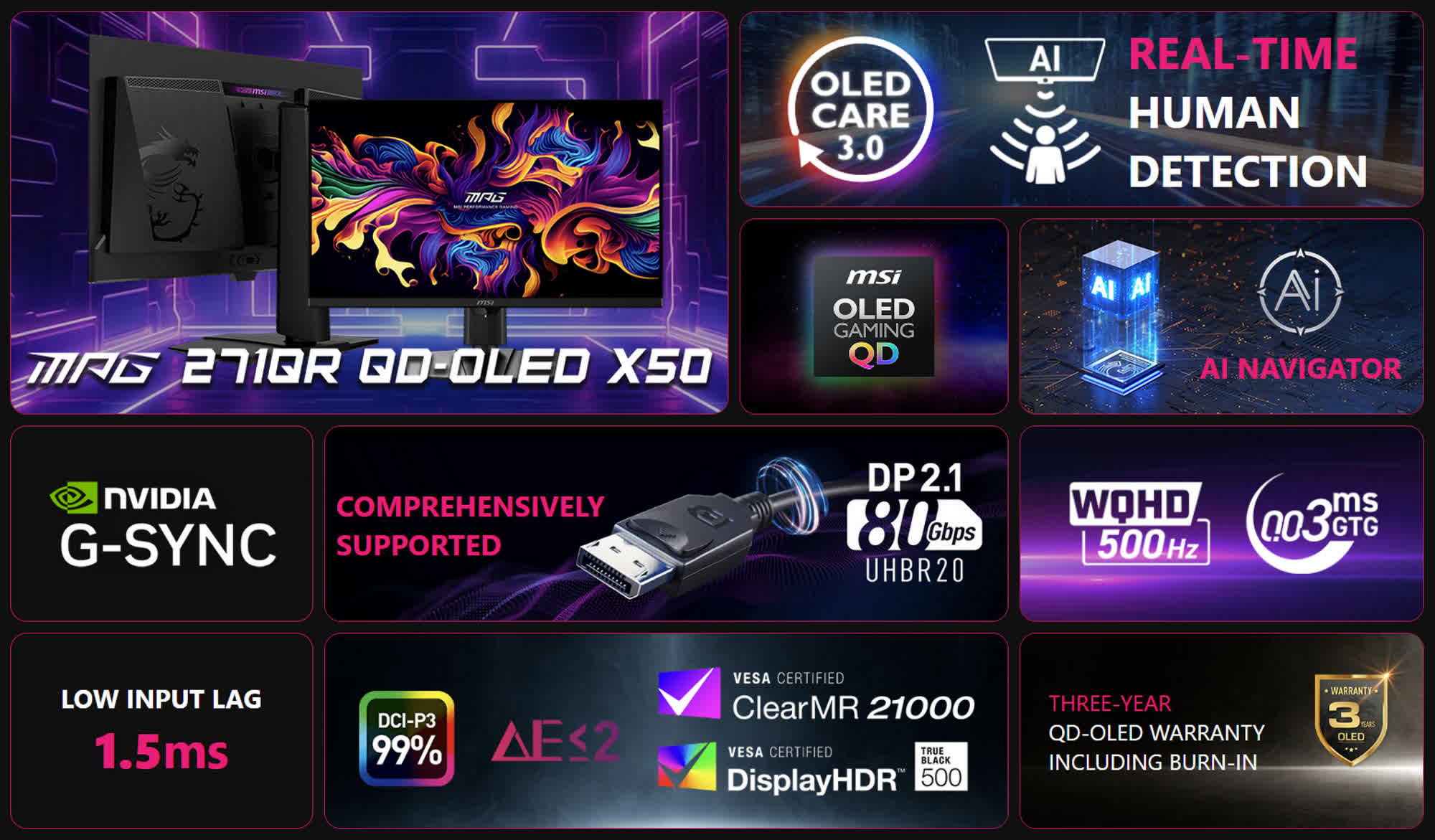
MSI claims OLED Care 3.0 takes a privacy-first approach. The AI Care Sensor processes everything on-device, so users' faces shouldn't leave the monitor or be stored online.

"Gamers can enjoy the full benefits of this intelligent technology with absolute peace of mind," the company promises.

As part of the premium MPG series, the MPG 271QR QD-OLED X50 will likely come with a "premium" price. However, MSI has yet to provide any details on the display's cost or availability.

Permalink to story:

 
1920x1080 is 1080p.

2560x1440 and 2560x1600 had colloquially been known as "2k" for as long as they have existed.
They have not, 2K is 2048 x anything. 1K in screen res is 1024. 2560 is 2.5K literally and has always been known as that if not called by their correct names of QHD and WQXGA. 2560x1440 is call quad HD as HD is 720 x 480 and QHD is 4x as many pixels in each direction.
 
Was there actually real market research suggesting customers wanted an "AI" monitor with always-on surveillance snapping candids every 0.2 seconds?!?

Or even take away the exaggerated AI BS and just call it the "monitor turns itself when you're not in front of it" feature - which to me sounds better the dumber it is - but I still think few if any gamers want their monitor to go black when they reach over for a beverage.

I am actively repelled by everyone of these features that just sound like opportunities for bugs and things to go wrong with no possible actual upside in being a better monitor.
 
1920x1080 is about 2k in width, which is how that nomenclature works. 1440p is not.
Not sure if there's maybe one specific niche industry like digital projection that calls that resolution "2K" or something, but I feel like my lifetime score of references to either 1920x1080 panels, or signals/encodings, has has been 100% "1080p" and 0% "2K".

To double check this, I just searched amazon for a "2K monitor". What came up was a list of 1440p panels, not 1080p.
 
1920x1080 is 1080p.

2560x1440 and 2560x1600 had colloquially been known as "2k" for as long as they have existed.
Not true young one.

Those existed long before 4K became a marketing term coined by people with little tech understanding.
Then later 2.6K became a thing for these resolutions.
Then after that lazy people referred to that as 2K.

Technology goes back farther than when you started paying attention to it.
 
Not sure if there's maybe one specific niche industry like digital projection that calls that resolution "2K" or something, but I feel like my lifetime score of references to either 1920x1080 panels, or signals/encodings, has has been 100% "1080p" and 0% "2K".

To double check this, I just searched amazon for a "2K monitor". What came up was a list of 1440p panels, not 1080p.
It's about 2000px wide.
 
So now they are calling a proximity sensor AI, fantastic...
Also don't understand the push for refresh rate, I've seen videos before where at 240 hz pro players were starting to not notice the difference in blind tests, never mind normal people, so why would you ever need 500hz, seems like we are getting a "big number is better" refresh rate race purely out of marketing and money reasons
 
So now they are calling a proximity sensor AI, fantastic...
Also don't understand the push for refresh rate, I've seen videos before where at 240 hz pro players were starting to not notice the difference in blind tests, never mind normal people, so why would you ever need 500hz, seems like we are getting a "big number is better" refresh rate race purely out of marketing and money reasons
Tests show practical gains in gaming performance even if it isn't consciously recognizable to "pros."

Framegen needs an outlet for its stupid numbers.
 
Not sure if there's maybe one specific niche industry like digital projection that calls that resolution "2K" or something, but I feel like my lifetime score of references to either 1920x1080 panels, or signals/encodings, has has been 100% "1080p" and 0% "2K".

To double check this, I just searched amazon for a "2K monitor". What came up was a list of 1440p panels, not 1080p.
I think there's a lot of cross-over between industries which is causing the confusion here.

Back in the day of analogue TV things were generally known by the number of horizontal scan lines eg. 576i or 486i. Then we moved to digital TV and along came 576p, 480p and 1080p - still refering to horizontal lines, with the added marketing name of Full HD (FHD) for 1080p.

Then we move into computer screens where things chop and change. Some are named after the horizontal resolution, some are named after vertical resolution, and some are given names for specific vertical by horizontal resolutions.

Throw in CCTV, film and camera standards also, and it's no wonder people get confused.
 
Tests show practical gains in gaming performance even if it isn't consciously recognizable to "pros."

Framegen needs an outlet for its stupid numbers.
Interesting, you got a source on that? (not doubting what you say, just curious as its been a while since I've dabbled in any tests or research on it)
 
Back