Nearly half of young Norwegians are fine with piracy to save money, survey shows

Daniel Sims

Posts: 2,469   +74
Staff
Cutting corners: Depending on who you ask, digital piracy has been a topic of controversy, partly due to the ambiguity surrounding its legality compared to physical theft or counterfeiting. A recent Norwegian government survey highlights that acceptance of piracy varies significantly across age groups. Unsurprisingly, younger respondents were the least opposed to piracy, often citing high costs as their primary justification.

A recent survey reveals that nearly half of Norwegians under age 30 have no qualms about streaming or downloading movies, music, or TV shows from unofficial sources. Slight less than half admit to having pirated digital media.

Conducted by Ipsos and published by the Norwegian government, the survey questioned 1,411 participants aged 15 and older about their attitudes toward digital piracy and counterfeit physical goods. As expected, these practices are less popular among older age groups. However, about one-third of all respondents expressed some level of acceptance toward piracy and buying knock-off goods.
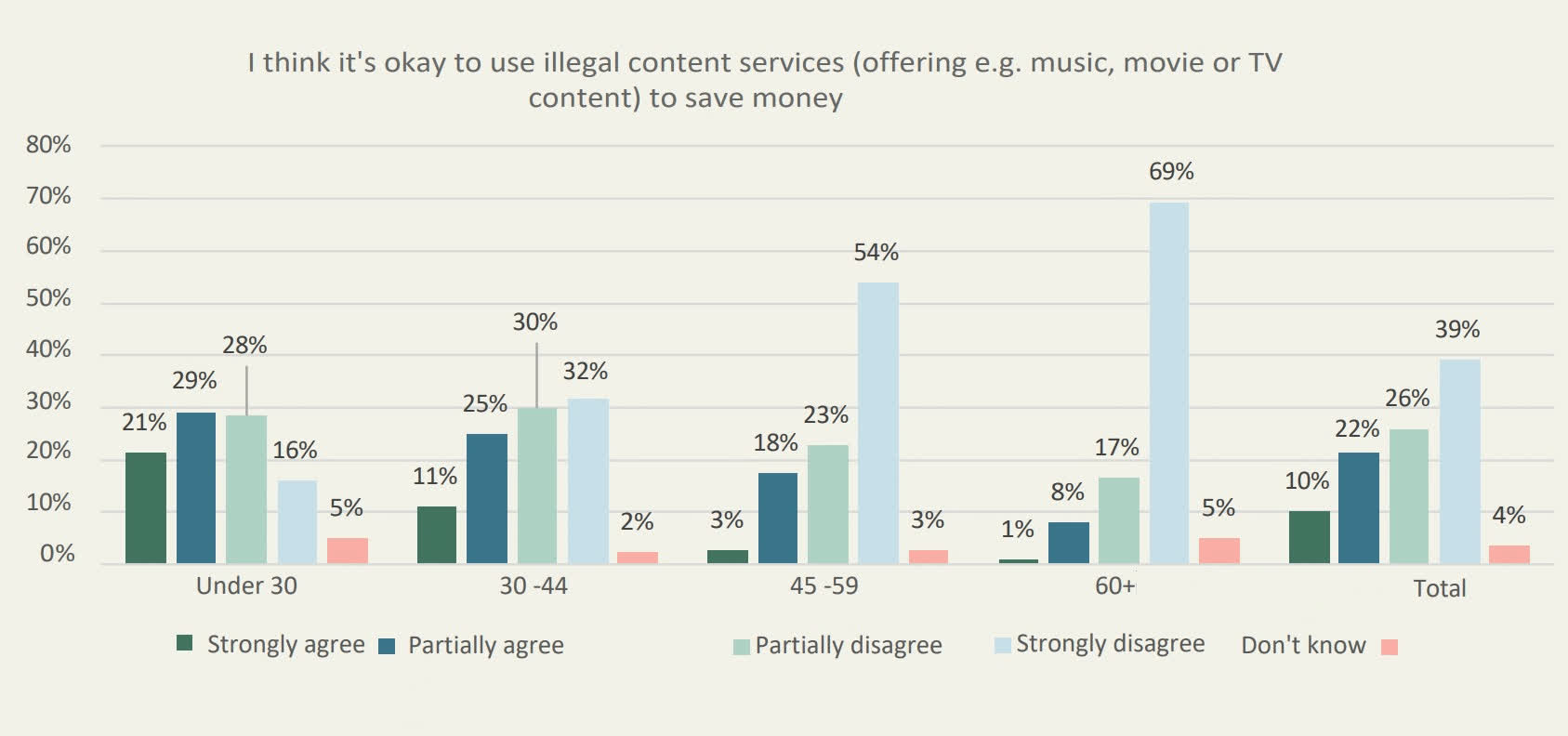
Translation by TorrentFreak, click to enlarge

The survey found that 21 percent of participants under 30 strongly agreed that accessing movies, music, or TV shows from illegal sources is acceptable when official channels are too expensive.

Another 29 percent partially agreed. Among respondents aged 30 to 44, the proportion who strongly or partially agreed only dropped slightly, to around 40 percent. In contrast, more than half of participants over 45 strongly disagreed with this stance.

Interestingly, respondents across all age groups were less concerned about pirating content that is unavailable through legal channels. Nearly two-thirds of those under 30, along with 46.6 percent of all respondents, deemed it acceptable in such cases.

Copyright holders frequently argue that piracy harms media industries and potentially affects jobs. Surprisingly, 71.2 percent of survey participants either fully or partially agreed with this assertion, suggesting that many consumers justify piracy despite acknowledging its potential harm.
While at least half of respondents from all age groups reported paying for legal streaming services, 44 percent of those under 30 admitted to knowingly or unknowingly accessing media from illegal sources. Among those who engaged in piracy, 40.6 percent said they would switch to official platforms if prices were more affordable.

Unfortunately for consumers, streaming companies are trending in the opposite direction. Netflix, Disney+, and YouTube Premium have all announced price hikes this year. Meanwhile, Amazon Prime Video (which is paid to begin with) recently introduced ads, launched a pricier ad-free subscription option, and plans to increase the number of ad slots next year.

Survey respondents were slightly less accepting of purchasing counterfeit physical items.

Among those under 30, 48.7 percent found it acceptable to buy knock-offs when authentic goods were too expensive. However, only 8.2 percent admitted to knowingly purchasing counterfeit products. The most commonly purchased counterfeit items were clothing, sunglasses, and electronics, in that order.

Permalink to story:

 
The concept of copyright emerged in the 17th century with the Statute of Anne in 1710 and was further developed through the Berne Convention in 1886. This system arose in response to authors' concerns during a time when the global population numbered around 500-600 million and technology consisted of manually operated printing presses capable of producing approximately 200 pages per day. At that time, it was impossible to predict the challenges that restricting free access to information would pose.

Over time, this concept has evolved and is now recognized as copyright law. However, copyright goes against the fundamental human right to free access to information and lacks the capacity to accommodate a population of 10 billion, along with computers and AI that generate content at a rate of many petabytes per day. This system was designed for a population of half a billion and a printing machine with a speed of 200 pages per day. Even then, it only protected mechanical rights (copies, printings, books) and not abstract rights related to ideas.

Similarly, patents can hinder progress. For instance, if Google had patented the paper on the transformer, AI would be illegal for everyone. No AI for anyone ever, just because of a patent. Another example is Boeing's patent for one part of its airplane turbines, which is necessary for a rotary combustion engine in cars that has lower fuel consumption, lower pollution, higher torque, and higher power. However, we cannot build it due to the patent and the entire world suffers from pollution as a result. There are many hidden situations like that where a patent doesn't allow a different path of innovation and technology to emerge.

Copyrights and patents suppress human rights to free access to information and the ability to work. Specifically, software doesn't need copyright because it is compiled to binary code. They should implement protection mechanisms inside the software instead. There is no need for legal protection; software can protect itself.
 
If high income, people use expensive tools for no cost, that gives them even more advantage compare to low incomes, so low income finds way to keep their job by lower their salaries and use also no cost tools and the circle continues.
 
Most people I know will pay for a product that is fairly priced and good quality.
And they will pirate everything else.

With the way prices are going up everywhere else, this is one of the easiest cost savers for the very limited amount of free time people still have left.
 
I don't understand the need for pirates to justify why they are pirating. Just fkn do it and shut up. I pirate all the time, and I don't try to convince myself and others that I'm somehow doing a good thing. Companies are trying to extract as much money from me, and I'm trying to ideally give them nothing, it's a never ending cycle.
 
Most people I know will pay for a product that is fairly priced and good quality.
And they will pirate everything else.
The pricing of digital media seems to be set in a fantasy world these days. The top recommendation in the TS article "Games you should be playing" costs £40 to download! An ebook "box set" of the Murderbot Diaries (a guilty pleasure) is priced on Amazon at nearly £40 which is insane. If you want to watch current (in cinema) movies on Amazon then the price seems a little better. I even saw an offer for 2 Odeon tickets (real movie) tickets for £10 which actually seemed well worth the money until I remembered that the wife and I don't like the same movies - can anyone recommend a SciFi period drama preferably with a few car chases?
 
Perhaps on the rare occasion pursuing the right course demands an act of piracy, piracy itself can be the right course?" Weatherby Swann -Curse of the Black Pearl.
 
I will continue to pirate.. and also purchase content, as is my want for the last 40 or so years. I'd say I would be doing much more of the later, rather than the former as I get older, however I don't think I will ever kick the habit.

They've been trying to stop piracy for at least the last 50 years (maybe longer?), and they haven't succeeded yet, so it's a humorous battle.
 
The price of media is insane and unrealistic for a product that can be copy and paste for free. Digital copies costing the same as physical copies is insane and they managed to increase price after that.

When I have to choose between food/housing and media, I'm choosing the former. Most content these days is a waste of time on top of a waste of money.

Only time I really pay for something these days is when it offers something more than just the content. Like for me, buying games on steam gives me a way to streamline linux gaming and help fund it. That, to me, is value.
 
The pricing of digital media seems to be set in a fantasy world these days. The top recommendation in the TS article "Games you should be playing" costs £40 to download! An ebook "box set" of the Murderbot Diaries (a guilty pleasure) is priced on Amazon at nearly £40 which is insane. If you want to watch current (in cinema) movies on Amazon then the price seems a little better. I even saw an offer for 2 Odeon tickets (real movie) tickets for £10 which actually seemed well worth the money until I remembered that the wife and I don't like the same movies - can anyone recommend a SciFi period drama preferably with a few car chases?

While prices have soared on a lot of things, gaming remains one of the best most resilant pieces against inflation. Games are actually cheaper now than they have ever been when compared to inflation. We were paying $70 for SNES games and N64 games. Even NES would hit 50-60. New games now days cost even less than that if they are not AAA.

When people complain about game prices I always head scratch because its the one thing that hasnt gone up in price with inflation. And with millions of indie developers and other companies launching $10-30 games, its cheaper than its ever been. You couldnt buy any nes, snes games back in the day for 10-30 bucks.

Those games back in the early 2000s and 90s costing $40-70 would be well over $100 now days when adjusted with inflation. Rarely are games selling for over $100 unless special collections with either physical bonus's, live service games, years of seasons pass or extra digital content.
 
As a Norwegian I can say this is strongly connected to the price of watching Premier League - the tv broadcaster that won the rights to stream those matches paid way too much for it - so the prices are outrageous (50+ dollars a month)
I'm jealous. Just one UFC fight is $80.
 
While prices have soared on a lot of things, gaming remains one of the best most resilant pieces against inflation. Games are actually cheaper now than they have ever been when compared to inflation. We were paying $70 for SNES games and N64 games. Even NES would hit 50-60. New games now days cost even less than that if they are not AAA.

When people complain about game prices I always head scratch because its the one thing that hasnt gone up in price with inflation. And with millions of indie developers and other companies launching $10-30 games, its cheaper than its ever been. You couldnt buy any nes, snes games back in the day for 10-30 bucks.

Those games back in the early 2000s and 90s costing $40-70 would be well over $100 now days when adjusted with inflation. Rarely are games selling for over $100 unless special collections with either physical bonus's, live service games, years of seasons pass or extra digital content.
I can understand your point if you find a game that totally suits you. For me, games like GTA3, the first Unreal Tournament, Titan Fall 2 and BL2 fell into this category and the fun I got from playing them more than made up for the purchase price.

The problem for me is that most games aren't like that for me and many seem just a waste of money and disk space. That doesn't mean I'll stop buying games but it does mean I'll wait till they're on sale at a more reasonable price.
 
As a Norwegian I can say this is strongly connected to the price of watching Premier League - the tv broadcaster that won the rights to stream those matches paid way too much for it - so the prices are outrageous (50+ dollars a month)
Stateside, they're giving it away in existing streaming services.
 
Counterfeit products intentionally take advantage of the consumer. The point of counterfeiting isn't to sell the product at a lower price. It's to sell it at the same price as the real product, but it's actually a lower quality item that tries to deceive the consumer into thinking it's not. It also might harm the reputation of the original brand because people believe it is made by them and it's actually lower quality. A knock-off product is not the same thing as counterfeit, where the knock-off is a cheaper version sold at a lower price and doesn't use the company branding. Knock-off products are not illegal, but counterfeit is. Nobody in their right mind would intentionally buy counterfeit products because you're paying full price for a scam product.
 
Piracy, gray market, black market I view as a legitimate part of the free market. When the markets get mispriced, especially using monopolies or digital controls, then market forces shift to piracy et al until market prices come back down. They'll always be some piracy et al just like they'll always be some inflation. It's necessary for the market to work efficiently. Illegal? Not likely, usually just maybe at odds with the online license agreement that you didn't read, wouldn't of understood, and can't modify even though the company can. Piracy et al balances these legal but unethical practices.
 
Back