How often do you upgrade your PC?

Julio Franco

Posts: 9,302   +2,234
Staff member

Is it me, or did PC gaming used to move faster? In the late 1990s and early 2000s, a graphics card could feel outdated within a year, and major platform jumps arrived so often that upgrading became part of the hobby. Today, things are different.

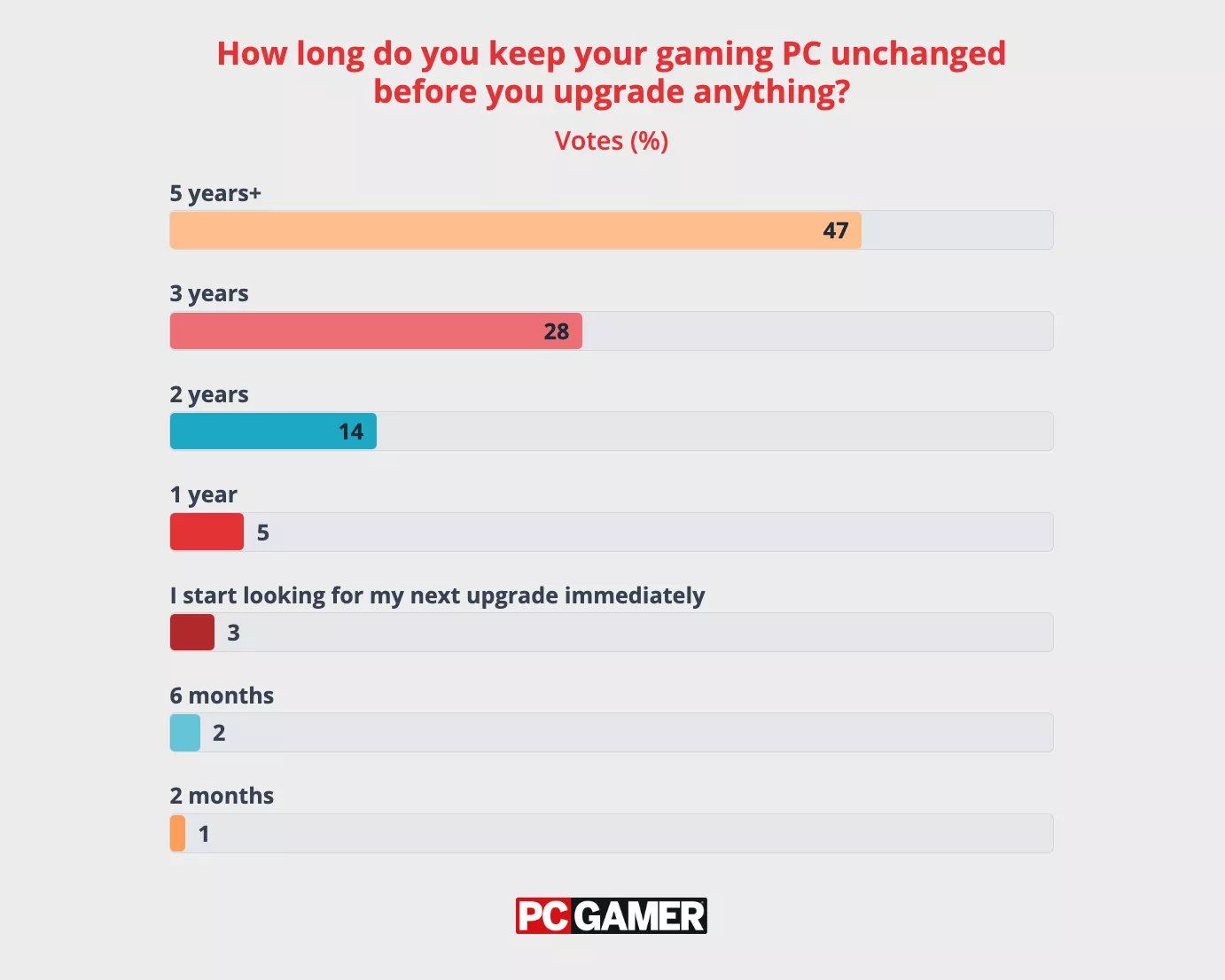
According to a recent PC Gamer reader survey, 47% of respondents said they wait at least five years before upgrading their PCs, while only a tiny minority start thinking about the next upgrade almost immediately after finishing a build.
That shift makes sense. You could argue modern CPUs and GPUs "last longer" than they used to, or at least that many gamers are still perfectly happy running hardware from several generations ago because it's good enough for most tasks and games. Rising component prices have also changed the equation. GPUs have become significantly more expensive, and more recently RAM and SSDs have given in to ongoing supply issues tied to AI infrastructure demand, making full-system upgrades harder to justify.

At the same time, enthusiast culture is very much alive, it has just evolved. Some users upgrade GPUs every generation but keep the same platform for nearly a decade. Others hold onto a desktop forever but replace laptops every few years. And then there are the tweakers who upgrade one part at a time until the original PC no longer technically exists.

So here's this weekend's question: what's your usual upgrade cycle these days? Do you replace GPUs every few years and stretch CPUs longer? Wait for major platform shifts like new sockets or DDR generations? Or are you the type who still gets the itch to upgrade the moment new hardware is announced?

Permalink to story:

 
I tend to alternate gpu and cpu upgrades every 2 years. But when intel stagnated on cpus I stopped that side and just did GPUs. There isn’t much gain to be had there either unless you jump to a 90 class. So I’m waiting until is see an improvement that matches the dollars I’m spending. It’s looking like one or the other every 4 years, if necessary. Currently on a 5800x3d (mb purchased in 2020) and a rtx 4080 (late 2023).
 
I buy a new computer roughly every ten years.
This previous Black Friday 2025, I bought a 285k/5090/64GB DDR5/8 TB SSD for just $4999.

Prices exploded a week later and I doubt they're coming down any time soon.

I won't buy another PC till 2036 or so. I will not upgrade to the 6090 or 7090. Instead I'll just reinvest into more stock.
 
I really got into PC two decades ago. Since then, I'm an addict for upgrading. Except for an 18month period when I was very broke, every time there is a new CPU or GPU that gives me more performance, or something new to overclock or tinker with, I'll get it. Sometimes I'll upgrade memory with a new kit, for the same reason. I've easily spent six figures on computer parts over those two decades.

Now that process node progress has slowed considerably, I'm quite sad as these upgrades are now very far apart and the uplift in performance is decreasing. I miss the days of yearly GPU releases. Getting one card, OCing the ever loving hell out of it, then getting a second for crossfire, doing the same to it, then doing it all over again. It was awesome.

I know the incredibly privileged place I'm in to be able to do these things. At least my friend group is always getting cheap hand me down parts.
 
Because of these video game webpages, Youtube channels, FOMO and access to credit cards, there are a lot of young men burning through money trying to keep up with the latest upgrades. One is my cousin.

If he'd invested in Nvidia, Micron, Microsoft, and Google like I'd told him too instead of constantly rebuilding his computer, he'd have huge gains and could just sell some stock to buy his upgrades. But he doesn't think like that.

I'm totally fine witrh prebuilt off-the-shelf desktops because they go on sale. My AAT2250 started around $6000, dropped to $4799 and now it's back up above $6000 because of the price chaos. I got it at $4799 with an added in 4TB SSD for just $199 which shot up to $399 a week later.

Thanks to the shutting down of the actual manufacturers however, eventually the audience will have no choice but to buy prebuilts instead of wasting their money on pointless and senseless upgrades trying to stay on top.

On top of who though?

As Wierd Al poins out "My computer has the clocks that rocks but it was obsolete before I opened the box"...

You're always going to be behind in this market.
 
Usually every couple of years I'd upgrade at least something, but less frequently of late, partly due to the underwhelming gains from new hardware, and now also due to crazy prices. I justify it by giving my 'old' kit to my family. There's usually somebody in need of some new bits.
 
I upgraded a CPU after 3 years, my older components are 5 or even 6 years old.
I am upgrading a CPU again because of Newegg's convenient tradein program.
I want to try Ultra 270k Plus which means I will send them my Ultra 265k.
Then I am done. I probably will build a full water loop since I got all the parts.
Then I will just use this system till it falls apart.


I upgrade when something breaks. Unfortunately, this has been the week that multiple things did :(
 
Out of curiosity, I've just gone back over my purchases for the last 15 years, which shows I've upgraded my main PC CPU and GPU almost every three years, though not at the same time.

Peripherals I upgrade when they break, or when I accidentally break them - like last week when I poured hot tea over my keyboard....oops.

Storage and memory has always been on an as-needed basis.

Monitors have been upgraded whenever I feel the need for a size or resolution change, so rarely.
 
CPU at every 2 generations, and usually a GPU at every gen.

I resale the parts I don`t need anymore after my upgrades.

I don`t buy 2000$ GPUs even if I am a multi-millionaire. I am not going to be the whale Nvidia would like me to be. The RX 9070XT is probably the best GPU AMD released in years, I can`t complaint for the price.
 
Last edited:
Had my i7 980xe at 4.3 ghz for 10 years starting with real crucial ssd 1st sata 6 ssd at 256 gigs and dual
fermi 480s sc in sli and pretty much upgraded the gpu every other year until gtx 690 lasted 3 years and eventually ended with a 1080ti ftw hybrid.
After 10 years on Nehalem x58 socket I upgraded to 9900ks/rtx 3090 hybrid and 2 years later to 4090 hybrid. After 3 years I took a leap of faith with 7700x am5 x670e itx build and months later upgraded to the 7800X3D the goat of itx builds. Year and half later I upgraded to 9800x3d/x870 atx mid tower build to accommodate a 5090 on air. Now we wait for the 12 core zen 6 x3d part/ rtx6090.😎
 
Used to do every two years, that slowed down to part by part when it's worth it and the price is right. That slowed down to once or twice per console generation.

With the current prices that further slowed down to screw this messed up industry. Raytacing adds nothing, I don't need 4k and I'm content playing older titles. I'll upgrade once parts die or when the Witcher 4 comes out and it doesn't run on my current hardware. Even then I'm probably waiting for a good deal on a used card and enjoy it without raytacing.

Minor visual improvements, fake frames and AI nonsense don't have my interest and I'm definitely not paying $/€1000+ for just a GPU
 
Let's see. I once had an Intel 3570K, then I built a new system with an Intel 8700K and now I have a Ryzen 7700X. I generally upgraded every five years but with how expensive hardware is these days I can't see myself spending the money on any kind of upgrade for this system.

Honestly, I don't even play games much these days so there's really no need to chase performance numbers for me. I've been talking about switching to the Mac for some time now so I'd probably just buy a Mac Mini when the time comes.

As for how hardware in the past improved so quickly is because back then performance improvements were easy, there was a lot of low-hanging fruit to grab off the performance tree. Today? Not so much. Each new upgrade and performance improvement has become smaller and far more expensive simply because all the low-hanging fruit on the performance tree has already been picked. And then there's the laws of physics that are coming into play. It used to be that shrinking the node sizes was easy. Today? Not so much. Each new node shrink is getting more and more difficult to do so and more costly. We're bumping up against the laws of physics here.
 
I bought my Threadripper 7980x just over 2 years ago... before that was an Intel 5960x... 8 years I think?
 
Coming after 14 years of using a Mac, I built my current PC in 2023 (5600X + 6750 XT) and have been adding bits and pieces ever since e.g. second NVMe drive, doubling the RAM, WiFi+BT card, and repair/replace faulty GPU. I intend to upgrade to a 5800X3D and 9070 XT to get a few more years out of it before doing a full-blown system upgrade to something like Zen 7. I'll pull the trigger soon on the GPU but I'm waiting for official confirmation on the 5800X3D 10th anniversary edition rather than forking out more than AUD750 (over USD500) on the secondhand market.
 
Ten years is a good period. Since Sandy Bridge and the advent of SSDs, computers are rarely slow: usually, the limit shows in encoding, rendering, or gaming.

I built a Ryzen computer in 2019, upgrading the CPU last year and replacing a blown PSU. I made a bit of a mistake, though, because at the time, I didn't play games, so got another iGPU (4600G). A few months later, after Doom 2016 rekindled my teenage joy in gaming, I bought a graphics card (B580).

Depending on the upcoming 5800X3D's price, I should like to get one, but if not, that's all right. My plan was to wait for AM6 and get a massive increase across the board.
 
Last edited:
New games are not worth the money, time and effort to upgrade for.

Looking back, my past few upgrades has been i5 2500K ---> i7 4700K ---> i7 8700K ---> and finally my current Ryzen 9 5900X with RTX4090.

Modern games are too boring for me to consider any upgrade or to spend anything more, especially with overblown, outrageous prices.

Besides, my current setup is more than enough for older, better games and for emulations.
 
Last edited:
I use laptops, So when they break... 3 to 5 years seems to be the norm, Right now this Alienware M18 I am using has a small keyboard fault but is otherwise still fine at about 3 years old.
 
I have a 1080p 10-bit OLED monitor with a pixel density of 141 ppi, a 75 Hz refresh rate, and 32 GB of RAM. The processor and graphics card operate under low load. I'm happy with the image quality. If games start lagging, I'll upgrade the system. That probably won't happen anytime soon.
At this point I bought 2g of Arctic MX-7 thermal paste and replaced the MX-4 with it, but that was also not necessary.
 
Last edited:
Back