Bottom line: A study of Backblaze's hard-drive fleet found that HGST and Western Digital drives had lower failure rates than Seagate and Toshiba drives after accounting for factors such as age, capacity, operating temperature, and form factor. The results show how raw fleetwide failure figures can obscure meaningful reliability differences when manufacturers' drives are at different stages of their service lives.
The peer-reviewed IEEE study was written by Christoph Siemroth of the University of Essex and Yeomyung Park of Sungkyunkwan University. It reviewed data on 443,156 drives used in Backblaze data centers from 2013 through the second quarter of 2025. The sample covered more than 1.66 million drive-years.
The researchers found that HGST drives failed at about 41% of Seagate's rate when compared under similar conditions. WD drives failed at about 52% of Seagate's rate. Toshiba drives had a rate equal to 107% of Seagate's rate.
HGST ranked first in the analysis, although the brand is no longer sold as a separate new-drive option. Western Digital acquired HGST in 2012 and later phased out the brand.
The study takes a different approach from Backblaze's regular quarterly reliability reports, which compare the drives active in the company's storage fleet at a given time. The authors said that can produce uneven comparisons because the fleets are not the same age.
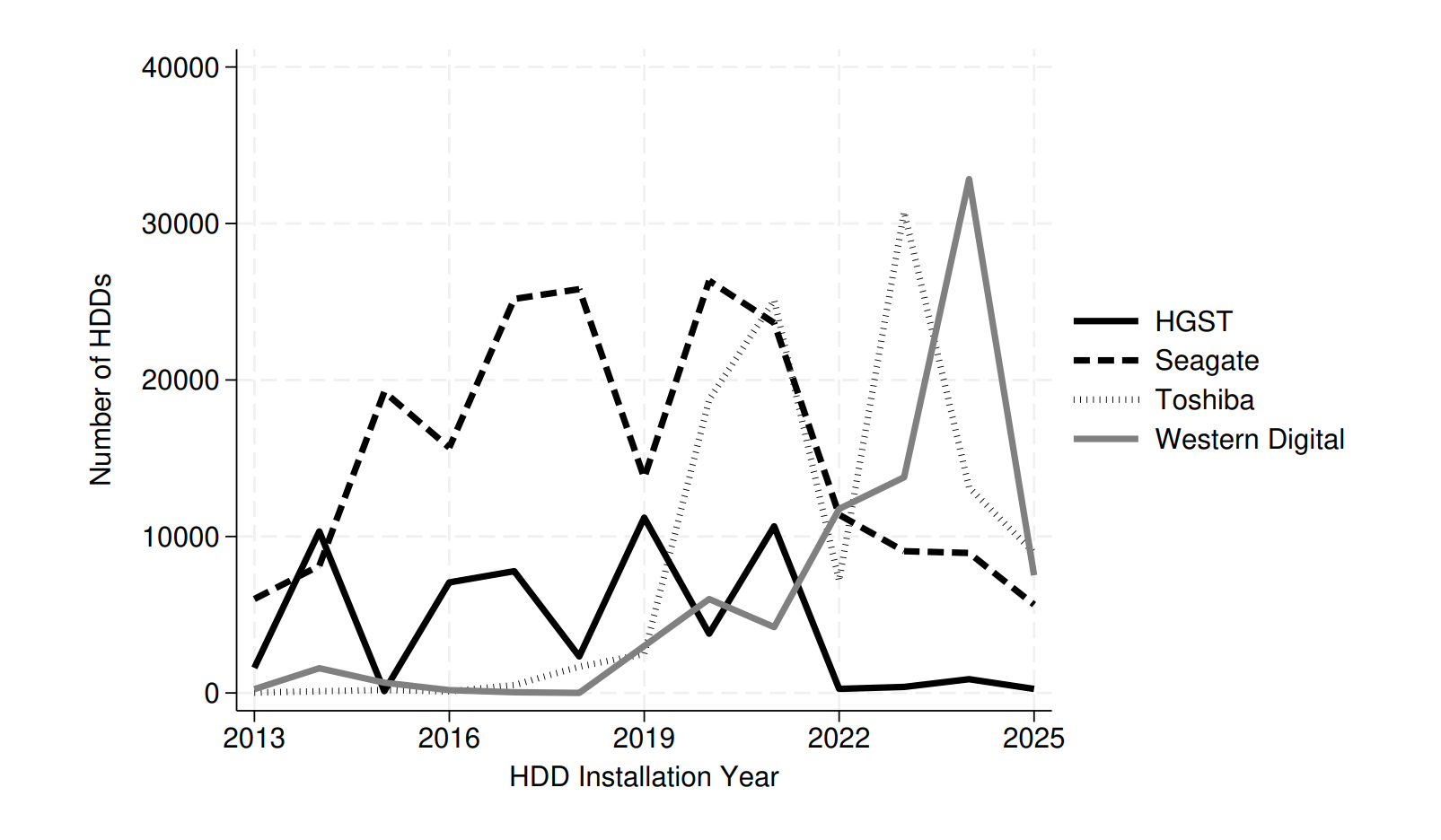
Number of HDDs installed by manufacturer and year.
Backblaze's drive mix shifted sharply over time, a factor the study accounted for when comparing manufacturer failure rates.
HGST accounted for many new Backblaze installations in 2014. Seagate was the main supplier from 2015 through 2020. Toshiba had the most new installations in 2023, and WD led in 2024. As a result, reported failure rates can compare old Seagate and HGST drives with newer Toshiba and WD models.
The researchers adjusted their analysis to account for those differences. They also excluded some of the bias created when drives leave service before they fail. About 146,943 drives, or 31% of the sample, were removed from Backblaze's dataset without a recorded failure. Most were likely replaced as the company moved to higher-capacity hardware.
Toshiba showed the clearest change in failure behavior as drives aged. Its monthly failure rate rose more than fourfold after 60 months in service. From 50 to 100 months, Toshiba drives failed at a rate of five to six per 1,000 drives each month. The other three brands generally remained at or below 2.5 failures per 1,000 drives per month over that period.
Seagate had the highest failure rate among newer drives in the study. But its rate did not increase as sharply with age as Toshiba's did. Backblaze has previously reported that many drive failures occur before a drive has been in operation for three years.
Operating temperature also mattered. The study found that each 1-degree Celsius increase in average drive temperature raised the failure rate by 2.1%. A 10-degree Celsius increase would raise the rate by about 23% when compounded.
Higher-capacity drives performed better in the model. Each additional terabyte of capacity was linked to a 3.4% decline in failure rates. The researchers said that may be partly tied to newer drive designs, including helium-filled enclosures and advances in head manufacturing.
The results do not necessarily apply to hard drives used in consumer PCs or home storage systems. Backblaze operates enterprise drives in data-center conditions, and the dataset does not include comparable workload data for each manufacturer.
The analysis is also weighted toward shorter service periods. Only 0.52% of drives in the study stayed in operation for more than 10 years. That makes the results more useful for evaluating reliability during a drive's early and middle years than for estimating its full lifespan.
WD and HGST finished close together in the adjusted ranking. The authors said that could reflect technology sharing after WD acquired HGST. Backblaze's most recent annual report put the company's overall annualized drive failure rate at 1.36% in 2025.
New study finds HGST, WD hard drives fail less often than Seagate and Toshiba


