Nine out of ten DuckDuckGo users don't want AI anywhere near their search

Alfonso Maruccia

Posts: 2,589   +975
Staff
Back to Digital Monke: Big Tech players are increasingly forcing AI into their products in every way they can. A significant portion of those affected users are understandably tired of the disrespect, and smaller internet services are beginning to carve out alternative routes to digital knowledge – ones that avoid as much AI slop and enshittification as possible.
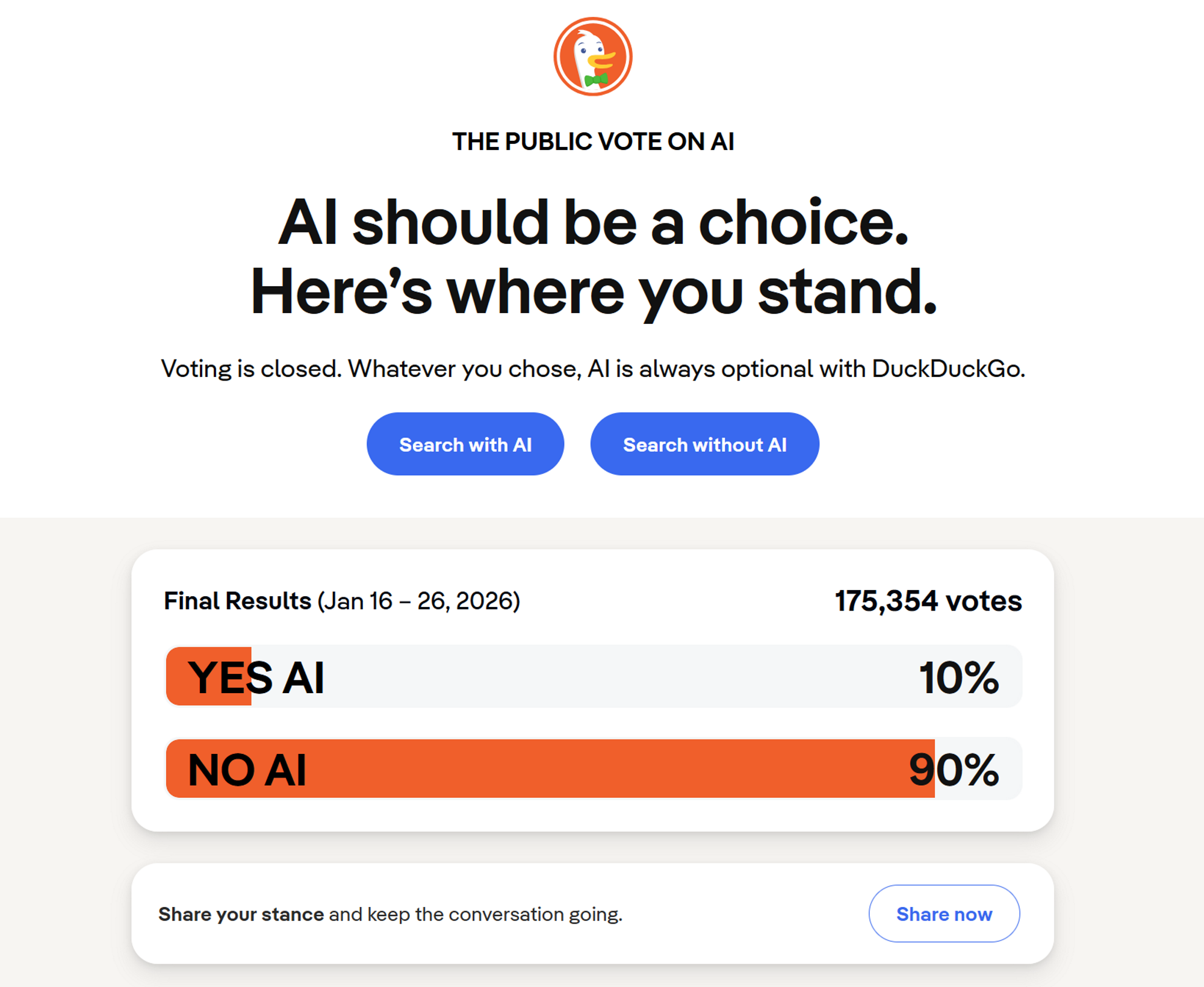
DuckDuckGo recently asked its community whether they actually wanted AI baked into their web browsing experience. The response was loud and clear: an overwhelming majority said no. Now, the company says it's going to honor that choice by offering two different versions of its search experience. Even so, power users can still tweak settings to land somewhere between "no AI" and "yes AI," depending on how much automation they're willing to tolerate.

On its Public Vote on AI page, DuckDuckGo stressed that heavy reliance on large language models and other AI technologies should always be a choice. Founder Gabriel Weinberg noted that most companies – and Big Tech in particular – are simply ignoring people who want the ability to opt out entirely.

Like other user-focused ventures trying to navigate the AI era, DuckDuckGo has been working on features that are mostly optional and easy to disable. The company launched VoteYesOrNoAI.com so its user base could cast an anonymous vote on AI adoption. In the end, 90 percent of more than 175,000 participants said they don't want to deal with any AI features at all.

DuckDuckGo, an alternative search engine handling hundreds of millions of queries each day, has long attracted users who genuinely care about online privacy. It's also likely that many of the people voting already held negative views of LLMs, chatbots, and other AI-driven tools. A DuckDuckGo representative later confirmed that the poll was run openly on the web with no tracking bots, meaning there was no practical way to separate actual DuckDuckGo users from the broader pool of voters.

In any case, DuckDuckGo has now introduced two new URLs designed to offer search with or without AI features enabled by default.

The noai.duckduckgo.com address disables Search Assist and AI links while turning on the recently introduced anti-slop image filter. Meanwhile, yesai.duckduckgo.com keeps all AI-related features active and does not filter AI-generated image clutter by default.

The shift comes as many users argue that Google search is now providing low-quality search results, with the company increasingly focused on serving AI-generated answers instead of traditional links. A search engine that delivers less AI slop could improve web browsing for millions of disgruntled netizens, even if DuckDuckGo can't guarantee a completely AI-free experience. After all, it pulls results from more than 400 different sources, excluding Google.

Permalink to story:

 
People want less interference, less tracking, less ads and more actual content, all of which are pure poison to a modern online platform seeking profit. The people want products, the tech companies want the people to be the product, but they have so little to offer in return for such a steep fee. A person's level of awareness of this determines how they survive in the modern connected world and how often they're taken advantage of by the services they decide to use.
 
Honestly, respect to DuckDuckGo for doing the bare minimum thing every other tech company forgot how to do: ask users what they want. The fact that 90% said “please stop” should be a loud alarm bell for the entire industry… but Big Tech will probably just interpret it as ship AI harder.
 
Honestly, respect to DuckDuckGo for doing the bare minimum thing every other tech company forgot how to do: ask users what they want. The fact that 90% said “please stop” should be a loud alarm bell for the entire industry… but Big Tech will probably just interpret it as ship AI harder.
The problem is what people say and what people do are two very different things.

You ask gamers, and they HATE microtransactions, DLC, always online DRM, ece, yet you look at the amount of money games with those systems bring in and it's obvious that people are either lying or are representative of a very small minority of users.

You ask automotive buyers, and they want physical controls, less whistles, and fewer screens. But what sells the most? The high end trim packages loaded with bells, whistles, screens, and annoyances.

I could go on.
 
The funniest part is that opt-out AI is now considered some radical privacy-forward innovation. Like congrats, we reinvented the checkbox...
The kind of person who uses DuckDuckGo understands what they are giving up, in the pursuit of digital anonymity. Personal autonomy and instant gratification are at polar opposites of the incentive spectrum.
 
I actually don't mind Brave's *optional* little AI summary at the top of search. It's a good balance.

Google drove me away from all of their products. Although my work just announced it is going to pay for Gemini & NotebookLM subs (in addition to ChatGPT already). Claude is still my preference.
 
AI in a search engine doesn't impact tracking/anonymity any more than any other "feature" a search engine could have... you've been datamined since long before AI existed...

People fear AI cause they've read science fiction and think it will be nuking Russia and sending Terminators after Sarah Connor...

I'd love to see the exact question that people were asked when this poll was done... I'm sure it was completely unbiased however... a railway train is also unbiased... but... wherever you lay the tracks, that's where it's going to go....
 
Last edited:
If your using Duck Duck Go and you voted you want AI, I would take it you don't know the point of the browser..... or your just .....well do the math.

Leave Brave and Duck Duck Go alone and away from AI
 
The only users Big Tech care about are stock holders
As they should. Public companies exist to serve shareholders—they’re public, as in, answerable to them. Management is legally required to grow long-term value. Chasing revenue isn’t some moral failing—it’s literally how the system works. If you don’t like their products or practices, don’t use them. Making profits is literally how businesses function.
 
As they should. Public companies exist to serve shareholders—they’re public, as in, answerable to them. Management is legally required to grow long-term value. Chasing revenue isn’t some moral failing—it’s literally how the system works. If you don’t like their products or practices, don’t use them. Making profits is literally how businesses function.
Everyone out here enjoying life in 3D but this guy sees it all in 2D and thinks he's superior
 
Everyone out here enjoying life in 3D but this guy sees it all in 2D and thinks he's superior
Wow, that almost made sense… oh wait, it’s hogwash…
Where is your evidence that AI is useless to society and that virtually every tech company must be stupid?
 
As they should. Public companies exist to serve shareholders—they’re public, as in, answerable to them. Management is legally required to grow long-term value. Chasing revenue isn’t some moral failing—it’s literally how the system works. If you don’t like their products or practices, don’t use them. Making profits is literally how businesses function.

Like many people with confirmation bias you don't understand the ruling of Dodge vs Ford.

https://en.wikipedia.org/wiki/Dodge_v._Ford_Motor_Co.

It doesn't legally mandate that directors of a company only purpose is to uphold stockholder value, but instead that they don't actively undermine it. It still gives them a wide latitude in how they run their company, and thereby profits/dividends shouldn't and/or can't be the sole measure of a public company's performance or success.
Ford had publicly stated that his intentions were to under serve the stockholders in favour of his personal/company goals. And that was the action that the court ruled on. If he had never said it chances are the court case would of never happened.

Secondly it isn't a law, it's a ruling. It applies to the specific case and sets a precedent for future rulings that come before the Michigan court.
No one other than the Ford motor company had to abide by the ruling. If another company's stockholders in a different state felt they were being mistreated by their executives in the same manner they would have to take them to court as well.
Of course that case would have to take into account the previous ruling but wouldn't be bound by it. To strengthen the precedent it would need to go the the Supreme Court and have them rule positively on it. The legislative branch would have to make it law if they so choose to, and then and only then it would make executives legally bound.

The big kicker is tests of the principal ruling seldom go to court for a number of reasons. Executives were ruled to be "duty bound" not "legally bound" which means they simply need to try to the best of their abilities, which is very hard to disprove.
As well executive compensation has been changed so that, due to the tax laws in regard to making more than 1 million in income per year, they now receive much of their compensation in stock and stock options. This places their emphasis on increasing the stock prices making the ruling moot in most cases.

TL/DR Executives of public companies are not legally but duty bound to always keep stockholder value in mind as they run the company. But have enormous latitude in how the do it, and as long as they can show they're are making their best efforts in this regard aren't disregarding any rulings on the matter.
 
Last edited:
Like many people with confirmation bias you don't understand the ruling of Dodge vs Ford.

https://en.wikipedia.org/wiki/Dodge_v._Ford_Motor_Co.

It doesn't legally mandate that directors of a company only purpose is to uphold stockholder value, but instead that they don't actively undermine it. It still gives them a wide latitude in how they run their company, and thereby profits/dividends shouldn't and/or can't be the sole measure of a public company's performance or success.
Ford had publicly stated that his intentions were to under serve the stockholders in favour of his personal/company goals. And that was the action that the court ruled on. If he had never said it chances are the court case would of never happened.

Secondly it isn't a law, it's a ruling. It applies to the specific case and sets a precedent for future rulings that come before the Michigan court.
No one other than the Ford motor company had to abide by the ruling. If another company's stockholders in a different state felt they were being mistreated by their executives in the same manner they would have to take them to court as well.
Of course that case would have to take into account the previous ruling but wouldn't be bound by it. To strengthen the precedent it would need to go the the Supreme Court and have them rule positively on it. The legislative branch would have to make it law if they so choose to, and then and only then it would make executives legally bound.

The big kicker is tests of the principal ruling seldom go to court for a number of reasons. Executives were ruled to be "duty bound" not "legally bound" which means they simply need to try to the best of their abilities, which is very hard to disprove.
As well executive compensation has been changed so that, due to the tax laws in regard to making more than 1 million in income per year, they now receive much of their compensation in stock and stock options. This places their emphasis on increasing the stock prices making the ruling moot in most cases.

TL/DR Executives of public companies are not legally but duty bound to always keep stockholder value in mind as they run the company. But have enormous latitude in how the do it, and as long as they can show they're are making their best efforts in this regard aren't disregarding any rulings on the matter.
Nice rant… but not really relevant to this thread… why would TONS of different CEOs from tons of different companies all decide to invest in AI? They’re not ALL id1ots you know… they except to see a return - and while the public jumps on the “Terminator / Skynet” bandwagon, the smart ones realize that’s nonsense and look to the future.
 
Search engines, DDG included, are swamped by marketers, SEO optimization, low quality referral sites and other enshittifcation processes can't serve netizens like in the good old days. There's too many manipulators.

I've ended up using perplexity pro as a search engine now, not cause of AI nonsense chat features, but literally because it works as a search engine... after years of increasingly chasing my tail trying to get technical answers out of standard search engines it is a godsend.
 
I think the funniest part is that the no-AI filter requires AI (or at least ML) to filter out the AI. 🙃

No, it doesn't. There's no such thing as "AI", and machine learning isn't and never will be AI. keywords aren't AI or machine learning. Imagine not even knowing the difference.
 
Nice rant… but not really relevant to this thread… why would TONS of different CEOs from tons of different companies all decide to invest in AI? They’re not ALL id1ots you know… they except to see a return - and while the public jumps on the “Terminator / Skynet” bandwagon, the smart ones realize that’s nonsense and look to the future.
Well, I would hardly call it a 'rant'. I thought that he explained it very nicely. Specially for someone like me. That is, a Brit who had never heard of this 'case'. And if it's accurate, then it does seem to be more sensible than the BS that I've been reading elsewhere - that basically, legally, "Line must go up'' for the poor old shareholders etc...Seems to me, that the CEOs etc. of these companies don't really give a hoot for normal shareholders, and are more fixated on getting increasing benefits from having THEIR noses in the shares trough.
 
A slight tangent..............but has anybody else using the Brave browser found that Youtube will no longer open videos at all now? Firefox/Waterfox are still OK though.
 
Well, I would hardly call it a 'rant'. I thought that he explained it very nicely. Specially for someone like me. That is, a Brit who had never heard of this 'case'. And if it's accurate, then it does seem to be more sensible than the BS that I've been reading elsewhere - that basically, legally, "Line must go up'' for the poor old shareholders etc...Seems to me, that the CEOs etc. of these companies don't really give a hoot for normal shareholders, and are more fixated on getting increasing benefits from having THEIR noses in the shares trough.
It was explained nicely… I suspect ChatGPT did a really good job for him… but it has no relevance to this thread.

Maybe look up how shares in companies work… if a CEO makes his or her company more valuable, their shares (and everyone else’s) increase in value… that’s why most companies give them stock options… you WANT the boss to have an incentive to make the company more valuable!

If CEOs are espousing AI, then the reason must be because they think this will add value to their companies… do you really think that all of these people are wrong? Very few people rise to the level of CEO by being dumb…
 
Back