A top economist says there's "zero evidence" AI is killing jobs, despite thousands of actual layoffs

midian182

Posts: 11,745   +178
Staff member
A hot potato: Concerned that your job could become one of the many lost to AI? According to Apollo Global Management's chief economist, you're worrying about nothing! Torsten Sløk claims that there is "zero evidence" of job losses because of AI, which will likely come as a surprise to the tens of thousands of people who have lost their jobs to AI.

Writing in a post last week titled "Zero Evidence of AI-Related Job Losses," Sløk points to ADP employment data to support his conclusion. The report found that private companies added almost 110,000 people to their payrolls in April.
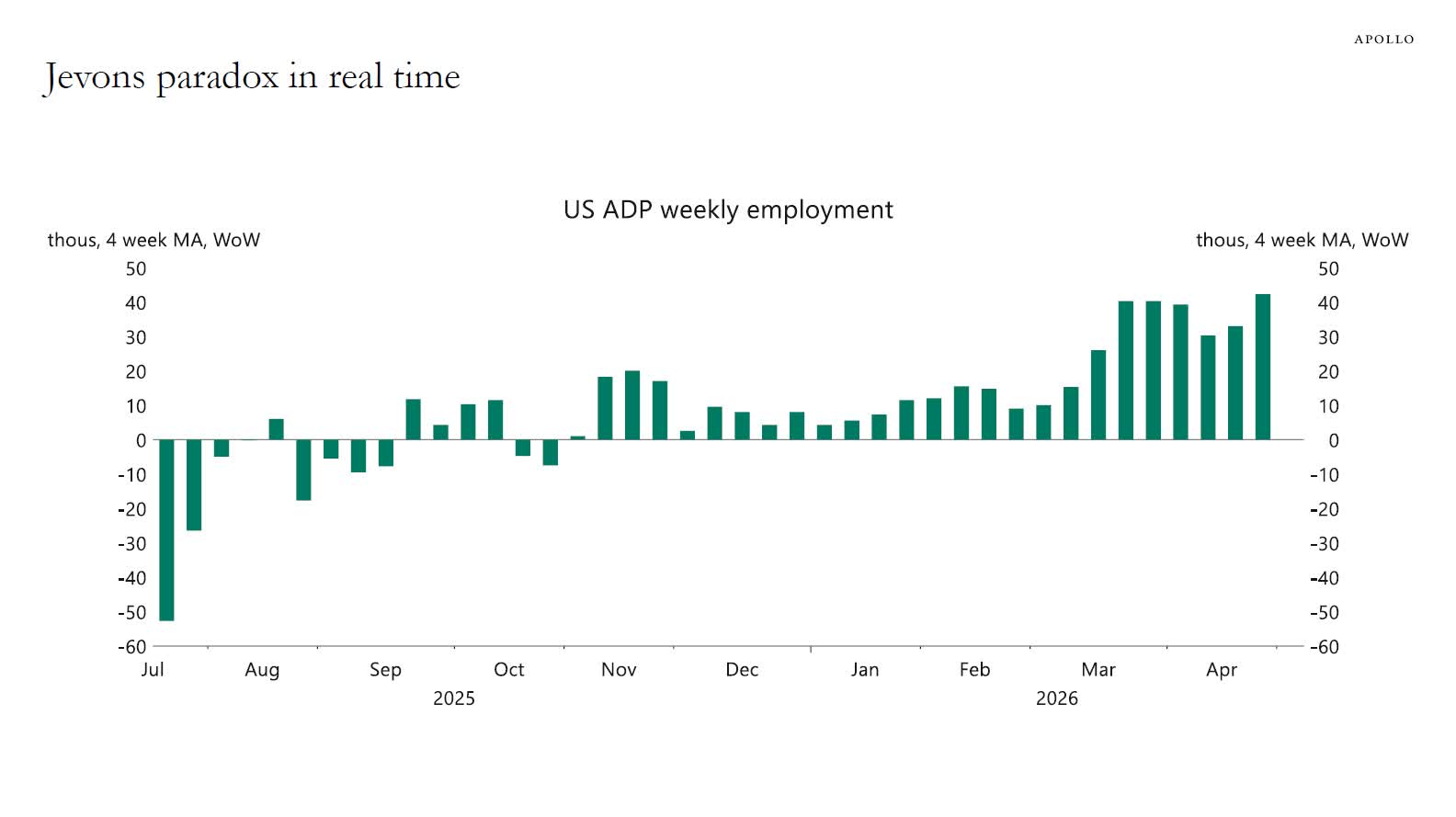
The executive argues that instead of lowering headcounts, many firms are hiring AI implementation experts.

"The bottom line is that the AI spending boom is stoking both employment and inflation," Sløk writes. "It is Jevons paradox playing out in real time: cheaper technology is creating more demand and more jobs."

There seems to be a sudden spate of claims that AI isn't actually taking people's jobs. OpenAI boss Sam Altman recently said he was "delighted" that his AI jobs apocalypse prediction was wrong. Box CEO Aaron Levie, Dell boss Michael Dell, and Goldman Sachs CEO David Solomon all have similar opinions. The fact that they are heads of companies heavily invested in AI definitely has nothing to do with it.

To suddenly start claiming AI isn't causing job losses almost feels like gaslighting. There have been almost 116,000 layoffs in the tech world so far in 2026, quickly approaching the 124,000 that we saw for the entirety of 2025. And a massive number have been tied to AI, either through direct job replacement or companies' resources being redirected toward AI infrastructure.
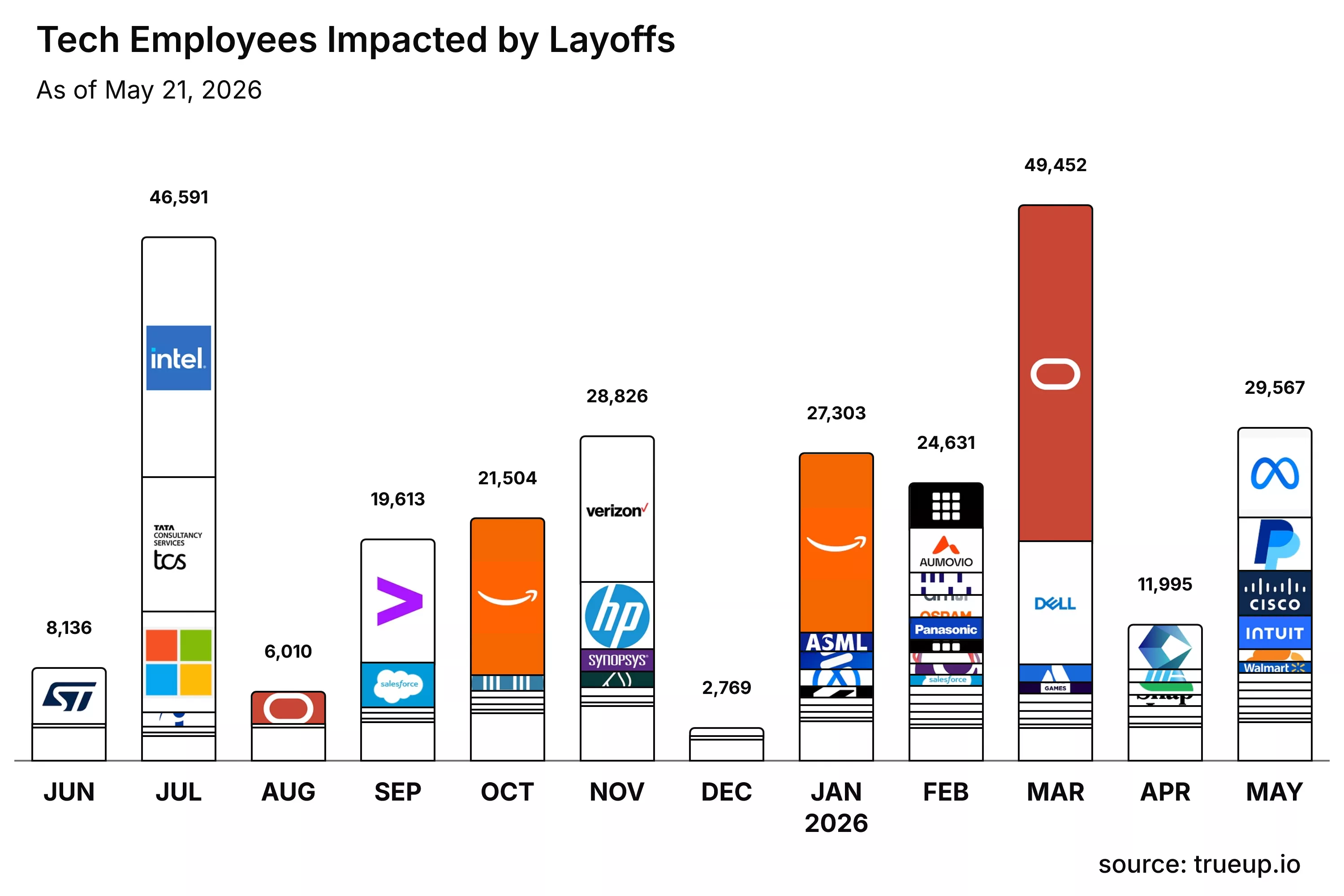
It was only last week that Wix laid off 1,000 people while citing the "fast evolution" of AI. Earlier this year, Block laid off over 4,000 people and couldn't have been clearer that it was because of AI reducing staffing needs. Intuit, Meta, Amazon, Cisco, IBM – the list of companies that have done the same thing is an extensive one.

The future doesn't look much better. A recent survey of almost 1,000 executives found that 99% said they expected AI to lead to reduced worker numbers at their companies in the next two years.

While it might be true that jobs are being created as a result of AI adoption – and that some companies blame the technology even when the layoffs have little to do with it – saying there is no evidence of AI-related job losses seems misleading at best and disingenuous at worst.

Permalink to story:

 
AI is definitely killing some jobs, but it may be somewhat overstated.

My understanding is that, in tech at least, there was an era where department management within companies were over-hiring because making their department bigger gave them more clout within the company. Now a lot of companies are trying to undo that damage and letting AI take the blame.

But it's clear that a lot of entry level jobs are already disappearing, so even if some other jobs are being created, it's getting a lot harder for new workers to get their foot in the door. Entry level coding jobs for example are basically going extinct.
 
Last edited:
So glad the author was unbiased when writing this article /s

Just because a company states that layoffs are because of AI - doesn’t mean they really are.

As has been stated many times on this site by numerous posters (me included), many companies over-hired during the pandemic and they are simply correcting themselves - AI is a convenient scapegoat, as “oops, we got it wrong” might not sit well with investors or superiors…
 
Finally, someone with common sense!
(on a side note, I'm truly shocked to see an article with such a title here, although the article itself is far less surprising and tries to paint a gloomy picture).

There's really zero evidence of AI is killing jobs. In fact there's evidence to the contrary. The fields that are allegedly most endangered by AI, e.g. software engineers, radiologists etc. have a notable rise in job openings in the last year. Radiologists, prophesied to disappear completely because of AI, are in acute shortage.
Not to mention the construction / infrastructure building boom etc., these things are always skipped in apocalyptic narratives.
 
Economists measure total jobs available, meaning jobs added in one place offset jobs lost in another.

Reporters on this site seem to consider only jobs lost: jobs lost always get a big story, and jobs gained are mostly silently ignored.

Layoffs and other forces moving jobs from where they are obsolete to where they are newly needed has been around a lot longer than AI has.
 
Still waiting for a honest CEO (although I guess that's like waiting for a sane religious zealot) that just says things as they are.
The aim is to replace as many jobs (costs) with AI as possible to make the green line go up. It will create some new jobs, in a ratio of 1:N, with the N being replaced having nowhere near the education needed to get that 1 new role.
The aim is to make that N bigger and bigger as AI progress is made, pay less people to make more profit. Companies aren't there to generate jobs, that's just a side effect of trying to generate profit.
People that make to the role of CEO don't tend to get there because they're just so darn nice and trying to make the world a better place.
Don't get the need for this attempted deceit when the truth is so crystal clear.

Then again, it can be somewhat entertaining when CEOs try to keep up pretenses. The McDonalds one sure loved that yummy burger product after taking that giant smaller than a mouses bite.
Or you know, just in general The Zuck.
 
I know the goal at my company was to have AI take over as much as possible, but in reality we have had massive layoffs due to moving our data centers off site and into Microsoft’s ‘cloud’ environment. Less people to maintain servers when you can pay Microsoft to do it as a subscription service. And what they can’t do, went to outsourcing at other companies. That historical knowledge is all gone now though, and we get plenty of laughs when stuff breaks and nobody knows how to fix it.
 
"Zero evidence" is doing a lot of heavy lifting here when the companies doing layoffs are explicitly citing AI in their internal memos. The economists who were right about automation "creating net jobs" over 30 years weren't much comfort to the 45-year-old autoworker in 1987.
 
Economists measure total jobs available, meaning jobs added in one place offset jobs lost in another.

Reporters on this site seem to consider only jobs lost: jobs lost always get a big story, and jobs gained are mostly silently ignored.

Layoffs and other forces moving jobs from where they are obsolete to where they are newly needed has been around a lot longer than AI has.
You obviously didn't read any of the article itself.
 
As has been stated many times on this site by numerous posters (me included), many companies over-hired during the pandemic and they are simply correcting themselves - AI is a convenient scapegoat, as “oops, we got it wrong” might not sit well with investors or superiors…
You may as well say it's fallout from the financial crisis too.
 
"Zero evidence" is doing a lot of heavy lifting here when the companies doing layoffs are explicitly citing AI in their internal memos. The economists who were right about automation "creating net jobs" over 30 years weren't much comfort to the 45-year-old autoworker in 1987.
Layoffs happen when the employees are no longer needed and are not expected to be needed soon. In most cases that means the company is in trouble, but you'll very rarely see that in the memos.

If you were a CEO of a company in trouble, what would you say - "We're in trouble" or "We're a dynamic team embracing cutting edge AI technologies to boost our productivity 10x blah blah .."? Of course you'd go for the BS.
 
You may as well say it's fallout from the financial crisis too.
If you want to be dismissive, then can you explain why the companies listed by tech spot over the last month all have workforces larger then in 2019, despite the layoffs?

It's COVID overhiring. Nobody can figure out how to explain the bloated workforces but want to bang the "AI BAD" gong.
At some point the AI apologists are going to have to stop blaming job losses on the pandemic, we're well past that.
At some point AI doomers are going to have to stop blaming AI when job counts are still elevated well above pre pandemic numbers. We're at the point where you have to stop running away and actually show your work.
 
That historical knowledge is all gone now though, and we get plenty of laughs when stuff breaks and nobody knows how to fix it.

Oh, it will take five to ten years, but this is ABSOLUTELY going to be a thing. There's one codebase I inherited (with a 40 year development history behind it) that I have zero idea how it works. And because SW Engineering as an industry is drying up (because everyone is fleeing because of AI), no one is going to be around to fix these codebases when they break. And it's going to be hilarious to watch it all burn.
 
At some point the AI apologists are going to have to stop blaming job losses on the pandemic, we're well past that.
You might be past that… but the world isn’t… worldwide pandemics are big events - just because you’re tired of hearing about it, doesn’t mean its effects have ended!

I’m sure people were tired of hearing about the Second World War in the 50s…. But they acknowledged it was still affecting them…
 
DEI hired and HR are getting fired because companies no longer want to be daycare for these insane children whose greatest contribution is endless whining and complaining.
 
What kind of economist is this? I mean, of course there's evidence, companies have laid off employees specifically saying they are going to use AI for what they were doing. Is it a NET loss? Don't know. Is it a long-term loss? Perhaps not, some of these companies have found that AI is just not fully suited for some of the tasks they assumed they could use it for in replacement of employees. And they are of course getting sticker shock from those bills as well, since they tend to use commercial services and not run on site. But I can't possibly take anyone seriously who claims 'zero evidence', that's just ridiculous.
 
People that make to the role of CEO don't tend to get there because they're just so darn nice and trying to make the world a better place.
I sincerely doubt you're accepting a paycheck from your employer simply because it "makes the world a better place".

Those who didn't sleep through their economics classes -- if they even took one --- realize that when a CEO increases a firm's profits, it means they're more efficiently converting inputs (labor, raw materials, etc) into goods and services ... and that's a good thing for all of us.
 
Back