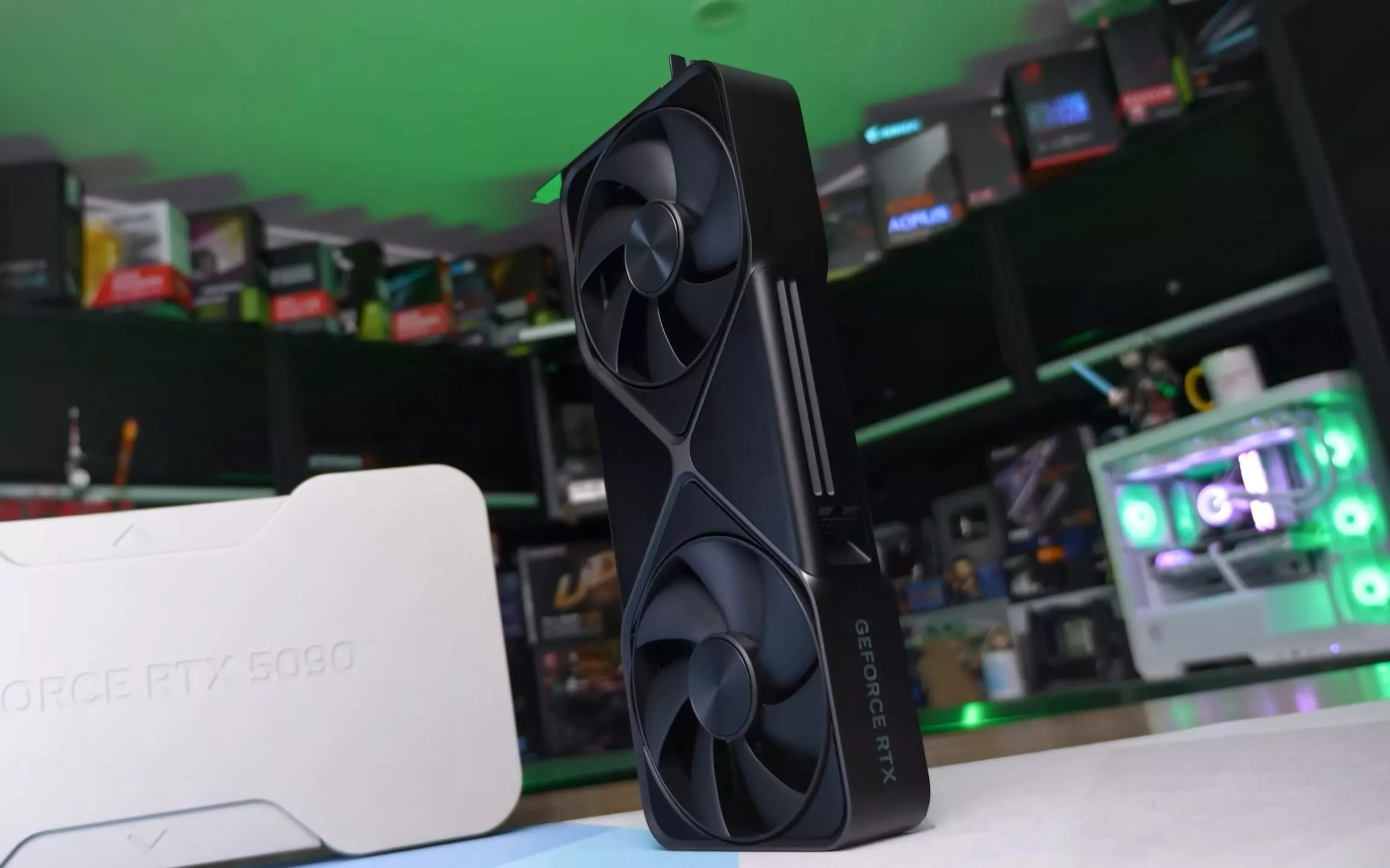
Nvidia could delay the RTX 5000 Super series indefinitely as AMD offers no 2026 competition

midian182

Posts: 11,734   +177
Staff member
Rumor mill: The absence of any RTX 5000 Super series announcements at CES came as no surprise. According to a new claim, the cards have now been delayed indefinitely. The industry memory crisis is the biggest factor, of course, but AMD's lack of new rival graphics cards in 2026 has apparently played a major part in the decision.

It had been expected that Nvidia would replicate what it did with the RTX 4000 series and release an RTX 5000 Super line within a year of the vanilla version's launch.

There were reports that the RTX 5000 Super cards could see a 50% increase in VRAM compared to the standard equivalent models and would be unveiled at CES, as was the case with the RTX 4000 Super cards.

But then the AI-driven memory crisis hit the industry, resulting in shortages and pushing up prices. There were rumors in November that the cards had been canceled as a result of the situation.

Now, a post on Board Channels citing industry sources claims to reveal more details behind Nvidia's decision to delay the Super series indefinitely.

AI's role in all this is reiterated. With demand for AI GPUs rising all the time, production line capacity is being reserved for the chips, which offer much higher profit margins.

One of Nvidia's many announcements during CES was its Vera Rubin server systems. The Rubin launch is now slated for mid-2026. That's months ahead of schedule and illustrates the priority Nvidia is giving to its AI segment.

The other issue is the price and diminishing availability of VRAM, especially GDDR7.

During a Q&A session at CES, Nvidia CEO Jensen Huang was asked if restarting production on older GPUs on legacy processor nodes might help ease the current memory supply and production issues. The CEO said it was a possibility, suggesting that the cards could be revamped with the latest AI tech to improve performance.

It had already been rumored that Nvidia could restart production of the RTX 3060. The most popular card on the Steam survey uses GDDR6 memory.

The final reason, which the Board Channels post claims is the most important, is that AMD has no consumer GPU products launching in 2026. That lack of competition means the RTX 5000 series can remain competitive – RDNA 5 cards aren't expected until the second half of 2027.

Another factor might be the RTX 6000 series. Reliable tipster @kopite7kimi believes it will land in the second half of next year, so Nvidia might worry that people would hold off buying a Super card in favor of a next-gen

Permalink to story:

 
AMD has never really offered any competition. It just price-fixes with NVidia and copies everything they do 6 months later. The 9070XT is probably their closest effort at competing in the last decade but it's hardly setting the world on fire. It's a complete open goal at the moment and they are just sitting on the ball. Rather than thinking 'the AI bubble is probably about to pop, we could steal a real march on NVidia at the moment in the consumer space and establish ourselves as a real player' they are just chasing the same slop train.
 
Jensen and Lisa Sunare first cousins and they're both getting exorbitantly rich off AI.

I do think AMD is offering competition, the 9070xt is better than what over 80% of the market has and not everyone wants to pay used car money for a graphics card. Halo products like the 5090 are good marketing, but AMD making a 5090 competitor isn't going to bring prices down. There is no fixing a dumb consumer.

On a final note, if you really want to solve the VRAM problem then we should stop enabling lazy developers to brute force games. It'd be fine things if we saw a quantum leap in graphics quality for the increase in hardware specs, but we didn't.
 
Jensen and Lisa Sunare first cousins.
This has been reported, but is false. Lisa Su is the child of a cousin of Jensen. They are related, but not cousins and they have never met outside of tech. They do not know each other and they emigrated at completely different times in different ways.
 
AMD has never really offered any competition. It just price-fixes with NVidia and copies everything they do 6 months later. The 9070XT is probably their closest effort at competing in the last decade but it's hardly setting the world on fire. It's a complete open goal at the moment and they are just sitting on the ball. Rather than thinking 'the AI bubble is probably about to pop, we could steal a real march on NVidia at the moment in the consumer space and establish ourselves as a real player' they are just chasing the same slop train.

The problem is that Nvidia has people believing that the software is MORE important than the hardware. I don't think anyone, aside from yourself, thinks GCN/RDNA is a copy of Nvidia. AMD used HBM on some of their consumer cards, Nvidia has not, and AMD used "chiplets" for the first time, not Nvidia.

It's a lot like most successful marketing programs, take a small improvement and market it as the latest "must have". Pretty soon, the feature becomes more important than the reason you needed the item in the first place.

Add that to the fact that AMD has a lot more oars in the water to keep track of, and a fraction of the resources and money of Nvidia and you get our current situation.

Let's not kid ourselves, being able to afford TSMC's latest node, as well as afford the yields that come from a gigantic monolithic chip, are their two biggest advantages.

The fact that AMD is in this at all in this day and age is amazing, and they don't have the luxury of just making the next card bigger, and more. Most companies in the modern age jettison everything except their "core competency/product" in order to "maximize shareholder value." To hell with the long term health of the company.
 
Oh noes!

No "super" refresh where you might have gotten more VRAM (or not) over the non-super, but only saw a 1-10% gain. Been there, seen that.

No thank you. Keep your trashy "super" variants, no one here will care.
 
IMO, this is corporate Hubris on the part of Nvidia. Perhaps Nvidia should sign up with Intel for lessons in corporate Hubris.
 
GB203 and GB206 are already maxed out for 5080 and 5060Ti - so no performance bump for these. Only marginal, single digit bump for 5070 series and 5060. GB202 is too valuable even if it half defective, jensen would rather kill himself than give away any 750mm silicon for less than couple of grands.
Without enough GDDR, I don't see how they could pull of supers this time.

 
Somehow, I think I will survive through this with only 3,487 video games to play across my existing hardware platforms for a few more years. I'll let you know if I ever run out of video games to play or I fail to move characters across the screen with only 44.1 teraflops of instant floating point processing power available to me.
 
AMD has never really offered any competition. It just price-fixes with NVidia and copies everything they do 6 months later. The 9070XT is probably their closest effort at competing in the last decade but it's hardly setting the world on fire. It's a complete open goal at the moment and they are just sitting on the ball. Rather than thinking 'the AI bubble is probably about to pop, we could steal a real march on NVidia at the moment in the consumer space and establish ourselves as a real player' they are just chasing the same slop train.

Lisa Su is now as mercenary as Leatherman on AI and just as delusional. She couldn't care less about consumer products also mimicking Leatherman. AMD is not losing any sleep at all over what's currently going on in the market. The AMD marketing at CES was 99.99% AI AI AI and more AI, there was literally 1 slide that didn't use the word AI and even then the product was designed to do AI.

If the whole DIY PC market vanished and all AMD had was console sales for apu's they would not be worried at all.
 
Jensen and Lisa Sunare first cousins and they're both getting exorbitantly rich off AI.

I do think AMD is offering competition, the 9070xt is better than what over 80% of the market has and not everyone wants to pay used car money for a graphics card. Halo products like the 5090 are good marketing, but AMD making a 5090 competitor isn't going to bring prices down. There is no fixing a dumb consumer.

On a final note, if you really want to solve the VRAM problem then we should stop enabling lazy developers to brute force games. It'd be fine things if we saw a quantum leap in graphics quality for the increase in hardware specs, but we didn't.
Either they are dumb consumers - or they have specific needs. Gaming at 4k consumes up to 18-20gb vram ..with games that are 2-3 years old. I'm fairly certain that newer games will be able to utilize the full width of the 32gb onboard vram in the near future - which would drastically reduce "draw calls" as the data is already available in the vram. Dumb consumers are the ones buying equipment that is already obsolete, like 8gb video cards - which already at 1440p has massive issues
 
Either they are dumb consumers - or they have specific needs. Gaming at 4k consumes up to 18-20gb vram ..with games that are 2-3 years old. I'm fairly certain that newer games will be able to utilize the full width of the 32gb onboard vram in the near future - which would drastically reduce "draw calls" as the data is already available in the vram. Dumb consumers are the ones buying equipment that is already obsolete, like 8gb video cards - which already at 1440p has massive issues
the 1080ti was a 4k card before RT was a thing and the best part about RT in most people's book is the ability to turn it on and off. If the most noteworthy part of a feature is the ability to turn it off then something you're doing is fundamentally flawed. If you take RT out of the equation with developers seemingly inability to use Nanite and Lumen, modern day graphics cards suddenly become irrelevant
 
AMD has never really offered any competition. It just price-fixes with NVidia and copies everything they do 6 months later. The 9070XT is probably their closest effort at competing in the last decade but it's hardly setting the world on fire. It's a complete open goal at the moment and they are just sitting on the ball. Rather than thinking 'the AI bubble is probably about to pop, we could steal a real march on NVidia at the moment in the consumer space and establish ourselves as a real player' they are just chasing the same slop train.
While I do agree with your post, except, Lisa Su and Jensen Huang aren’t related, they just happen to be two Taiwanese American engineers running competing GPU giants. This was all a rumor and has been debunked.
 
The problem is that Nvidia has people believing that the software is MORE important than the hardware. I don't think anyone, aside from yourself, thinks GCN/RDNA is a copy of Nvidia. AMD used HBM on some of their consumer cards, Nvidia has not, and AMD used "chiplets" for the first time, not Nvidia.

It's a lot like most successful marketing programs, take a small improvement and market it as the latest "must have". Pretty soon, the feature becomes more important than the reason you needed the item in the first place.

Add that to the fact that AMD has a lot more oars in the water to keep track of, and a fraction of the resources and money of Nvidia and you get our current situation.

Let's not kid ourselves, being able to afford TSMC's latest node, as well as afford the yields that come from a gigantic monolithic chip, are their two biggest advantages.

The fact that AMD is in this at all in this day and age is amazing, and they don't have the luxury of just making the next card bigger, and more. Most companies in the modern age jettison everything except their "core competency/product" in order to "maximize shareholder value." To hell with the long term health of the company.
I do agree that Nvidia’s marketing and sheer resources give them a huge edge, being able to afford the latest nodes and massive monolithic chips is no small advantage. And yes, software features often get hyped to the point where they feel more important than the hardware itself.

However, where I disagree, AMD isn’t just “barely keeping up.” HBM, chiplets, and RDNA aren’t marketing fluff...they’re real hardware innovations that solved actual engineering problems. AMD’s approach is clever...they do more with less, and that agility keeps them competitive in a space dominated by a giant like Nvidia.

While Nvidia can throw money at any problem, AMD’s strategy proves that smart engineering under constraints can still deliver meaningful advancements.
 
Either they are dumb consumers - or they have specific needs. Gaming at 4k consumes up to 18-20gb vram ..with games that are 2-3 years old. I'm fairly certain that newer games will be able to utilize the full width of the 32gb onboard vram in the near future - which would drastically reduce "draw calls" as the data is already available in the vram. Dumb consumers are the ones buying equipment that is already obsolete, like 8gb video cards - which already at 1440p has massive issues
Like yRaz stated, 1080 Ti handled 4K just fine before RT existed, and the fact that RT is mostly optional shows how hype can outpace real world impact.

Features like Nanite and Lumen can push gpu and vram needs, but developers aren’t fully using them yet. Today’s cards aren’t obsolete, future proofing helps, but hype doesn’t make previous gen hardware irrelevant.

Choosing a lower vram card doesn’t make consumers dumb...it just means they live within their means, like so many others should do.
 
Like yRaz stated, 1080 Ti handled 4K just fine before RT existed, and the fact that RT is mostly optional shows how hype can outpace real world impact.

Features like Nanite and Lumen can push gpu and vram needs, but developers aren’t fully using them yet. Today’s cards aren’t obsolete, future proofing helps, but hype doesn’t make previous gen hardware irrelevant.

Choosing a lower vram card doesn’t make consumers dumb...it just means they live within their means, like so many others should do.
1080ti was able to display a 4k desktop picture - but it wasn’t a 4k gaming card, not near enough horsepower for that
 
1080ti was able to display a 4k desktop picture - but it wasn’t a 4k gaming card, not near enough horsepower for that
That’s revisionist history. The 1080 Ti absolutely was used as a 4K gaming card in its time...60 FPS in many titles with high settings, especially pre RT and pre UE5. No one was claiming maxed out settings forever, but it had the raw raster performance and VRAM to make 4K gaming viable.

I leave this for you.

and this, for its time.

And some of the examples are newer games....so...
 
Last edited:
That’s revisionist history. The 1080 Ti absolutely was used as a 4K gaming card in its time...60 FPS in many titles with high settings, especially pre RT and pre UE5. No one was claiming maxed out settings forever, but it had the raw raster performance and VRAM to make 4K gaming viable.

I leave this for you.

and this, for its time.

And some of the examples are newer games....so...

Yes it did, if you settled with 60 fps average in 4K/UHD on high settings. However 1080 Ti lost steam fast, by 2019-2020 it was already somewhat dated for anything else than 1440p (in new/demanding games) and by having no DLSS support, it dated pretty badly from here.

I used 1080 Ti from launch in 2017 and it felt dated by 2020, when I replaced it with a 3080 and the upgrade was extremely noticable and huge.

DLSS 2 and forward, also provided extreme longevity however I replaced the 3080 with a 4090 later which I still use in my main rig.

A friend of mine still uses my old 3080 and enjoys DLSS 4 bigtime. Don't underestimate the power of good upscaling (with proper game support) for longevity. Something GTX series (and AMD users) don't have.

1080 Ti might have 11GB VRAM but the GPU arch is dated and with no DLSS support it just don't do well at all today and have not done well in newer games for years at this point.

VRAM alone won't secure you good longevity. This is nothing new.

Look at Radeon 6800 16GB, did not age very well.
Look at 7900 XTX 24GB and 7900 XT 20GB.
None of them support FSR 4 and they buckle under low RT loads, which are forced in many newer games (RT elements)

6700XT 12GB was praised for longevity but ended up loosing to 3070 8GB in most new games anyway + 3070 has DLSS 4 support. They launched at the same MSRP.

VRAM is important but you can always adjust settings to get around it - if you don't have access to good upscaling (with actual massive support in games), longevity will take a huge hit.

I would rather have good upscaling and lower VRAM, than more VRAM with bad upscaling.

Radeon 5000, 6000 and 7000 dated like milk in comparison to RTX 2000, 3000 and 4000 series due to AMD not having good upscaling and support in actual games.

DLSS 4 using preset k looks extremely good and absolutely destroys FSR 3.1 in both image quality and support + beats FSR 4 pretty easy as well.
RTX 2000 series from 2018 has full support. There's like 1000+ DLSS titles now and pretty much all new AAA games has DLSS. Many non-DLSS games even have mods that can force DLSS/DLAA.

FSR 4 is the first FSR version worth using really but AMD struggle with game support.
FSR Redstone might change this, we will see.
I used a Radeon 6800 in my HTPC before I bought a 9070 Non-XT.
The difference between FSR 3.1 and FSR 4 is night vs day and when your dated GPU won't do native res gaming anymore, you are stuck with upscaling or extremely low settings.

Upscaling + High preset looks better than Native + Low preset. At least, when we talk FSR 4 or DLSS 4+

Never used FSR 2/3 on my Radeon 6800. Looked horrible. Too many artifacts and visual anomalies. DLSS 4 using preset k is close to perfection in this regard but FSR 4 is "good enough" now AMD just needs to fix the lack of support in games and sadly AMD GPU users with Radeon 7000 or older, will never get FSR 4. FP8 emulation is too demanding, even for 7900 XTX, which is why AMD won't bother getting FSR 4 to work. You might as well use FSR Native if you don't gain performance with FSR 4 Quality/Balanced anyway.

Some people tested 7900 XTX under Linux with FSR 4 but the performance was low. Bruteforcing FSR 4 is not really possible and in most cases, performance will be lower than native on 7000 and older, meaning FSR Native is a better idea but that won't help you with performance, only demand even more power.
 
Last edited:
Yes it did, if you settled with 60 fps average in 4K/UHD on high settings. However 1080 Ti lost steam fast, by 2019-2020 it was already somewhat dated for anything else than 1440p (in new/demanding games) and by having no DLSS support, it dated pretty badly from here.

I used 1080 Ti from launch in 2017 and it felt dated by 2020, when I replaced it with a 3080 and the upgrade was extremely noticable and huge.

DLSS 2 and forward, also provided extreme longevity however I replaced the 3080 with a 4090 later which I still use in my main rig.

A friend of mine still uses my old 3080 and enjoys DLSS 4 bigtime. Don't underestimate the power of good upscaling (with proper game support) for longevity. Something GTX series (and AMD users) don't have.

1080 Ti might have 11GB VRAM but the GPU arch is dated and with no DLSS support it just don't do well at all today and have not done well in newer games for years at this point.

VRAM alone won't secure you good longevity. This is nothing new.

Look at Radeon 6800 16GB, did not age very well.
Look at 7900 XTX 24GB and 7900 XT 20GB.
None of them support FSR 4 and they buckle under low RT loads, which are forced in many newer games (RT elements)

6700XT 12GB was praised for longevity but ended up loosing to 3070 8GB in most new games anyway + 3070 has DLSS 4 support. They launched at the same MSRP.

VRAM is important but you can always adjust settings to get around it - if you don't have access to good upscaling (with actual massive support in games), longevity will take a huge hit.

I would rather have good upscaling and lower VRAM, than more VRAM with bad upscaling.

Radeon 5000, 6000 and 7000 dated like milk in comparison to RTX 2000, 3000 and 4000 series due to AMD not having good upscaling and support in actual games.

DLSS 4 using preset k looks extremely good and absolutely destroys FSR 3.1 in both image quality and support + beats FSR 4 pretty easy as well.
RTX 2000 series from 2018 has full support. There's like 1000+ DLSS titles now and pretty much all new AAA games has DLSS. Many non-DLSS games even have mods that can force DLSS/DLAA.

FSR 4 is the first FSR version worth using really but AMD struggle with game support.
FSR Redstone might change this, we will see.
I used a Radeon 6800 in my HTPC before I bought a 9070 Non-XT.
The difference between FSR 3.1 and FSR 4 is night vs day and when your dated GPU won't do native res gaming anymore, you are stuck with upscaling or extremely low settings.

Upscaling + High preset looks better than Native + Low preset. At least, when we talk FSR 4 or DLSS 4+

Never used FSR 2/3 on my Radeon 6800. Looked horrible. Too many artifacts and visual anomalies. DLSS 4 using preset k is close to perfection in this regard but FSR 4 is "good enough" now AMD just needs to fix the lack of support in games and sadly AMD GPU users with Radeon 7000 or older, will never get FSR 4. FP8 emulation is too demanding, even for 7900 XTX, which is why AMD won't bother getting FSR 4 to work. You might as well use FSR Native if you don't gain performance with FSR 4 Quality/Balanced anyway.

Some people tested 7900 XTX under Linux with FSR 4 but the performance was low. Bruteforcing FSR 4 is not really possible and in most cases, performance will be lower than native on 7000 and older, meaning FSR Native is a better idea but that won't help you with performance, only demand even more power.
You’re not wrong that DLSS materially improves longevity once it exists, but you’re kind of proving the opposite point when it comes to Nvidia not releasing new GPUs.

The 1080 Ti didn’t age badly because it lacked DLSS. It aged because Nvidia moved the goalposts by tying core performance expectations to proprietary features that older hardware would never get. In 2017 and 2018, native rendering performance still mattered most, and the 1080 Ti absolutely delivered. The fact that a 2017 GPU felt dated by 2020 says more about how fast Nvidia pivoted toward feature gated rendering than about the raw capability of the card itself.

DLSS is not free longevity. It is artificial longevity. It works because Nvidia aggressively pushed adoption and made it the default path forward. That’s great for RTX owners, but it also means Nvidia can slow actual hardware progress and lean harder on software crutches. Which is exactly what we are seeing now with stretched launch cycles and minimal generational raster gains.

Comparing longevity purely through the lens of DLSS support also ignores a key point. Native performance still matters when you don’t get a new GPU every cycle. If Nvidia delays releases and relies on DLSS to prop up older cards, that only works as long as you are okay with permanently running upscaled output. That is not the same thing as genuine performance scaling.

As for AMD, yes their upscaling lagged badly and FSR 2 and 3 were weak. But cards like the 6800 and 7900 series did not age badly in raw terms. They age poorly relative to Nvidia’s software ecosystem, not because the silicon suddenly became incapable. That distinction matters when the discussion is about hardware releases, not vendor lock in advantages.
 
You’re not wrong that DLSS materially improves longevity once it exists, but you’re kind of proving the opposite point when it comes to Nvidia not releasing new GPUs.

The 1080 Ti didn’t age badly because it lacked DLSS. It aged because Nvidia moved the goalposts by tying core performance expectations to proprietary features that older hardware would never get. In 2017 and 2018, native rendering performance still mattered most, and the 1080 Ti absolutely delivered. The fact that a 2017 GPU felt dated by 2020 says more about how fast Nvidia pivoted toward feature gated rendering than about the raw capability of the card itself.

DLSS is not free longevity. It is artificial longevity. It works because Nvidia aggressively pushed adoption and made it the default path forward. That’s great for RTX owners, but it also means Nvidia can slow actual hardware progress and lean harder on software crutches. Which is exactly what we are seeing now with stretched launch cycles and minimal generational raster gains.

Comparing longevity purely through the lens of DLSS support also ignores a key point. Native performance still matters when you don’t get a new GPU every cycle. If Nvidia delays releases and relies on DLSS to prop up older cards, that only works as long as you are okay with permanently running upscaled output. That is not the same thing as genuine performance scaling.

As for AMD, yes their upscaling lagged badly and FSR 2 and 3 were weak. But cards like the 6800 and 7900 series did not age badly in raw terms. They age poorly relative to Nvidia’s software ecosystem, not because the silicon suddenly became incapable. That distinction matters when the discussion is about hardware releases, not vendor lock in advantages.

1080 Ti aged badly because it used a dated arch, lacking features, including DLSS.
A big chip with alot of VRAM means nothing with proper feature support. We have seen this many times before.

Wrong, DLSS is completely free longevity and pretty much all new games has it. DLSS 4 using preset k is literally gold for all RTX owners, especially 2000/3000 users. I know many gamers still using RTX 2000/3000 solely because of DLSS.

AMD is going to same route anyway. UDNA will be AMDs "RTX moment" and RDNA will be left to rot when it happens. AMD already left RDNA1, 2 and 3 to rot when RDNA 4 / FSR 4 came out due to Matrix (AI) cores being present on RDNA 4, which is the biggest difference really.

What Nvidia has been doing since RTX 2000 has paid off massively. They sit at like +90% marketshare, dominates the gaming market without even trying at all, while AMD struggles to keep up in terms of features. Rasterization performance still matters but if you only look at raster perf and VRAM in 2026 you are doing it wrong. Upscaling and frame gen matters big time for longevity.

Again, I would rather have good upscaling than alot of VRAM on a GPU with dated arch, that buckles when RT loads are forced (as in many new games, from 2022 and up)

DLSS 4 works on every single RTX card ever released.
FSR 4 works on Radeon 9000 only. Also, FSR support is massively lacking compared to DLSS. Radeon 5000, 6000 and 7000 owners were abandoned and they need upscaling the most.

= That is all you need to know.

My best friend bought a 7900 XTX. He loved the card in the beginning but felt like an ***** when Radeon 7000 did not get FSR 4. As more and more games gets forced RT elements, he got lower and lower performance. Today he can't push high settings at all in new and demanding games. What do you need 24GB VRAM for, when you can't max out games anyway? He is forced to run medium'ish settings today, with no good upscaling to help. He hate the way FSR 2/3 looks and it is not an option for him. He have seen DLSS 4 on my 4090 and he would use it instantly if he had access to upscaling like this. FSR 3.1 is barely on DLSS 2 level overall, which is 6 years old. DLSS 4 is vastly better than DLSS 2. DLSS have improved alot over time, way more than FSR. FSR 4 is the only big jump and decent version but it is still worse than DLSS 4 for sure, in both image quality and game support.

He runs 3440x1440 and is forced to run medium'ish settings in most demanding games now. With FSR 4 he would have been able to still be at high/ultra with higher fps. No can do, AMD said.

And yes, Radeon 6000/7000 aged badly. Due to rasterization focus only. RT elements destroy performance. VRAM don't matter when chip is weak and with no good upscaling to help.

Proof:
Lets look at an > AMD SPONSORED GAME < using RT elements.

Avatar: https://www.techpowerup.com/review/avatar-fop-performance-benchmark/5.html

3070 8GB beats 6800 16GB even in 4K ULTRA due to better arch (which can handle RT elements) and when you enable upscaling, it will be a homerun for the 3070. DLSS 4 works flawless on 3070, where 6800 is forced to use crappy FSR 3.

And this is why raster perf + VRAM matters very little in the long run, if you don't have access to good upscaling too.

You need it all these days. A capable GPU (with good raster perf, that will do RT without big perf hit), FSR 4 or DLSS 4 support with "enough" VRAM but you can always adjust settings to get around this.

RDNA 1, 2 and 3 aged like milk compared to RTX 2000, 3000 and 4000.
And this has nothing to do with Nvidia. Game engines became more advanced. RT and RT elements is the future. Game developers can't wait to stop doing fake/baked lighting for example. They spend TONS of time doing this. RT eventually will be the ONLY solution and it will be MANDATORY at some point. In just a few years. There is already games that won't run without RT support and AMD GPUs takes a massive hit in these. Only RDNA 4 does decently at RT, and also has good upscaling.

Why do you think AMDs SOLE FOCUS with Radeon 9000 was improving RT performance and deliver GOOD UPSCALING? Simple. Because it is the future.
 
Last edited:
1080 Ti aged badly because it used a dated arch, lacking features, including DLSS.
A big chip with alot of VRAM means nothing with proper feature support. We have seen this many times before.

Wrong, DLSS is completely free longevity and pretty much all new games has it. DLSS 4 using preset k is literally gold for all RTX owners, especially 2000/3000 users. I know many gamers still using RTX 2000/3000 solely because of DLSS.

AMD is going to same route anyway. UDNA will be AMDs "RTX moment" and RDNA will be left to rot when it happens. AMD already left RDNA1, 2 and 3 to rot when RDNA 4 / FSR 4 came out due to Matrix (AI) cores being present on RDNA 4, which is the biggest difference really.

What Nvidia has been doing since RTX 2000 has paid off massively. They sit at like +90% marketshare, dominates the gaming market without even trying at all, while AMD struggles to keep up in terms of features. Rasterization performance still matters but if you only look at raster perf and VRAM in 2026 you are doing it wrong. Upscaling and frame gen matters big time for longevity.

Again, I would rather have good upscaling than alot of VRAM on a GPU with dated arch, that buckles when RT loads are forced (as in many new games, from 2022 and up)

DLSS 4 works on every single RTX card ever released.
FSR 4 works on Radeon 9000 only. Also, FSR support is massively lacking compared to DLSS. Radeon 5000, 6000 and 7000 owners were abandoned and they need upscaling the most.
I’m not saying the 1080 Ti is still competitive today. The whole point is that at launch and for several years after, it was absolutely a 4K card. In 2017 to 2019 it could do 4K high or very high at playable frame rates in the vast majority of games available at the time. That was the definition of a 4K GPU back then. Judging it by 2023 to 2026 standards and feature expectations is hindsight.

It didn’t age poorly because it was weak. It aged because the industry shifted away from native rendering toward AI assisted techniques that the hardware was never designed to support. That’s an important distinction. A dated architecture does not mean insufficient performance for its era. Pascal delivered massive raster throughput, and that’s exactly why the card lasted as long as it did.

Calling DLSS completely free longevity ignores the tradeoff. DLSS only exists because NVIDIA made it the forward path and tied performance expectations to it. Yes, it works extremely well and has huge support, but it also means longevity is now gated behind proprietary features rather than raw capability. That’s great if you’re inside the ecosystem, not so much if you’re evaluating hardware value in isolation.

On the 4K point specifically, people forget what games looked like and demanded in 2017 to 2019. Native 4K high at 60 fps was achievable on a 1080 Ti in many titles. That is not revisionist history. The fact that newer games assume DLSS and RT as baseline does not retroactively make the card not a 4K GPU for its time.

I also agree that upscaling and frame generation matter more today. That’s obvious. But that does not mean VRAM and raster performance suddenly became irrelevant, nor does it mean older GPUs failed because they were badly designed. They failed because the goalposts moved. If NVIDIA delays hardware progress and leans more on DLSS to compensate, that’s a strategic success, not proof that raw hardware stopped mattering.

All you need to know, the 1080 Ti was a 4K card in its era, that is what the conversation started with...it aged due to a fundamental shift in rendering philosophy, and DLSS is a powerful tool for extending hardware life, not proof that hardware without it was never valid in the first place. I never disagreed with that.
 
I’m not saying the 1080 Ti is still competitive today. The whole point is that at launch and for several years after, it was absolutely a 4K card. In 2017 to 2019 it could do 4K high or very high at playable frame rates in the vast majority of games available at the time. That was the definition of a 4K GPU back then. Judging it by 2023 to 2026 standards and feature expectations is hindsight.

It didn’t age poorly because it was weak. It aged because the industry shifted away from native rendering toward AI assisted techniques that the hardware was never designed to support. That’s an important distinction. A dated architecture does not mean insufficient performance for its era. Pascal delivered massive raster throughput, and that’s exactly why the card lasted as long as it did.

Calling DLSS completely free longevity ignores the tradeoff. DLSS only exists because NVIDIA made it the forward path and tied performance expectations to it. Yes, it works extremely well and has huge support, but it also means longevity is now gated behind proprietary features rather than raw capability. That’s great if you’re inside the ecosystem, not so much if you’re evaluating hardware value in isolation.

On the 4K point specifically, people forget what games looked like and demanded in 2017 to 2019. Native 4K high at 60 fps was achievable on a 1080 Ti in many titles. That is not revisionist history. The fact that newer games assume DLSS and RT as baseline does not retroactively make the card not a 4K GPU for its time.

I also agree that upscaling and frame generation matter more today. That’s obvious. But that does not mean VRAM and raster performance suddenly became irrelevant, nor does it mean older GPUs failed because they were badly designed. They failed because the goalposts moved. If NVIDIA delays hardware progress and leans more on DLSS to compensate, that’s a strategic success, not proof that raw hardware stopped mattering.

All you need to know, the 1080 Ti was a 4K card in its era, that is what the conversation started with...it aged due to a fundamental shift in rendering philosophy, and DLSS is a powerful tool for extending hardware life, not proof that hardware without it was never valid in the first place. I never disagreed with that.

Well as I said I had a 1080 Ti and even by 2019 it started feeling slow in demanding AAA games at high res (3440x1440 and 4K/UHD), which was the reason I upgraded to RTX 3080 in 2020, a huge upgrade. Massive even.

Pascal just lacked too many advanced features to age well. Just like AMD GPUs.

4K without upscaling is just demanding and even the best GPU will feel dated after a few years, even my 4090 feels dated for native 4K today, luckily DLSS saves the day.

DLSS makes 4K possible on pretty much any RTX GPU. DLSS Performance mode using DLSS 4 looks fantastic and the internal res is only 1080p.

Raster performance will never be irellevant, even Huang said this.

DLSS, DLAA, DLDSR, FG and MFG are all tools, you can choose to use or not.
Most people that have access to them tho, are using them.

Techspot had a pool. The vast majority of 4K gamers use upscaling. There is little point in running native 4K unless your GPU can't do upscaling well but if you GPU can't do proper upscaling (meaning DLSS or FSR 4), it won't do 4K native anyway, due to lack of power.

That is why I say. If you buy a GPU today, make sure it have a decent chip with proper feature support. Good upscaling (most important) and maybe consider looking at FG/MFG as well. These features has come to stay. People who looks at rasterization perf and VRAM only, needs to wake up. It will bite them in the *** eventually.

Just like my friend regrets his 7900 XTX 24GB purchase. A card that looked solid on paper with VRAM for years but lacks good upscaling and too many features are missing + bad RT performance.
 
Well as I said I had a 1080 Ti and even by 2019 it started feeling slow in demanding AAA games at high res (3440x1440 and 4K/UHD), which was the reason I upgraded to RTX 3080 in 2020, a huge upgrade. Massive even.

Pascal just lacked too many advanced features to age well. Just like AMD GPUs.

4K without upscaling is just demanding and even the best GPU will feel dated after a few years, even my 4090 feels dated for native 4K today, luckily DLSS saves the day.

DLSS makes 4K possible on pretty much any RTX GPU. DLSS Performance mode using DLSS 4 looks fantastic and the internal res is only 1080p.

Raster performance will never be irellevant, even Huang said this.

DLSS, DLAA, DLDSR, FG and MFG are all tools, you can choose to use or not.
Most people that have access to them tho, are using them.

Techspot had a pool. The vast majority of 4K gamers use upscaling. There is little point in running native 4K unless your GPU can't do upscaling well but if you GPU can't do proper upscaling (meaning DLSS or FSR 4), it won't do 4K native anyway, due to lack of power.

That is why I say. If you buy a GPU today, make sure it have a decent chip with proper feature support. Good upscaling (most important) and maybe consider looking at FG/MFG as well. These features has come to stay. People who looks at rasterization perf and VRAM only, needs to wake up. It will bite them in the *** eventually.

Just like my friend regrets his 7900 XTX 24GB purchase. A card that looked solid on paper with VRAM for years but lacks good upscaling and too many features are missing + bad RT performance.

You’re just restating the same point at this stage, and I don’t actually disagree with most of it. Yes, DLSS is widely used. Yes, upscaling is now the norm at 4K. Yes, feature support matters more today than it did in the Pascal era. None of that is controversial.

Where we keep talking past each other is that you’re framing this as proof that the 1080 Ti was never really a 4K card, when the reality is simply that expectations and rendering pipelines changed. Feeling slow in 2019–2020 at ultra wide or 4K in newer AAA titles does not invalidate what the card was capable of in its own generation. That’s not aging “badly,” that’s the industry moving on and that is what the topic was about.

Saying even a 4090 feels dated at native 4K today kind of proves the point. Native 4K has become an unreasonable benchmark because vendors and developers assume upscaling. That doesn’t mean older GPUs failed due to bad design, it means the target shifted.

I’m not arguing people should ignore DLSS or buy GPUs without feature support today. Of course those features matter now. My point has always been narrower than what you keep responding to....the 1080 Ti was a legitimate 4K GPU in its era, and its decline was driven by a shift toward feature dependent rendering, not because it was fundamentally inadequate hardware.

At this point we’re just going in circles. If you need to have the last word, you can have it. DLSS and FSR 4 are important.
 
Back