The big picture: Nvidia has fired back at AMD with new benchmark results showcasing the superior performance of its latest GPUs running DeepSeek's AI models. This comes after AMD's recent publication of benchmarks that positioned its Radeon RX 7900 XTX ahead of Nvidia's offerings.
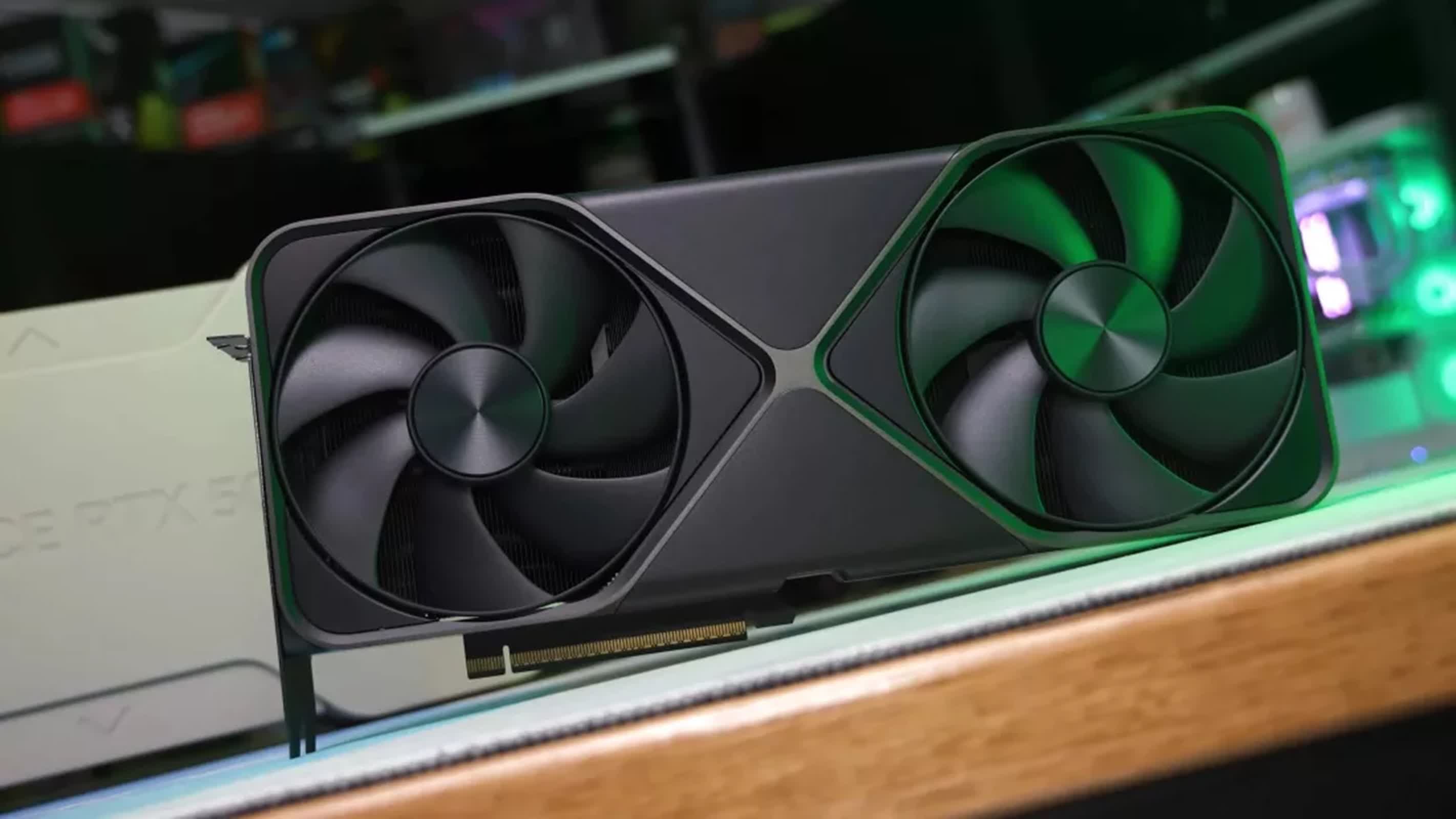
Nvidia's counterattack claims that its new GeForce RTX 5090 GPU outperforms AMD's flagship by a staggering margin. According to Team Green, the RTX 5090 is up to 2.2 times faster than the RX 7900 XTX when running DeepSeek R1 AI models.
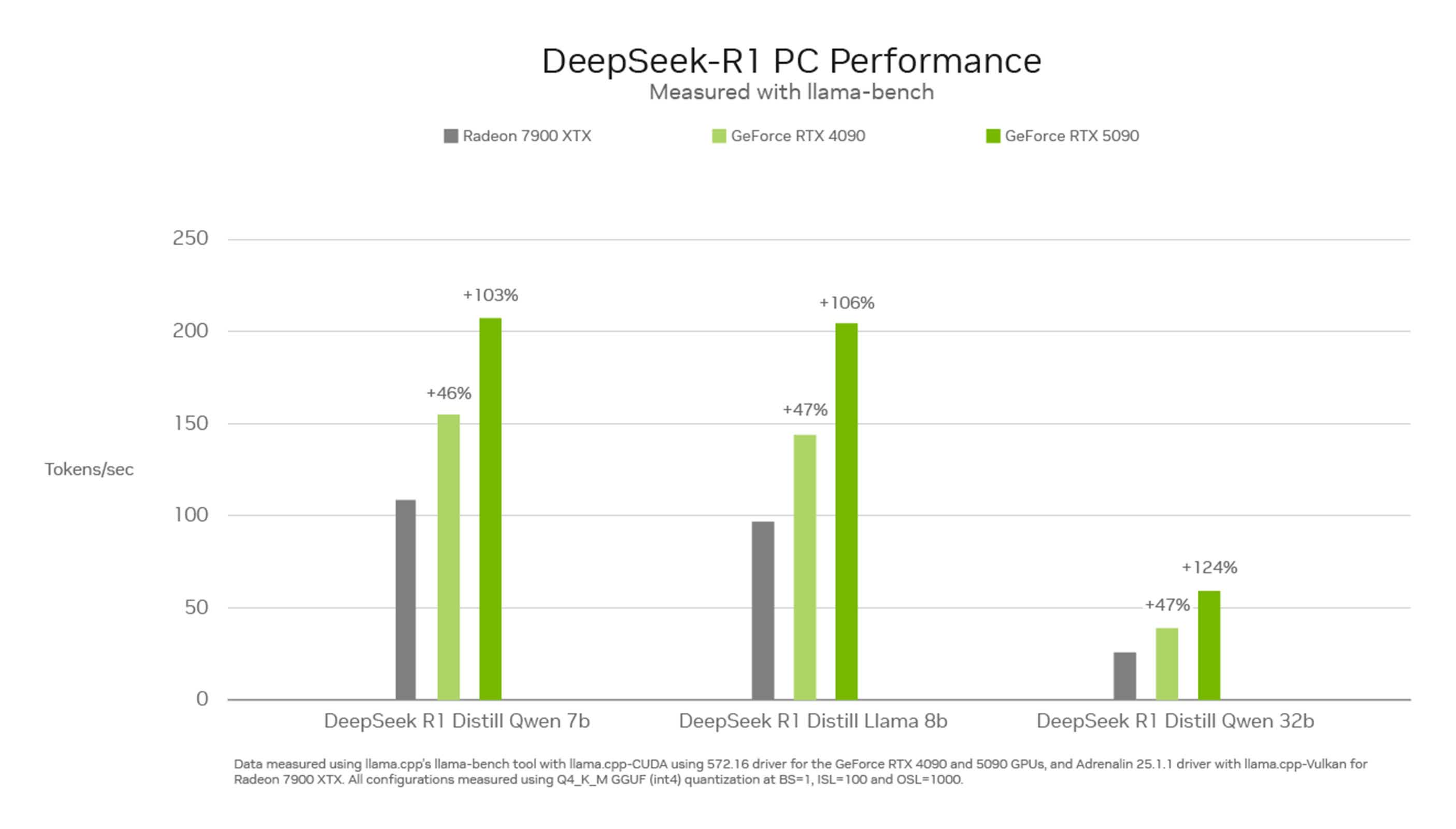
The tech giant conducted extensive benchmarks using three versions of the DeepSeek R1 AI model: Distill Qwen 7b, Llama 8b, and Qwen 32b. When using the Qwen LLM with 32b parameters, Nvidia reports that the RTX 5090 was 124 percent faster than AMD's contender, while the previous-generation RTX 4090 still managed a 47 percent lead.
Similar patterns emerged across other tests. With Llama 8b, the RTX 5090 reportedly outpaced the RX 7900 XTX by 106 percent, while the RTX 4090 maintained a 47 percent advantage. Even in the Qwen 7b test, Nvidia's latest offering was 103 percent quicker, with the RTX 4090 showing a 46 percent performance edge.
These results starkly contrast with AMD's earlier benchmarks, which had shown the RX 7900 XTX outperforming NVIDIA's RTX 4090 and 4080 in most scenarios, with leads of up to 113 percent and 134 percent, respectively.
Nvidia also claimed that its GeForce RTX 50 Series GPUs, powered by up to 3,352 trillion operations per second of AI processing capability, are uniquely positioned to run DeepSeek's family of distilled models faster than any other option in the PC market. This is because DeepSeek's R1 model family, which Nvidia described as part of a new class of 'reasoning models.
These LLMs are designed to mimic human problem-solving processes by allocating more computational resources to 'thinking' and 'reflecting' on complex issues. This approach, known as test-time scaling, allows the model to dynamically allocate computing resources during inference to reason through problems more effectively.
Nvidia also noted that its RTX 50 Series GPUs, featuring dedicated fifth-generation Tensor Cores, are built on the same Blackwell GPU architecture that drives AI innovations in data centers. This architecture enables RTX to fully accelerate DeepSeek models, delivering peak inference efficiency on personal computers.
The company also touted its RTX AI platform, an ecosystem that opens up DeepSeek-R1 capabilities to over 100 million Nvidia RTX AI PCs worldwide, including those equipped with the latest GeForce RTX 50 Series GPUs.
Nvidia argued that high-performance RTX GPUs ensure AI capabilities remain accessible, even without an internet connection. This not only offers low latency but also enhances privacy, as users can avoid uploading sensitive materials or exposing their queries to online services.
Nvidia fires back at AMD, claims RTX 5090 is twice as fast as top Radeon in DeepSeek benchmarks


