Nvidia warranty payouts surged 1,000% last year, not that they can't afford it

Daniel Sims

Posts: 2,480   +75
Staff
Connecting the dots: A warranty tracker recently reported that claims fulfilled by AMD and Nvidia increased substantially over the past few years, astronomically so in Team Green's case. While the report does not fully explain the sudden increase, the numbers coincide conspicuously with the AI boom and the release of flagship Nvidia graphics cards that became notorious for melting and burning power cables.
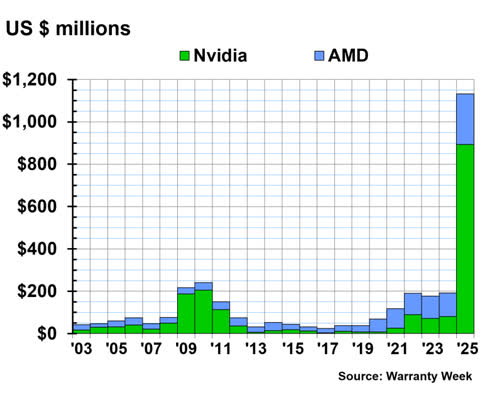
Charts from Warranty Week indicate that Nvidia paid $894 million in warranty claims in 2025, an 11-fold increase from $84 million the prior year. Although the newsletter does not mention specific products, 2025 saw the release of the company's RTX 5090, which has well-documented power cable issues.

The GPU manufacturer paid more in claims during each quarter of 2025 than in all of 2023: $147 million in Q1 (the RTX 5090 launched in January), $80 million in Q2, and $156 million in Q3. However, the majority of claims, $511 million, were paid in the fourth quarter.
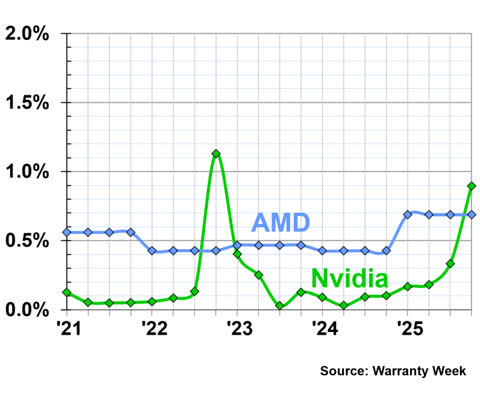
Warranty claims rates provide another notable data point. Nvidia's remained close to zero before 2023 but spiked to slightly over 1% that year, then settled back down before spiking again in 2025. Furthermore, last year's explosion in claims was preceded by a much smaller, but still significant rise in claims that began in 2022, potentially following the release of the RTX 4090 in October of that year.

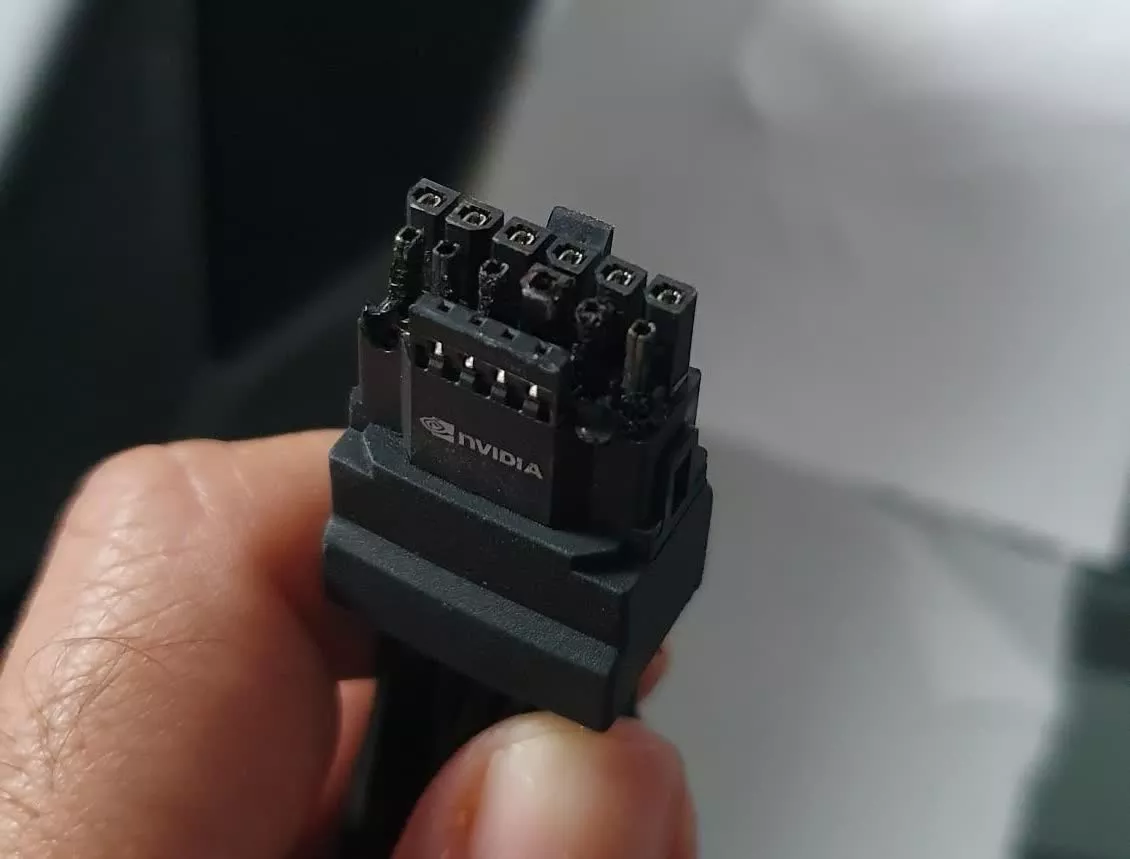
The two monstrous flagship GPUs, which remain at the top of PC gaming performance charts today, are infamous for their adoption of 12VHPWR and later 12V-2x6 power cables as well as their unusually high power ratings. Nvidia received numerous complaints from owners of the 450W RTX 4090 about melting power cables. Even after the company blamed user error, repair shop Northridge Fix said in 2024 that it was receiving hundreds of melted 4090s each month.
Reports persisted after GPU manufacturers switched to the supposedly safer 12V-2x6 cables and other companies introduced various safety features. Late last year, Northridge Fix, still receiving damaged flagship GPUs, criticized the RTX 5090's design.

Although Nvidia's warranty payout spikes coincide with the introduction of the RTX 4090 and 5090, other factors might also be involved. The report does not specify whether it includes only claims from home users of discrete graphics cards or also enterprise servers, the latter of which have exploded in number since Nvidia GPUs sparked the AI boom. On top of its astronomical increase in data center GPU sales, Nvidia likely also pays more for each claim due to tariffs.

Permalink to story:

 
Once again we're assuming that the 12v connector is to blame when the compute and networking cards, which per Nvidias own financial statements is the source of the drastic increase in warranty costs, don't use it.
 
Incredible!
But more Incredible than this is that they wouldn't change such a failure of a design, worsening it's condition from 30x to 40x series gpus.
 
“Explosion “ == 1 percent… I call “clickbait “!

Nvidia has sold more GPUs over the past few years than they’ve sold in their history… of COURSE there are more RMA claims!

The graph shows it peaks at 1% … there’s no story here…
 
“Explosion “ == 1 percent… I call “clickbait “!

Nvidia has sold more GPUs over the past few years than they’ve sold in their history… of COURSE there are more RMA claims!

The graph shows it peaks at 1% … there’s no story here…
Someone doesn't understand the difference between an imperial number of failures and a failure rate.

1 in 100 and 10 in 1000 are the same failure rate. 1 in 100 and 100 in 1000 are not.

Nvidias failure rate has increased, not just the number of failures, the percapita failures. Per capita doesn't care how many you sold in total. Doubling the number sold wouldn't change per capita.
 
Someone doesn't understand the difference between an imperial number of failures and a failure rate.

1 in 100 and 10 in 1000 are the same failure rate. 1 in 100 and 100 in 1000 are not.

Nvidias failure rate has increased, not just the number of failures, the percapita failures. Per capita doesn't care how many you sold in total. Doubling the number sold wouldn't change per capita.
And someone doesn't read graphs... it has peaked at just over 1% - both times (end of 2022 and now) - despite the insane amount of sales, the quality remains the same. Hence... no story here...
 
The data is poor, the title is click bait.

the actual article does a decent job of outlining all the unknowns, but the majority of the article is taking unknown data to make it about gaming video cards.

 
And someone doesn't read graphs... it has peaked at just over 1% - both times (end of 2022 and now) - despite the insane amount of sales, the quality remains the same. Hence... no story here...
Sure. Failure rate at 1% is considered as not bad.
But going from 0.1% to 0.9% means that failure rate did grow 9 times.
Multiple that with amount of GPUs sold and higher prices ... and you will get 10x more money paid for warranty claims.
Which is what article says.
 
Sure. Failure rate at 1% is considered as not bad.
But going from 0.1% to 0.9% means that failure rate did grow 9 times.
Multiple that with amount of GPUs sold and higher prices ... and you will get 10x more money paid for warranty claims.
Which is what article says.
Did you REALLY read the graphs? They went to 1% back in 2022 as well - then down again… then back to 1% again… this isn’t a story…
 
Sure. Failure rate at 1% is considered as not bad.
But going from 0.1% to 0.9% means that failure rate did grow 9 times.
Sure .. if that data is valid. The graph, however, clearly shows otherwise. The very month after the 4090 was released and the media's "melting" campaign began, the RMA rate instantly spiked to 1%.

Fast forward a few months to early 2023 -- NVidia keeps selling more 4090s. If a design flaw was inherent, we'd expect RMAs to continue rising. But, with the die down in media attention, the RMA rate returns to near zero. That rather clearly proves the problem here lies not in card design, but the lemming-like behavior of today's Internet videogamer.
 
The panic of 4090 owner may be behind the rise of claims after the 1st wave of "burned connectors articles"
And? Did you read the rest of the comments? The panic seems to have vanished once a few months passed - much like I’m sure the 5090 panic will do as well…

As an aside, I got an anti-sag bracket for my 4090 and have had no issues for over 2 years - much like over 99% of the rest of Nvidia owners…
 
Once again we're assuming that the 12v connector is to blame when the compute and networking cards, which per Nvidias own financial statements is the source of the drastic increase in warranty costs, don't use it.
Their compute cards do. Networking cards likely require much less power and can be bus powered.

Plus it's inherently wrong to compared server and DIY setups. Servers have world class cooling and people who monitor and maintain them. DIY ranges from competent builders who assemble 50+ computers a year to dimwits with too much money not knowing what a 5090 even is, but stupid enough to buy it on recommendation and then proceed to haphazardly assemble the PC themselves with poor cooling to boot.
That rather clearly proves the problem here lies not in card design, but the lemming-like behavior of today's Internet videogamer.
Ah yes. It's the whiny gamers argument again. Meanwhile people well versed in component design and PCB's have called out the flawed design:
 
Incredible!
But more Incredible than this is that they wouldn't change such a failure of a design, worsening it's condition from 30x to 40x series gpus.
End the end, a weak design equals more money in our economy.

The number of sold units will always be higher than RMAed units.

No gov will force a resolution on Nvidia, so the scam continues.
 
Ah yes. It's the whiny gamers argument again. Meanwhile people well versed in component design and PCB's have called out the flawed design:
The mere fact you quote "Buildoidz" as a renowned expert on electrical engineering proves my point better than I can myself. Nothing changes the reality here: if a design defect existed, RMA rates would have steadily increased in pace with the number of cards outstanding. Instead, rates cratered the moment media attention turned elsewhere.
 
Back