Nvidia has overtaken Apple as TSMC's largest customer, Jensen Huang says

Skye Jacobs

Posts: 1,913   +58
Staff
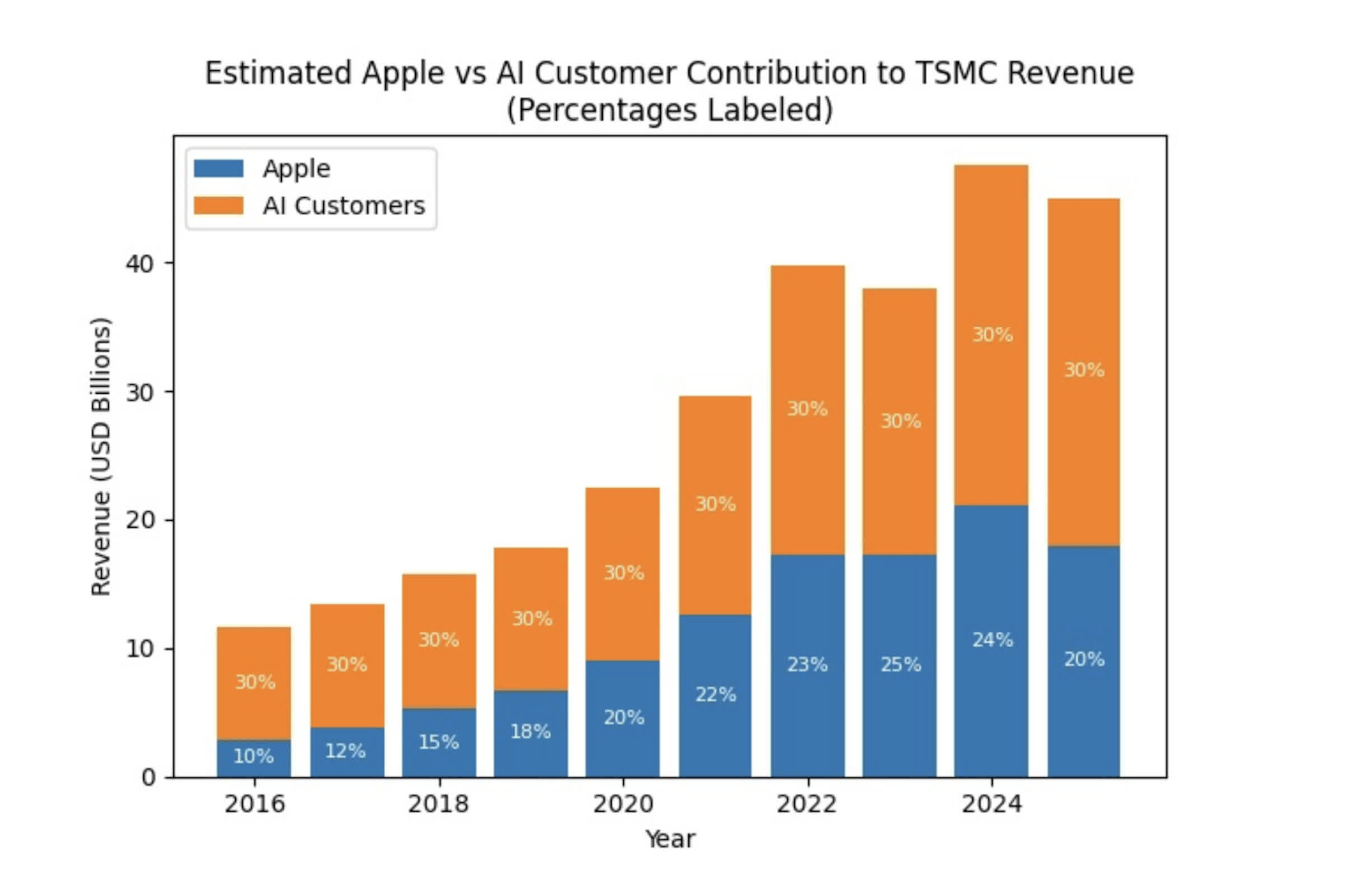
What just happened? The world's most valuable semiconductor relationship just shifted: Nvidia has overtaken Apple as the largest customer of TSMC, according to CEO Jensen Huang. The disclosure, paired with his separate call for "trillions" of dollars in new AI infrastructure investment, illustrates how the center of gravity in tech hardware is moving rapidly from mobile devices to artificial intelligence systems.
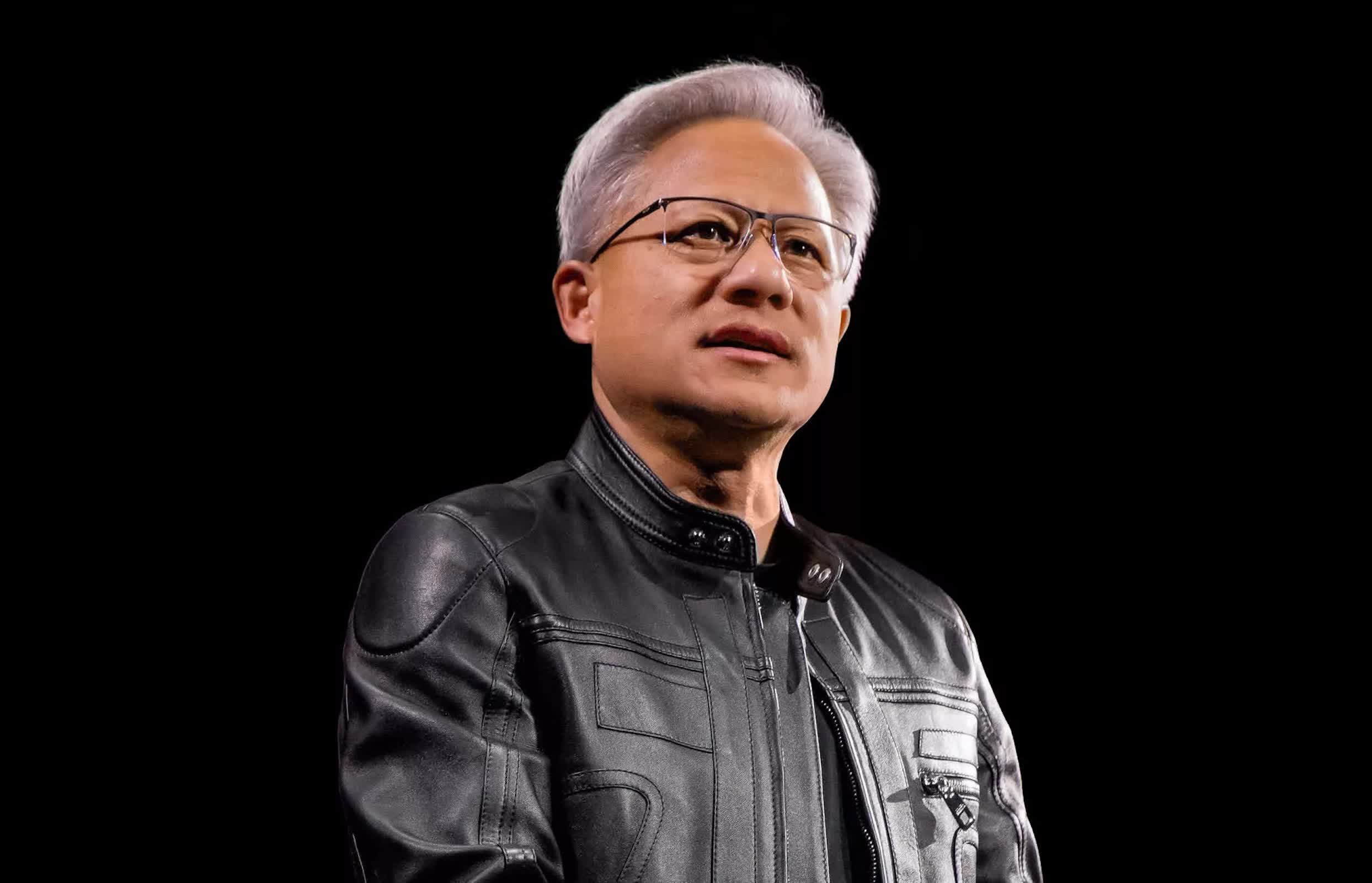
Huang made the remark about TSMC during an interview on the A Bit Personal with Jodi Shelton podcast. When the host referred to TSMC founder Morris Chang's recollection that a young Huang once promised to become one of the foundry's biggest clients, Huang laughed and said, "Morris will be happy to know Nvidia is TSMC's largest customer now."

It's a symbolic turn: Apple seized that spot more than a decade ago, after TSMC became the exclusive manufacturer of its iPhone and iPad processors. Nvidia had been a leading partner in the early 2000s, before mobile silicon and Apple's custom chips vaulted Cupertino to the top.

The reversal reflects the explosive economics of AI. Every major cloud provider and enterprise is racing to secure Nvidia GPUs – fueling record revenue for Nvidia and forcing chip foundries to reallocate capacity toward AI processors. A tipster says TSMC may even be raising prices for Apple's production runs and will no longer give Apple priority in shipments, though neither company has confirmed any such changes.
A few days after his podcast appearance, Huang took a broader view at the World Economic Forum, where he joined BlackRock CEO Larry Fink in a fireside discussion about AI's economic footprint. There, he characterized the global AI system as a "five-layer cake," starting with energy at the base, followed by semiconductors, cloud infrastructure, AI models, and finally the application layer that generates revenue across industries.

He described the current moment as the early stage of "the largest infrastructure buildout in human history" – a transformation already involving hundreds of billions of dollars and ultimately requiring trillions more.

That scaffold, he explained, extends from electricity generation and chip production to data centers and specialized applications in sectors such as healthcare, manufacturing, and finance. TSMC plans roughly 20 new fabrication plants worldwide, while manufacturers like Foxconn, Quanta, and Inventec are developing dozens of new "AI factories" to assemble GPU-based systems. Semiconductor heavyweights, including Micron, SK Hynix, and Samsung, are also investing tens to hundreds of billions of dollars to meet soaring memory demand.

Huang said venture capital spending now reflects this shift. 2025 was one of the biggest years on record for AI-focused startups, with funding flowing into so-called "AI-native" companies across key industrial categories. That momentum, he suggested, validates the confidence fueling Nvidia's rise from a graphics-card designer to a supplier critical to the entire digital economy.

Both developments – the confirmation that Nvidia now leads TSMC's revenue chart and Huang's trillion-dollar forecast for AI buildout – capture a single trend: computing's gravitational pull has moved away from consumer electronics and toward industrial-scale intelligence. As long as that momentum continues, Nvidia's grip on both chip manufacturing demand and AI infrastructure design seems likely to deepen even further.

Permalink to story:

 
Nice example of scale differences between products for everyone and a few ultra rich. How insane the tech spending have to get for it to catch people buying phones.

Incidentally, this is why everyone wants to sell a not-a-screenless-phone-promise AI hardware device.
 
Just as human progress hinges on our ability to efficiently harness energy from the environment (first harnessing chemical energy via burning fuels, then harnessing potential energy through nuclear reactors, and harnessing the kinetic energy of photons via solar photovoltaic panels and who knows what’s next...), computing advancements specifically are similarly fundamentally driven by how the ASML machine laser interacts with the tin droplet. This involves progressively hitting the droplet more times: once for the first level initially, twice for the second level today, and three times for the latest High NA EUV machines.

So, this simple concept, the number of laser hits on the tin droplet inside the ASML machine, determines the strength of the violet light produced, thus expanding the available space for progress in computing. All subsequent layers are, of course, also important, but at the core is that laser, which strives to hit the tin droplet in the best way to produce the ultraviolet light with the maximum energy.
 
Just as human progress hinges on our ability to efficiently harness energy from the environment (first harnessing chemical energy via burning fuels, then harnessing potential energy through nuclear reactors, and harnessing the kinetic energy of photons via solar photovoltaic panels and who knows what’s next...), computing advancements specifically are similarly fundamentally driven by how the ASML machine laser interacts with the tin droplet. This involves progressively hitting the droplet more times: once for the first level initially, twice for the second level today, and three times for the latest High NA EUV machines.

So, this simple concept, the number of laser hits on the tin droplet inside the ASML machine, determines the strength of the violet light produced, thus expanding the available space for progress in computing. All subsequent layers are, of course, also important, but at the core is that laser, which strives to hit the tin droplet in the best way to produce the ultraviolet light with the maximum energy.
Your point?
 
Your point?
My point highlights that it's not only about TSMC's capacity. For example, the next generation of Vera Rubin cannot simply have more transistors and be manufactured on the same TSMC node as Blackwell, which already shares a node very similar to Hopper's. Without an increase in the density of transistors, a chip with more transistors will become too power-consuming and difficult to cool, and yields will decrease, making it increasingly expensive. So, the ability to overcome these fundamental barriers and expand the ability for progress, depends entirely on the ASML machine.
 
My point highlights that it's not only about TSMC's capacity. For example, the next generation of Vera Rubin cannot simply have more transistors and be manufactured on the same TSMC node as Blackwell, which already shares a node very similar to Hopper's. Without an increase in the density of transistors, a chip with more transistors will become too power-consuming and difficult to cool, and yields will decrease, making it increasingly expensive. So, the ability to overcome these fundamental barriers and expand the ability for progress, depends entirely on the ASML machine.
Yes… but the article wasn’t about TSMC’s capacity… it was about NVIDIA becoming their largest customer.
 
You can, if you want to pay 10k US $ for one. AI chatbot wars are screwing too many things up.

5090 was never really meant for gamers. It is a prosumer card. 32GB is massive overkill for gaming. 5090 is selling like crazy to people doing AI workloads at smaller scale, homelabs etc. Even companies buy them (depending on AI budget)

5090 makes sense still, because Nvidia uses the 5090 to show its gaming dominance, yet most gamers buy 5080 or slower. 5060, 5070 and somewhat 5080 series is still the bread and butter, aimed at gamers and what most gamers buy.

Nvidia sits at 90% gaming marketshare without even trying and AMD don't seem to want to participate much, as making "cheap GPUs" lowers their CPU/APU output at TSMC, which is where they make the most money.

And this is why we need a good TSMC alternative. Hopefully Intel 18A/14A will be decent and cheap. I lost hope in Samsung, as their "2nm" node seems worse than TSMC 5nm and almost at TSMC 7nm. Intel is still the closest competitor to TSMC.

Chinas SMIC is not even beating TSMC 7nm. So SMIC / Samsung is def. worse than Intel overall.

TSMC ramped prices multiple times over the last 5 years. Monopoly is bad. Having companies compete over allocation only makes this worse.

I could easily see Nvidia using a cheaper fab than TSMC 3nm for RTX 6000 series just like they did with RTX 3000 series, where TSMC was heavily "overbooked" as well. Result? Nvidia gained alot of marketshare due to "cheap" Samsung 8nm chips, which they continued to make and sell,. even after RTX 4000 came out at TSMC 5nm.

However, if RAM constraints keep being a problem, it will make less sense to make gaming products on a cheaper and worse node. If RAM continues to be a problem, I could see both Nvidia and AMD not releasing any lower end GPUs and save the RAM modules for mid to high-end stuff next generation.
 
Last edited:
5090 was never really meant for gamers. It is a prosumer card. 32GB is massive overkill for gaming. 5090 is selling like crazy to people doing AI workloads at smaller scale, homelabs etc. Even companies buy them (depending on AI budget)

5090 makes sense still, because Nvidia uses the 5090 to show its gaming dominance, yet most gamers buy 5080 or slower. 5060, 5070 and somewhat 5080 series is still the bread and butter, aimed at gamers and what most gamers buy.

Nvidia sits at 90% gaming marketshare without even trying and AMD don't seem to want to participate much, as making "cheap GPUs" lowers their CPU/APU output at TSMC, which is where they make the most money.

And this is why we need a good TSMC alternative. Hopefully Intel 18A/14A will be decent and cheap. I lost hope in Samsung, as their "2nm" node seems worse than TSMC 5nm and almost at TSMC 7nm. Intel is still the closest competitor to TSMC.

Chinas SMIC is not even beating TSMC 7nm. So SMIC / Samsung is def. worse than Intel overall.

TSMC ramped prices multiple times over the last 5 years. Monopoly is bad. Having companies compete over allocation only makes this worse.

I could easily see Nvidia using a cheaper fab than TSMC 3nm for RTX 6000 series just like they did with RTX 3000 series, where TSMC was heavily "overbooked" as well. Result? Nvidia gained alot of marketshare due to "cheap" Samsung 8nm chips, which they continued to make and sell,. even after RTX 4000 came out at TSMC 5nm.

However, if RAM constraints keep being a problem, it will make less sense to make gaming products on a cheaper and worse node. If RAM continues to be a problem, I could see both Nvidia and AMD not releasing any lower end GPUs and save the RAM modules for mid to high-end stuff next generation.
5090 was totally meant for gamers… Prosumers bought them up (as they do all 90 / Titan cards) because they perform great without paying “Pro” prices…and they don’t require the support of those cards…

You don’t think Nvidia would rather sell them for the 5000 / 6000 pro prices instead?

This is the reason the gaming cards are scarce - they make FAR more profit from their “real” pro cards.
 
5090 was totally meant for gamers… Prosumers bought them up (as they do all 90 / Titan cards) because they perform great without paying “Pro” prices…and they don’t require the support of those cards…

You don’t think Nvidia would rather sell them for the 5000 / 6000 pro prices instead?

This is the reason the gaming cards are scarce - they make FAR more profit from their “real” pro cards.
Gaming cards are not scarce, 5090 is

5090 is not made for gaming, because no game needs 32GB or even close, by the time games will need 32GB, 5090 will be outdated

I know 3 people with 5090, none of them mainly play games but uses them for AI and work, which is why they wanted 32GB VRAM

99.752% of gamers buys 5080 and lower.
 
Gaming cards are not scarce, 5090 is

5090 is not made for gaming, because no game needs 32GB or even close, by the time games will need 32GB, 5090 will be outdated

I know 3 people with 5090, none of them mainly play games but uses them for AI and work, which is why they wanted 32GB VRAM

99.752% of gamers buys 5080 and lower.
Scarcity has nothing to do with what something is MEANT for.

No game NEEDS 32gb - but the card certainly performs better for games than any other….

Who you know is irrelevant- there are over 8 billion people on this planet - your personal acquaintances are not statistically significant.
 
Scarcity has nothing to do with what something is MEANT for.

No game NEEDS 32gb - but the card certainly performs better for games than any other….

Who you know is irrelevant- there are over 8 billion people on this planet - your personal acquaintances are not statistically significant.
Tons of games wants 32GB today, unless you accept degraded performance.

Many new AAA games even has 32GB listed in requirements, so its official.
16GB is only enough for esport titles or AAA games on lower presets.


You speak like a person who plays old games on old hardware when saying 16GB RAM is plenty, yet claims 5090 is selling like crazy to gamers.. Makes sense :joy:

Absolutely no 5090 owners use less than 32GB RAM.
 
Tons of games wants 32GB today, unless you accept degraded performance.

Many new AAA games even has 32GB listed in requirements, so its official.
16GB is only enough for esport titles or AAA games on lower presets.


You speak like a person who plays old games on old hardware when saying 16GB RAM is plenty, yet claims 5090 is selling like crazy to gamers.. Makes sense :joy:

Absolutely no 5090 owners use less than 32GB RAM.
Think you’re replying to the wrong person… I argued that the 5090 IS for gamers…
 
Think you’re replying to the wrong person… I argued that the 5090 IS for gamers…
No I did not, because 5090 is selling in extremely low quantity to "gamers"
Gamers meaning people that only play games and nothing else.

5090 is selling well due to 32GB VRAM which is great for AI / work. 5090 is a cheap entry level alternative for doing AI workloads, even companies buys 5090s for AI

5090 scarcity began because of this.
 
No I did not, because 5090 is selling in extremely low quantity to "gamers"
Gamers meaning people that only play games and nothing else.

5090 is selling well due to 32GB VRAM which is great for AI / work. 5090 is a cheap entry level alternative for doing AI workloads, even companies buys 5090s for AI

5090 scarcity began because of this.
Then you’re just being silly… yes, the 90 series cards (and titans before them) were always purchased as a cheap quadro/pro card… but… do you think that’s WHY they were made?
Why would Nvidia want you to only pay 2-3k for a card when they could sell it for double (or more) to an enterprise?

The 5090 is meant for gamers - that it is sometimes being purchased for other uses is not really relevant to the conversation.

Look at the GAMING benchmarks…
 
Then you’re just being silly… yes, the 90 series cards (and titans before them) were always purchased as a cheap quadro/pro card… but… do you think that’s WHY they were made?
Why would Nvidia want you to only pay 2-3k for a card when they could sell it for double (or more) to an enterprise?

The 5090 is meant for gamers - that it is sometimes being purchased for other uses is not really relevant to the conversation.

Look at the GAMING benchmarks…
5090 is not made for gamers. No game needs 32GB VRAM or even close. Even 24GB is overkill. It is entry level AI cards.

9 out of 10 buying a 5090 series card (5090D included) don't use them for gaming.

You can buy 4x 5090 for a single 96GB RTX Pro card. No comparison. The 5090s are better value depending on AI workload. Hence why stock is low and price skyrocketed.
 
5090 is not made for gamers. No game needs 32GB VRAM or even close. Even 24GB is overkill. It is entry level AI cards.
But they DO perform better on games than any other card…
9 out of 10 buying a 5090 series card (5090D included) don't use them for gaming.
Not the point - They make them to show they make the best GAMING card in the world.
You can buy 4x 5090 for a single 96GB RTX Pro card. No comparison. The 5090s are better value depending on AI workload. Hence why stock is low and price skyrocketed.
Yes - but you don’t get the enterprise support. It’s kind of like how MS doesn’t care if individuals pirate windows/office as long as enterprises pay full price.
 
But they DO perform better on games than any other card…

Not the point - They make them to show they make the best GAMING card in the world.

Yes - but you don’t get the enterprise support. It’s kind of like how MS doesn’t care if individuals pirate windows/office as long as enterprises pay full price.
Stop being clueless, people that know what they are doing don't need "enterprise support" anyway, haha

5090 is better value for AI and that is the only thing that matter. 5090D sells in huge quantity for AI to China. 5090/5090D is selling mostly to non-gamers.

5090 has a 0.39% share on Steam HW Survey. Less than AMD RX 570 and you claim gamers is flocking around 5090? hahah

Nvidia launched the 5090 "for gamers" to show how much they are ahead compared to AMD but in reality, RTX 5080 and below is what is selling. Also, 5080 and below won't catch fire when gaming = Big plus
 
Last edited:
Stop being clueless, people that know what they are doing don't need "enterprise support" anyway, haha
If you work for a company, you do… maybe get a clue?
5090 is better value for AI and that is the only thing that matter. 5090D sells in huge quantity for AI to China. 5090/5090D is selling mostly to non-gamers.
The amount of 5090s for sale pales in comparison to the amount of pro level cards being sold.
5090 has a 0.39% share on Steam HW Survey. Less than AMD RX 570 and you claim gamers is flocking around 5090? hahah
Cause there aren’t that many - it’s a flagship product meant for getting the best gaming benchmarks - profits come from other cards.
Nvidia launched the 5090 "for gamers" to show how much they are ahead compared to AMD but in reality, RTX 5080 and below is what is selling. Also, 5080 and below won't catch fire when gaming = Big plus
Now you’re contradicting yourself - yes, it’s for gamers :)
Everything they make sells - there’s a GPU crunch… but the PRO cards are the ones Nvidia makes the most profit from.
 
Back