Jensen Huang predicts Nvidia AI chip revenue will hit $1 trillion by 2027

Skye Jacobs

Posts: 2,010   +58
Staff
The big picture: The world's most valuable company is widening its ambitions once again. During Nvidia's annual GPU Technology Conference in Silicon Valley, chief executive Jensen Huang unveiled a sweeping roadmap that deepens the company's bets on artificial intelligence hardware and pushes its manufacturing footprint into new territory.
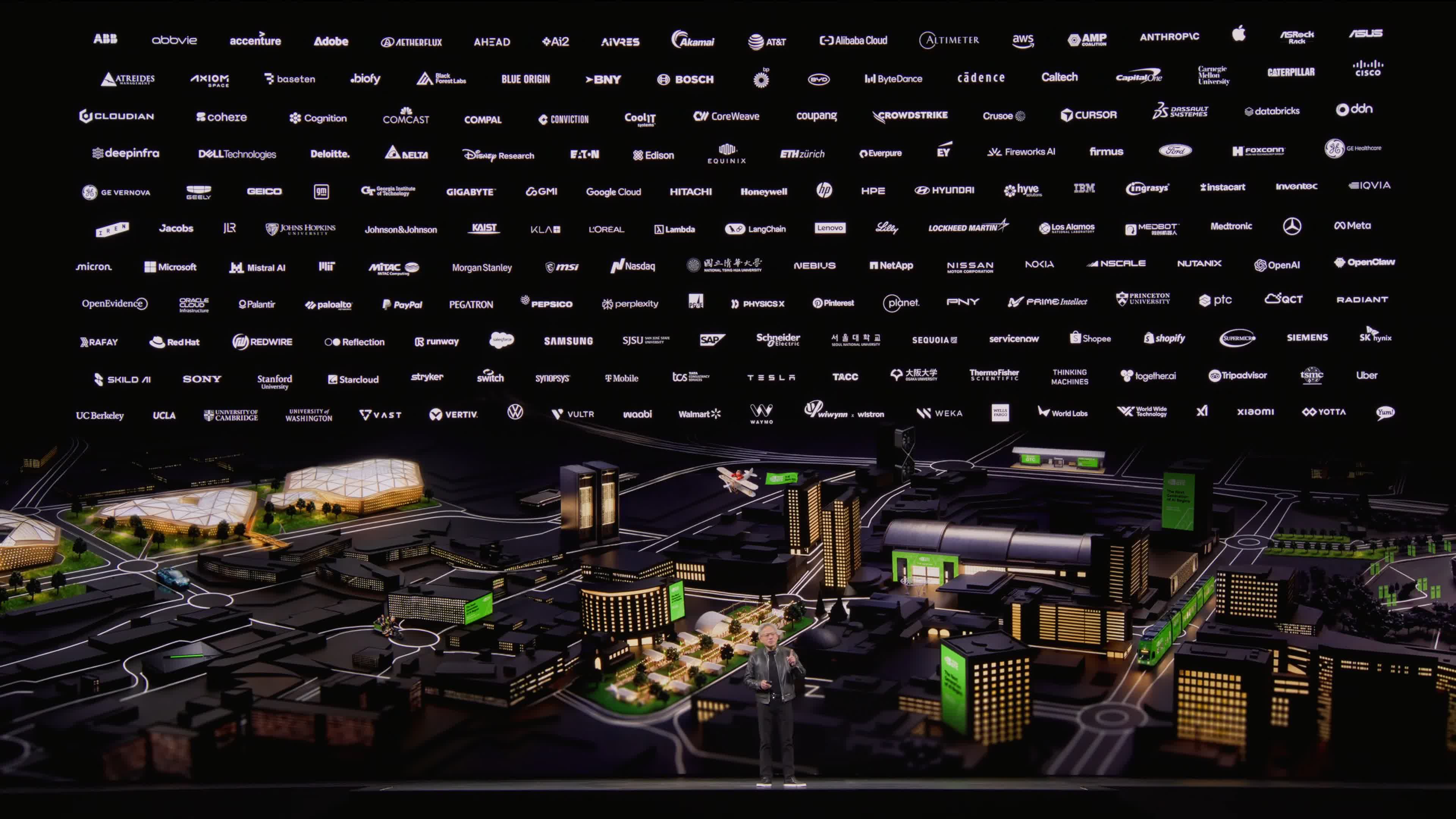
"The inference inflection has arrived," Huang said during the keynote, framing the next stage of the AI boom around systems designed not just to train models but to run them at massive scale.

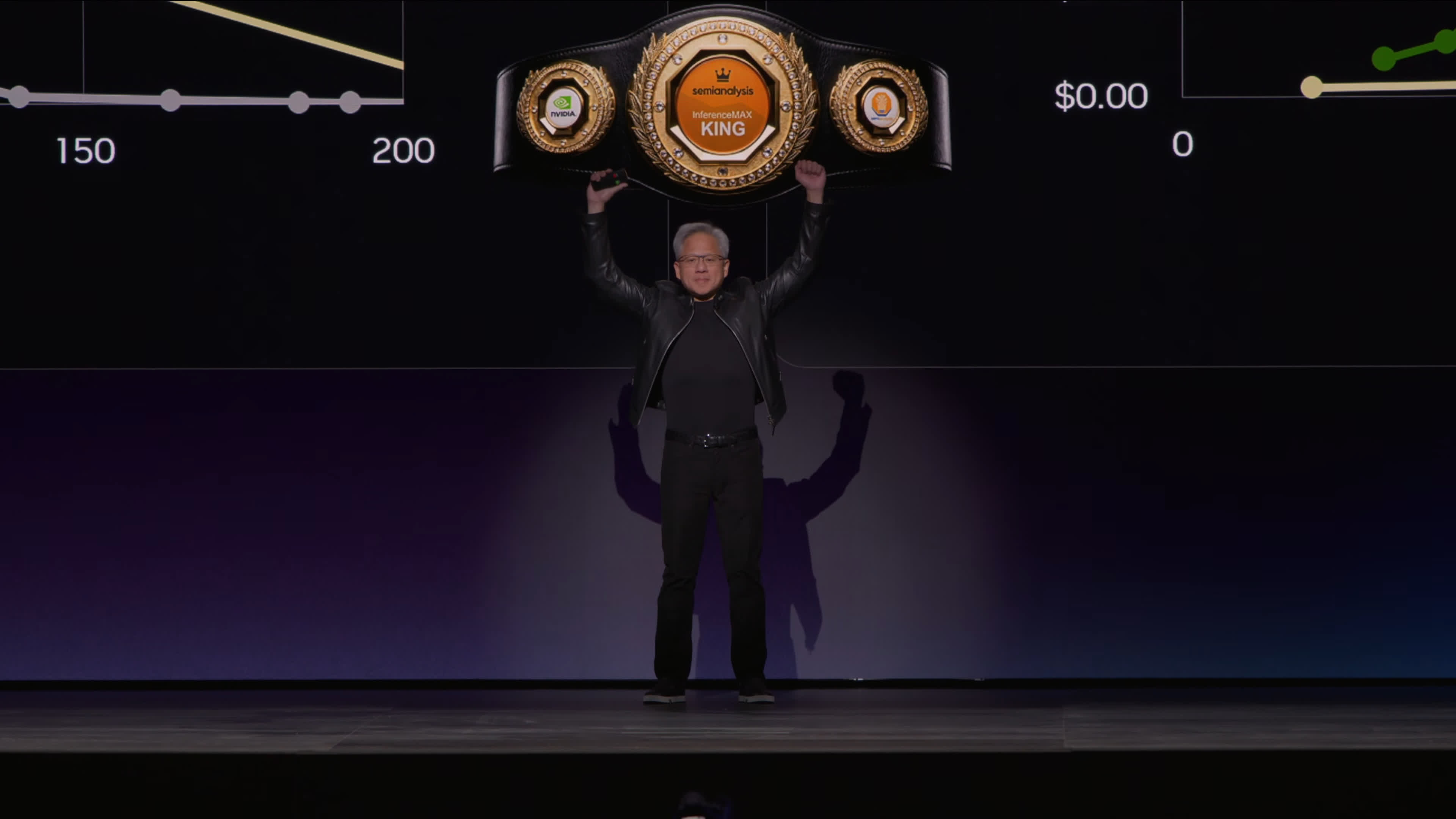
Huang said Nvidia expects revenue from AI-focused chips to total at least $1 trillion through 2027, roughly double his earlier projection of $500 billion through the end of 2026, as enterprise demand for computational capacity continues to surge.

The figure far exceeds Wall Street estimates, which peg Nvidia's total revenue for fiscal 2027 and 2028 at roughly $835 billion, according to Capital IQ data. Huang said his prediction stems from what he described as "high confidence demand and purchase orders" for the company's next-generation processors. The forecast also extends Nvidia's earlier cumulative outlook rather than representing a new annual revenue target, effectively stretching the company's previous $500 billion platform estimate by another year.

Huang's message was based on a familiar theme: that the exponential growth in computing power needed for AI inference continues to reshape the semiconductor industry's economics. The CEO cited rising enterprise adoption of AI developer tools, such as Anthropic's Claude Code, as one of the main drivers of the need for more efficient compute systems.
"Inference will only become more important as more companies adopt personal AI agent tools such as OpenClaw," he said.

Nvidia increasingly frames this next phase as the rise of "AI factories" running agentic workloads at scale, where inference demand could eventually eclipse model training as the dominant computing task.

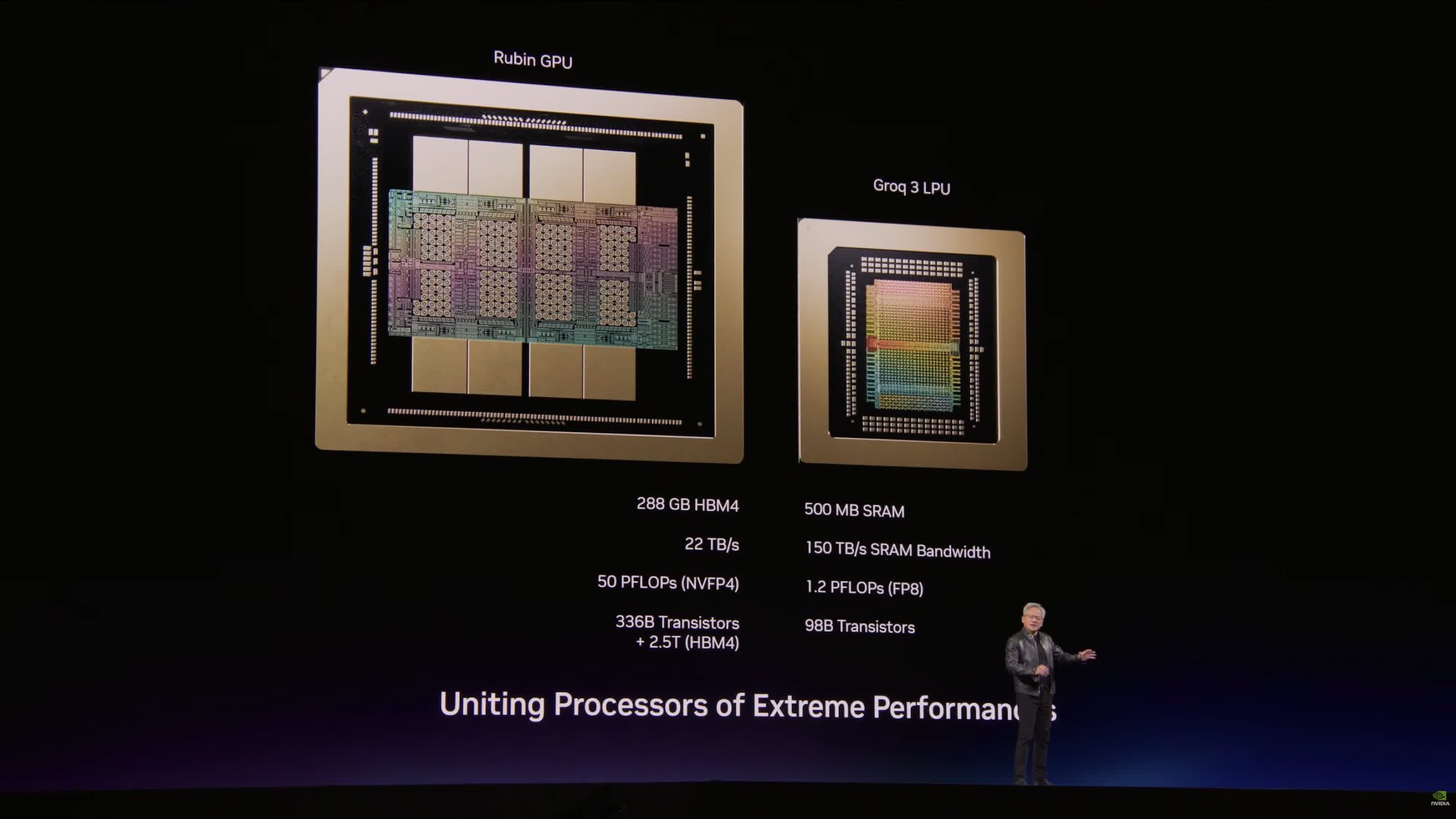
To feed that demand, Nvidia is expanding beyond its longstanding GPU architecture. Huang announced a new chip, the Groq 3, described as a "language processing unit" designed to accelerate the responsiveness of AI systems during user interactions. The chip will be produced by Samsung Electronics.
Groq 3 is also the first product to emerge from Nvidia's licensing agreement with chip startup Groq, signed late last year. The deal brought Groq founder Jonathan Ross – best known for his work on Google's early AI chips – into Nvidia's fold. Huang said the Groq 3 chips are already in volume production and scheduled to begin shipping in the second half of 2026, likely during the third quarter.
Huang also used the stage to highlight Nvidia's growing presence across unconventional computing environments. He detailed partnerships involving robotaxi systems and introduced a chip concept intended for "orbital data centers" – an approach aimed at managing AI workloads in space. The idea aligns loosely with similar concepts Elon Musk has floated, including integrating his companies SpaceX and xAI through such orbital infrastructure.

Analysts suggested that investors remain cautious, balancing near-term excitement over Nvidia's technological expansion with questions about the sustainability of long-term growth. Gene Munster, managing partner at Deepwater Asset Management, said the company's stock faces what he called a "wall of worry" despite sharply rising demand. "Bottom line from Jensen's keynote," he told the Financial Times, "demand is measurably stronger than even the highest expectations, and investors are still having a hard time getting comfortable with that."

Permalink to story:

 
Just wait till they start filling those Palantir domestic Reaper AI data centres, running pre-crime LLM's. We'll wish for Miniroty Report, as what's coming is far, far worse.

This because a RTX 6070 is going to cost 1,000,000,000 a card?
No, that's the 6030 512MB, which will be about equal to the 1030. There's no way the 6070 will be that cheap.
 
Considering the actual workload of the vast majority of inference hardware, this man is very happy selling trash compactors.
 
Really wish I'd invested in Nvidia back in the day.

Even if the AI bubble pops, Nvidia has made bank in a historic way.
there have been many most valuable companies in the past, there will be others in the future. AI ASIC chips are coming, nVidia won't hold the spotlight forever
 
there have been many most valuable companies in the past, there will be others in the future. AI ASIC chips are coming, nVidia won't hold the spotlight forever
Ok, but that doesnt dismiss anything Scott said. nVidia has absolutely skyrocketed in value and anyone that had shares pre cough when they were $3 a share made absolute bank.
 
Ok, but that doesnt dismiss anything Scott said. nVidia has absolutely skyrocketed in value and anyone that had shares pre cough when they were $3 a share made absolute bank.
Then he should start looking for the next most valuable company in the world. Hind sight is 20/20
 
People like to say the PC market has survived shocks before, crypto being the most recent, but this isn’t that. This time isn’t a cycle, it’s an economic shift driven by two forces that don’t care about gamers or enthusiasts.

First: AI. It’s consuming manufacturing capacity at a scale the PC market can’t compete with. And why would it? AI and data centers are where the money is. Foundries don’t run on nostalgia... they follow margins. If every advanced chip can be sold at a premium, it will be. The PC market isn’t being ignored... it’s being outbid.

Second: physics. For years node shrinks delivered easy wins that resulted in more performance, lower power, and cheaper transistors. That era is very much over. Progress is now slower, harder, and exponentially more expensive to implement. You can’t brute-force your way past the limits of reality and no amount of market demand can bend the laws of physics.

Put those together and this isn’t a temporary shortage or a rough patch, it’s a future where cutting-edge silicon is more difficult and more expensive to manufacture and the PC market is no longer first in line.
 
I wonder who wouldn't like to see this arrogant little toad get some comeuppance?
"Pride goeth before destruction, and an haughty spirit before a fall."
 
I wonder who wouldn't like to see this arrogant little toad get some comeuppance?
"Pride goeth before destruction, and an haughty spirit before a fall."
Even if that happens, you're still not thinking about the overall exponential increase in price when it comes to manufacturing. TSMC's 2 nm node prices are absolutely bonkers crazy. According to some estimates, it's $30,000 per 300mm wafer.
 
If we take a 300 mm wafer, it might yield 150 to 200 dies for a typical NVIDIA-class GPU, but once yield losses are factored in, that drops to roughly 110 to 185 usable chips. At around $30,000 per wafer, that’s about $160 to $270 per die.

Add 24 GB of GDDR memory—another $60 to $90—and now you’re looking at roughly $220 to $360 just for the silicon and memory before the card even exists.

Once you factor in the PCB, power delivery, cooling, assembly, and margins, that easily climbs into the $500 to $800 range in total board cost. By the time it hits retail at $800 to $1,200 or more, it’s not hard to see how you got there. This isn’t just markup—it’s the cost structure of modern GPUs finally catching up with reality.
 
If we take a 300 mm wafer, it might yield 150 to 200 dies for a typical NVIDIA-class GPU, but once yield losses are factored in, that drops to roughly 110 to 185 usable chips. At around $30,000 per wafer, that’s about $160 to $270 per die.

Add 24 GB of GDDR memory—another $60 to $90—and now you’re looking at roughly $220 to $360 just for the silicon and memory before the card even exists.

Once you factor in the PCB, power delivery, cooling, assembly, and margins, that easily climbs into the $500 to $800 range in total board cost. By the time it hits retail at $800 to $1,200 or more, it’s not hard to see how you got there. This isn’t just markup—it’s the cost structure of modern GPUs finally catching up with reality.

Mmm, please note that Nvidia has a profit margin of, what, 40-50% on these chips. It used to be less, but now they don't settle for less.
 
I wonder who wouldn't like to see this arrogant little toad get some comeuppance?
"Pride goeth before destruction, and an haughty spirit before a fall."
Believe it or not, there are people in the world who aren't hatefully envious of success.

Mmm, please note that Nvidia has a profit margin of, what, 40-50% on these chips. It used to be less, but now they don't settle for less.
55% as of last count ... but it was 16% back in 2023. The higher margins aren't because NVidia refuses to "settle for less", but the simple economics of price acting to equalize supply with demand.
 
there have been many most valuable companies in the past, there will be others in the future. AI ASIC chips are coming, nVidia won't hold the spotlight forever
I never said anything about forever.
If you bought Nvidia a few years ago your ROI is awesome.
Even if the bubble pops tomorrow Nvidia has a pile of cash to fund R&D for the next decade.
 
Believe it or not, there are people in the world who aren't hatefully envious of success.
🤣 When people figure out that polishing a turd still leaves them with a turd well...

Let's look at this in the not-too-distant future when people realize the similarity between AI and content companies drooling over the money they thought they would make by starting their own streaming services.

I'm not saying there are no valid use cases for AI, but as a general tool, AI is, so far, proving to be useless drivel.
 
I'm not saying there are no valid use cases for AI, but as a general tool, AI is, so far, proving to be useless drivel.
You can't alter reality by denying it. Medical diagnostics, logistics and shipping, industrial manufacturing, aerospace engineering, materials science, graphic design, mining and petroleum exploration, drug research and validation, translating and transcribing, financial fraud detection, video and audio editing -- there isn't a field out there that isn't being radically transformed by AI.
 
Back