Nvidia is giving developers more control over DLSS 5, after accusations it turns games into "AI slop"

midian182

Posts: 11,755   +179
Staff member
What just happened? Nvidia has revealed more details about DLSS 5, which has possibly become its most hated product ever because many consider it little more than an AI filter. The company has now explained more about the latest iteration of its rendering technology, including the (just) two sliders developers can use to alter the intensity.
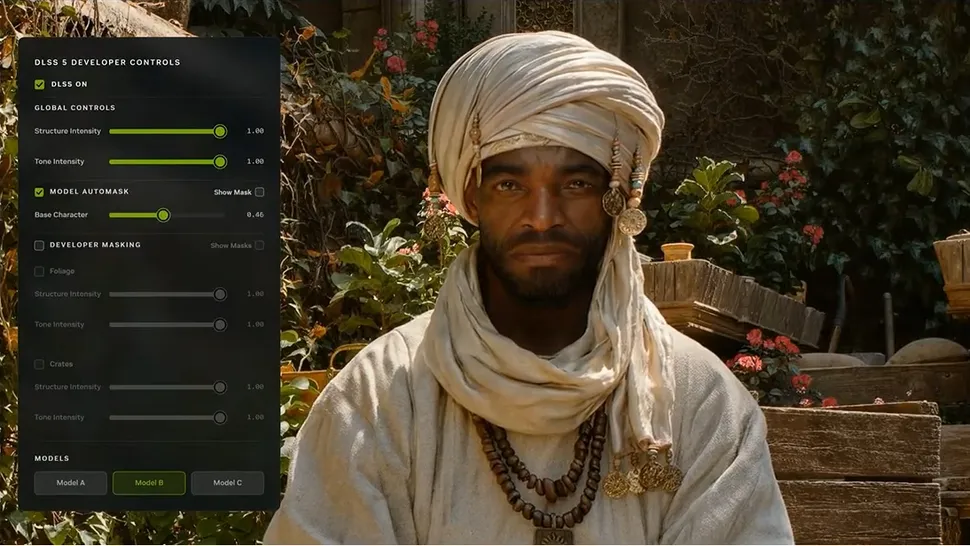
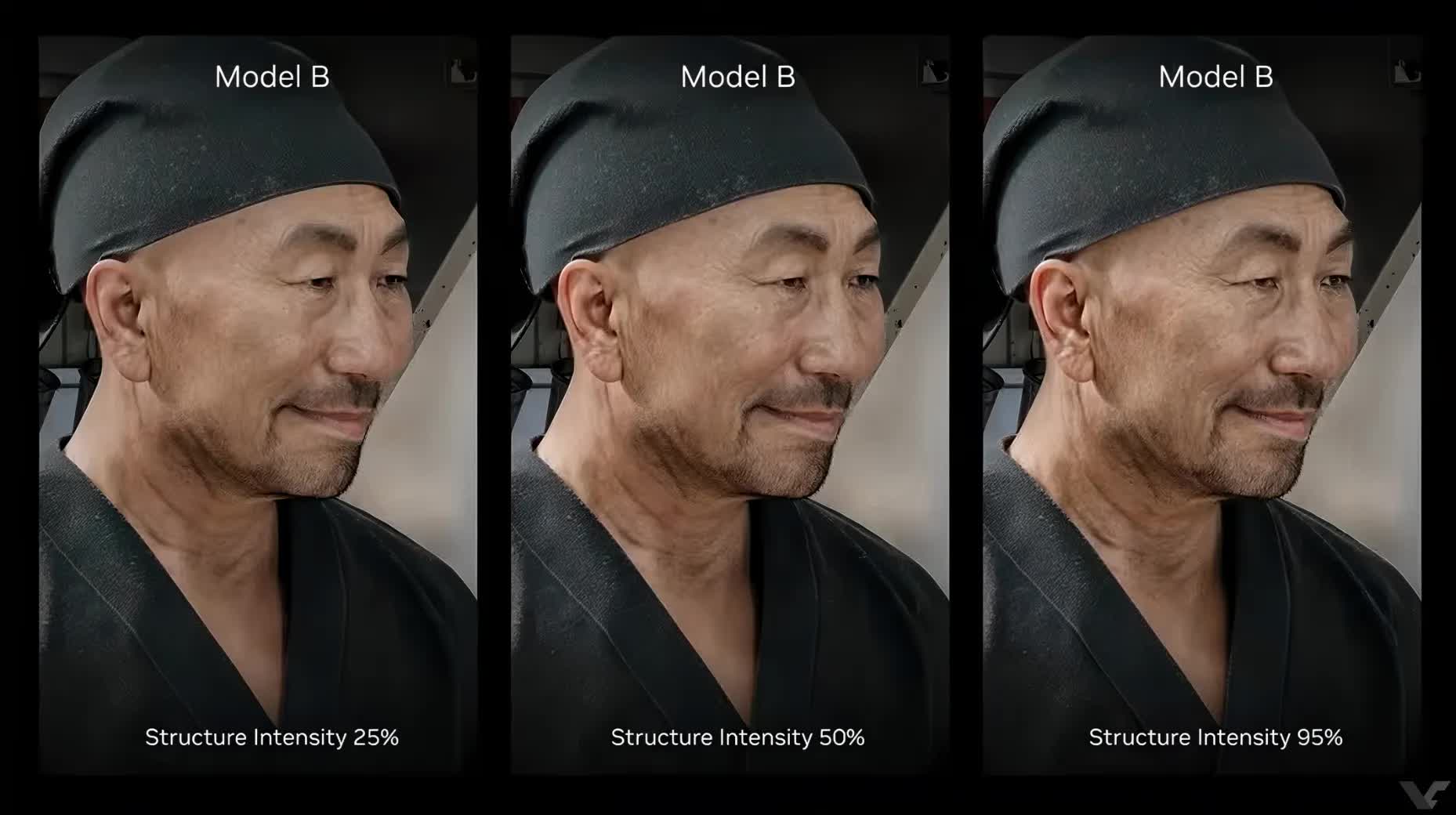
Nvidia used its SIGGRAPH 2026 keynote to demonstrate the controls that developers will receive when DLSS 5 launches this fall. The two main global sliders are Structure Intensity and Tone Intensity, which essentially determines how enthusiastically the AI repaints a frame.

Structure Intensity controls high-frequency details, including ambient occlusion, reflections, contact shadows, and subsurface scattering. Turning it up can improve how light passes through skin, hair, foliage, and translucent materials. Tone Intensity handles lower-frequency elements such as lighting, colors, and the broader mood of a scene.

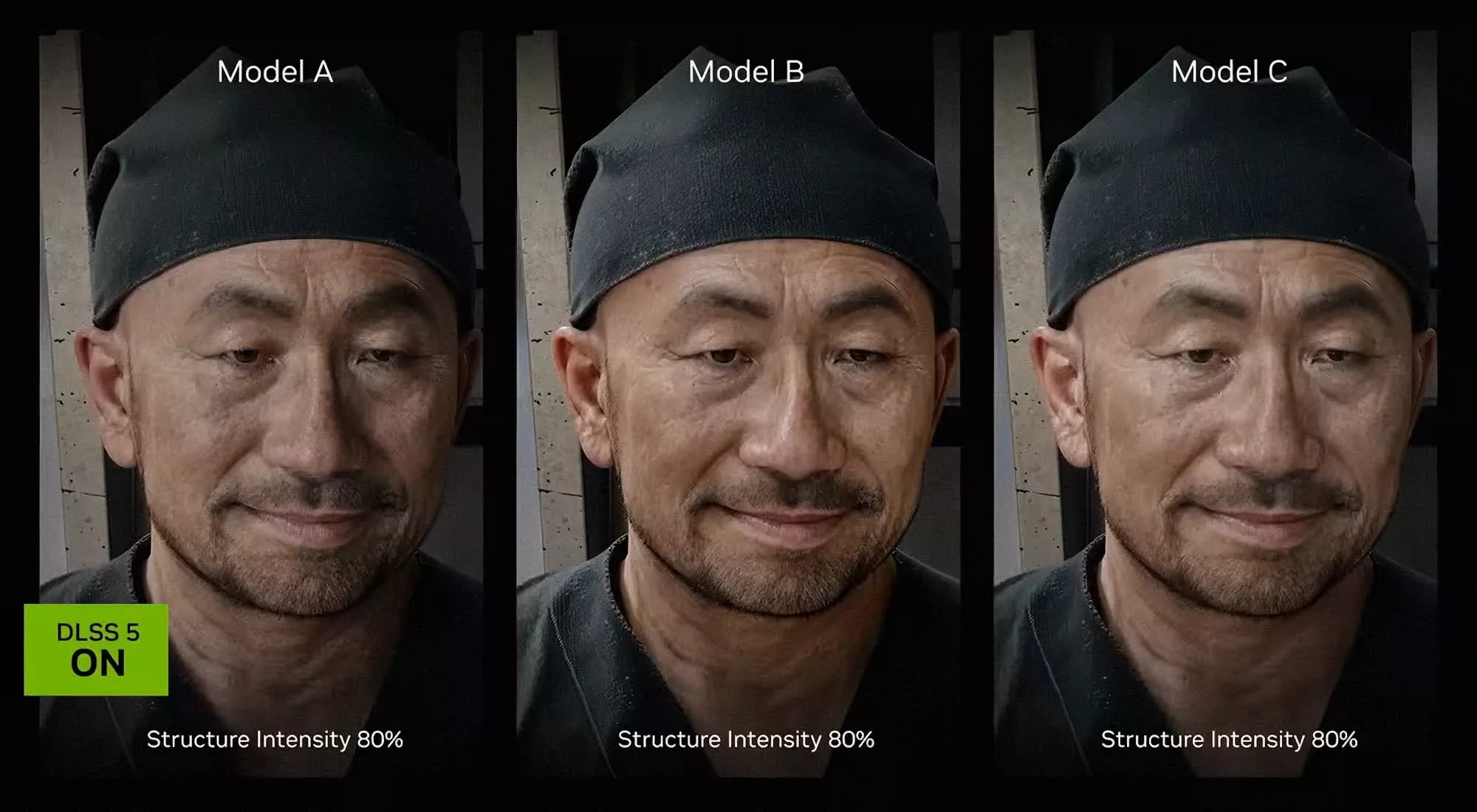
These aren't the only controls, despite the attention-grabbing total of only two sliders. DLSS 5 currently offers three separately trained models, labeled A, B, and C, each producing a different interpretation of the same rendered image.

Developers are not locked into one model for an entire game and can swap them between scenes, environments, and cutscenes.
The system can also automatically identify and mask a character, allowing artists to apply DLSS 5 only to that person or leave them untouched while enhancing the environment. Developers can create their own engine-side masks for individual objects or groups of props, with independent Structure and Tone settings for each. Nvidia demonstrated separate controls for bottles, grapes, a pitcher, and other scene elements.
That granular masking could potentially ease some concerns about DLSS 5 turning every character into the same uncannily smooth AI creation. As reported following the technology's March unveiling, its alterations to Resident Evil Requiem's Grace Ashcroft and Leon Kennedy led to accusations of it being AI slop. Jensen Huang responded that critics were "completely wrong" and insisted developers would retain full artistic control.

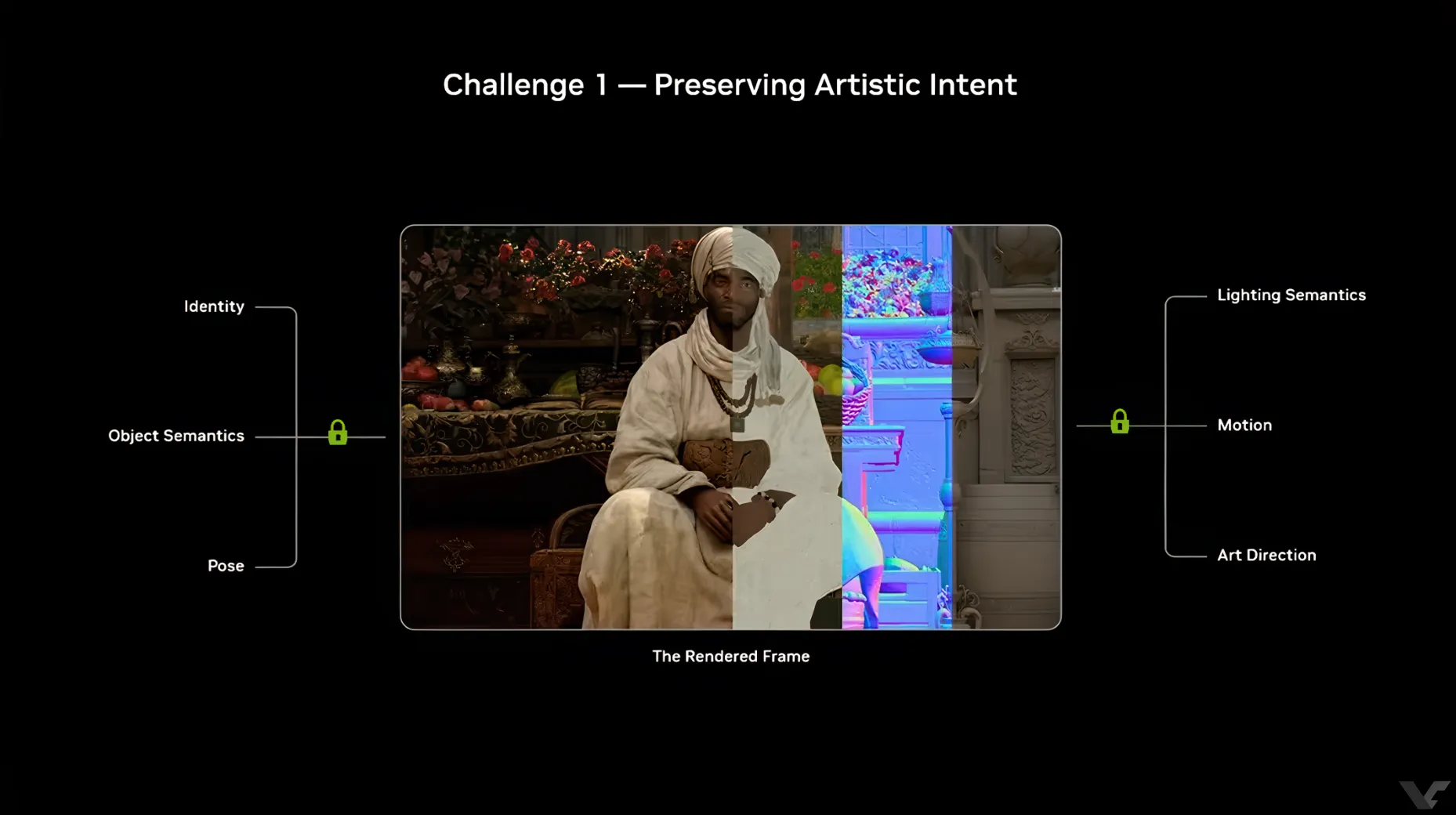
Nvidia says DLSS 5 begins with the conventionally rendered frame and then adds a learned generative stage to enrich its appearance. It added that Internal buffers containing information such as albedo, surface normals, and lighting help anchor the result to the artists' intentions. Motion vectors allow the model to process frames causally – one frame in and one frame out – without looking ahead, which Nvidia says prevents shimmering, drifting, and swimming.

The company says it has distilled knowledge from much larger generative systems into a compact, one-step pixel-space diffusion transformer designed solely to improve rendered game frames. Nvidia reiterated that the finished technology is intended to run on a single GPU, although it still has not revealed performance or VRAM requirements.
Early hands-on coverage claimed that DLSS 5 was more nuanced than a simple face filter, but questions remain. Nvidia previously "confirmed" that its primary input is a 2D frame plus motion vectors, and the system can still infer details incorrectly when objects become obscured.

Nvidia says more developer controls are being built based on partner feedback. We'll find out whether the three models, object masks, and two main sliders are enough to win over gamers when DLSS 5 arrives this fall.

Permalink to story:

 
Devs could also choose to not use dlss5, or DLSS at all. You have far and xess to choose from, or you could choose native rendering, but then you have to put in effort to optimize and that's hard.
 
Before the conservatives kick in w/ "AI slop" claims, this photo-realism is being achieved through software and hardware (I.e. tensor cores), which is pretty much the entire development history of graphics.
 
This is AI slop because it's not improving anything graphics wise, and it's overwriting the original work done by game developers. Games don't need to look photo realistic, let developers choose if they want photo realism, no need to DLSS slop them down everyones throats. I enjoy games for the escape away from reality, not to see games with an Instagram model filter.
And sure, game devs could choose to use something else besides DLSS, but publishers have the final say and of course they're going to take the piles of money Jensen hands to AAA game companies to use their tech.
 
Before the conservatives kick in w/ "AI slop" claims, this photo-realism is being achieved through software and hardware (I.e. tensor cores), which is pretty much the entire development history of graphics.
Notice how everyone had a decent upscaler now like DLSS 4.5, Fsr 4.1, Xess 3, Pssr2, etc. Eventually everyone will have a decent neural network renderer. Nvidia just wants to corner the market with their proprietary solution. Also notice they haven't announced the improvements on the brute forced approach they shown off originally from needing 2 rtx 5090s. I mean 1 rtx 5090 will still be crazy but they probably still need time to cook to get it be brute forced lite!
 
I'll take style over realism any day. I have a lot of experience with real life and I gotta say, it kinda sucks. I play games to escape reality. Old School Runescape is one of the most popular MMOs in the world and people love its 20 year old graphics that were arguably already 10 years old at release. Would love to see DLSS5 try to put a realistic face on a runescape model
 
I don't really get DLSS5. If Nvidia needs to find more things for the tensor cores to do, why not just use them to enhance RT more? Why not a 2nd gen ray reconstruction or something? Why not AI enhanced path tracing? An ML Instagram filter is kinda neat I guess, but not the direction the market is heading in.
 
I don't really get DLSS5. If Nvidia needs to find more things for the tensor cores to do, why not just use them to enhance RT more? Why not a 2nd gen ray reconstruction or something? Why not AI enhanced path tracing? An ML Instagram filter is kinda neat I guess, but not the direction the market is heading in.
Something that I would love to see done with these things is better AI in videogames. After you play RTSs and turn based games enough, you start to learn and be able to predict how they will act and make strategies around it. I would love more advanced AI in games where you can never predict what the AIs will do
 
Something that I would love to see done with these things is better AI in videogames. After you play RTSs and turn based games enough, you start to learn and be able to predict how they will act and make strategies around it. I would love more advanced AI in games where you can never predict what the AIs will do
Nvidia became a Trillion dollar company 3 years ago and we still have dumb ai NPCs in Video games while Nvidia's worth is now 5x and growing.
 
Nvidia became a Trillion dollar company 3 years ago and we still have dumb ai NPCs in Video games while Nvidia's worth is now 5x and growing.
Something I really want to see in games, especially with local AI models, could be improved randomly generated quests that aren't held back by the limitations of procedural generation and, eventually, AI NPCs with unique dialogue and routines so that every playthrough is different. Of course keep the crafted side of games, but AI generation as a layer on top of, say, Skyrim so you can keep playing long after you beat the game, that would be pretty awesome. Not just garbage like "another settlement needs your help"
 
Before the conservatives kick in w/ "AI slop" claims, this photo-realism is being achieved through software and hardware (I.e. tensor cores), which is pretty much the entire development history of graphics.
This is not about conservatives, it's about how this is just an AI slop filter plastered on top of a rendered image and pretending that it somehow looks "more realistic".
 
Before the conservatives kick in w/ "AI slop" claims, this photo-realism is being achieved through software and hardware (I.e. tensor cores), which is pretty much the entire development history of graphics.
This is not about conservatives, it's about how this is just an AI slop filter plastered on top of a rendered image and pretending that it somehow looks "more realistic".
 
Something I really want to see in games, especially with local AI models, could be improved randomly generated quests that aren't held back by the limitations of procedural generation ...
Go somewhere.
Watch something or talk to somebody.
Kill something/somebody or destroy something.
Defend something or prevent somebody to being killed.
Obtain (fetch, harvest, mine, buy, craft, steal, ...) something.
Something else
+ combination of above mentioned

ChatGPT may deliver a smoother looking texting than procedural generation but that it is.
There is not much what AI could do about it.

After all ... since Ancient Greeks came with their classic drama only 12 story plots were developed.

... eventually, AI NPCs with unique dialogue and routines so that every playthrough is different.
That is another story.
There is a lot of to improve using AI generated content, behavior, ...

Of course keep the crafted side of games, but AI generation as a layer on top of, say, Skyrim so you can keep playing long after you beat the game, that would be pretty awesome. Not just garbage like "another settlement needs your help"
I am afraid that even with AI all we get will end like:
"Go there I do not know where, bring that, I do not know what, give it to somebody, I do not know who so something, I do not what, may or may not happen."

 
Back