Nvidia's first consumer CPU in over a decade is coming – and it has RTX cores built in

Why are you counting transistors?
For the same reason you count square footage on a home or horsepower on a sports car. How else would you compare entirely different chips? If transistors are too raw a metric for you, we can use performance instead -- that would demolish your comparison even worse.

Look at the die size, wafer cost and yield rate if you want to make a cost argument.

The RTX 5090, absolutely massive at 750mm².
The 8800 Ultra, still quite large at 484mm².

That's a 54.96% size increase versus a 258.2% price increase, but yes that can greatly be attributed to wafer costs/yield rate
Not just lower yields and high wafer costs, but far higher costs for the manufacturing facilities used to build these chips. The 8800 was built in 65nm fabs that cost under $1B, the 5090 in 4nm fabs that cost fifty times as much. Oh, and 4nm manufacturing also requires far more steps than 65nm, and is correspondingly slower.

You're also ignoring the fact that 4nm design tools cost far more, and, despite the die size being only 50% larger, it contains 100X as many working parts -- all of which must be designed, validated, and tested by engineers.
 
For the same reason you count square footage on a home or horsepower on a sports car. How else would you compare entirely different chips? If transistors are too raw a metric for you, we can use performance instead -- that would demolish your comparison even worse.
By cost? Since that's what we were comparing in the first place.
Suddenly pulling in a metric like transistor count makes no sense, that transistor count has increased is a given since that's pretty much the one driving factor behind the entire chip industry, squeezing more transistors into less space to increase performance/reduce costs.

Not just lower yields and high wafer costs, but far higher costs for the manufacturing facilities used to build these chips. The 8800 was built in 65nm fabs that cost under $1B, the 5090 in 4nm fabs that cost fifty times as much. Oh, and 4nm manufacturing also requires far more steps than 65nm, and is correspondingly slower.
We were talking about the 8800 ultra, not the 8800. Ultra is on 90nm, not 65nm.
Also the RTX 5090 is on 5nm, not 4nm. Doesn't take away from it taking longer, there being more steps though.

90nm fab back then cost ~$2.5b, not $1b (~$4.1b compensating for inflation)
Fab for the RTX 5090 isn't as you're trying to phrase it a x50 = $50b either. Not sure how you ended up there, I guess the 4 vs 5nm is part of it. IT's about $21.8b, so x5.3 (rather than x50).

The fabs back then are also much smaller compared to their more current counterparts processing far fewer wafers a month.

You're also ignoring the fact that 4nm design tools cost far more, and, despite the die size being only 50% larger, it contains 100X as many working parts -- all of which must be designed, validated, and tested by engineers.
Imo if you start getting that far into the nitty gritty, those design and validation tools have made massive headway since then greatly simplifying things.
Although for NVIDIA in particular they have been bragging for a long time that adding AI into every step of the workflow has greatly reduced costs/time needed. Dunno how much the RTX 5090 was affected by that but their latest claims:
What took "eight people about 10 months" is down to one GPU doing it overnight.

--

Anyway, way too far into the nitty gritty.
Point is, stuff has gotten expensive and as someone with limited means - I'm not a fan

I wasn't the target audience for the 8800 ultra, think back then I went from a Radeon 9800SE unlocked to 9800 Pro to NVIDIA 6600 GT to Radeon HD 4850. I'm not the target audience for the RTX 5090 either, at this point I'll likely be using my Radeon 6700 XT for many years to come still (bought 2nd hand at the end of the Ethereum farming boom). I'm a fan of bang-a-buck, hence my negative view on the current and future market.
 
By cost? Since that's what we were comparing in the first place.
Suddenly pulling in a metric like transistor count makes no sense
Was that a joke? What you're buying is transistors, not raw die space -- and yes, the transistors are smaller, but smaller transistors cost far more than large ones: they require far more expensive fabs, more manufacturing steps, and more complex and pricey design tools.

90nm fab back then cost ~$2.5b, not $1b
Oops! You're quoting Intel fab costs, not TSMC:

"...When TSMC launched its volume production for the 90nm node (Nexsys) in 2004, the estimated development and construction cost for their new 300mm wafer facilities was $1B to $2B per fab...."


But the 8800 Ultra was manufactured in 2007, in TSMC's Fab 14, which, when converted to 300mm 90nm production had a net cost of $1B.


Imo if you start getting that far into the nitty gritty, those design and validation tools have made massive headway since then greatly simplifying things.
Sure. Otherwise designing a chip with 100x the transistors like the 5090 would cost 100x as much, rather than the 5-10X it now does.
 
Was that a joke? What you're buying is transistors, not raw die space
What you're paying for (or rather NVIDIA/AMD etc) is die space.
It's what determines the price.
No one starts their purchase with how many transistors do I want to buy, but rather with what can I afford - which is largely determine by die size and gives a decent indicator of if you're getting screwed or not. It's why people have claimed that NVIDIA keeps giving us less for more as from generation to generation it should remain relatively similar in the same performance class and the price should remain relatively stable as a result. Let's take the xx60 class of NVIDIA GPUs:

RTX 3060, RTX 4060, RTX 5060
276mm², 159mm², 181mm²
RTX 3060 to RTX 4060 - straight up scam imo, they could have sold it for less - tiny die compared to its predecessor and it's also why it performs like absolute trash. That's not a xx60 class product that's barely a xx50 class product (but they killed those off).
RTX 4060 to RTX 5060 - NVIDIA realized the RTX 4060 is trash and made the successor slightly larger, still a bad deal compared to the RTX 3060 and why the performance uplift over it is nothing to write home about.
Two generations of GPU and what do you get for it? Basically nothing.

-- and yes, the transistors are smaller, but smaller transistors cost far more than large ones: they require far more expensive fabs, more manufacturing steps, and more complex and pricey design tools.
They do, but not to the scale we're being charged.
CPUs haven't seen the same *****ic scaling, they're made in the same fabs.
They're not heavily cutting down on die there sizes either, they're not trying to charge the same price for a much smaller chip - they just give you more performance. That's how it should be yet isn't in the GPU market.
 
What you're paying for (or rather NVIDIA/AMD etc) is die space.
It's what determines the price.
Now you're simply being absurd. Firstly, die space isn't the only cost metric: chips have differing numbers of layers and other manufacturing steps, all of which drastically influence manufacturing time and cost.

Secondly, comparing die space across different nodes is like comparing the price of an acre of land in Palm Beach to one in the Gobi desert. Extreme-EUV lithography is extraordinarily expensive.

Thirdly, you're only considering manufacturing costs, when R&D and tapeout costs are a substantial portion of the total -- and these are in direct, linear relationship to the complexity (transistor count) of the chip.

No one starts their purchase with how many transistors do I want to buy, but rather with what can I afford - which is largely determine by die size and gives a decent indicator of if you're getting screwed or not.
Eh? Try as I might, I can't decode this word salad. If you've switched from the NVidia-TSMC relationship back to consumers again, then what they purchase is not die size or transistors, but performance. As I told you already. And the 5090 has some 7,000% better performance than an 8800. I can't imagine how much you'd be whining if it was priced by that metric.
hing.
They do, but not to the scale we're being charged.
Good god, the bathos is getting thick. NVidia's net margins back in 2007 were 14.8%. In 2023, before the AI rush started and demand shortages struck, their margins were only 16.1%. In another 18 months, there'll be a supply glut and their margins will return to normal.
 
Now you're simply being absurd. Firstly, die space isn't the only cost metric: chips have differing numbers of layers and other manufacturing steps, all of which drastically influence manufacturing time and cost.
A cost metric that isn't perfect but a decent indicator as it shows what you're getting. One that shows if you're getting the short end of the stick or not.
That difference between RTX 3060 and RTX 4060 clearly shows you're getting shafted.
Or if you prefer bashing AMD, clearly shows that their RX 6500 (XT) was a piece of garbage, way too small for a desktop gaming chip.

Secondly, comparing die space across different nodes is like comparing the price of an acre of land in Palm Beach to one in the Gobi desert. Extreme-EUV lithography is extraordinarily expensive.
Costs from generation to generation go up yes, but not as much as we're being charged. If the die size is reduced as much as between the RTX 3060 and 4060 they're double dipping.
The consumer doesn't get performance or a discount, just a fatter margin for NVIDIA and the most important (entry point) and highest volume seller was/is a terrible deal.

Don't see the same thing happening there in the CPU market with die sizes between similar products from different generation massively going up or down in size afaik (I'm sure there's exceptions to the rule). Their GPU die sizes are harder to compare with the 'out of the ordinary' architectural choice for their Infinity Cache (increased the die size quite a bit so they could cut costs on memory).

Eh? Try as I might, I can't decode this word salad. If you've switched from the NVidia-TSMC relationship back to consumers again, then what they purchase is not die size or transistors, but performance. As I told you already. And the 5090 has some 7,000% better performance than an 8800. I can't imagine how much you'd be whining if it was priced by that metric.
hing.
Don't get this irrelevant performance comparison. It was the flagship of then vs the flagship of now.
That performance goes up - duh. Especially when we look back far enough of when we still got big upgrades from every single node (not so much anymore now that we're nearing physical limits).

Don't take my word salad for it then, Dr Ian Cutress, Hardware Unboxed/Techspot or my personal favorite although no longer active AdoredTV have all made similar points. iirc Hardware Unboxed even has a nice scatter graph somewhere with die sizes / arguing why the prices are effed.

Anyway you've made your points, some I can agree with, some I don't. It's clear we have different opinions on the subject.
 
That difference between RTX 3060 and RTX 4060 clearly shows you're getting shafted.
So you lost the debate with the 8800, and so decided to switch to two different cards? OK, let's go there. The 4060 is 10% faster than the 3060, uses 30% less power, and yet costs 21% less in inflation-adjusted dollars -- outstanding value progress in just two years time.

Costs from generation to generation go up yes, but not as much as we're being charged. If the die size is reduced as much as between the RTX 3060 and 4060 they're double dipping.
How long are you going to pursue this absurd argument? The 3060 was made on a DUV node, whereas the 4060 on the far more expensive EUV process. There's far more involved in manufacturing cost than just total die space.
 
So you lost the debate with the 8800, and so decided to switch to two different cards? OK, let's go there. The 4060 is 10% faster than the 3060, uses 30% less power, and yet costs 21% less in inflation-adjusted dollars -- outstanding value progress in just two years time.
My initial reaction to the 8800 ultra was in response to someone else. tbh I wouldn't use that as an example if it wasn't mentioned already.

The RTX 3060 12GB launched before the RTX 3060 8GB (same MSRP - not adjusted for infaltion) as the RTX 4060 8GB.
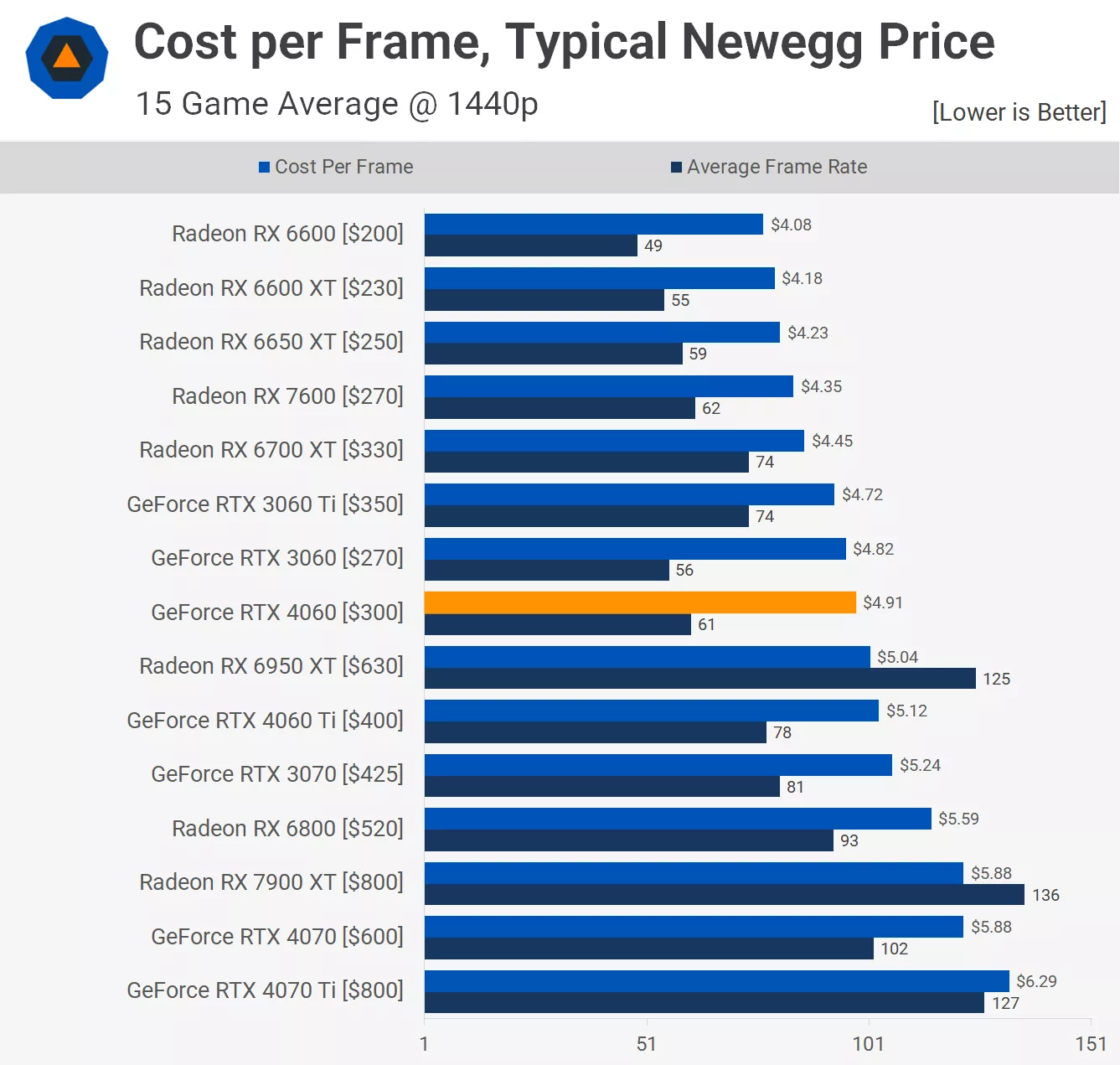
That the RTX 4060 is more power efficient is a given with that tiny die (and TSMC's process tends to be more refined than Samsungs). The cost to performance ratio for a new card (I assume we both like techspot since we're on this site) source techspot:
Cost2-p.webp


Don't know about you but I remember new generations of cards being exciting. Used to be to the point where you'd roughly get the performance of a previous gen card a class higher (xx70) for the price of the new gen xx60 card. We used to frequently get increased VRAM amounts as well. Roughly the same price for the same performance and a reduction in VRAM is very disappointing.
The power reduction is nice, especially in Europe (danged Russia didn't do the power bills any good) but nothing to get all that excited about when it's the only thing that it got going for it. (There's framegen as well if you're into that I suppose)


How long are you going to pursue this absurd argument? The 3060 was made on a DUV node, whereas the 4060 on the far more expensive EUV process. There's far more involved in manufacturing cost than just total die space.
I'll stop making it. At least in this thread.
If the RTX 6060 comes a long with a die much smaller than the RTX 5060 one I'll likely make it again (or more likely, Techspot will do it for me).
(Not because I think I'm wrong but because I think enough was said - neither of us is changing our minds)
 
Don't know about you but I remember new generations of cards being exciting
I certainly do: my first discrete video card was an EGA adaptor, purchased in 1985. I also still have an original TNT2 card in a box somewhere. But neither the desires of us consumers nor the demands of TSMC and NVidia can circumvent the laws of physics. Lithography is following a logarithmic curve: The linear-time->exponential-areal-density component of Moore's Law was never accurate -- it was simply a rough approximation accurate for a period of time.
 
Back