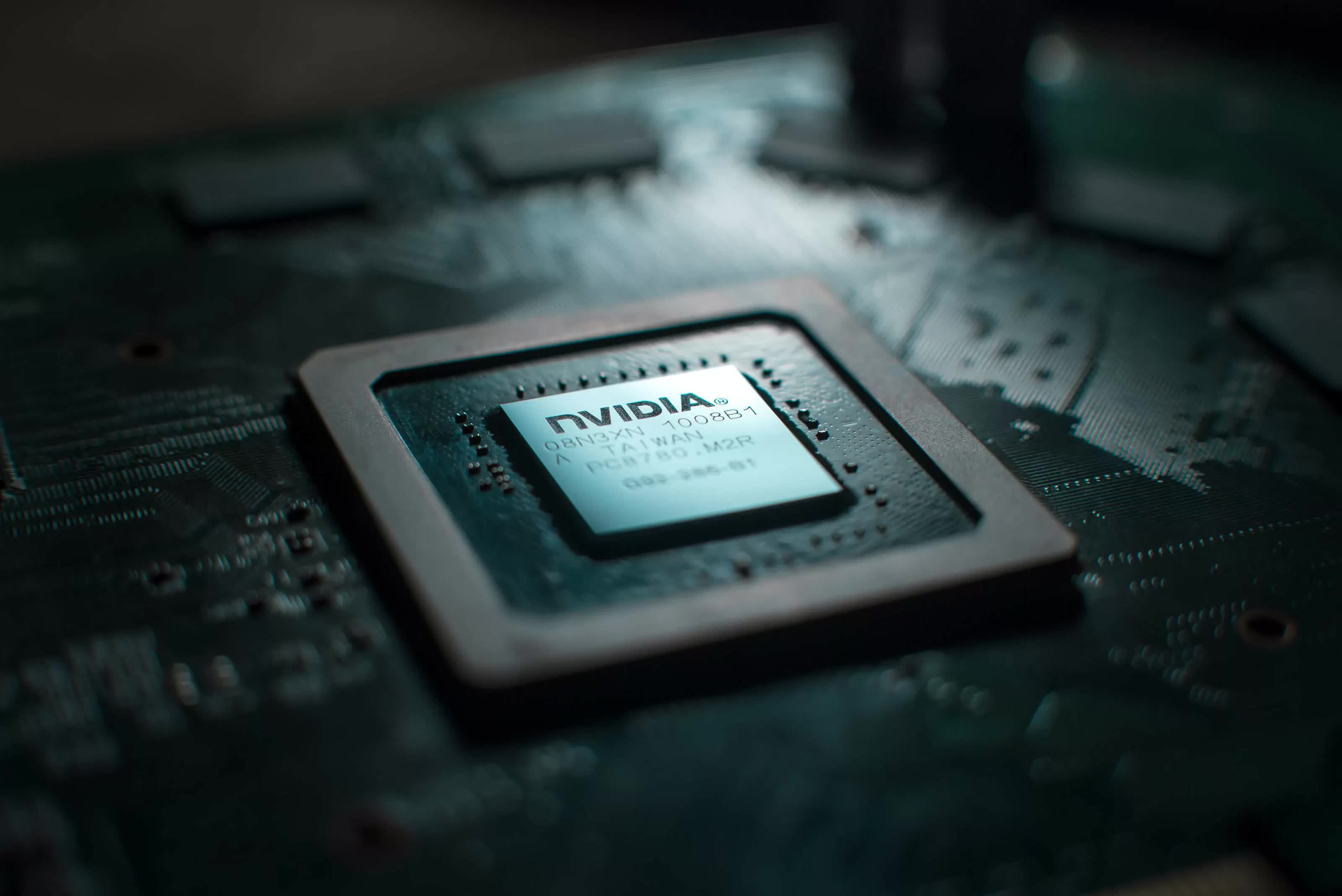
Nvidia's first consumer CPU in over a decade is coming – and it has RTX cores built in

Daniel Sims

Posts: 2,472   +74
Staff
Highly anticipated: We know for a fact Nvidia has been working on a consumer-level Arm-based CPU for some time, with the chip widely expected to target the same premium laptop space as Qualcomm's Snapdragon X Elite, Apple's M-series silicon, and Intel's latest mobile processors. After two suspected internal delays, cryptic social media posts from Nvidia, Microsoft, and Arm point to a coordinated Computex reveal on Monday, when the company is expected to introduce N1, its first consumer CPU in more than a decade.

Update (Jun 1): Nvidia RTX Spark CPU is now official: "superchip" will power Windows laptops and desktops. Read the full story here or watch the keynote above (RTX Spark and PC section starts at around 1 hour 20mins in).

Update (May 31): With Nvidia's Computex reveal now less than a day away, a last-minute leak appears to fill in some of the missing details around its long-rumored N1 laptop chips. According to documents seen by VideoCardz, the flagship N1X may arrive in two configurations: a full-fat version with 20 Arm CPU cores and 48 Blackwell SMs, equivalent to 6,144 CUDA cores, plus a slightly cut-down model with 18 CPU cores and 40 SMs.

Both are reportedly designed for a 45W to 80W package power range, support as much as 128GB of LPDDR5X memory, and include a PCIe layout of 12 PCIe 5.0 lanes plus five PCIe 4.0 lanes.
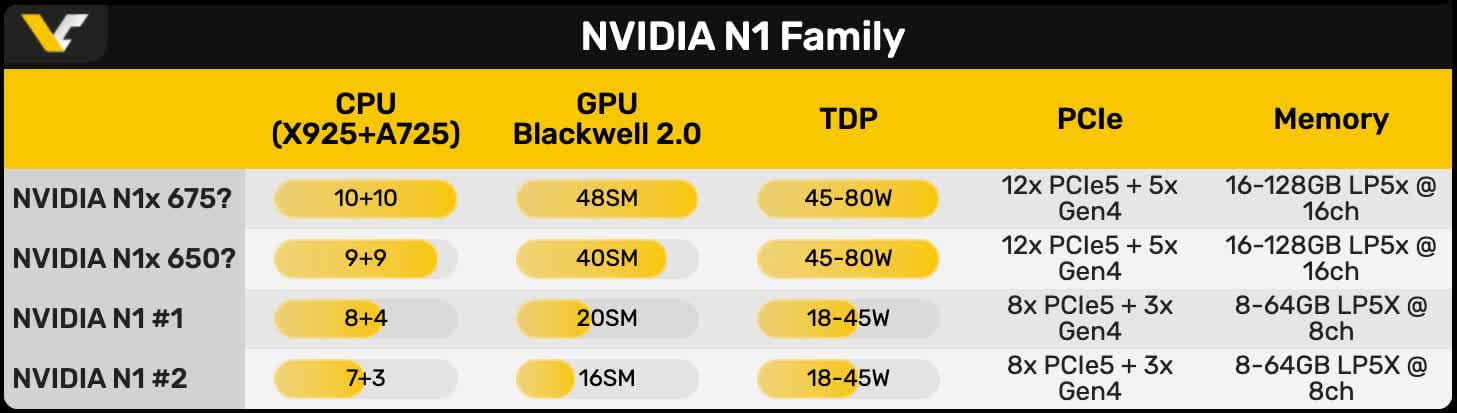
The same leak also points to a lower-power N1 chip aimed at more affordable or thinner systems. That part is said to come in 12-core and 10-core CPU versions, paired with either 20 SMs or 16 SMs, translating to 2,560 or 2,048 CUDA cores.

Power would reportedly fall between 18W and 45W, with support for up to 64GB of LPDDR5X. Nvidia's own positioning appears to separate storage support as well, with N1X handling up to three M.2 drives while N1 is limited to two.

Separately, early retailer listings for Dell XPS laptops and Lenovo Yoga Pro models suggest Nvidia may brand the high-end chips as N1X 650 and N1X 675. One listing pairs the N1X 650 with 32GB of memory and a 1TB PCIe SSD for around €3,199, while the N1X 675 model is shown with 64GB of memory and the same storage for about €4,049.

A cheaper Yoga Pro 7 configuration with the non-X N1 is also listed, reinforcing earlier model-name leaks tied to Lenovo's upcoming Arm-based Windows laptops.

As always with pre-launch retailer data, the final specs, clocks, power limits, and availability could change. But the leak suggests Nvidia is preparing more than a single showcase chip. If accurate, N1X would target high-end Windows on Arm laptops with integrated Blackwell-class graphics, while N1 could give Nvidia a more mainstream entry point. The formal announcement is expected during Jensen Huang's opening keynote at Computex.

Identical posts from Nvidia, Arm, and Microsoft contained the words "A new era of PC," followed by the coordinates "25.0528, 121.5990," which map to the Computex 2026 venue in Taipei. The cryptic posts can be seen as early confirmation that Nvidia is finally ready to support Windows' push into Arm chipsets.

Qualcomm's Snapdragon X chips have spearheaded Microsoft's attempt to replicate the power-efficiency gains Apple has enjoyed since transitioning its Mac lineup to in-house Arm-based SoCs. Arm said that other chipmakers would follow Qualcomm's example, and rumors that Nvidia might be the first have circulated since late 2024.

Reports so far have indicated that Nvidia and hardware partners initially planned to introduce devices featuring the new CPUs, likely to be called the N1 series, last year. However, serious hardware faults prompted an internal delay to Q1 2026, a window that has since passed.

The PCs, likely laptops but possibly also 2-in-1 notebooks, are expected to be consumer-oriented versions of Project Digits, the high-end workstation mini PC Nvidia unveiled at CES 2025. Leaks indicate that the N1 (or N1X) will feature 20 cores split into two 10-core clusters and a Blackwell-based integrated graphics chip with 6,144 CUDA cores, the same count as the RTX 5070, albeit at a lower clock speed and power rating.

Tentative benchmarks suggest the SoC could rival recent mobile chips from Qualcomm, Apple, Intel, and AMD. A leaked notebook motherboard containing the chip also featured an 8+6+2-phase VRM setup and 128GB of RAM clocked at 8,533 MT/s.
The N1X would represent a meaningful step into new territory for Nvidia. The company currently dominates the dedicated GPU and AI data center markets, and N1 could mark its first consumer CPU since the Tegra X1, which powered the Nvidia Shield TV over a decade ago. If successful, it could intensify competition in the mobile processor market and make Microsoft's Windows-on-Arm ambitions more viable.

Computex 2026 runs June 2 – 5, but Jensen Huang's keynote is set for the day before, on Monday, June 1 at 11 am Taipei time at the Taipei Music Center, making it the likely stage for this and other Nvidia PC related announcements. Additional N1 variants could arrive later this year, with the N2 series expected to follow in 2027.

Permalink to story:

 
One day there will be a "Wolf of Wallstreet" style documentary about the debauchery taking place right now in the upper ranks of the tech industry. Can you imagine the parties going on right now? Can you imagine what they're saying about the average consumer in the board room? Good times.
 
One day there will be a "Wolf of Wallstreet" style documentary about the debauchery taking place right now in the upper ranks of the tech industry. Can you imagine the parties going on right now? Can you imagine what they're saying about the average consumer in the board room? Good times.
Most likely "Oh my god are they STILL whining about how they cant buy a 5090 for $300?"
 
Normally I'd be excited for a new competitor in a stale market to get some innovation or drive prices down.

Sadly this new competitor is NVIDIA, so I fully expect all innovation to be AI this and AI that. As for prices - it's NVIDIA, the company that can sell every bit of capacity they can get for phat margins in the server space. Experts are maximizing profit to the extreme.

--

And well... I've kinda lost interest in new PC hardware. Prices are effed, most new games are effed. Old games on old hardware is where it's at.
 
Isn't the N1X just the same chip that is in those Nvidia Spark mini-PCs? Just with probably lower clocks for the laptop versions. We already know how those perform; good if you need local CUDA with lots of memory space, not particularly exciting for anything else.
 
Isn't the N1X just the same chip that is in those Nvidia Spark mini-PCs? Just with probably lower clocks for the laptop versions. We already know how those perform; good if you need local CUDA with lots of memory space, not particularly exciting for anything else.
It's the same chip, we dont know what changes will be made, aside from being available with less then 128GB for consumers.

The N1 non X is more interesting. If the 5070 chip is strangled by bandwidth, a cut down 5060ti esque iGPU would perform about the same and the price would be lower.

The DGX wasn't intended for consumer workloads or gaming, the thing couldn't even run Windows. So who knows what performance was left on the floor there.
 
This would be interesting if it weren't from Nvidia who already has a monopoly on one market, and now they're partnering up with Microslop to monopolize the PC market with systems with a fixed config that will likely be premium priced like a MacBook pro. And if you can't afford that well you're stuck with renting a gaming pc in the cloud.

The whole AI rampocalypse feels like the biggest tech scam ever, apparent shortages yet there's still plenty of ram and storage on retailer shelves, however companies can't keep surviving when they're already down over 50% since last year. Jensen and every company involved in AI is likely counting on the entire enthusiast market to fold, then everyone will have no choice but to buy these overpriced laptops.
 
More like " look at them crying how they can't afford PC's anymore."
Unless you want to go back to 2009 wages, stop complaining about the price of flagships.

8800 ultra was $1200 adjusted for inflation, BTW. Sucks to be poor.
This would be interesting if it weren't from Nvidia who already has a monopoly on one market, and now they're partnering up with Microslop to monopolize the PC market with systems with a fixed config that will likely be premium priced like a MacBook pro. And if you can't afford that well you're stuck with renting a gaming pc in the cloud.

The whole AI rampocalypse feels like the biggest tech scam ever, apparent shortages yet there's still plenty of ram and storage on retailer shelves, however companies can't keep surviving when they're already down over 50% since last year. Jensen and every company involved in AI is likely counting on the entire enthusiast market to fold, then everyone will have no choice but to buy these overpriced laptops.
This is an utterly insane conspiracy theory. Nothing is stopping, say, AMD from releasing an ARM SoC to compete with nVidia. Or Mediatek. Or even Google.

These companies have far more important things to worry about then trying to take away your precious bing bing wahoo machines. Calm down. Do you really think that there is a cabal of C suites in some dark meeting room, heavy with cigar smoke, plotting to remove your ability to buy....laptops?
 
Unless you want to go back to 2009 wages, stop complaining about the price of flagships.

8800 ultra was $1200 adjusted for inflation, BTW. Sucks to be poor.
Then a 5090 shouldn't be any more than $1,200.
Enjoy paying even more for a 6090 then, Jensen should list it at $6,090 for the lulz.
Flexing your wealth, as I've seen others do here doesn't impress me, sorry not sorry, those who are really wealthy don't waste their time on tech forums. Go buy a yacht or something.
This is an utterly insane conspiracy theory. Nothing is stopping, say, AMD from releasing an ARM SoC to compete with nVidia. Or Mediatek. Or even Google.

These companies have far more important things to worry about then trying to take away your precious bing bing wahoo machines. Calm down. Do you really think that there is a cabal of C suites in some dark meeting room, heavy with cigar smoke, plotting to remove your ability to buy....laptops?

AMD has absolutely no reason to, Qualcomm has barely broken into the laptop market, their drivers are dog ****, and performance is lacking, the only reason to buy a Windows on ARM laptop is if you need battery life and for some reason are attached to Windows only applications.
Mediatek is likely in an anti-competition agreement since they agreed to partner up with the jacketman, and if Qualcomm SoC's can't perform through all of the Microslop bloat, then MS would have to come up with some real magic to get a slower Mediatek SoC to have any kind of decent performance in W11.

But it isn't any conspiracy, if you've been paying attention sales are down for the PC market as a whole, and the gaming market is down 50-70% since last year, that kind of decline simply isn't sustainable for companies with low margins.
Gamers Nexus has a good video interviewing people in the gaming industry, they're all concerned how they're supposed to survive when people simply aren't building gaming PC's anymore. It is directly from people in the enthusiast hardware space reporting things are looking bleak, yet unsurprisingly people would rather yell it's clickbait and lies. I've enjoyed gaming as a hobby for decades, but gamers are being sqeezed out first, as companies don't care since they would rather you rent a computer, because owning a computer means you have local computing power for your own AI, of course no company on the AI hype train wants that.
My bing bing wahoos are just fine, I have more than enough of a backlog to not worry about needing new hardware for a long time, the problem is replacing anything that fails, and I'm certainly not going to pay 400X more for RAM or an SSD.
Also yes, the C-suite are probably smoking something in a boardroom, or on some illicit drugs given how some of those billionares sound so zooted they can barely get a sentence together, figuring out the next way they can screw over the consumer.

The next way is sell you a laptop with one configuration, with soldered RAM, at a significant premium with the Nvidia tax, probably starting out at competitive prices, then pricing them at whatever they please because gamers will still buy it. And since everything is soldered in, Nvidia can sell you another new laptop once their latest feature doesn't work with your hardware. And just look at how inflated the whole GPU market has become, or the Steam Deck, yet gamers are still buying them up, the hobby has been completely ruined by stupidity, FOMO, and greed.
 
Last edited:
I'll never understand the thought that ARM and RISC will obsolete every other CPU in the market. The list of failed RISC CPUs is rather long. WART (Window on ARM RT) has been around for 14 years, and every new CPU comes out brings yet another buggy version that sort of works. The dirty little secret is that the only software that runs well has been rewritten for ARM natively. The only company that's managed to get away with using ARM well is Apple, and that's because they wanted the profit and control over their hardware that could only be accomplished by having total control of hardware, software, and OS.

Microsoft wants to be like Apple soooo bad they can taste it. Making their own CPUs would get them there. I for one, am NOT interested in handing Microsoft the keys to the hardware as well.

When they get to an ARM PC that can run the x86 Windows with the sped of a 9950x, support all of the hardware currently on the market, both pcie and USB, and runs any legacy programs including DOS, then I'll start paying attention. Right now, to upgrade my PC's, I do little more that move the hard drive over to a new PC build or laptop.

ARM right now is just Jensen getting his foot in the door, Qualcomm trying to expand their reach, and Microsoft having a way to take everything in house. ARM is just an different type of processor, designed mostly for low power use, that's no better or worse than x86...just different.
 
Last edited:
I'm not that much excited about this new chip. Most likely it'll be cpu bottlenecked unless they did some magic design similar to Apple's stuff. 5070 level of graphics power requires a decent cpu horsepower. ı guess we will see very soon. Either way, even if it turns out as a mediocre product, I hope Nvidia keeps on improving it in next generations. I also hope it comes with an acceptable price tag.
 
"One listing pairs the N1X 650 with 32GB of memory and a 1TB PCIe SSD for around €3,199, while the N1X 675 model is shown with 64GB of memory and the same storage for about €4,049."

LOL! Hilarious prices. The 64GB model is around $4,700 USD. Good luck selling these joke laptops for that kind of price. Intel and AMD have nothing to worry about at these ridiculous prices.
 
Man, I’m so happy I switched to Mac. The M5 Max is such a monster. It performs the same, or better, in all the games I play (WoW, Balloons TD6, and Minecraft to name a few) than my 9800X3D. Not having to deal with Windows has been a blessing. Although MacOS has its issues with multitasking and window snapping, it works well.
 
I'm interested to see how much of the bad reputation Windows on ARM has is the result of Qualcomm and how much is the translation layer. These could be really good if the software works. Not for the current prices, of course, but someday.
 
Unless you want to go back to 2009 wages, stop complaining about the price of flagships.

8800 ultra was $1200 adjusted for inflation, BTW. Sucks to be poor.
And a RTX 5090 start starts at ~$4299 at the moment.

Furthermore,
"the legendary Nvidia GeForce 8800 Ultra (released in 2007), was an unprecedented, historical outlier that fundamentally changed the pricing structure of enthusiast graphics cards"

So yeah, strike one in consumers getting screwed I suppose.

--

Bigger problem is the bottom of the market, the most cards have always gotten sold in the $150-250 bracket. That's entirely gone, now we start at the RTX 5060 for $360. And the performance curve from RTX 3060 to 4060 to 5060 is extremely underwhelming, the needle has barely budged

These companies have far more important things to worry about then trying to take away your precious bing bing wahoo machines. Calm down. Do you really think that there is a cabal of C suites in some dark meeting room, heavy with cigar smoke, plotting to remove your ability to buy....laptops?
Yes.
Why would any company want to deal with market fluctuations and people owning what they buy. Getting a nice steady monthly payment from them and gradually increasing that payment to make the green line go up is way more profitable and predictable.
As long as you're big enough no other company can compete with you, as long the customers want you're offering they can shout all the way as long as they keep paying.

It's why SAAS has overtaken from owning your software, it's why streaming services were willing to make a loss for ages.
 
And a RTX 5090 start starts at ~$4299 at the moment ... So yeah, strike one in consumers getting screwed I suppose..
Learn math. The RTX 5090 contains 92 billion transistors; the 8800 to which you compared only 0.7B The 5090 is manufactured in nodes that cost $50B; the 8800 in nodes built for under $1B. You're comparing the cost of a single-wide trailer to that of a 100-room mansion. Be very glad technological advances make that mansion only 4X.

Here's a much better comparison. The Snapdragon 4 chip has twice the transistors of that 8800 and runs at four times the frequency -- it can be bought today in bulk for all of $10.
 
Last edited:
Learn math. The RTX 5090 contains 92 billion transistors; the 8800 to which you compared only 0.7B The 5090 is manufactured in nodes that cost $50B; the 8800 in nodes built for under $1B. You're comparing the cost of a single-wide trailer to that of a 100-room mansion. Be very glad technological advances make that mansion only 4X.

Here's a much better comparison. The Snapdragon 4 chip has twice the transistors of that 8800 and runs at four times the frequency -- it can be bought today in bulk for all of $10.
Why are you counting transistors? That's a metric for performance if anything, not costs.
Look at the die size, wafer cost and yield rate if you want to make a cost argument.

The RTX 5090, absolutely massive at 750mm².
The 8800 Ultra, still quite large at 484mm².

That's a 54.96% size increase versus a 258.2% price increase, but yes that can greatly be attributed to wafer costs/yield rate (and thus what TSMC charges). I wouldn't have used the 8800 ultra as an example if someone else hadn't done so already. Back then you'd simply get a much cheaper regular 8800 for much less without taking a big performance hit. Back then you had options to get affordable cards and good performance.

Now the performance increases especially in the lower segment get smaller and smaller whilst the costs go up and up. Always expected it to move to all in one chips like possibly the one in this article.
I however expected AMD to be the one to make the first serious move a couple of years after acquiring ATI and it never really happened aside from console chips. The SteamDeck might've been the first PC success there but that's thanks to Valve rather than AMD. AMD had all the cards for ages, now Intel has caught up in GPU performance and ARM might be getting mature enough for NVIDIA to make a move.
AMD had a long window to make it happen and never did.
 
Back