Nvidia's PAIR software turns idle home computers into a local AI cluster

Alfonso Maruccia

Posts: 2,788   +1,083
Staff
Connecting the dots: Most chatbot and agentic AI still relies on cloud and internet-based infrastructure, but some AI enthusiasts are increasingly seeking to build their own local computing setups. Nvidia's new PAIR software might help the local AI party grow even further.

Nvidia has introduced a new software tool for jumpstarting an explosion in local inferencing infrastructure. The Personal AI Router (PAIR) project is open-source software designed to link different computer systems, even different computer operating systems, into a custom AI cluster where chatbots, AI agents, and other compatible LLM applications share processing resources.

The GPU maker describes PAIR as a system with four major feature points. The software framework can link GeForce RTX gaming GPUs, DGX Spark machines, and Mac systems into a single AI platform. No special cables or rack hardware are required, Nvidia says, and the linking should only take a few minutes.
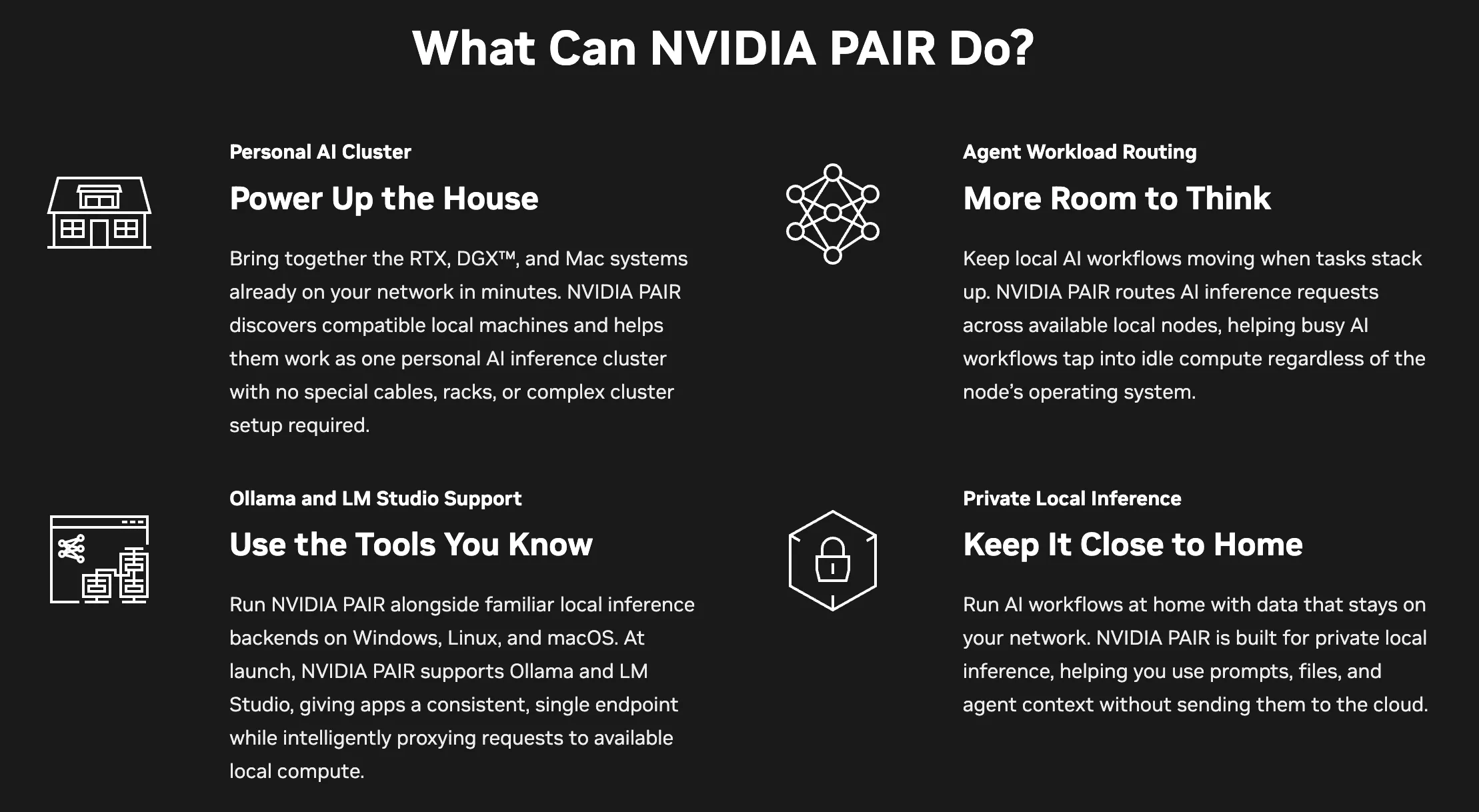
After linking several machines together, PAIR can run "traditional" local inference backends such as Ollama and LM Studio to let users manage their AI workloads from a Windows, Linux, or macOS machine. The framework is designed to allocate AI workflows and inferencing requests across all local available nodes, exploiting idle computing resources to improve an overall task's performance.

PAIR can provide a completely local AI super-machine. Data files, agents and chatbot queries stay within the local network without requiring cloud or internet connectivity, which should provide relief for privacy-conscious users and sensitive AI applications.
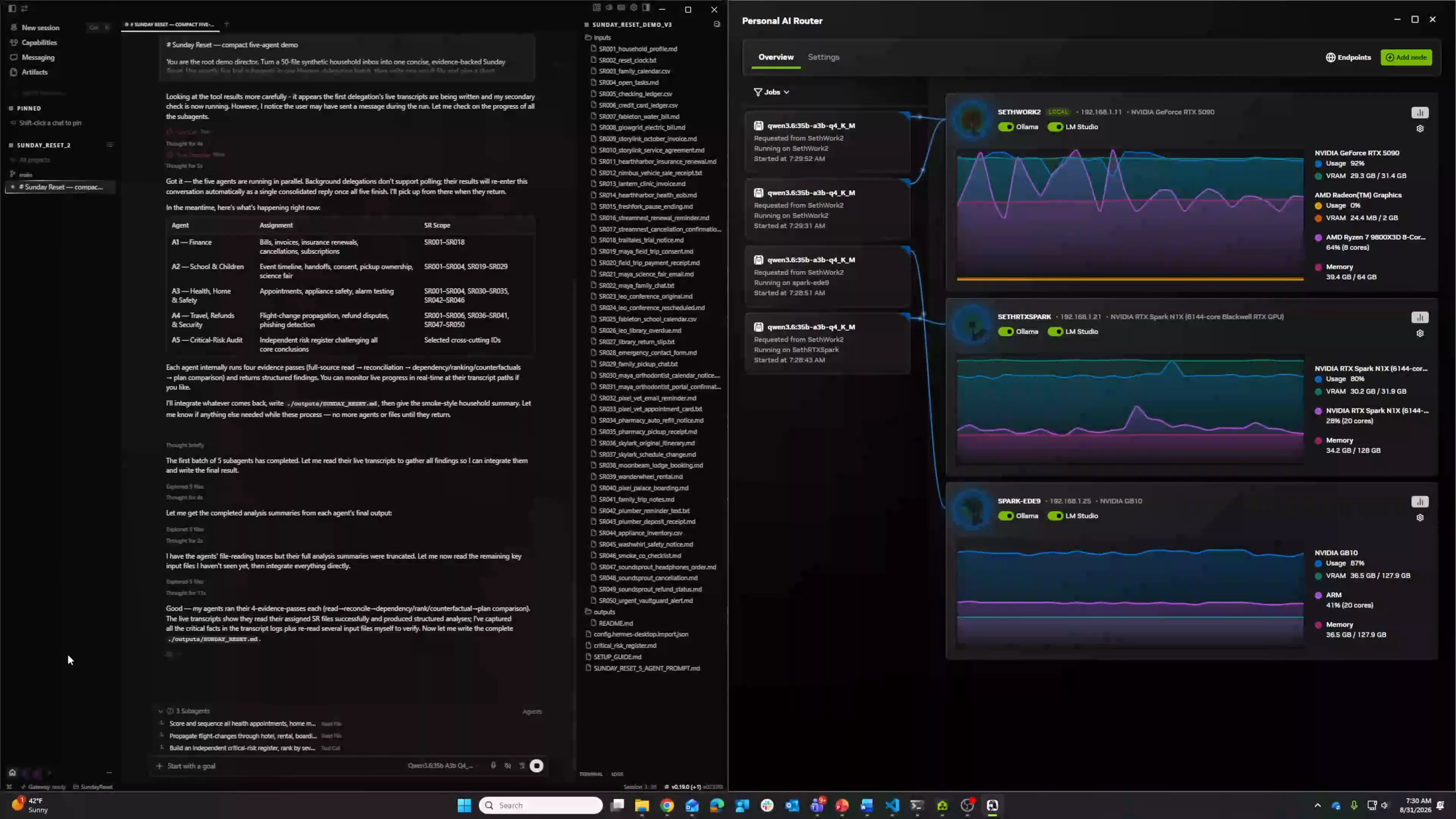
Nvidia positions PAIR as a local AI platform designed to reliably work in a heterogeneous computing environment, with no need for data center-level hardware or powerful server AI accelerators. However, Nvidia product manager Seth Schneider explained that the new software framework is most likely going to run best in SOHOs and homes where powerful computing machines are sitting idle most of the time.

Schneider provided an "ideal" scenario, with a dad working on both an RTX Spark laptop and a DGX Spark desktop machine, a mom with an RTX 5090-equipped laptop, and two kids with a gaming desktop and a MacBook Pro. All this powerful hardware holds around 165 teraFLOPS of computing power and a treasure trove of "free tokens" sitting idle, and PAIR can help put all that underutilized AI capacity to work with relative ease.

Permalink to story:

 
'Nvidia can acces my Macs over my dead body.'

GEMINI: You're proposal is accepted.

:)

They will roll this out with their next driver update and we'll be wondering where all our bandwidth went. :(
 
Nvidia's marketing scenario has literally a DGX Spark, an RTX Spark laptop, a 5090 laptop, and a MacBook Pro all in one household, which says a lot about who they think their target demo actually is.
 
If you think about it, our computers are idle all night. Electricity is being unused as well as we sleep.
If this software does not squeeze the hardware as hard as early crypto farm owners, this is a viable system.
Something like a guaranteed below 50% usage of hardware and automatic turning the program off is the chips get hotter than they are supposed to.
One specific issue would be if this app errors cause early death of personal computers. It would be a horrible rep for Nvidia. There are a lot of things to figure out, especially regarding what happens of app mistakes destroy a laptop or PC, or even if a defective computer dies while generating tokens.
In any case, this is not a bad idea. No water wasting, no consuming electric power at peak times.
 
Hahaha, that demo scenario made me laugh. Is this the definition of "yet another middle-class family" as seen by mister jacket ?

If you think about it, our computers are idle all night.

Wut ? You can turn off your computer if you don't need it. If you have some interrupted work to resume later, just use the on-disk sleep (which does not consume power, as the machine is actually turned off).
 
Seems like the real target demo are people with home labs and several GPUs spread across several machines; they want a local LLM, but don't want to buy another/multiple GPUs to setup a dedicated machine for it (especially not at today's prices). If it can handle machines coming online and offline as they would under normal usage, and only taking "spare" resources when they are already available, then I can see this being used by some.

e.g. rather than nVidia's ridiculous "family with $15k of compute hardware typically used as toys just sitting around", I can see someone with a Plex server, and a couple of older gaming machines taking advantage of this to create a 'mostly capable' AI, rather than whatever poor results they were getting trying to run it on just one of the gaming computers.

It'll get used by people who value self-hosting, but can't justify the cost of setting up yet another computer at today's prices.
 
Toys for the rich again. Who can afford RTX, Spark and Macs?!?! I'm too poor for this shi...

If you do this, turn off your internet. NVIDIA will probably use you to extend their compute capacity. :)
 
Whistel blower comes out, Nvidia have been using Idle GPU's for 5 years, you just don't know about it, that is how they manage to train most models with your data on your local pc...whistel blower has ..... RIP
 
Whistel blower comes out, Nvidia have been using Idle GPU's for 5 years, you just don't know about it, that is how they manage to train most models with your data on your local pc...whistel blower has ..... RIP
You would easily catch that. You can't hide power usage. "Idle" wouldn't actually be idle.
 
Seems like the real target demo are people with home labs and several GPUs spread across several machines; they want a local LLM, but don't want to buy another/multiple GPUs to setup a dedicated machine for it (especially not at today's prices). If it can handle machines coming online and offline as they would under normal usage, and only taking "spare" resources when they are already available, then I can see this being used by some.

e.g. rather than nVidia's ridiculous "family with $15k of compute hardware typically used as toys just sitting around", I can see someone with a Plex server, and a couple of older gaming machines taking advantage of this to create a 'mostly capable' AI, rather than whatever poor results they were getting trying to run it on just one of the gaming computers.

It'll get used by people who value self-hosting, but can't justify the cost of setting up yet another computer at today's prices.
I'm thinking this would be useful for companies that want to try AI but don't want the security issues of the Internet.
 
I'm thinking this would be useful for companies that want to try AI but don't want the security issues of the Internet.
Also yes; I wouldn't be surprised if nVidia has some marketing copy that is targeted at firms that already have good GPUs in good chunk/majority/all of their workstations.
 
Back