Open Printer is a fully open-source inkjet with DRM-free ink and no subscriptions

Daniel Sims

Posts: 2,452   +74
Staff
Why it matters: HP has long faced sharp criticism for forcing users to purchase expensive, DRM-locked ink cartridges or pushing them toward subscription services. Even Brother, traditionally viewed as a more open alternative, came under suspicion of following HP's practices. In an apparent response, a crowdfunding campaign for a fully unlocked printer is set to launch soon.
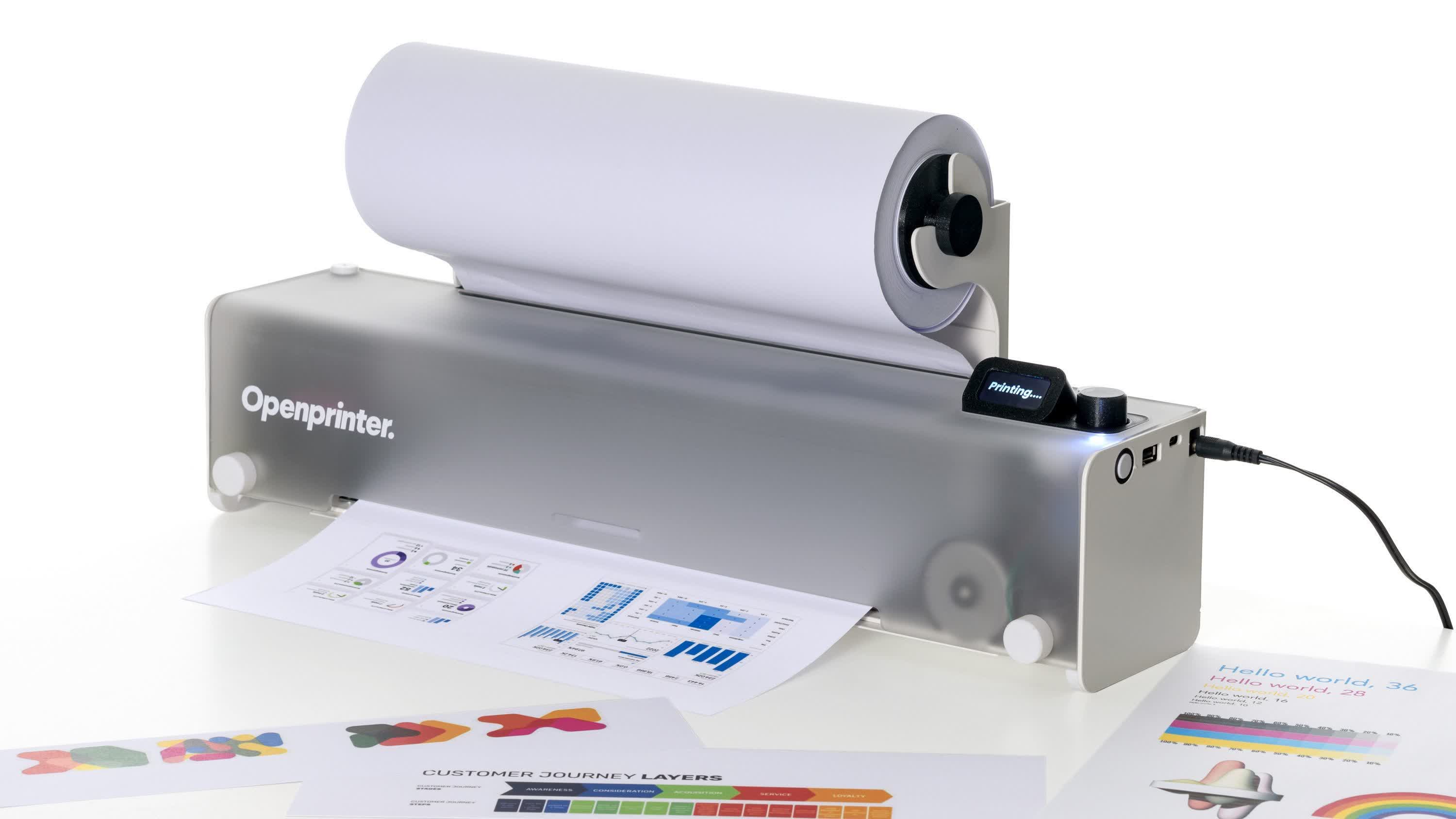
Paris-based firm Open Tools plans to launch a crowdfunding campaign for a printer that focuses on repairability and customization, with no restrictions on how users refill ink.

Called the Open Printer, the project is an open-source inkjet printer assembled from standard components. The electronics, mechanical design files, firmware code, and bill of materials are licensed under Creative Commons, allowing anyone to provide custom enhancements or replacement parts.

If the Open Printer gains widespread support, its open nature might enable it to last longer than models from larger companies that cease supporting them after releasing new ones.
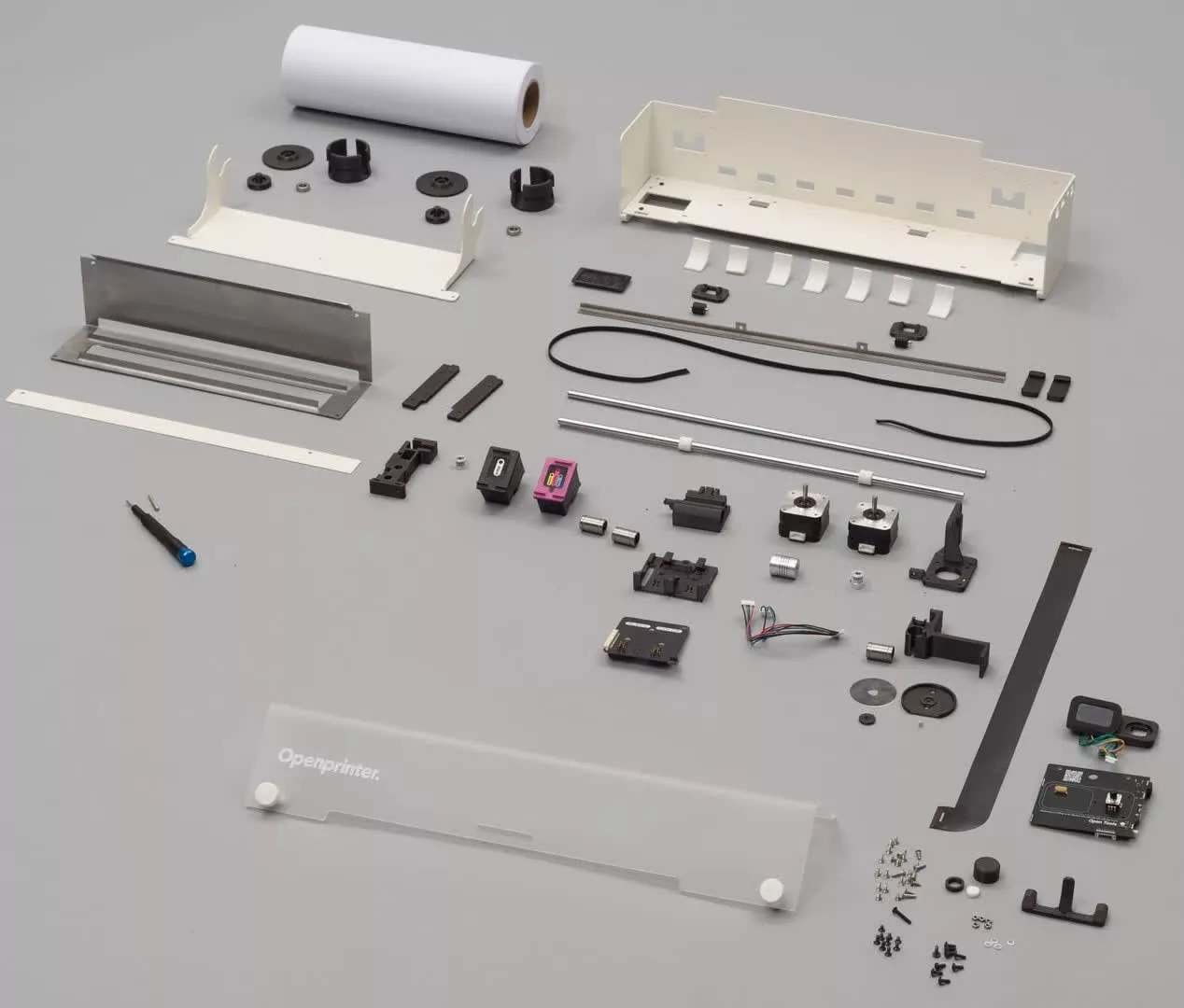
Users accustomed to purchasing HP's expensive ink cartridges due to the company's DRM implementation might be interested in the Open Printer because it uses no proprietary drivers or DRM. The printer accepts American HP 63 and European HP 302 cartridges that users can refill – no requirement to buy new cartridges.

The open-source firmware also means that, unlike HP, the Open Printer will never use software updates to lock users into certain ink cartridges or subscription services.

Capable of printing at 600 dpi in black and white or 1,200 dpi in color, the Open Printer is intended for both office and creative usage. Supported paper sizes include North American letter, tabloid, European A4, A3, 11-inch-wide rolls, and 27mm-wide rolls. A built-in automatic cutter can slice rolls into standard sheets.
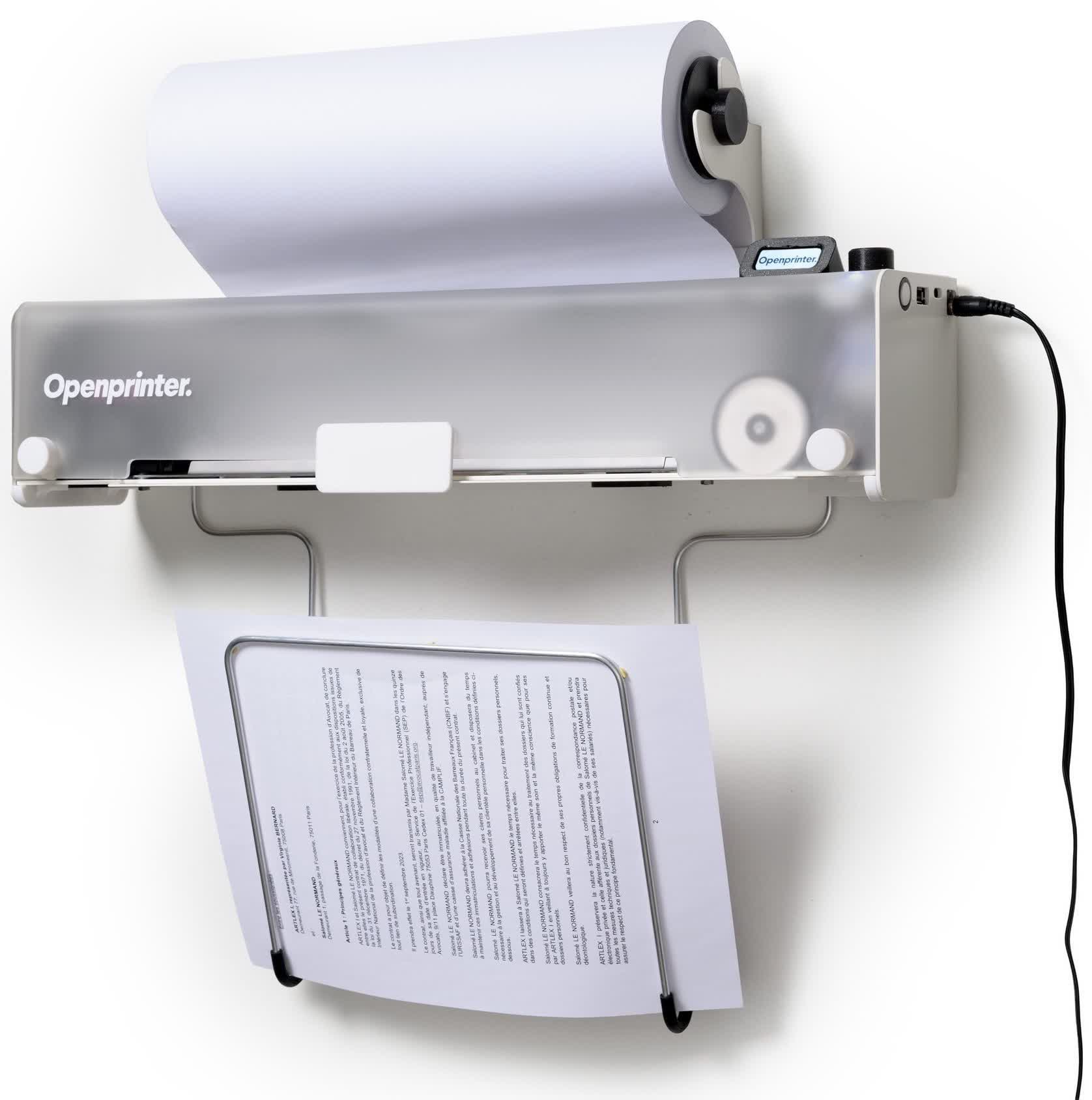
The control interface consists of a 1.47-inch TFT LCD screen with 172 x 320 pixels and a Jogger wheel, running on a Raspberry Pi Zero W. The Open Printer connects to Windows, macOS, Linux, Android, and iOS devices through USB-C, Wi-Fi 5, and Bluetooth 4.1 connections. USB storage drives can also connect through a USB-A port. The device can sit on a desk or hang on a wall.

Release details, including pricing and the crowdfunding campaign's start date and funding goal, remain unclear. Interested parties should subscribe to updates on the project's Crowd Supply page.

Permalink to story:

 
I'm all for open hardware and software, but

1) The Raspberry Pi Zero W is 8 years old and 32 bit, some Linux distros are already phasing out support. What are their plans for the time when it becomes unavailable altogether?

2) They also rely on ancient HP cartridges and refill service providers. Same question.

3) The whole design is stupid without trays. No, I don't want my printer and its cables to hang on the wall, it looks ugly and stupid. And I don't even know where I could buy such rolls of paper btw. That "automated paper cutting" begs for constant malfunctioning. And I'll have to replace the blade every now and then, how is that convenient, and who'll supply those? Also, if I want to change paper size, I would have to remove the whole thing from the feeder, roll it up, put in the other one, painstakingly insert into the inlet, do my printing, then repeat the whole thing in reverse. And I'll have to keep around whole rolls of different sizes. And the tray for the outgoing paper doesn't have any rails to guide the papers, meaning the papers will fall around horizontally as they please, and after a while probably on the floor. Even the photo shows just one paper laying in the tray, I don't think that's by accident... Stupid, stupid, stupid. There's a reason (many reasons, actually) for printers to have proper trays.

4) "Plans to launch a campaign". That's like 7 steps away from realization lol.

I guess the intentions are good, but right now, too many odd choices that I think make this thing doomed from the start. They need some serious rethinking before it's market-ready.

I have a better idea: just stop printing. I know there are things where you can't avoid it yet, but thankfully it becomes more and more few and far between.
 
I'm all for open hardware and software, but

1) The Raspberry Pi Zero W is 8 years old and 32 bit, some Linux distros are already phasing out support. What are their plans for the time when it becomes unavailable altogether?

2) They also rely on ancient HP cartridges and refill service providers. Same question.

3) The whole design is stupid without trays. No, I don't want my printer and its cables to hang on the wall, it looks ugly and stupid. And I don't even know where I could buy such rolls of paper btw. That "automated paper cutting" begs for constant malfunctioning. And I'll have to replace the blade every now and then, how is that convenient, and who'll supply those? Also, if I want to change paper size, I would have to remove the whole thing from the feeder, roll it up, put in the other one, painstakingly insert into the inlet, do my printing, then repeat the whole thing in reverse. And I'll have to keep around whole rolls of different sizes. And the tray for the outgoing paper doesn't have any rails to guide the papers, meaning the papers will fall around horizontally as they please, and after a while probably on the floor. Even the photo shows just one paper laying in the tray, I don't think that's by accident... Stupid, stupid, stupid. There's a reason (many reasons, actually) for printers to have proper trays.

4) "Plans to launch a campaign". That's like 7 steps away from realization lol.

I guess the intentions are good, but right now, too many odd choices that I think make this thing doomed from the start. They need some serious rethinking before it's market-ready.

I have a better idea: just stop printing. I know there are things where you can't avoid it yet, but thankfully it becomes more and more few and far between.
I do get your concerns. They have to design around what's available now, and while those particular print cartridges are an old design, they are also one of the more prevalent cartridges in the world, I believe (or used to be, not sure if this is still true). Refill services are more apt to be available for a very widespread cartridge that has been in service forever. There are also plenty of self-refill systems, including specifically designed refillable cartridges in this form factor, that are readily available now. Paper rolls are not a problem - plotter paper rolls are readily available in a wide variety of sizes, people won't have an issue finding them. In fact, this whole printer seems to be mimicking many traditional graphics plotters, just in a new and novel form factor. I'm with you on the Raspberry Pi though, would hope they are accounting for updating to more recent (or future) Pi models.

This printer isn't going to be for everyone, I think it's more intended to try to shake up the industry and shine a harsher light on the whole "subscription for ink" business model, while giving people who really want it an alternative. It's also going to be open, so that could mean plenty of opportunities to see after-market user created solutions to the tray situation.

It's clever, unconventional, and just a little downright weird. Might be popular, might be a non-starter right out of the box - you never know these days! Should be interesting to see how it goes.
 
I'm all for open hardware and software, but

1) The Raspberry Pi Zero W is 8 years old and 32 bit, some Linux distros are already phasing out support. What are their plans for the time when it becomes unavailable altogether?

2) They also rely on ancient HP cartridges and refill service providers. Same question.

3) The whole design is stupid without trays. No, I don't want my printer and its cables to hang on the wall, it looks ugly and stupid. And I don't even know where I could buy such rolls of paper btw. That "automated paper cutting" begs for constant malfunctioning. And I'll have to replace the blade every now and then, how is that convenient, and who'll supply those? Also, if I want to change paper size, I would have to remove the whole thing from the feeder, roll it up, put in the other one, painstakingly insert into the inlet, do my printing, then repeat the whole thing in reverse. And I'll have to keep around whole rolls of different sizes. And the tray for the outgoing paper doesn't have any rails to guide the papers, meaning the papers will fall around horizontally as they please, and after a while probably on the floor. Even the photo shows just one paper laying in the tray, I don't think that's by accident... Stupid, stupid, stupid. There's a reason (many reasons, actually) for printers to have proper trays.

4) "Plans to launch a campaign". That's like 7 steps away from realization lol.

I guess the intentions are good, but right now, too many odd choices that I think make this thing doomed from the start. They need some serious rethinking before it's market-ready.

I have a better idea: just stop printing. I know there are things where you can't avoid it yet, but thankfully it becomes more and more few and far between.
The only point of yours I agree with is automated cutter, but I suspect that a community effort can refine that if it proves to be troublesome.

The rest of your concerns irrelevant, imo. The RPi Zero is more than enough to run an inkjet, especially since some people use them to run 3d printers. If an OS ever stops supporting 32-bit client devices (that is probably a long way off), then the community will just select a new SBC and make the necessary tweaks to get it to work. As for the cartridges, the way you refill them is with a syringe; what are you talking about with a "refill service"?

If an open source community can take on Stratasys and and create printers that exceed what Stratasys is capable of with most polymers (not all, tbf; hobbyists still haven't really figured out PEEK, but they're getting close), then I think an open source community can take on HP. And Stratasys makes HP look permissive with their IP by comparison.

If this project succeeds, it'll be 2D printing's RepRap moment, proving that it is possible to side-step existing patents and create a functioning product.

No, the real challenge will be creating an open-source inkjet cartridge itself. While you can probably DIY any refill you want right now, I expect HP and others will try to frustrate that process as much as possible if this project succeeds. Eventually, any open source community will need to figure out how to design & manufacture their own cartridge, but if they could figure out nozzles, extruders, and eddy current bed scanners, I think they can figure out a printer cartridge.
 
I've been in the copier/printer/fax/computer/etc business for over 40 years.
This "lock down" mode for these things just drives me nuts.
On the dry toner side, what ticks me off is when they come out with a new model,
that looks almost exactly like the previous model, they reprogram the crum chips
in the toner cartridge, change the pattern of the "knobs" on the top of the cartridge
so it won't fit on the old machines and the old cartridge won't work on the new machine.
But the drum? Typically they are the same! That means the TONER is the same! Then,
the OTHER rub I have is the price they charge for yellow, magenta & cyan toner/ink versus
black. Other than the color IT IS THE SAME!
When troubleshooting on toner based machines, sometimes you swap a color, to see if a problem
follows the color unit. If it wasn't the same, it wouldn't work.
Consumers get screwed, but nothing is ever done about it.
 
I've been in the copier/printer/fax/computer/etc business for over 40 years.
This "lock down" mode for these things just drives me nuts.
On the dry toner side, what ticks me off is when they come out with a new model,
that looks almost exactly like the previous model, they reprogram the crum chips
in the toner cartridge, change the pattern of the "knobs" on the top of the cartridge
so it won't fit on the old machines and the old cartridge won't work on the new machine.
But the drum? Typically they are the same! That means the TONER is the same! Then,
the OTHER rub I have is the price they charge for yellow, magenta & cyan toner/ink versus
black. Other than the color IT IS THE SAME!
When troubleshooting on toner based machines, sometimes you swap a color, to see if a problem
follows the color unit. If it wasn't the same, it wouldn't work.
Consumers get screwed, but nothing is ever done about it.
yea the toner stuff itself is cheap, but you have to buy a whole new thing!
 
Like a 100 years went by and printers still suck, they broke all the time, ink is expensive AF, stop working without showing any error at all and microsoft as the cherry on the top keep changing the menu that you can use to fix it.

It is about time someone sends them all to bankrupt or to evolve finally and stop scamming their buyers.
 
This printer isn't going to be for everyone, I think it's more intended to try to shake up the industry and shine a harsher light on the whole "subscription for ink" business model, while giving people who really want it an alternative. It's also going to be open, so that could mean plenty of opportunities to see after-market user created solutions to the tray situation.

The ink subscription thing is happening because the printing market is shrinking fast (and managed printing does pretty well in the commercial market). People just don't print nearly as much as before, and ink was their way of making money for consumers. This printer sounds nice, but in the end it is still an ink printer. Unless you print regularly, the cartridges will dry out again. And people will once again get mad that they need to refill it every single time they want to print. And proceed to complain on the internet how this device is such a rip off.
 
As soon as I saw that this relied on hp 63 (or equivalent) cartridges, I knew it wasn't as big of a deal as it's being made out to be. Not that it isn't a fun project. But it's not "solving" anything in a meaningful way, nor is it open source hardware for one of the key components that makes the a printer in the first place.

So what's missing from this article is that hp 63 cartridges are being chosen because the cartridge IS also the printhead. So it's not like this is an open printer in the sense of having a completely independent, open source hardware printhead. Instead the one part that it would be nice to have an open alternative to is the one part they're effectively sourcing from HP actually. So this whole thing is a fun project on one hand (there's other far more interesting projects trying to incorporate these printhead ink cartridges, but still kudos for designing and manufacturing a printer that takes advantage of them!) but on the other hand it entirely misses on reducing reliance on companies like HP, on their IP, and I'm this case on their manufacturing. I'll sit up and pay attention when a company brings to market an in house designed and independently manufactured printhead. Until then, this honestly isn't actually any REAL progress compared to chip free firmware and CISS systems that can already be found. Or for that matter just getting an ecotank system from one of the big names.

So kudos to them on one hand for all the work to do the mechatronics and driving the printhead… but advancing the open source hardware cause in any truly meaningful way this is actually really not when it relies on purchasing a closed source cartridge/printhead to work in the first place.
 
RPI Zero 2W works great in bare metal mode, also 64-bit and all 4 cores. It starts in just one second after power on.
(As people said this printer based on old Zero W).

 
I'm all for open hardware and software, but

1) The Raspberry Pi Zero W is 8 years old and 32 bit, some Linux distros are already phasing out support. What are their plans for the time when it becomes unavailable altogether?

2) They also rely on ancient HP cartridges and refill service providers. Same question.

3) The whole design is stupid without trays. No, I don't want my printer and its cables to hang on the wall, it looks ugly and stupid. And I don't even know where I could buy such rolls of paper btw. That "automated paper cutting" begs for constant malfunctioning. And I'll have to replace the blade every now and then, how is that convenient, and who'll supply those? Also, if I want to change paper size, I would have to remove the whole thing from the feeder, roll it up, put in the other one, painstakingly insert into the inlet, do my printing, then repeat the whole thing in reverse. And I'll have to keep around whole rolls of different sizes. And the tray for the outgoing paper doesn't have any rails to guide the papers, meaning the papers will fall around horizontally as they please, and after a while probably on the floor. Even the photo shows just one paper laying in the tray, I don't think that's by accident... Stupid, stupid, stupid. There's a reason (many reasons, actually) for printers to have proper trays.

4) "Plans to launch a campaign". That's like 7 steps away from realization lol.

I guess the intentions are good, but right now, too many odd choices that I think make this thing doomed from the start. They need some serious rethinking before it's market-ready.

I have a better idea: just stop printing. I know there are things where you can't avoid it yet, but thankfully it becomes more and more few and far between.
If this printer becomes relevant, the marketplace will provide or fix all of questions.
 
An open source printer sounds like the natural endgame after decades of manufacturers holding our documents hostage behind overpriced ink. It’s less a gadget and more an act of rebellion in hardware form.
YEAH!!! Anything to hurt HP
 
Nice start, but a couple of things that I'd suggest they change a couple of things:
1) Just use a paper tray instead of roll-type paper (the tray can be top-fed if necessary).
2) Use a 64-bit RISC-V board instead of a PI because RISC-V is open source and the Arm-based PI is not
 
The ink subscription thing is happening because the printing market is shrinking fast (and managed printing does pretty well in the commercial market). People just don't print nearly as much as before, and ink was their way of making money for consumers. This printer sounds nice, but in the end it is still an ink printer. Unless you print regularly, the cartridges will dry out again. And people will once again get mad that they need to refill it every single time they want to print. And proceed to complain on the internet how this device is such a rip off.
If it has refillable cartridges that wont be a problem. My family's ecotank has been very reliable and without the dry out issue that affects sponge cartridges.
 
As others have pointed out, there's a factual inaccuracy in the headline of this article: this printer is not "fully open-source". It's licensed under CC BY-NC-SA 4.0, which means it's not open source, and no-one else can legally sell replacement cartridges, parts etc.

It might still be a good printer and enjoyed by some, but calling it fully open-source is simply inaccurate.
 
Photo enthusiasts will love the idea of roll feed - printing large panoramas for example.
Definitely. But this "V1" definitely isn't going to hit "inkjet photo printer" quality. Those use significantly more colors than your typical document printer. But if this succeeds, I can definitely foresee a fork of this project to adapt it to use photo printing cartridges. The only other hang-up is that I don't think photo paper for inkjets is available as rolls for consumers. Someone might be able to strike a deal with printer mills to sell consumer-sized rolls, but I think it is more likely that it will stick with regular photo printer paper (that you can tell the printer to slice into panoramas, if you so desire)
 
Back