Tech layoffs have already passed 100,000 in 2026 as the industry cuts jobs to fund AI

Daniel Sims

Posts: 2,468   +74
Staff
A hot potato: Tech sector job losses in early 2026 have already surged past 100,000, and the past month suggests the trend is not subsiding. While AI automation is likely not the sole cause, aggregated reports suggest it is the leading factor, with Meta's transition into an "AI-first" company headlining May's damage to the job market.

Meta's decision to lay off 8,000 workers to offset AI investments while potentially redirecting another 7,000 toward AI-related roles is the largest in a brutal series of tech company layoffs over the past month. Layoffs have exceeded 20,000 in every month of 2026 so far except April.

The figures come from TrueUp, which aggregates layoff reports from tech companies and estimates totals for each month. May is shaping up to be one of the worst months of the past year, a high threshold.
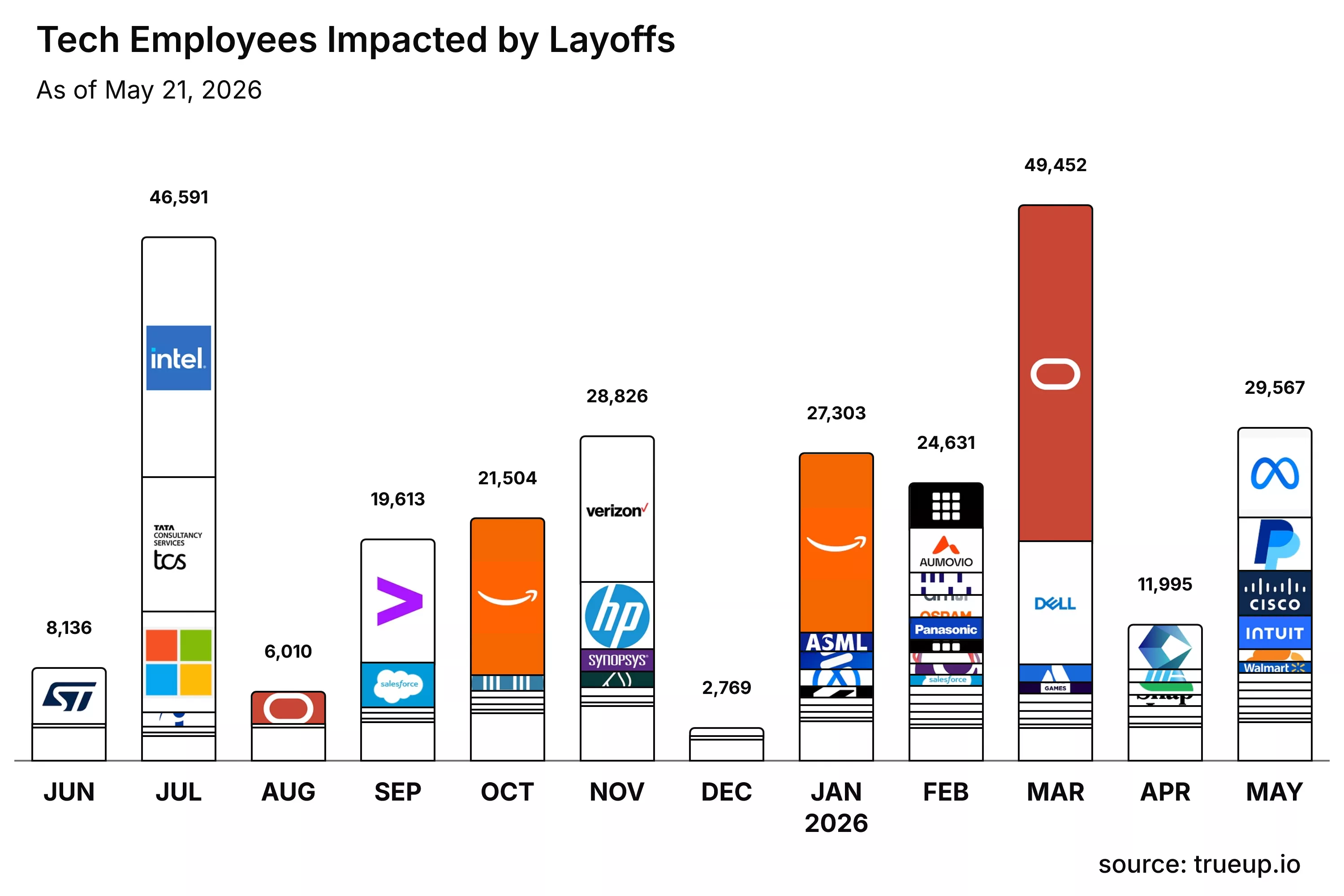
Meta is attempting to reduce labor costs as it prepares to spend over $100 billion in 2026 on AI data centers and related hardware. At the same time, the company aims to train its AI systems by monitoring employees' workstation activity, which some of them have described as "incredibly demoralizing."

Although TrueUp's graph also shows a large block of layoffs from PayPal, it remains unclear how many, if any, will occur in May. Sources recently told the Wall Street Journal that, like Meta, PayPal aims to eliminate about 20% of its workforce over the next two to three years, which could amount to 4,760 workers.

Cisco also recently announced around 4,000 layoffs. CEO Chuck Robbins framed the number as optimistically low, stating that the company is investing in AI infrastructure to avoid being left behind in the rush to adopt the technology.
Meanwhile, Intuit cut 3,000 jobs – 17% of its global workforce – to streamline its operations as it adopts AI, though it claims the layoffs are "not about AI." Affected employees will receive 16-week severance packages and other benefits.

While AI appears to be behind most of the job losses, industry insiders suggest that overhiring and resizing are also significant factors. Some of the latest reports, which do not yet contain solid numbers, also indicate that difficulties in video game development are contributing to the current wave.

Quantic Dream recently announced around 95 layoffs following the cancellation of Spellcaster Chronicles, a failed MOBA whose servers will shut down on June 19. Bungie might also be planning significant layoffs after confirming that Destiny 2's June 9 update will be the game's last. Destiny 3 is not currently in development.

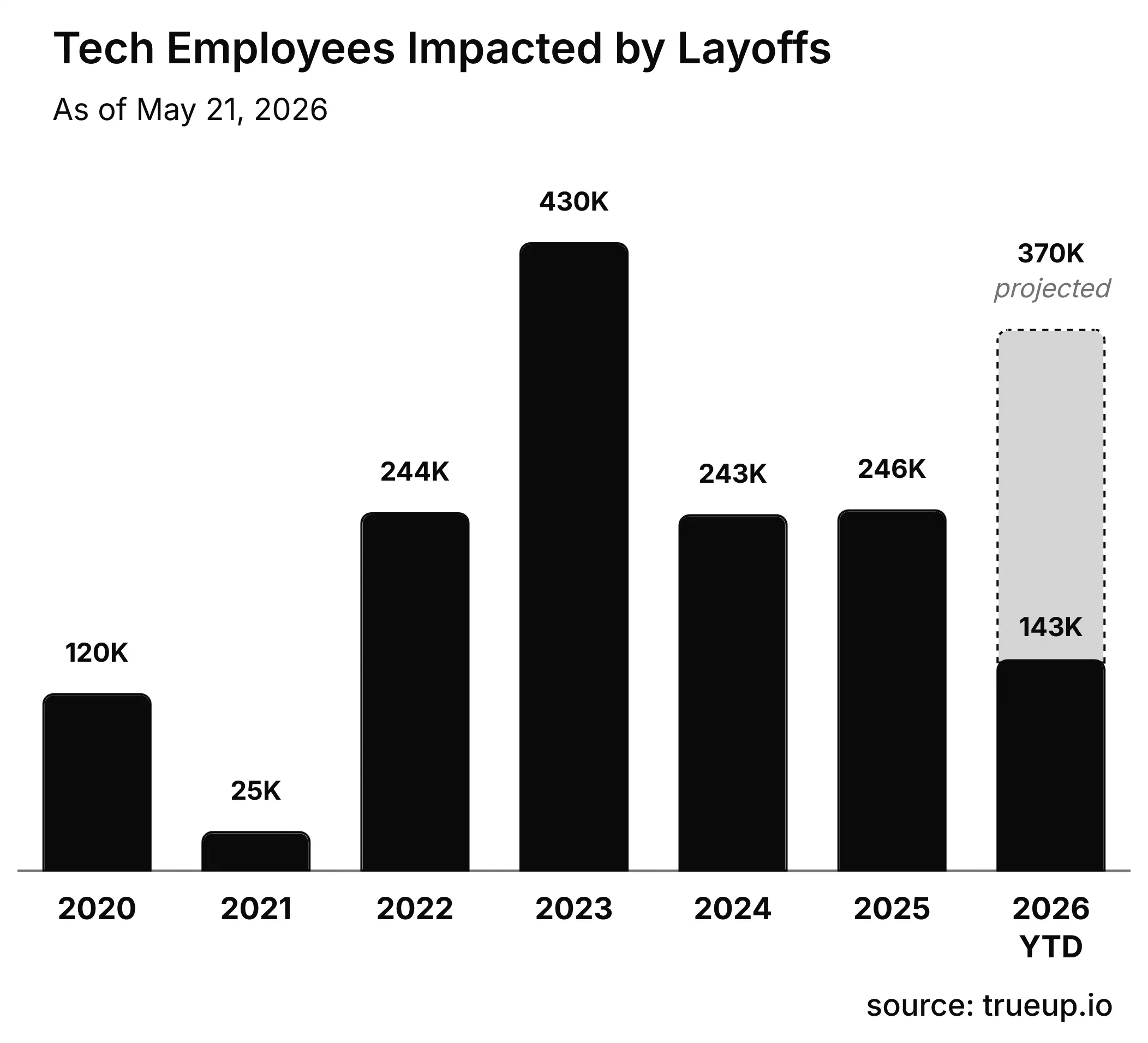
TrueUp projects that tech sector layoffs in 2026 could reach 370,000, significantly exceeding the previous two years. Layoffs reached 430,000 in 2023.

Permalink to story:

 
What's TechSpot going to write about when there's no more enthusiast/gaming hardware and everything is datacenters? When's the last time this site reviewed anything that connects to a backplane?
 
The average tech pro annual salary in the US is ~$100K, give or take.
100K layoffs * 100 K salary makes $10 billion 'savings' per year. That's barely enough for a single datacenter - only the Tract Data Center in Texas is twice that amount, around 20 billion.

Third grade math and less than a minute is enough to prove the "cuts jobs to fund AI" nonsense wrong.
 
It's funny that we've shifted from dropping employees because AI replaced them to dropping employees because AI ate the budget used to pay them.
Both "dropping employees because AI replaced them" and "dropping employees because AI ate the budget used to pay them" stories are utter nonsense. Both are merely fanning AI hysteria. The annual salaries of 100K employees are not enough even for a single big datacenter.
 
Both "dropping employees because AI replaced them" and "dropping employees because AI ate the budget used to pay them" stories are utter nonsense. Both are merely fanning AI hysteria. The annual salaries of 100K employees are not enough even for a single big datacenter.
Not utter nonsense. People were let go because CEOs believed AI could already replace them. Other people were let go because CEOs wanted to show Wall Street they were offsetting the cost of AI.

(Yes AI was also an excuse to lay off others but that doesn't negate my points)
 
Not utter nonsense. People were let go because CEOs believed AI could already replace them. Other people were let go because CEOs wanted to show Wall Street they were offsetting the cost of AI.

(Yes AI was also an excuse to lay off others but that doesn't negate my points)
Meta employs 70,000 people even after all the layoffs. In 2019 they employed just 45,000 people.
Cisco employs 82,000 people even after all the layoffs. In 2019 they employed just 75,900 people.
Intuit employs 15,200 people even after all the layoffs. In 2019 they employed just 9,400 people.

Now do you notice a pattern here? Despite "Muh AI", these companies all still employ more people then they did pre pandemic. The cuts we are seeing now are the result of overhiring, which has been called out for half a decade now. And as pnntmp already showed, the costs of these employees are a drop in the bucket compared to AI development, so they are not offsetting anything.

As for the other companies: Quantum Dream and Bungie both released absolute stinkers of games and burned through hundreds of millions of dollars each on projects that dont pan out. Bungie has OVER 1,200 EMPLOYEES. WHY?!?!? These companies are SUPER bloated and needed to cut headcount a decade ago.
 
Not utter nonsense. People were let go because CEOs believed AI could already replace them. Other people were let go because CEOs wanted to show Wall Street they were offsetting the cost of AI.

(Yes AI was also an excuse to lay off others but that doesn't negate my points)
Looks like nonsense to me.
How could you possibly know what CEOs "believed"?

An elementary calculation (see above) shows that the salaries of the laid off employees can't possibly be "offsetting the cost of AI." - the amount 'saved' from salaries is ridiculously small, compared to what's being invested in datacenters and the rest of AI infrastructure. The WallStreet guys are not idi0ts, they can handle simple math.
 
At a macro level having layoffs is not necessarily a bad thing as companies evolve. But when you have layoffs and no real growth in hiring to compensate, then you're looking at an industry recession.

There is some hiring in tech right now but it's not as broad as it used to be. There is hiring in certain very specific disciplines, at specific companies, at specific locations. Everybody else is frozen.
 
It makes no sense and the math doesn't add up, yet corporations are still replacing people with AI regardless, and unsurprisingly some are still blaming it on covid.
 
What's TechSpot going to write about when there's no more enthusiast/gaming hardware and everything is datacenters? When's the last time this site reviewed anything that connects to a backplane?
Monitors, keyboards and mice, maybe retro game emulators? There won't be much else left when there won't be any RAM or SSD's for gaming hardware.
 
Looks like nonsense to me.
How could you possibly know what CEOs "believed"?

An elementary calculation (see above) shows that the salaries of the laid off employees can't possibly be "offsetting the cost of AI." - the amount 'saved' from salaries is ridiculously small, compared to what's being invested in datacenters and the rest of AI infrastructure. The WallStreet guys are not idi0ts, they can handle simple math.
Because I research CEO behavior at an R1 university. I've written textbooks on this.

It does not have to 100% offset the expense to be offsetting. 100K firings is $10B/year but it's not about the exact math but the "positive signal to the market". And Wall Street sends stocks up every time there are layoffs. The brokers move first and then turn around and sell the trend to the normies.
 
Because I research CEO behavior at an R1 university. I've written textbooks on this.

It does not have to 100% offset the expense to be offsetting. 100K firings is $10B/year but it's not about the exact math but the "positive signal to the market". And Wall Street sends stocks up every time there are layoffs. The brokers move first and then turn around and sell the trend to the normies.
Companies only do layoffs if they have problems. There's no other reason.
Why would you lay people off if everything's fine???
 
Because I research CEO behavior at an R1 university. I've written textbooks on this.

It does not have to 100% offset the expense to be offsetting. 100K firings is $10B/year but it's not about the exact math but the "positive signal to the market". And Wall Street sends stocks up every time there are layoffs. The brokers move first and then turn around and sell the trend to the normies.
Oh yeah? Link them, let's see your work.
It makes no sense and the math doesn't add up, yet corporations are still replacing people with AI regardless, and unsurprisingly some are still blaming it on covid.
Where? These companies are still employing MORE PEOPLE then before COVID.

IDK why you write "unsurprisingly some are still blaming it on covid" when we can demonstrate, with numbers, that yes these massive hiring sprees from Red Lung still have lingering effects on corporate size today.

Could you at least try to explain why the numbers dont add up before jumping to doomerism? BTW still waiting on that evidence that nvidia has abandoned the market.
 
I still wonder if all of these tech layoffs aren't so much to do with AI, but being blamed on AI for BAD decisions made when all of the work from home stuff started during Covid?
 
Hmm. There are a few people who have said that AI hasn't been hurting the job market(Endymio, SquidSurprise for a start). I'll bet they make excuses and blame it on something else, like the economy or some other unrelated excuse.
 
Last edited:
Companies only do layoffs if they have problems. There's no other reason.
Why would you lay people off if everything's fine???
I'm generally a defender of business, but that's a pretty naive outlook.

CEOs are largely compensated in stock.

CEOs are replaced if the stock price is bad for too long (unless they are founders with majority voting shares like Zuck then they can do whatever).

The market likes signals that companies are "making strategic moves", "making the hard decisions", "implementing cost reductions for improved efficiency", etc. So, as always, incentives matter.

If you really want a "problem" that's easy too. The problem is that AI is taking too long to get to profit given the crazy capital outlays. So cutting payroll to partially offset the cost shows "financial restraint" and that management is focused on doing what is necessary to get to those future profits investors want.
 
I'm generally a defender of business, but that's a pretty naive outlook.

CEOs are largely compensated in stock.

CEOs are replaced if the stock price is bad for too long (unless they are founders with majority voting shares like Zuck then they can do whatever).

The market likes signals that companies are "making strategic moves", "making the hard decisions", "implementing cost reductions for improved efficiency", etc. So, as always, incentives matter.

If you really want a "problem" that's easy too. The problem is that AI is taking too long to get to profit given the crazy capital outlays. So cutting payroll to partially offset the cost shows "financial restraint" and that management is focused on doing what is necessary to get to those future profits investors want.
You assume people are idi0ts that can be easily fooled by CEOs mimicking some measures, but that's simply not the case. It's not possible to offset anything by cutting jobs, not even partially, because the 'savings' are microscopic compared to the cost of compute, and that's crystal clear to everyone. Paying huge money for compute and then getting rid of people you need to use it efficiently, only to fool people for a short while - that's outright lunacy, no one sane would do it. People are laid off if they are not needed or if the company can't afford to pay them. Even if there are anecdotal examples of CEOs doing it to make false impressions, these are too rare to explain whatever trend.
 
I've written textbooks on this.

Wall Street sends stocks up every time there are layoffs. The brokers move first and then turn around and sell the trend to the normies.
Reality -- as well as the literature in the field -- prove this wrong, such as this study by a professor at Europe's top business school:

How Do Shareholders Respond To Downsizing

"...The core of the paper is a meta-analysis. We show that layoffs announcements have an overall negative effect on stock market prices, and this remains true whatever the country, the period of time or the type of firm considered....."


What you refer to is a fringe case, where shareholders view the firm as struggling due to a bloated workforce, and thus respond positively to reduction-in-force announcements. And even these upticks are brief and limited, unless the results of that RIF are reflected in the next P&L statement.
 
Last edited:
To be fair, I suspect it's only just beginning in the US. I'm not an expert in these things but this is my take:

Workers losing their jobs due to AI is probably a tiny part of the problem.

The NYSE is riding a high just because a disproportionate amount of it's investments are in AI companies. The AI industry appears to be a bubble that's keeping the US afloat at the moment. If any fail ...

I appreciate that tariffs were aimed at bringing industry back to America but that hasn't happened and you're just left with American consumers paying those tariffs.

America is losing the current Iran war and it's costing $1b/day plus losses to keep playing. A big issue is whether Trump will put boots on the ground if only just to hide all the other issues at home.

Fuel prices have yet to rise dramatically but this happen and that means the cost of everything will rise.

US treasury bonds are now having to pay higher yields to get countries to buy them. This dictates how much Americans pay for their mortgages and car payments etc. Any loans in the US will soon cost more.

Countries are also now considering moving away from petrodollars. Petrodollars and US treasury bonds previously allowed America to have such a high debt to GDP ratio. It effectively allowed them to print money. If countries start moving away from petrodollars then your left with a country who's debts are $40 trillion but who's GDP is $37 trillion.

Just saying ...
 
To be fair, I suspect it's only just beginning in the US. I'm not an expert in these things but this is my take:

Workers losing their jobs due to AI is probably a tiny part of the problem.

The NYSE is riding a high just because a disproportionate amount of it's investments are in AI companies. The AI industry appears to be a bubble that's keeping the US afloat at the moment. If any fail ...

I appreciate that tariffs were aimed at bringing industry back to America but that hasn't happened and you're just left with American consumers paying those tariffs.

America is losing the current Iran war and it's costing $1b/day plus losses to keep playing. A big issue is whether Trump will put boots on the ground if only just to hide all the other issues at home.

Fuel prices have yet to rise dramatically but this happen and that means the cost of everything will rise.

US treasury bonds are now having to pay higher yields to get countries to buy them. This dictates how much Americans pay for their mortgages and car payments etc. Any loans in the US will soon cost more.

Countries are also now considering moving away from petrodollars. Petrodollars and US treasury bonds previously allowed America to have such a high debt to GDP ratio. It effectively allowed them to print money. If countries start moving away from petrodollars then your left with a country who's debts are $40 trillion but who's GDP is $37 trillion.

Just saying ...
yeah, sure .. workers losing jobs, it's a bubble, losing the Iran war despite the fact no coherent 'Iran' entity exists anymore, fuel prices 'yet to rise dramatically' no matter they are falling, everyone is allegedly 'moving away from petrodollars' since decades but somehow it's not happening (not that it matters) ... you're definitely not a troll 🤣🤣
 
yeah, sure .. workers losing jobs, it's a bubble, losing the Iran war despite the fact no coherent 'Iran' entity exists anymore, fuel prices 'yet to rise dramatically' no matter they are falling, everyone is allegedly 'moving away from petrodollars' since decades but somehow it's not happening (not that it matters) ... you're definitely not a troll 🤣🤣
I understand you disliking what I said but I tried to explain why each point was an issue for America. Was there something in particular you didn't understand?
 
I understand you disliking what I said but I tried to explain why each point was an issue for America. Was there something in particular you didn't understand?
You mean besides that all those points were utter nonsense? Such as the Iran War costing "$1B a day". It was nearly $2B/day in the first six days when we were expending munitions at lightning pace, but it tapered off fast and the last month has been only around $75M/day. Or the doomsaying about treasury bond yields, when they're lower than they were three years ago, and less than one-third their historical highs.
 
Last edited:
You assume people are idi0ts that can be easily fooled by CEOs mimicking some measures, but that's simply not the case. It's not possible to offset anything by cutting jobs, not even partially, because the 'savings' are microscopic compared to the cost of compute, and that's crystal clear to everyone. Paying huge money for compute and then getting rid of people you need to use it efficiently, only to fool people for a short while - that's outright lunacy, no one sane would do it. People are laid off if they are not needed or if the company can't afford to pay them. Even if there are anecdotal examples of CEOs doing it to make false impressions, these are too rare to explain whatever trend.
There are books and academic research to back this up beyond anecdotes. I was merely trying to briefly explain why CEO incentives and stock market reactions explained why was puzzling to you.
 
Back