Looking ahead: Qualcomm is positioning itself to capture a share of the next decade's data center spending surge by combining its expertise in mobile efficiency with a scalable rack design. The company is no longer presenting itself solely as a smartphone chipmaker; it is now entering the infrastructure race that will determine which hardware powers the next generation of AI applications.
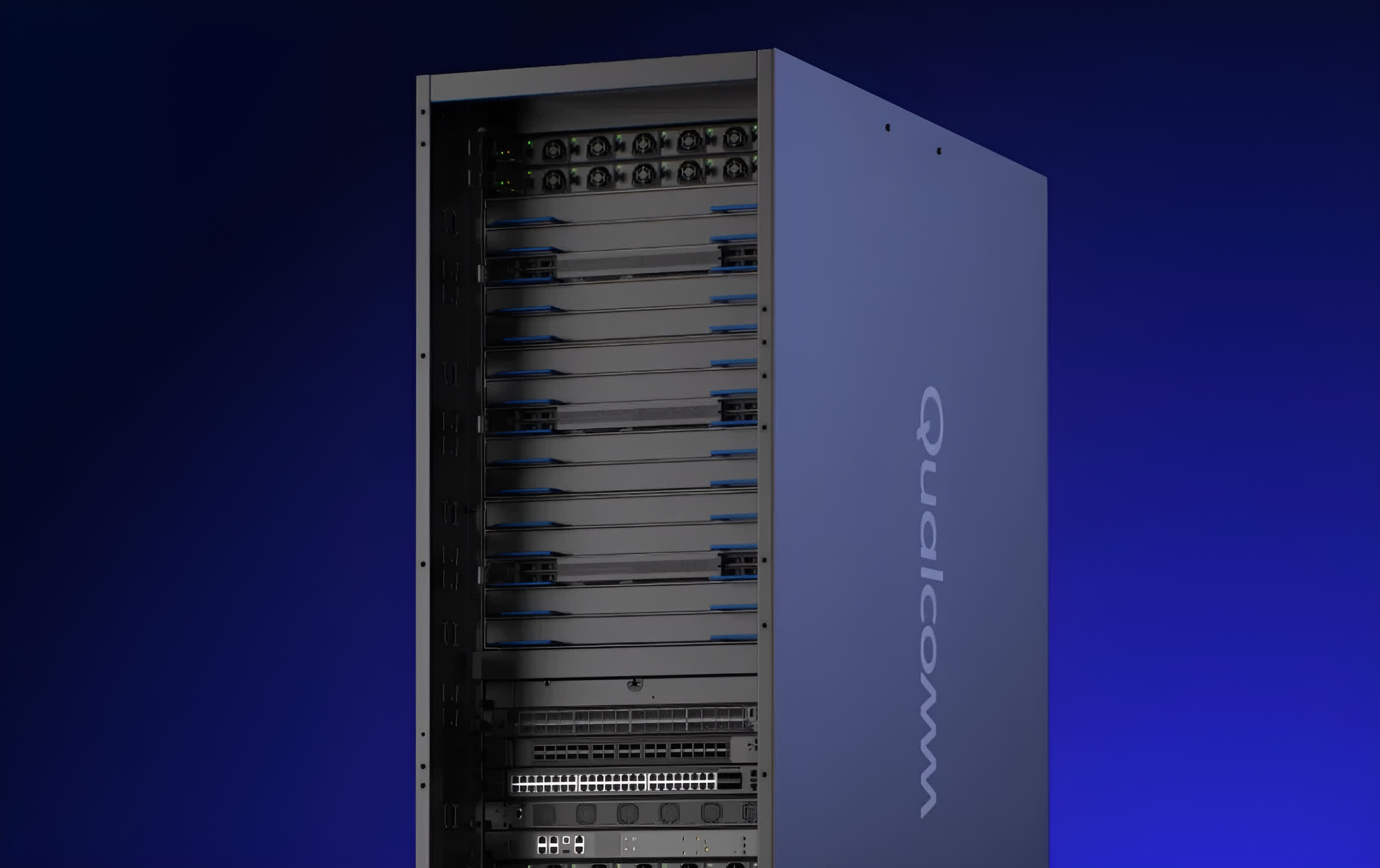
Qualcomm is expanding beyond its roots in mobile technology, directly challenging the companies dominating artificial intelligence hardware. The semiconductor firm has announced that it will enter the high-end data center market with two new AI accelerator chips, marking its most ambitious move yet into the computing infrastructure that underpins the current AI boom.
The company plans to release two products: the AI200 and AI250, both designed for the inference side of AI deployment. The AI200 will be available commercially in 2026, followed by the AI250 in 2027.
Both chips can be configured as full, liquid-cooled server racks for large-scale data centers. Qualcomm also committed to updating its AI data center hardware annually.
While Qualcomm is best known for its mobile-oriented Snapdragon processors and wireless connectivity chips, the new line of AI accelerators borrows technology from its Hexagon neural processing units, which are optimized for low-power machine learning tasks in smartphones. Company executives said these same design efficiencies could make Qualcomm's rack-scale systems cost-competitive with data center offerings from Nvidia and AMD, whose GPUs currently dominate the field.
"The idea was to first prove ourselves in mobile and edge computing before scaling up to the data center level," Durga Malladi, general manager for Qualcomm's data center and edge business, said in an earnings call. "Our architecture allows customers to either buy our complete rack system or combine our chips with their own designs."
.@HUMAINAI is targeting 200 megawatts of Qualcomm AI200 and AI250 rack solutions, starting in 2026, to deliver high-performance #AI inference services in the Kingdom of Saudi Arabia and globally.
– Qualcomm (@Qualcomm) October 27, 2025
Learn more here: https://t.co/T9RQw5R7iK pic.twitter.com/Wl6Vw3kgAA
The hardware structure of Qualcomm's new systems resembles Nvidia's HGX and AMD's Instinct-based platforms: large racks holding dozens of interconnected accelerators that function as a single compute unit. Each rack consumes approximately 160 kilowatts of power, comparable to current high-performance GPU clusters. The company emphasized what it calls superior performance per dollar per watt.
Unlike Nvidia's H100 GPUs, which specialize in both training and inference, Qualcomm is targeting inference workloads only. This includes generating text using pretrained models or supporting interactive applications that require real-time processing. Malladi said these tasks represent an increasing share of AI data center usage.
The company declined to disclose pricing or the number of NPUs a single rack could hold but confirmed that its AI cards support 768 gigabytes of memory, an amount exceeding the capacity of comparable products from Nvidia and AMD. Qualcomm said it has developed a new memory management architecture designed to improve speed and reduce energy consumption during inference operations.
Qualcomm's entry signals an intensifying effort to expand the AI semiconductor ecosystem, potentially loosening Nvidia's dominance in the sector. The company already has its first major client: Saudi Arabia-based Humain, which will deploy Qualcomm's AI200 and AI250 systems starting in 2026. The partnership could power data center capacity equivalent to 200 megawatts once fully operational.
Qualcomm also said its systems will be available as discrete components for hyperscale cloud operators that prefer to design and assemble their own racks. Its CPUs and accelerator cards could, in principle, be supplied even to rivals. "Our goal is to give customers choices – take the full rack or mix and match," Malladi said.
Qualcomm steps into the AI infrastructure race with new AI200 and AI250 accelerators

