The bleeding edge: Nanomachines were once a distant fantasy of science fiction writers and video games like Deus Ex and Metal Gear Solid. However, recent advances in miniaturization have brought those far-fetched scenarios closer to reality. We may soon see microscopic robots that can heal us from the inside or perform other tasks difficult to accomplish on the macro scale.
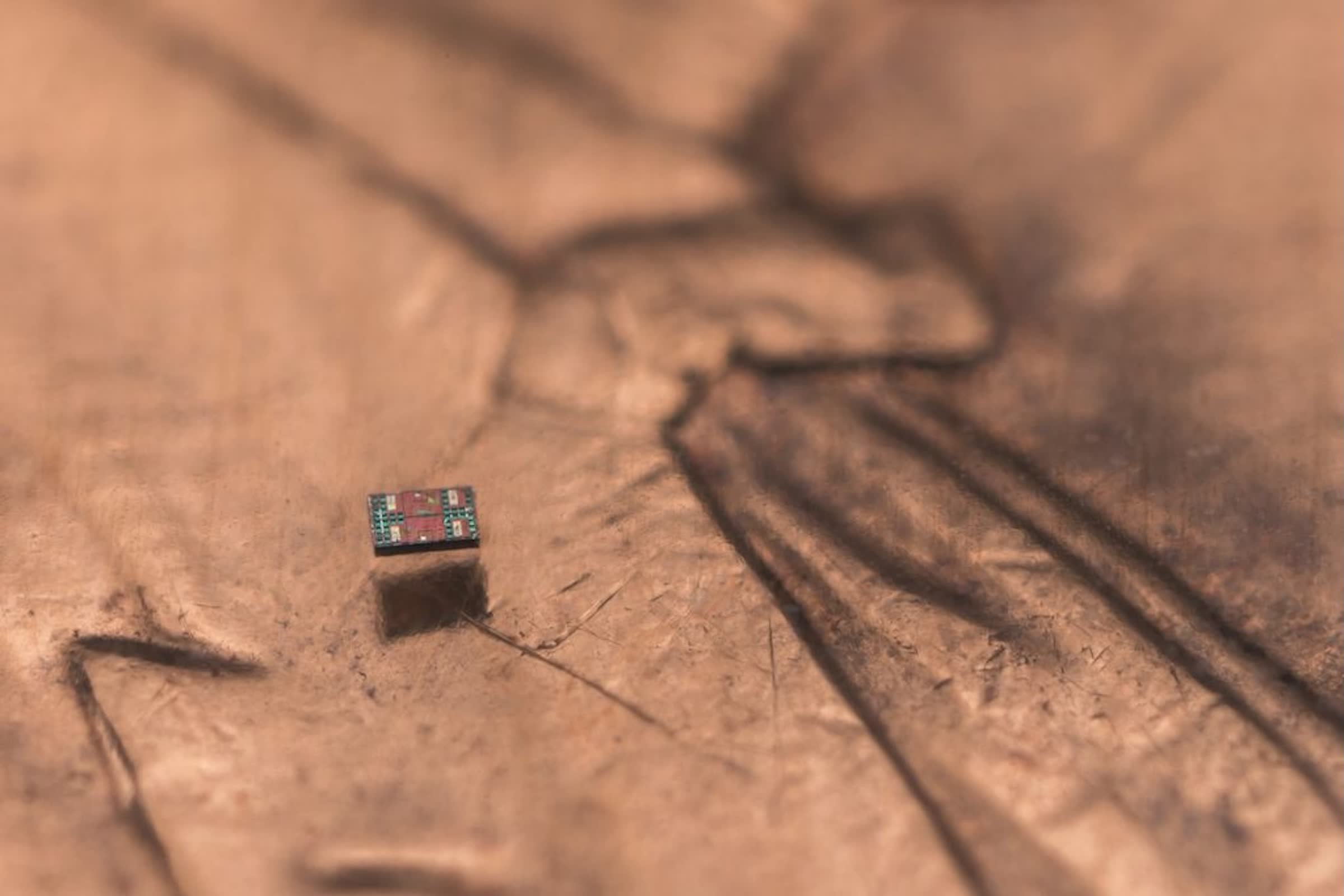
In a joint advance from the University of Pennsylvania and the University of Michigan, engineers have designed the smallest fully programmable autonomous robots ever built – machines small enough to operate at the scale of biological cells. Each robot, roughly 200 by 300 by 50 micrometers, is smaller than a grain of salt and costs about a penny to produce. Despite their size, the devices can move, sense, compute, and respond to their surroundings without any tether, magnetic field, or external controller.
Assistant Professor of Electrical and Systems Engineering Marc Miskin told Science Alert that these autonomous robots are 10,000 times smaller than current microbots.
"That opens up an entirely new scale for programmable robots," Miskin said.
The researchers, who recently published their work in Science Robotics and Proceedings of the National Academy of Sciences, envision potential uses ranging from tracking the health of single cells to helping build microscale machines. Because the robots operate in the same size regime as many microorganisms, they could one day navigate tissue environments or microscopic manufacturing lines that are inaccessible to traditional robotics.
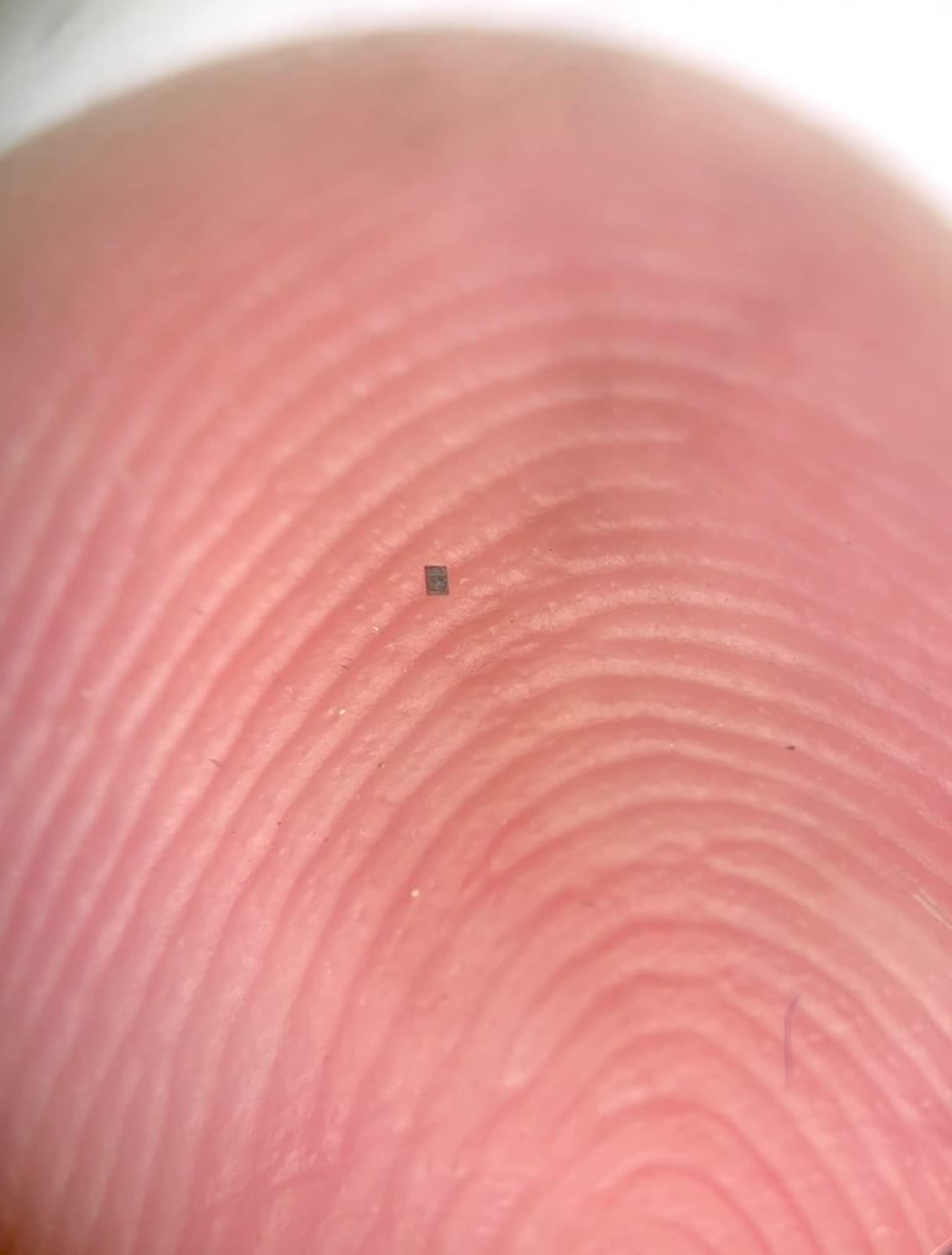
Reducing robots to sub-millimeter sizes introduces new physical constraints, where inertia and gravity give way to surface forces like drag and viscosity. Conventional mechanical limbs quickly break or fail to generate movement in such conditions, forcing the team to rethink what propulsion means at the microscopic level.
"If you're small enough, pushing on water is like pushing through tar," Miskin said.
The group developed a novel locomotion system that doesn't rely on moving parts. Instead of using tiny gears or oars, each robot manipulates the ions in its surrounding liquid through induced electric fields. Those ions then push nearby water molecules, effectively propelling the robot through the fluid.
"It's as if the robot is in a moving river," Miskin said, "but the robot is also causing the river to move."
By tuning this generated field, the robots can travel in complex trajectories and coordinate like a school of fish, reaching about one body length per second. Because there are no moving components, the design remains mechanically robust – Miskin noted that researchers can transfer the robots between samples repeatedly without damage. A simple LED light supplies energy, and the machines can operate for months.

A projected time-lapse of tracer particle trajectories near a robot consisting of three motors tied together.
Physical motion was only half the challenge. To create robots that could act independently, the Penn team turned to David Blaauw's group at the University of Michigan, known for developing the world's smallest computer. The collaboration began after a DARPA meeting five years ago, where both researchers realized their technologies were complementary. Integrating computation into such small devices required ultra-efficient electronics; each robot's solar panels generate just 75 nanowatts – over 100,000 times less power than a smartwatch.
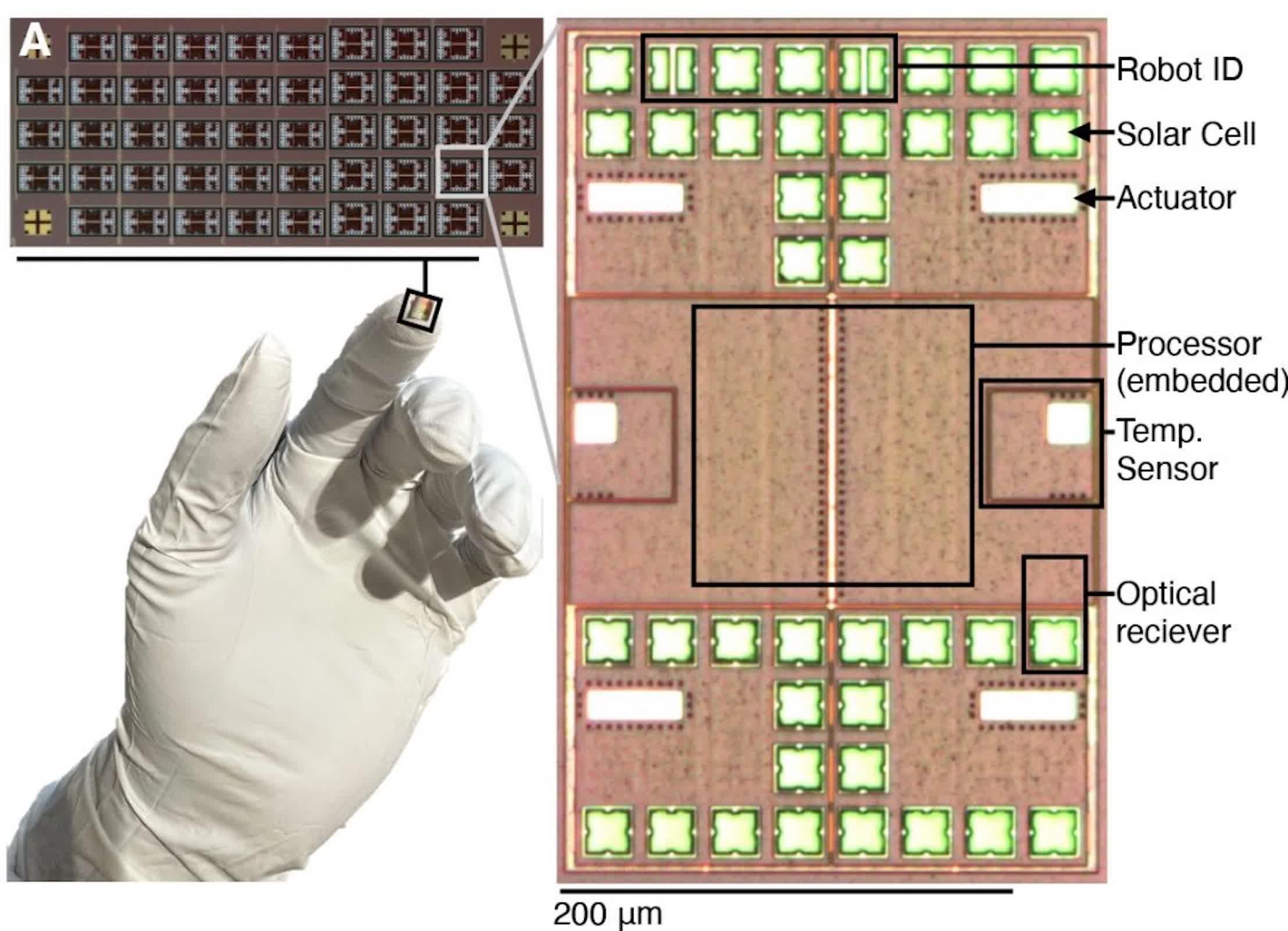
The robot has a complete onboard computer, enabling it to operate autonomously once programmed.
Blaauw explained that his team built circuits that run on extremely low voltages, cutting the computer's power draw by more than a thousandfold. Even so, the panels dominate most of the robot's surface area, leaving minimal room for the processor and memory. The result is a fully integrated device featuring a processor, memory, sensors, and motor function – all within a structure measuring a few hundred micrometers. The microcomputer enables the robots to sense temperature with a precision of about one-third of a degree Celsius and react accordingly, making it possible, for example, to follow heat gradients that indicate biological activity or to report environmental data in real time.

The final stages of microrobot fabrication deploy hundreds of robots simultaneously. The tiny machines can then be programmed individually or en masse to carry out experiments.
Human observers communicate with the robots through motion. Blaauw's team encoded data, such as measured temperature, into physical movements.
"We designed a special computer instruction that encodes a value, such as the measured temperature, in the wiggles of a little dance the robot performs," he said. "We then look at this dance through a microscope with a camera and decode from the wiggles what the robots are saying to us. It's very similar to how honey bees communicate with each other."
Researchers can power and program each robot individually with specific pulses of light. This architecture allows them to assign unique instructions to different robots in a swarm, enabling each to perform distinct roles within a coordinated task.
Miskin and Blaauw see the current design as a starting point rather than an endpoint. The platform's hybrid of mechanical simplicity, efficient electronics, and scalable fabrication offers potential across fields that require distributed, microscopic intelligence. Miskin described the work as the first step toward layering on additional intelligence and functionality, demonstrating that a tiny, fully functional robot can survive and operate for months, opening the door to a new future for microscale robotics.


