
The bleeding edge: Imagine listening to music or a podcast without headphones while not disturbing others or having a private conversation in a crowded place with the assurance that only the intended listener can hear your voice. Scientists have developed a new technology called "audio enclaves" that could make this a reality by creating localized pockets of sound isolated from their surroundings.

Directing sound to a specific location is difficult because of how sound waves behave. As vibrations move through the air, they spread out, especially at lower frequencies. This effect, known as diffraction, makes it hard to keep audio contained in one area, particularly with bass-heavy tones. Isolating sound frequencies is even more challenging.
Specialized equipment, like parametric array loudspeakers, can direct sound vibrations to a specific point in a focused beam. However, those in the beam's path can still hear the transmission. Limiting the sound to only the targeted location is still impossible using current technology.
To achieve total sound isolation, researchers from the University of Pennsylvania and Lawrence Livermore National Laboratory used ultrasound and nonlinear acoustics to "bend" soundwaves to produce audible vibrations that occur only at a specific location.
At 20kHz and above, ultrasound is inaudible to humans. Most people are familiar with its use in medical imaging. However, it behaves identically to audible sound waves. Therefore, it is susceptible to the same principles and wave manipulation as audible sound. The researchers leveraged these properties to create a breakthrough, dubbed "audio enclaves," that uses ultrasound as a carrier for lower frequencies. Since ultrasound travels "silently," it can transport the audible sounds to a location without anybody hearing it except those at the target location.
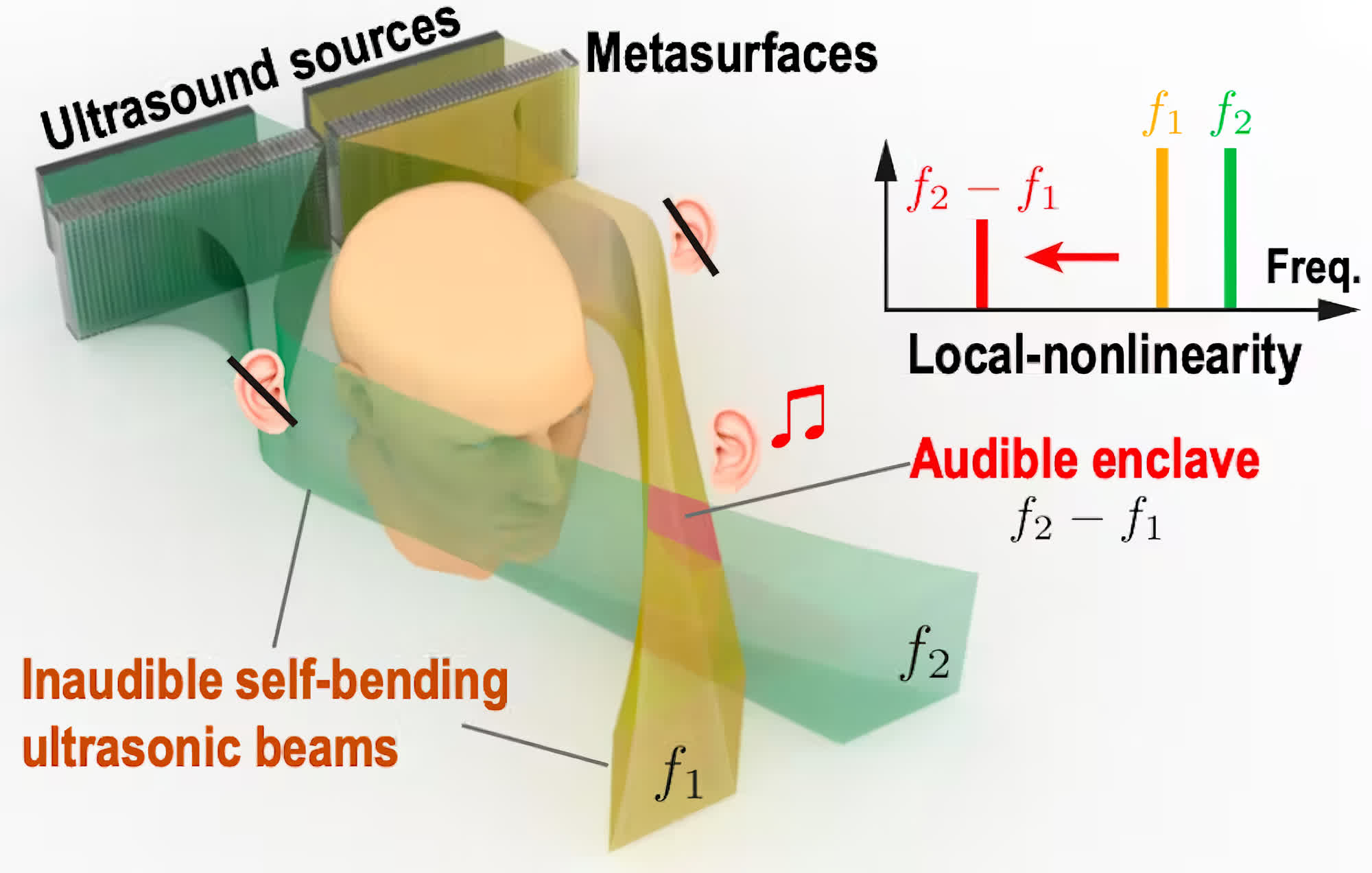
Audible enclaves are created at the intersection of two ultrasound beams.
The researchers used two ultrasound beams at slightly different frequencies to do this. When the beams intersect, a phenomenon known as difference frequency generation occurs, creating an audible sound.
"When two ultrasonic beams of slightly different frequencies, such as 40 kHz and 39.5 kHz, overlap, they create a new sound wave at the difference between their frequencies – in this case, 0.5 kHz, or 500 Hz, which is well within the human hearing range," the study's authors wrote. "Sound can be heard only where the beams cross. Outside of that intersection, the ultrasound waves remain silent."
Another key innovation of the research is the self-bending of the ultrasound beams. Using acoustic metasurfaces, the researchers can control the path of ultrasonic vibrations, effectively curving the beams around obstacles and allowing them to intersect at a specific point.
"Crucially, we designed ultrasonic beams that can bend on their own. Normally, sound waves travel in straight lines unless something blocks or reflects them. However, by using acoustic metasurfaces – specialized materials that manipulate sound waves – we can shape ultrasound beams to bend as they travel. Similar to how an optical lens bends light, acoustic metasurfaces change the shape of the path of sound waves. By precisely controlling the phase of the ultrasound waves, we create curved sound paths that can navigate around obstacles and meet at a specific target location."
The researchers say that audio enclaves have a vast array of applications. The most obvious is eliminating the need for headphones in many situations. For instance, museums could offer personalized audio guides that follow individual users. Car passengers could listen to music without interfering with the driver's navigation instructions. It could also provide corporate and military environments with an alternative means of secure communication.
The authors admit that despite its potential, the technology is still very new, with many challenges to overcome before it is commercially viable. Nonlinear distortion can impact sound quality, and generating the high-intensity ultrasound fields required for audio enclaves can be energy-intensive. The researchers are working on these areas to make the technology more efficient and practical for real-world use.
Image credit: Jiaxin Zhong et al
Researchers harness ultrasound to create isolated pockets of sound only you can hear in a crowd


