Sam Altman predicts Artificial General Intelligence by 2030, says AI will take over 40% of tasks

midian182

Posts: 11,624   +175
Staff member
Crystal ball: Sam Altman has given another prediction on when artificial general intelligence (AGI) – an AI vastly smarter than humans – will arrive: the OpenAI boss said that "superintelligence" will be here by 2030. He also said that 30-40% of tasks that happen in the economy today will be taken over by AI in the not very distant future.
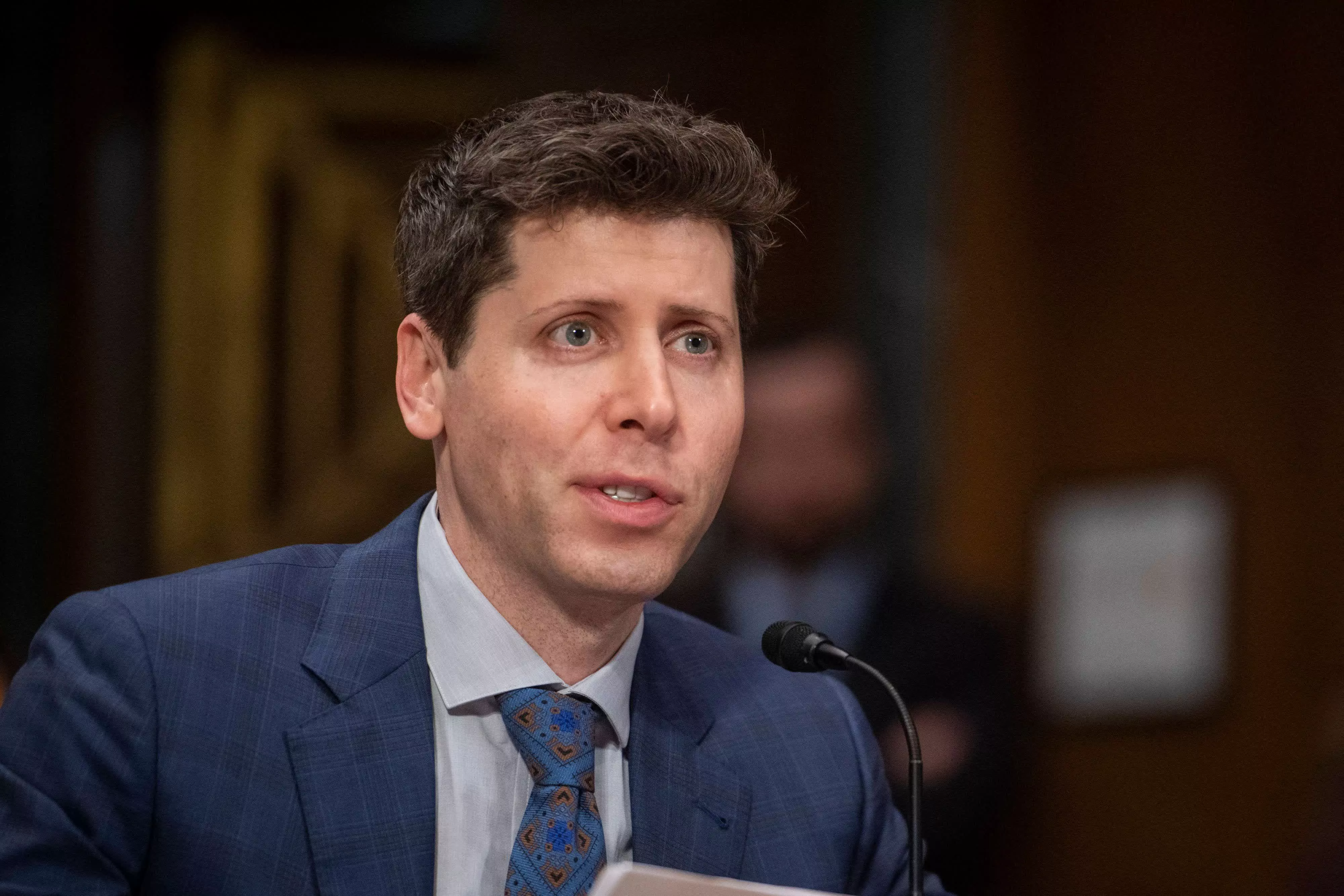
Jan Philipp Burgard, editor-in-chief of the Die Welt newpaper, interviewed Altman on behalf of the Axel Springer Global Reporters Network this week in Berlin. Altman was in Germany's capital to receive this year's Axel Springer Award.

The interview covered several areas, including the development of an AI superintelligence. Altman said that the latest GPT-5 model is in many ways smarter than a lot of people, himself included, but an actual superintelligent AI will emerge before the end of the decade.

"If we don't have models [by 2030] that are extraordinarily capable and do things that we ourselves cannot do, I'd be very surprised," he said.
We've already seen thousands of people laid off as a result of generative AI, either directly or indirectly. Burgard asked Altman what percentage of today's jobs are likely to disappear in the foreseeable future.

Altman, not wanting to paint too pessimistic a picture, pointed out that many jobs from 30 years ago do not exist today, even without the influence of AI. The CEO was less willing to put a figure on what percentage of jobs will be taken by AI; instead, he claimed 30-40% of tasks that "happen in the economy" will be done by AI in the not very distant future.

When asked about what advice he would give to his son so his job won't be replaced by AI in 30 years, Altman said, "the meta-skill of learning how to learn, of learning to adapt, learning to be resilient to a lot of change. Learning how to figure out what people want, how to make useful products and services for them, how to interact in the world."

Altman was also asked if he agreed with AI researcher Eliezer Yudkowsky, who said that the relationship between superintelligence and humans is roughly the same as the relationship between humans and ants. Does Altman fear that AI could eventually view us as ants and destroy us?

Unsurprisingly, Altman thinks AGI will treat humanity as a loving parent. This is similar to the views of AI "godfathers" Geoffrey Hinton and Meta's Yann LeCun, who recently said that building "maternal instincts" into AI models was important to ensure that "they really care about people."

Altman did admit that there could be side effects and consequences to using AGI that we don't understand, "And so it is very important that we align it to human values. But we get to align this tool to human values and I don't think it'll treat humans like ants. Let's say that."

Burgard broached the subject of many tech companies reversing their previous liberal-democratic leanings to show support for Donald Trump. Altman said he believes the tech industry should work with whomever the US president is, adding that there has been some welcome policy changes since Trump was inaugurated this year, citing a "more general pro-business climate and pro-tech climate."

Altman finished by saying he expects more presidents and leaders around the world to use AI for decisions. Given the controversy Swedish Prime Minister Ulf Kristersson stirred up after revealing that he regularly consults AI chatbots in his role as head of government, plenty of people will likely disagree with Altman on this one.

Finally, Altman confessed that unlike many users, he doesn't turn to ChatGPT for help with relationship issues.

Permalink to story:

 
AGI is a myth to anyone with a basic understanding of computer science. If it's even possible, it won't happen within our lifetimes.

Sam Altman's a grifter and spouting more BS to try to suck up as much venture funding as possible before the bubble bursts, a bubble he himself acknowledged the existence of mere weeks ago. VCs who invest in this deserve to lose.
 
With the rate that the "AI" search engines are performing today, there is no way in hell they'll be anywhere near the capabilities he thinks they'll be by 2030.

I'm more likely to believe him if he said that that quantum computers will be a household device before actual AI becomes a thing.
 
Whenever Sam Altman says "AI" is going to do something, I take it to mean that he himself is going to physically do it.
 
With the rate that the "AI" search engines are performing today, there is no way in hell they'll be anywhere near the capabilities he thinks they'll be by 2030.

I'm more likely to believe him if he said that that quantum computers will be a household device before actual AI becomes a thing.
You better believe that quantum computers is the next bubble waiting to happen after the AI bubble pops.
 
This is great news for job creation -- I can not imagine the vast army of workers it would take to clean up the resulting mess if half the economy was turned over to AI in anything resembling its current state.
 
Hehe, just to add to all this enthusiasm, wasn't AGI meant to do every job? And then Super AGI is meant to solve all are ills?
 
AGI is a myth to anyone with a basic understanding of computer science. If it's even possible, it won't happen within our lifetimes.

It's unclear whether strong AI will be reached in our lifetimes. On the architectural side, there's a lot of work to be done; LLMs are only one faculty; sentience hasn't been reverse engineered yet; and power is a barrier. But, if the mammalian brain works according to the laws of physics, it can be replicated. I suspect the versions that finally work will be close to Nature's design and manufacturing.
 
It's unclear whether strong AI will be reached in our lifetimes. On the architectural side, there's a lot of work to be done; LLMs are only one faculty; sentience hasn't been reverse engineered yet; and power is a barrier. But, if the mammalian brain works according to the laws of physics, it can be replicated. I suspect the versions that finally work will be close to Nature's design and manufacturing.
The human brain doesn't run on 1s and 0s. Every decision we make and every thought we have is the result of complex chemical reactions with varying hormone levels. It's not just a lever in our heads that goes from happy to sad. Every neuron synapse in our brains can be influenced in thousands of ways with millions of possible levels of hormones affecting the outcome.

Every single possible combination must be expressed to emulate proper intelligence, and that requires exponentially more computational power then we currently possess as a planet.
 
The human brain doesn't run on 1s and 0s. Every decision we make and every thought we have is the result of complex chemical reactions with varying hormone levels. It's not just a lever in our heads that goes from happy to sad. Every neuron synapse in our brains can be influenced in thousands of ways with millions of possible levels of hormones affecting the outcome.

Every single possible combination must be expressed to emulate proper intelligence, and that requires exponentially more computational power then we currently possess as a planet.

Yes, it is a power and compute problem fundamentally. The brain's synapses eclipse transistor counts and support electrical or chemical links, providing the infrastructure for information transfer. The brain uses about 12–20 W, outclassing the indecent amount of power used by GPUs to run LLMs.

The transistor paved the way for yesterday's and today's devices. Analogue biological computing may do the same for strong AI. In principle, Nature's design can be copied and implemented, but we haven't got there yet; Ryzen may seem impossible to the designers of ENIAC.

I would say the numerical encoding isn't important but a matter of implementation. Neural transmission along axons does work in an "all-or-nothing" way according to voltage thresholds, similar to how binary is represented in computers. Also, artificial neural networks are starting to abstract, in a simplified way, how the brain's networks work.
 
Because the person who has something to sell you in that space is who you should listen to. Tell him to prove it by having his "AI" learn things without them being fed to it to amalgumate a response from and to solve the spam calls, texts, and email problems.
 
It's unclear whether strong AI will be reached in our lifetimes. On the architectural side, there's a lot of work to be done; LLMs are only one faculty; sentience hasn't been reverse engineered yet; and power is a barrier. But, if the mammalian brain works according to the laws of physics, it can be replicated. I suspect the versions that finally work will be close to Nature's design and manufacturing.
The brain can't be replicated, because it's thinking power is based on a relationship. I won't go into this here, but it is easily proven and has been for 1300 hundred years (John of Damascus). As with most things, statistics will show that the relationship is not a guess. But while machines can't think, they can learn. Machine learning is the future.
 
The brain can't be replicated, because it's thinking power is based on a relationship. I won't go into this here, but it is easily proven and has been for 1300 hundred years (John of Damascus). As with most things, statistics will show that the relationship is not a guess. But while machines can't think, they can learn. Machine learning is the future.

I couldn't easily find a description of his view, but Google extracts suggest it is mind-body dualism. This hasn't been solved yet, whether the mind is non-physical and apart from the brain, or whether it emerges solely from the brain (physicalism). If the mind is indeed non-physical, then yes, it can't be replicated. If physicalism is true, it could be replicated if the technology were capable and we had a complete description.

Having said that, there is a great deal of evidence showing that the mind follows from the physical neural substrate and their connections (though I do not rule out that there could be something extra-physical to it). Awareness seems to be tied to the lower brainstem, in that damage or disruption causes loss of consciousness. There appears to be an intricate network across the brain that conjures up what we perceive. Most animals also show awareness, which is problematic for the mind-body dualism approach.
 
Back