Samsung readies LPCAMM2 LPDDR5X modules with up to 96GB and 9600 MT/s

Skye Jacobs

Posts: 2,010   +58
Staff
In brief: Samsung is preparing a new wave of LPCAMM2 modules powered by LPDDR5X memory, further advancing compact, high-performance computing. Production is expected to begin soon, with the upcoming modules offering capacities of up to 96GB and transfer speeds reaching 9,600 MT/s.
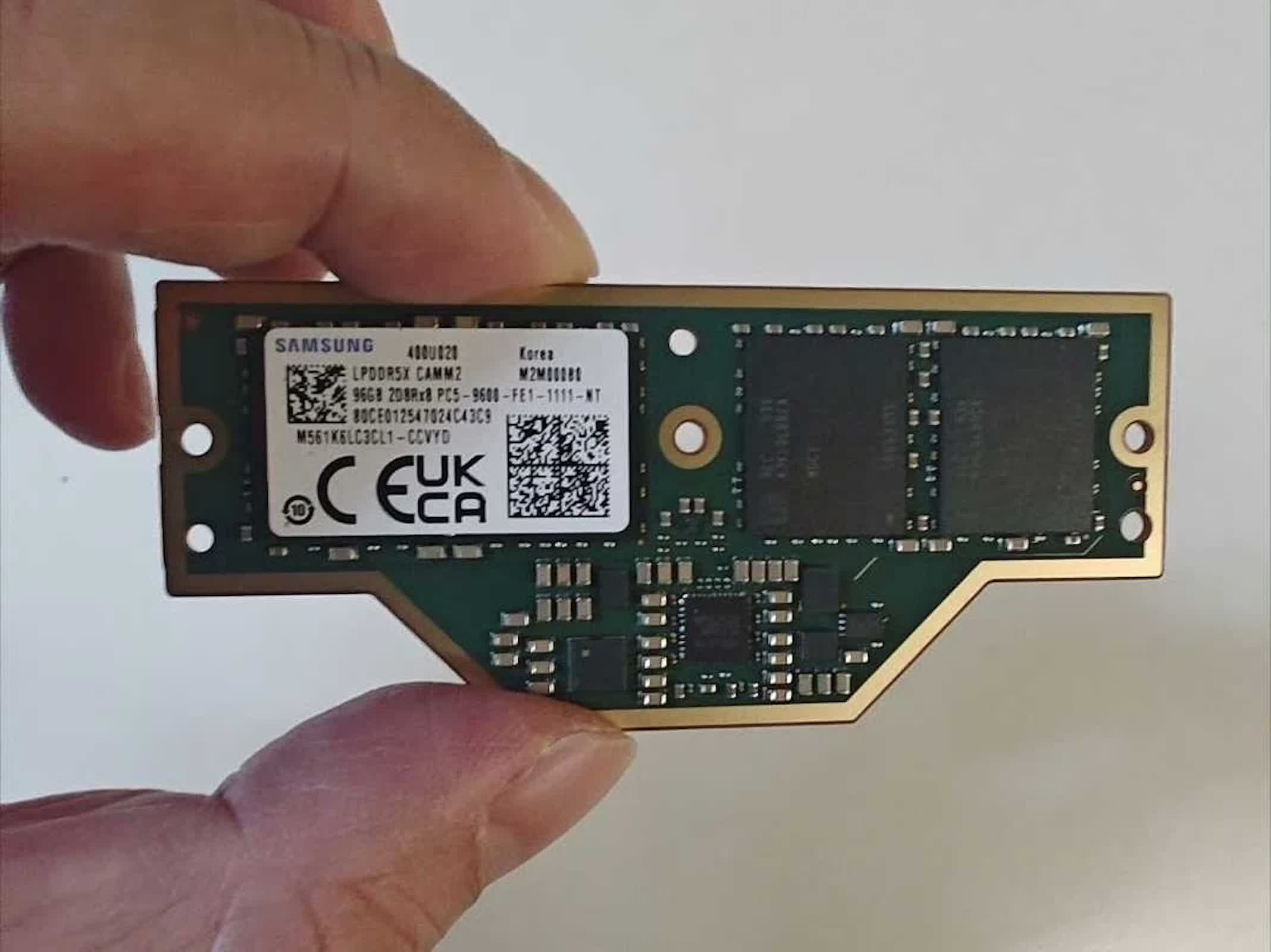
The LPCAMM2 design is part of an ongoing effort to replace soldered LPDDR in mobile and ultra-thin systems with memory that is both upgradeable and space-efficient. It builds on first-generation LPCAMM2 modules, which typically shipped with LPDDR5 memory. The new LPDDR5X variant continues that evolution, delivering higher efficiency and faster data throughput while providing additional performance headroom without increasing power consumption.

Lenovo's China manager recently posted a photo on Weibo of Samsung's LPCAMM2 LPDDR5X module featuring a dense 2D8Rx8 PC5 configuration, rated at 96GB and reaching speeds of up to 9,600 MT/s. At present, those specifications align with only one processor family on the market – Intel's newly released Core Ultra Series 3, also known as Panther Lake.

Intel's platform is the first to officially support memory speeds at that level, targeting both high-end mobile devices and edge AI systems.

The collaboration between Intel and memory manufacturers around LPCAMM2 has been developing for some time. Intel previously demonstrated early LPCAMM2 modules from Crucial running on reference validation platforms. Those Crucial modules offered capacities of up to 64GB and speeds reaching 7,500 MT/s under the part number CT64G75C2LP5X.M48C1. Intel has since confirmed official support for modules reaching 9,533 MT/s and capacities up to 96GB with its Panther Lake CPUs.
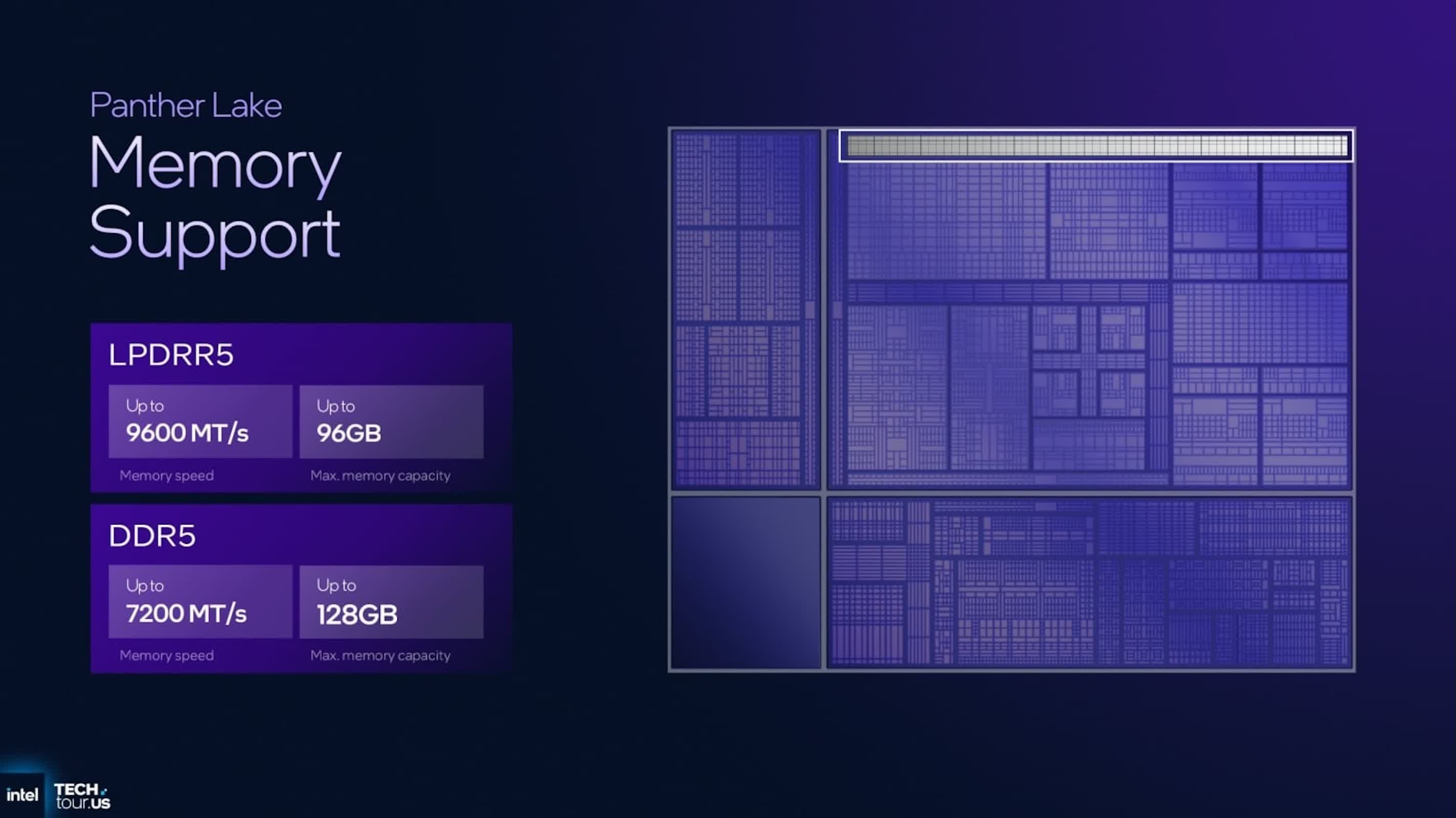
Recent engineering samples indicate that the first LPCAMM2 memory kits shipping with upcoming devices will operate at around 8,533 MT/s, with top-tier 9,600 MT/s variants expected to reach the market in the second half of the year.

As production ramps up, these modules are expected to appear across a broad range of mobile platforms, AI inference systems, and embedded computing environments that demand both compact designs and high throughput.

Samsung's entry marks an important milestone for modular, low-power memory. Although LPCAMM2 remains a relatively new technology, its impact could extend well beyond laptops to edge and industrial computing, where flexibility and upgradeability are becoming increasingly valuable.

The combination of LPDDR5X efficiency, a 96GB capacity ceiling, and speeds of up to 9,600 MT/s suggests that the next generation of portable and edge systems could soon approach desktop-class performance – within far tighter power and thermal envelopes.

Permalink to story:

 
I have a feeling we are still going the way of soldered memory on consumer devices.

In fairness, I think this is the best chance we'll get to see OEMs adopt LPCAMM2. Them being able to sell a larger volume of 8/12GB LPCAMM2 systems in the short term would help keep build costs down, lowering their risk, while customers benefit from the promise of being able to upgrade down the road. Otherwise, you'd have resistance to anything with less than 16GB of RAM if it wasn't upgradeable.
 
In fairness, I think this is the best chance we'll get to see OEMs adopt LPCAMM2. Them being able to sell a larger volume of 8/12GB LPCAMM2 systems in the short term would help keep build costs down, lowering their risk, while customers benefit from the promise of being able to upgrade down the road. Otherwise, you'd have resistance to anything with less than 16GB of RAM if it wasn't upgradeable.
Most consumers are fools. I speak to a lot of zoomers that know less about tech than my boomer parents do. We are going to see a trend here soon if soldered on memory where the only solution is to buy a new device and those devices will have the bare minimum installed on them. I don't think people realize we're about to see 16gigs of system ram and 8gigs of VRAM be the standard for several years.

You can say it's wrong all you want and I'll be right there with you, but that's the true.
 
Most consumers are fools. I speak to a lot of zoomers that know less about tech than my boomer parents do. We are going to see a trend here soon if soldered on memory where the only solution is to buy a new device and those devices will have the bare minimum installed on them. I don't think people realize we're about to see 16gigs of system ram and 8gigs of VRAM be the standard for several years.

You can say it's wrong all you want and I'll be right there with you, but that's the true.

I don't know if it's set in stone that soldered memory will become the only option even if OEMs want it that way. By that logic, upgradeable storage would have gone extinct a decade ago. And who knows, maybe anti-e-waste regulatory requirements will materialize and force manufacturers to implement the technology. Fingers crossed...

VRAM has never been upgradeable. If anything, I'd argue that 4-5 years more years of 8GB GPUs will force publishers to keep optimizing for them to hit the widest possible install base. Shoot, from that lens, V/RAM capacity stagnation isn't as bad as it sounds. We all know how much of a bloated mess Windows has become, for example... The fact is, none of this shortage would be much of an issue if not for developers' laziness in the first place!
 
Small size, dual mode on the same module, replaceability. This is great for as long as it is priced reasonably after RAM production is raised enough to supply servers and people's computers.

I like my galaxy book3. But my joy of having it always feels smaller when I remember about soldered RAM.
I want replaceable stuff. If these companies truly cared about ecology and recyclability, they would make a better effort at making parts replaceable and interchangeable. Look at SSDs for example. They are so thin that you could put a short NVME in a phone if you wanted. And yet Apple "has" to solder SSDs on every laptop thewy sell. They should be punished for that mother earth ad with fat female. They want to create piles of garbage.
 
I have a feeling we are still going the way of soldered memory on consumer devices.
I think that LPCAMM2 modules might be the solution to this problem.

Right now, any laptop that uses socketed SODIMM modules is stuck at between 5500 and 6500MT/s. The reality is, we're quickly getting to a point where memory timings are becoming so tight, that the signal is essentially noise if the traces are too long. By definition, socketed RAM requires the traces to be long, in order for the contacts to make a solid connection.
 
I think that LPCAMM2 modules might be the solution to this problem.

Right now, any laptop that uses socketed SODIMM modules is stuck at between 5500 and 6500MT/s. The reality is, we're quickly getting to a point where memory timings are becoming so tight, that the signal is essentially noise if the traces are too long. By definition, socketed RAM requires the traces to be long, in order for the contacts to make a solid connection.
Memory speed is a huge problem. With sodimms the hx 370 loses 40-50% of it's graphical capability due to bandwidth issues. Even with CSODIMMs, the highest speed so far is just 7200, not enough to feed the cores, and we're gonna get bigger ones eventually.

Or you can make the bus wider but that brings its own problems, especially in size constrained mobile setups.
 
Memory speed is a huge problem. With sodimms the hx 370 loses 40-50% of it's graphical capability due to bandwidth issues. Even with CSODIMMs, the highest speed so far is just 7200, not enough to feed the cores, and we're gonna get bigger ones eventually.

Or you can make the bus wider but that brings its own problems, especially in size constrained mobile setups.

890M is clearly bandwidth starved and AMD has been dragging it's feet on memory speed and support for newer standards like LPCAMM and CUDIMM (on desktop). I believe 9000 series APU's might support LPCAMM but at what speed? Even 8000MT's wouldn't be enough to truly do justice for 16CU iGPU IMO.

I honestly would get Panther Lake over any AMD apu with Halo being hard to buy and very expensive.
 
890M is clearly bandwidth starved and AMD has been dragging it's feet on memory speed and support for newer standards like LPCAMM and CUDIMM (on desktop). I believe 9000 series APU's might support LPCAMM but at what speed? Even 8000MT's wouldn't be enough to truly do justice for 16CU iGPU IMO.

I honestly would get Panther Lake over any AMD apu with Halo being hard to buy and very expensive.
AMD's issue with LPCAMM is tha tnobody has seemingly made a commercially viable release of it anywhere near LPDDRX speed. If LPCAMM cant go over 5600 without running into the same issues as SODIMM, then what is the point of it?

CSODIMM is an option on mobile but it tops out at 7200 right now. LPDDR5x soldered memory continues to be the best choice until someone can work out CAMM2's kinks.

Panther lake is very impressive. Hopefully it puts pressure on AMD to start updating things again. For instance, 3d cache? Cache is majorly beneficial to GPUs too,t hat's why they have the infinity cache, and even the lowly 2CU 610m sees a boost compared to non x3d models. So if they cant crank up the memory speed, they could put one of those fancy 128MB zen 6 3d modules on the APUs......
 
Back