First look: The speed at which blood loss can become fatal has long challenged both military medics and trauma surgeons. Now, researchers at the Korea Advanced Institute of Science and Technology (KAIST) have created a powder-based hemostat that forms an impenetrable hydrogel barrier in just one second when applied to a wound.
The agent, known as AGCL powder, was developed through a cross-disciplinary collaboration between materials science and biological engineering, with input from an active-duty South Korean Army Major whose battlefield experience shaped the design's real-world focus.
The hemostatic technology was developed by a joint research team led by Professor Steve Park and Professor Sangyong Jon. The formulation's key capability lies in its instant transition into a solid hydrogel upon contact with blood, creating a strong physical and chemical seal that halts bleeding almost immediately.
KAIST described the advance as a potential lifesaving development for conditions as extreme as combat or natural disasters, where immediate medical intervention is rarely available.
Traditional patch-type hemostats have long struggled with irregular or deep wounds, as their flat shape hinders full contact. They are also vulnerable to environmental factors such as moisture and temperature, which reduce their stability and usability in the field. The KAIST team designed their solution in powder form to overcome those constraints. The loose granules can cover wounds of varying depths and contours.
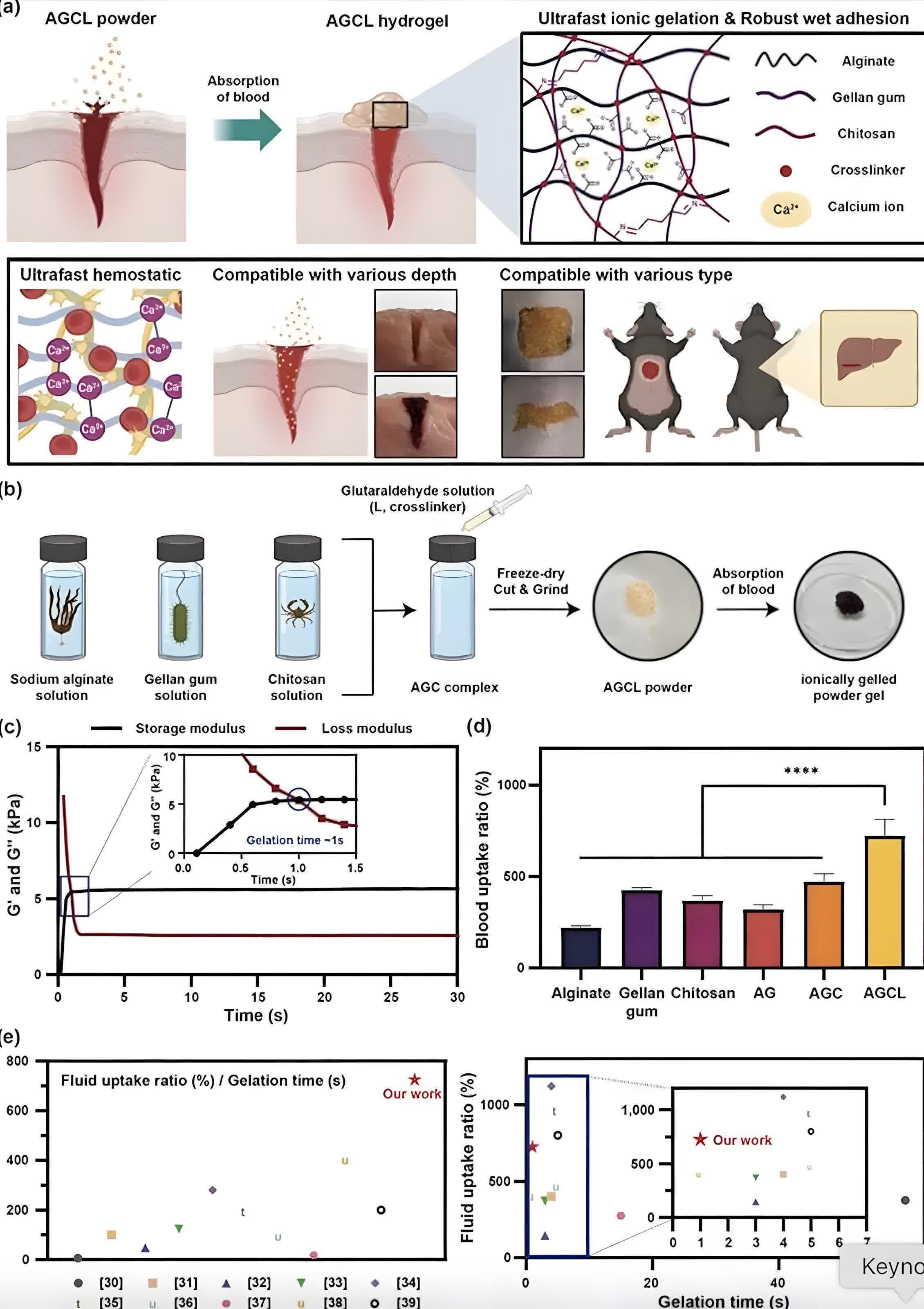
AGCL powder development strategy and fabrication schematic/ Gelation speed and blood absorption capacity of AGCL powder
The AGCL powder's mechanism relies on ionic reactions between the natural polymers and calcium in the blood. The base structure integrates three naturally derived materials – alginate, gellan gum, and chitosan – each serving a distinct function.
The alginate and gellan gum components react with calcium ions to trigger ultrafast gelation, while chitosan chemically bonds with blood components, reinforcing coagulation and biological hemostasis. KAIST reports that this reaction produces a cohesive gel barrier within roughly one second, making it one of the fastest-acting hemostatic materials tested to date.
Performance tests highlighted the powder's internal architecture. The engineered three-dimensional matrix can absorb blood equivalent to 725% of its own weight while maintaining strong adhesion. Its sealing strength measured over 40 kilopascals – comparable to being pressed firmly by hand – allowing it to hold even under high-pressure bleeding scenarios.
In addition to mechanical durability, the agent achieved a hemolysis rate under 3% and cell viability above 99%, with antibacterial efficacy of 99.9%.
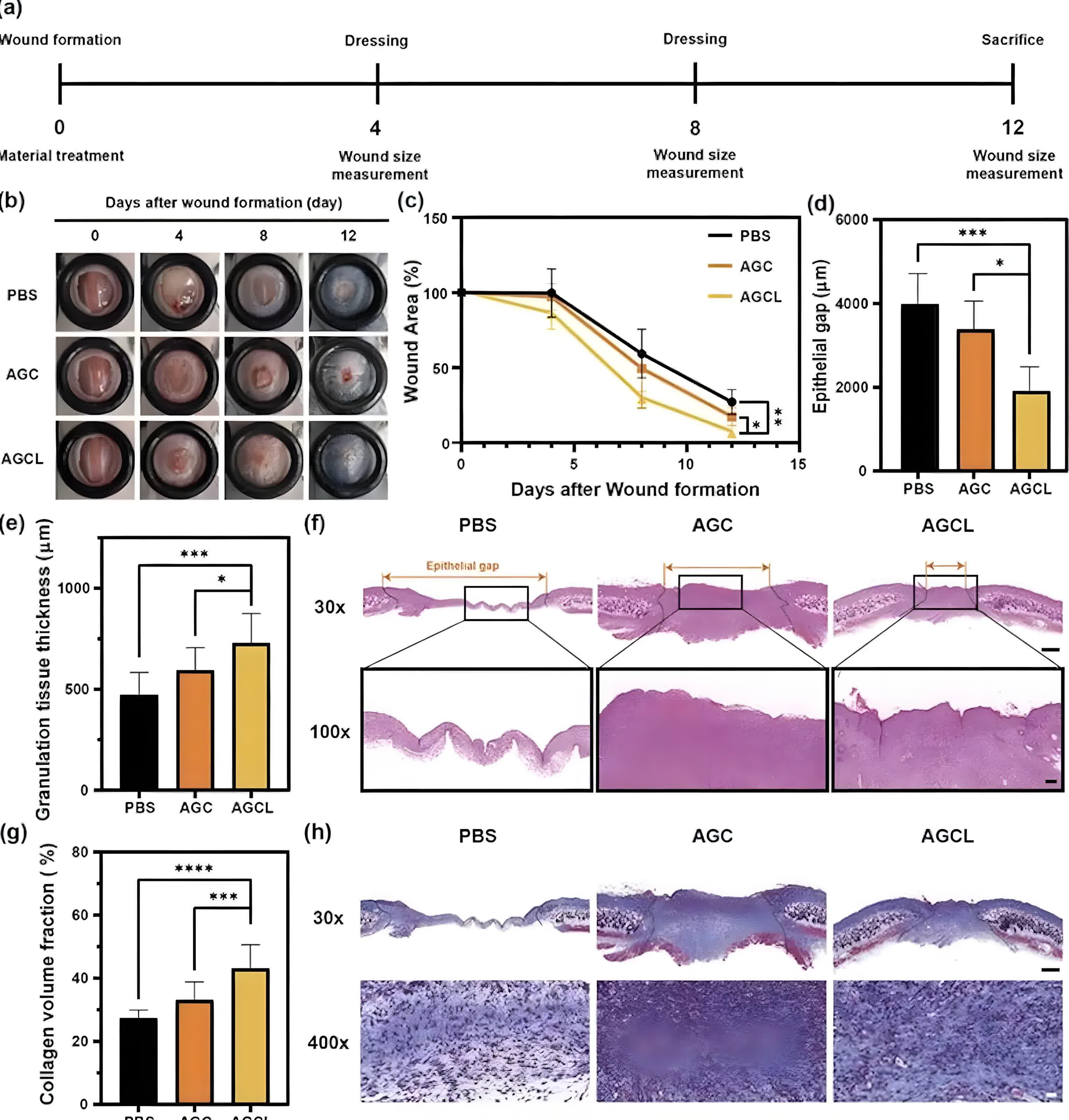
Validation of efficacy in wounds through animal experiments / Validation of efficacy in a liver surgery model
Animal testing reinforced the laboratory data. When applied to surgical liver injuries, the powder reduced both bleeding volume and time compared to existing hemostatic products. Liver function normalized within two weeks of treatment, and follow-up toxicity checks revealed no abnormal effects. The material also showed tissue-rebuilding benefits, supporting the growth of new blood vessels and collagen at the wound site.
Perhaps most notable for emergency medicine is the material's stability under stress. The researchers found the powder stayed effective for two years, even in heat and humidity. That reliability, coupled with its powder format, makes it easy to transport and store for military units or disaster-response teams in remote or rugged areas.
KAIST characterized the project as an example of defense technology transitioning into civilian innovation – a path previously taken by technologies such as GPS and microwave ovens. The research won both the 2025 KAIST Q-Day President's Award and the Minister of National Defense Award at the 2024 KAIST-KNDU National Defense Academic Conference.
Ph.D. candidate and Army Major Kyusoon Park, who participated in the research, said that his motivation was "a sense of mission to save even one more soldier," expressing hope that the technology "will be used as a life-saving technology in both national defense and private medical fields."
Scientists create a spray-on powder that seals life-threatening wounds in seconds