
The takeaway: Memory manufacturers have been teasing DDR6 system memory for several years, but a new roadmap from SK hynix suggests the technology may not arrive until the end of this decade. Alongside related technologies such as LPDDR6, 3D DRAM, and the successor to GDDR7, DDR6 is expected to deliver substantial improvements in memory speed and efficiency over current standards.
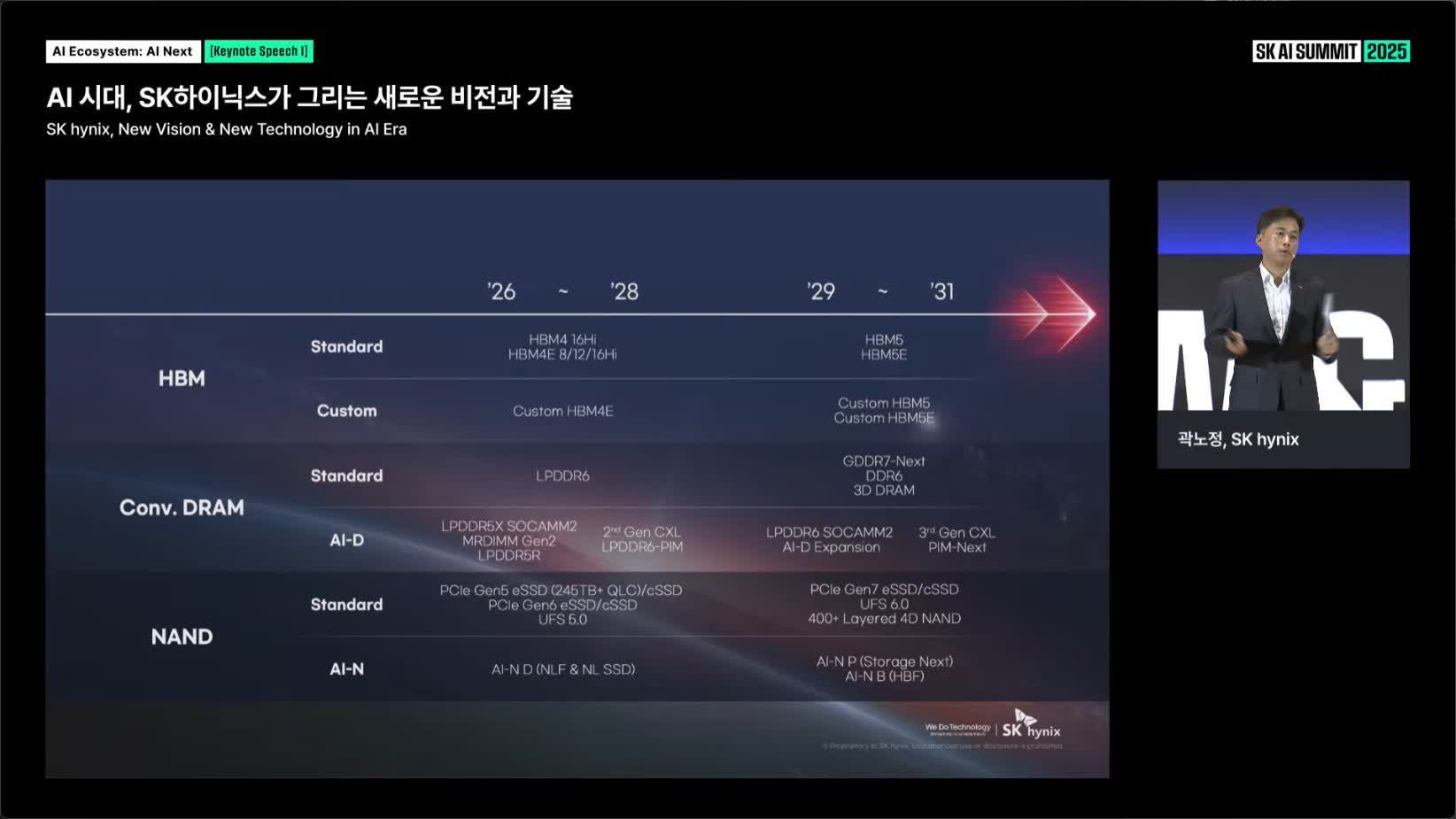
SK hynix has unveiled a new roadmap outlining its upcoming memory technologies. While the chart doesn't include detailed specifications, it reveals the company's plans to introduce DDR6, a successor to GDDR7, and other next-generation standards by 2031.
The roadmap – first spotted by @harukaze5719 – was reportedly shown during the 2025 SK AI Summit in Seoul as part of SK Group Chairman Anthony Chey's AI Next keynote. At the event, SK hynix highlighted how future memory and storage protocols will enable next-generation devices to meet rising AI performance demands.
src: SK AI Summit 2025 pic.twitter.com/zbcKq4Frad
– 포시포시 (@harukaze5719) November 3, 2025
The roadmap divides various hardware sectors into two columns, one covering the 2026 – 2028 period and another projecting launches from 2029 to 2031. SK hynix expects to roll out technologies such as HBM4, HBM4E, and LPDDR6 starting next year and continuing through 2028. Meanwhile, HBM5, HBM5E, DDR6, and 3D DRAM are slated for introduction between 2029 and 2031.
The company also lists an item labeled "GDDR7-Next" under standard memory for the latter timeframe, alongside DDR6 and 3D DRAM. While earlier GDDR generations have featured enhanced iterations like GDDR6X, SK hynix's successor to GDDR7 will most likely take the form of GDDR8.
Earlier reports suggested that manufacturers could begin introducing DDR6 memory as soon as 2027. The next-generation standard is expected to double the base speeds of DDR5, jumping from 8,800 megatransfers per second (MT/s) to 17,600 MT/s. In theory, overclocked modules could push performance even higher, potentially reaching up to 21,000 MT/s. A new multi-channel architecture will also boost bandwidth compared to DDR5.
SK hynix's roadmap further places PCIe 7.0 SSDs within a launch window that aligns with the PCI Special Interest Group's current timeline for the protocol. The fastest PCIe 5.0 SSDs available today can achieve read speeds of around 14 GB/s, while early PCIe 6.0 prototypes have more than doubled that figure, exceeding 30 GB/s. PCIe 7.0 devices, expected to enter a live compliance program in 2028, could once again double performance. Meanwhile, the final draft specification for PCIe 8.0 may arrive around the same time.
SK hynix expects to launch DDR6 and GDDR7 successor after 2028


