You are using an out of date browser. It may not display this or other websites correctly.
You should upgrade or use an alternative browser.
You should upgrade or use an alternative browser.
SpaceX and Tesla plan their own natural gas power plants for massive $16.8 billion Texas chip factory
- Thread starter Skye Jacobs
- Start date

LordVile95
Posts: 901 +574
Data centres aren’t a requirement they’re a bottomless money pit and they can be ordered and built within a few years which a gas plant will also take. It’s not like it will be ready tomorrow. It’s a slight delay on something that will likely be worthless around the time it’s builtI would absolutely support an SMR for a facility like this. Reliable 24/7 nuclear power with very low operating carbon emissions makes a ton of sense for a semiconductor fab.
But “they should wait until they can get an SMR” sounds much easier than it actually is.
We don't currently have a warehouse full of commercially available SMRs sitting around waiting to be delivered. The U.S. is still licensing designs, building supply chains and getting the first projects through construction. Even DOE is talking about broader SMR generation arriving in the early 2030s.
So what exactly should Tesla and SpaceX do in the meantime...leave a $16.8 billion factory sitting idle for several years? That is not going to happen.
Natural gas absolutely produces CO₂. Nobody should pretend otherwise. The EIA puts natural gas electricity at roughly 0.96 pounds of CO₂ per kWh on average, although it is considerably lower carbon than coal. That is a legitimate downside.
But energy decisions aren't made by choosing whichever source has the lowest CO₂ number and ignoring everything else. You also have to consider reliability, availability, construction time, capacity and cost.
If an SMR becomes practical for this site later, great. I'd be all for transitioning some or all of the generation to nuclear.
But “wait until nuclear is ready” isn't an energy plan. It's a delay.
LordVile95
Posts: 901 +574
Because it’s a part of the natural carbon cycle created from breaking down trees and not all of it is into the atmosphere a large part of it goes into enriching soil. It’s not digging up gas from deep in the earth and burning it.Each year, termites dump 20 million tons of methane and 50 billion tons of CO2 into the atmosphere. Why don't we work on reducing the world termite population?
Guy doesn’t know how averages work. If the average gets to 22 degrees then agriculture would collapse becaure everywhere where food grows would be too dry and the weather would be unpredictable. Oh and the Gulf Stream would likely collapse so that would be fun.Meanwhile:
Current global average temperature: 59F
Temperature preferred by man and most of the plant/animal species upon which he depends: 72F.
And they should be getting an SMR from the likes of Rolls Royce rather than building another gas plant to fund an unprofitable data centre funded on debt?While your post is correct, the problem with military-grade SMRs is that they require HEU fuel. However, we do have commercial SMRs that use LEU or HALEU.

Endymio
Posts: 5,605 +5,232
Who told you something so ridiculous? During the early Carboniferous, mean global temperature topped 22C ... and yet in terms of plant and animal life, it was the richest, most biologically diverse period in earth's history.Guy doesn’t know how averages work. If the average gets to 22 degrees then agriculture would collapse
Learn how global warming works. Through a process called polar amplification, most warming occurs in higher latitudes. During the early Carboniferous, the tropics were less than 1C warmer than today-- but near-tropical conditions covered most of the planet.
Not that this is relevant, as atmospheric CO2 then was at the 8,000 ppm level, some twenty times as high as today. We could burn oil and gas for 5,000 years and not reach that level, even if so much petroleum existed on earth-- which it doesn't.
The point stands. The mild amount of warming we're predicted to experience over the next few centuries will be almost entirely beneficial to mankind. We're already seeing many of those benefits, with higher crop yield and longer growing seasons in regions like Northern Europe and Canada.

Plutoisaplanet
Posts: 2,027 +2,726
It may not be China and insects, but Tesla has been sued for building its clean vehicle plant in Germany over environmental concerns (namely, a few dozen snakes and lizards). At this point, I wouldn’t be surprised if they were sued to protect literal bugs.As for lawsuits over insects and China funded NGOs...come on. We can discuss a gigantic industrial project without immediately turning everything into a conspiracy theory.
https://fortune.com/2021/02/02/elon...ctric-cars-endangered-animals-lizards-snakes/
Endymio
Posts: 5,605 +5,232
This exposes the great evil on the philosophy of modern-day environmentalists: anything in "nature" is good, whereas anything man does is "bad" and inherently harmful. These people have turned man's greatest strength -- his ability to modify our environment to better suit ourselves -- into our greatest weakness.Because it’s a part of the natural carbon cycle
Nature isn't kind and benevolent. It freezes you in winter, burns you to death in summer, kills you with storms, lightning, earthquakes, plagues, droughts, famines. The "natural" carbon cycle varies atmospheric CO2 wildly from 20X today's level down to 30% less -- but always on an ever-downward trend that, had man not intervened, would have eventually reached the 200ppm level at which point photosynthesis stops and all plants and animals on earth die.
Endymio
Posts: 5,605 +5,232
Fact, not conspiracy theory. China is actively funding a large number of these anti-AI and anti-datacenter groups in the US:As [for] China funded NGOs...come on. We can discuss a gigantic industrial project without immediately turning everything into a conspiracy theory.
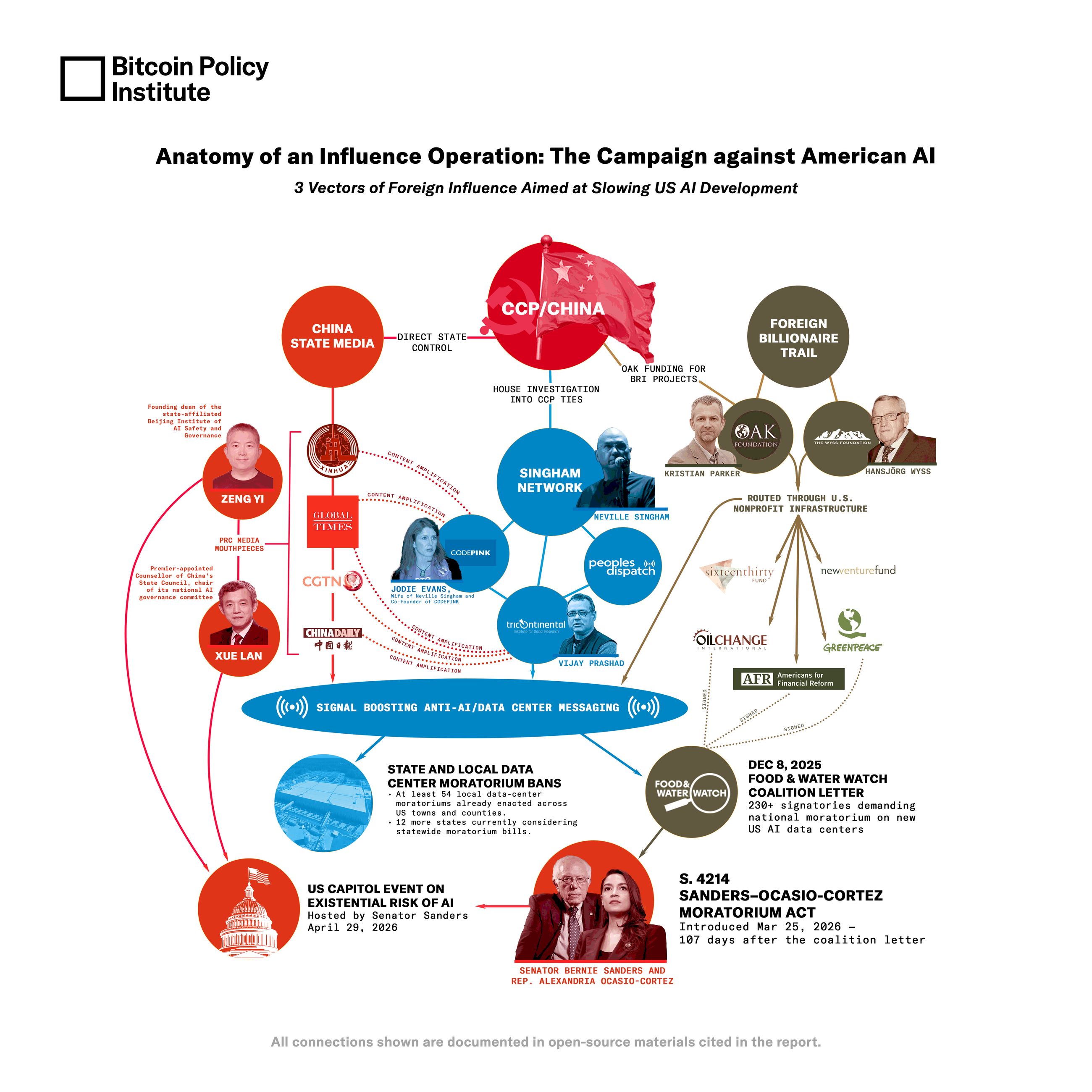
One of these groups founded is the "Party of Socialism and Liberation". One of its founders, Jack Tensley, has testified as a "concerned local resident" against dozens of datacenter projects across the country:

Endymio
Posts: 5,605 +5,232
Datacenters are beneficial, and they emit less than 0.1% the GHG that termites do-- and they do it without causing tens of billions of dollars of property damage a year.Because [termites] are beneficial
Killing all the deadly animals in Europe's forests is why lackwitted modern-day Europeans -- and their descendants in America -- believe nature is a kind, nurturing "mother" and the great outdoors is nothing but one big friendly park. And it was little over a century ago that tigers alone were eating several thousand people a year in just one country: India.I am willing to bet that it is thinking like this that is behind some of humanity's major foibles over the ages. Kill them all!!!
But no one is talking about exterminating termites entirely (a sheer impossibility). Even a tiny reduction in the overall termite population would save more GHG emissions than shutting down every data center on earth. But such a thought strikes horror in the minds of every slack-jawed environmentalist alive ... because termites are "natural", and mankind is not.

Fair point. There does seem to be real substance behind this, and I think it deserves more than being waved away as a conspiracy theory.Fact, not conspiracy theory. China is actively funding a large number of these anti-AI and anti-datacenter groups in the US:
One of these groups founded is the "Party of Socialism and Liberation". One of its founders, Jack Tensley, has testified as a "concerned local resident" against dozens of datacenter projects across the country:
There are documented China linked influence efforts around U.S. AI and data center policy, and the Singham network in particular has raised legitimate questions about foreign funding, activist groups, and amplification through Chinese state media. The Jack Tensley example also appears to be real...he has spoken publicly against data center projects while presenting himself as a concerned resident.
The only distinction I’d keep in mind is that “China-linked” does not automatically mean every person or organization involved is directly controlled or paid by the CCP. Some connections are funding, some are organizational, and some are media amplification.
But overall, yes...this is worth paying attention to. Foreign governments absolutely have an interest in slowing U.S. AI infrastructure development, and pretending that influence campaigns simply do not happen would be naive.
At the same time, legitimate local concerns about power, water, land use and emissions still deserve to be judged on their own merits. Both things can be true.
Fair correction...the Germany example is legitimate. Tesla absolutely did face environmental challenges over protected snakes and lizards, and courts even temporarily halted some clearing while it was sorted out.It may not be China and insects, but Tesla has been sued for building its clean vehicle plant in Germany over environmental concerns (namely, a few dozen snakes and lizards). At this point, I wouldn’t be surprised if they were sued to protect literal bugs.
https://fortune.com/2021/02/02/elon...ctric-cars-endangered-animals-lizards-snakes/
So yes, I’ll concede the “literal bugs” part may not be as far-fetched as I made it sound.

My issue was more with immediately attaching “China-financed NGO” to it without evidence. There’s a big difference between saying, “A project this large will probably face environmental lawsuits”...which history says is entirely plausible, and assigning some foreign conspiracy to those lawsuits before they even exist.
Environmental review can occasionally become excessive, but protecting habitats is also a normal part of building something on this scale. The sensible discussion is where that line should be drawn, not assuming everyone who files an environmental objection is secretly working for Beijing.
I think we're mixing several different things together now.Data centres aren’t a requirement they’re a bottomless money pit and they can be ordered and built within a few years which a gas plant will also take. It’s not like it will be ready tomorrow. It’s a slight delay on something that will likely be worthless around the time it’s built
First, Terafab is a semiconductor factory, not a data center. The chips may ultimately feed AI/data center workloads among many other things, but manufacturing advanced semiconductors and operating a data center aren't the same business.
Second, saying data centers will “likely be worthless” by the time this is finished is a pretty enormous assumption. Maybe the AI investment boom gets badly overbuilt...I've said myself that there is plenty of reason to question the amount of money being thrown at AI infrastructure.
But current evidence doesn't say data centers are disappearing. The IEA is projecting global data center electricity consumption to more than double by 2030 and says they're expected to account for roughly half of U.S. electricity demand growth through then.
Could those forecasts be wrong? Absolutely.
But “there may be an AI bubble” and “this infrastructure will be worthless in a few years” are very different statements.
As for waiting for an SMR, I actually like the SMR idea. I think nuclear is probably one of the best long term answers for enormous continuous loads like this.
The problem is availability. You can't compare the construction time of a conventional gas plant with an SMR while ignoring that commercial SMR deployment itself is only beginning. The first wave is expected around 2030, with larger deployment after that.
So we're back to the same engineering tradeoff...use an available, reliable source now, or delay a $16.8 billion project waiting for a technology that may ultimately be better but isn't readily deployable yet.
I'm perfectly willing to debate whether Terafab itself is a massive overinvestment. That's a legitimate argument.
But calling it worthless before the concrete is even dry isn't analysis. It's a prediction.
LordVile95
Posts: 901 +574
No? It’s there’s the base level that cycles naturally and has done for hundreds of thousands of years and the added amount we put on which has thrown it off kilter in less than 150.This exposes the great evil on the philosophy of modern-day environmentalists: anything in "nature" is good, whereas anything man does is "bad" and inherently harmful. These people have turned man's greatest strength -- his ability to modify our environment to better suit ourselves -- into our greatest weakness.
You really need to get off Facebook and read actual literature. Natural events and ice ages change the atmospheric make up over millions of years but not to the level we have in the short space of time it’s been done.Nature isn't kind and benevolent. It freezes you in winter, burns you to death in summer, kills you with storms, lightning, earthquakes, plagues, droughts, famines. The "natural" carbon cycle varies atmospheric CO2 wildly from 20X today's level down to 30% less -- but always on an ever-downward trend that, had man not intervened, would have eventually reached the 200ppm level at which point photosynthesis stops and all plants and animals on earth die.
I actually think there are two fair questions buried in the sarcasm here.Tesla/SpaceX building a fab sounds to me like yet another Musk brain fart; Musk's typical exercise of passing gas through every one of his bodily orifices. Billions or Trillions of dollars doesn't a genius make.
I supposed if Musk's planned Rise of the Machines and conquering the Universe doesn't come to pass, with Intel in the mix, they just might find a real market for what the production capability they end up with.
On the batteries, you're absolutely right that the energy has to come from somewhere. A battery isn't a generator, and nobody is getting free energy by charging one battery with another.
My understanding of the proposed setup is natural gas generation plus very large battery arrays. The gas turbines generate the electricity, the batteries store excess generation and can then handle spikes, short term interruptions, load balancing, etc. That's basically what grid scale battery storage is designed to do.
So if somebody described it as “the batteries power the batteries,” I'd be scratching my head right along with you.
As for Terafab itself, I also think skepticism is perfectly reasonable. Musk has a habit of announcing extremely ambitious timelines and ideas, and some turn out much closer to reality than others.
Where I'd disagree is jumping from “Musk exaggerates” to “therefore this is another phantom project.”
This one has already moved beyond a tweet or concept sketch. Tesla and SpaceX have announced an initial $16.8 billion investment, Texas has actual incentive/project filings, a site has been selected, and Intel is involved.
Does that guarantee the eventual monster facility will be built exactly as advertised? Absolutely not. I'd be skeptical of the most extravagant long term projections too right along with you.
But that's where I think we should separate healthy skepticism from predetermined conclusions.
Question the economics. Question the power requirements. Question whether they can manufacture competitively. Question the timeline. 100%
Those are all good questions.
“It's Musk, therefore it must be nonsense” isn't really helping any more than “It's Musk, therefore it must be genius.”
Endymio
Posts: 5,605 +5,232
Where do you get this absurd nonsense? There is no "base level" -- the earth's original atmosphere was primarily CO2 -- as much as 10 million pascals worth (curent levels are only about 40 pascals, or 1/250,000 as much.) The "natural cycle" is a continual downward trend that, if not stopped, would have resulted in the halting of photosynthesis and the end of all life on earth.No? It’s there’s the base level that cycles naturally and has done for hundreds of thousands of years and the added amount we put on which has thrown it off kilter in less than 150.
Another fun fact: Some 2.6 million years ago, these "natural cycles" destroyed the earth's climate stability and caused it to begin experiencing regular ice ages. In an unbelievably rapid period of a few decades, temperatures would drop 30F globally and glaciers would cover much of the Northern Hemisphere. We call this the Quaternary Period, and it is the lack of sufficient CO2 in the atmosphere that generates this instability. Atmospheric H2O is a far stronger GHG than CO2 ... but water vapor drops out of the air at a given temperature, while CO2 does not.
In short, the idea that "Mother Nature knows best" is total rubbish. Had we left nature alone, it was only a matter of time before these "natural cycles" would have destroyed civilization entirely.
Last edited:
LordVile95
Posts: 901 +574
Mate you have shown time and time again you don’t understand the basics and science and this is no different. Basically anything that doesn’t fit your agenda is worms departs the literal mountains of evidence to the contrary.Where do you get this absurd nonsense? There is no "base level" -- the earth's original atmosphere was primarily CO2 -- as much as 10 million pascals worth (curent levels are only about 40 pascals, or 1/250,000 as much.) The "natural cycle" is a continual downward trend that, if not stopped, would have resulted in the halting of photosynthesis and the end of all life on earth.
Another fun fact: Some 2.6 million years ago, these "natural cycles" destroyed the earth's climate stability and caused it to begin experiencing regular ice ages. In an unbelievably rapid period of a few decades, temperatures would drop 30F globally and glaciers would cover much of the Northern Hemisphere. We call this the Quaternary Period, and it is the lack of sufficient CO2 in the atmosphere that generates this instability. Atmospheric H2O is a far stronger GHG than CO2 ... but water vapor drops out of the air at a given temperature, while CO2 does not.
In short, the idea that "Mother Nature knows best" is total rubbish. Had we left nature alone, it was only a matter of time before these "natural cycles" would have destroyed civilization entirely.
There’s a reason why you’re comparing the atmosphere when the earth was forming billions of years ago to when it was stable. The natural cycle dies warm and cool the earth but fairly predictably and our extraction of Carbon and pumping into the atmosphere is measurably changing it on a human timescale and will cause widespread issues from food scarcity and deaths due to heat and extreme weather.
We’re also in an ice age now dum dum.
Endymio
Posts: 5,605 +5,232
After your debacle on the satellites thread, you really shouldn't speak.Mate you have shown time and time again you don’t understand the basics [sic] and science
The earth's atmosphere has never been "stable". Never. And you still haven't addressed the point that these "natural cycles" would eventually result in the end of all life on earth.There’s a reason why you’re comparing the atmosphere when the earth was forming billions of years ago to when it was stable.
You fail to realize that carbon we're "extracting" was originally in the atmosphere to begin with....our extraction of Carbon and pumping into the atmosphere is measurably changing it
Utter nonsense. The increase in atmospheric CO2 alone has already increased global crop yields from 7% to 30% depending on species, and will continue to do so. Global warming means longer, more fertile growing seasons and less crop damage from cold, which at present outweighs crop damage from heat by more than a factor of 20....and will cause widespread issues from food scarcity and deaths due to heat and extreme weather.
Last edited:
Endymio
Posts: 5,605 +5,232
Having trouble reading? I've told you several times (including the post you just responded to) that we're in the Quaternary Period, otherwise known as the Quaternary Ice Age.. Did you not know this?We’re also in an ice age now dum dum.
Though to be more precise, we're in a warm interglacial called the Holocene -- a brief pause in that ice age. And if and when that brief pause ends, so does modern civilization -- unless we've added enough CO2 to the atmosphere to prevent it.
Similar threads

- Replies
- 30
- Views
- 112

- Replies
- 11
- Views
- 165

Latest posts
-
 Adobe Premiere is now available on Android, offering free 4K video editing
- JaredTheDragon replied


-
TechSpot is dedicated to computer enthusiasts and power users.
Ask a question and give support.
Join the community here, it only takes a minute.