The Best CPUs: Gaming, Productivity, and the Best Bang for Your Buck

I went AM4 to AM5 and it was very much worth it. From 5800X3D to 9800X3D was a massive upgrade. Night vs day literally. From good to much better. Made me actually able to use my high refresh rate monitor to the fullest with a truly massive increase in 1% lows.

Let me guess, you are a GPU bound gamer thinking 60 fps is good enough?

What you claim entirely depends on requirements. It is subjective. I'd never settle with AM4 or a 6 year old GPU. No enthusiast would, unless money is the issue.

I see what you mean tho, but then you are not really an enthusiast anymore.

Some would also say 8700K and RTX 2070 is perfectly fine still, do you agree? It might be, for their 1080p 60 Hz IPS monitor. For me, dumpster worthy. It is all subjective.
No I have a 5080, but for the majority of people paying all that money for AM5 isn't worth it at the moment. You will get plenty enough performance to play any game released today at good frame rates at 1440p (and with some minor texture/ray tracing/shadows etc compromises and a little DLSS upscaling even 4K) on a 5800X3D with something like a 3080 or a 9070XT. If you have a lot of money and want to crank everything to the max then spend $2000 to upgrade but it's a incredibly poor value proposition at the moment given the ludicrous prices.
 
Facts:
1) If you are gaming above 1080P the AMD X3D CPUs are irrelevant.
2) If you are gaming AT 1080P but not using a $4500.00 Nvidia RTX 5090 series the AMD X3D CPUs the performance differences are miniscule.
3) "More cores" myth: unless you need to run niche applications that can actually use multiple cores you are throwing money away with your CPU AND electricity bill. More cores above 6 will not noticeably improve your game, productivity, and internet. And yes, even if you "stream sometimes". Go for it if you like reading benchmark graphs.

This article is mostly on as the best value for most gamers is the Core Ultra 250K Plus. Hands down. But here's where the article falls right in line with AMD's mantra "best CPUs for gaming". AMD loves that all the way to the bank. But read above, again and if you know someone that must have an RTX 5090 GPU to game at 1080P, get them into financial counseling.
 
This article is mostly on as the best value for most gamers is the Core Ultra 250K Plus. Hands down.
Anything that needs DDR5 is automatically out of consideration in any conversation involving value. If you had said the 12600KF ($160 on pcpartpicker right now) for example, you might have had a point.
 
Except you don't know what the market behaviour is, because you don't have data on it. That means you don't know what you're talking about and are just making ignorant guesses. What makes you think your ignorant guesses have any value to others?


That's exactly how discussion works. You are not a valid source of data, you're just a random nobody on the internet. If you cannot produce evidence to support what you're saying, what you're saying has no value.


Except you admitted you don't have data about any of this, so what you're "observing" is completely disconnected from reality and, again, is nothing but a worthless ignorant opinion to other people. Without evidence, what you say will rightfully be dismissed as such.


And for the third time now, I will point out that the other commenter did exactly that, and you jumped in in his defense. If you don't agree with him, just state that and stop responding, because you have nothing of value to add to this conversation otherwise.


Blatant strawman. I never said you need a "perfect dataset", I said you need any evdience whatsoever. And you have none. So your "generalized observations" are disconnected from reality and therefore worthless.


I'm not the one making statements that require evidence. You are. I'm asking where your evidence is, and you're the one failing to provide it and admitting your claims are not based on any evidence.


Except nobody said that anywhere in this thread. You're arguing with nobody (and still losing, because despite arguing with a claim nobody made you still failed to have evidence to support yourself).


I don't "have to have the last word". This is an anonymous account on a niche tech forum, with zero identity, that is in no way connected to my real person. I have zero reason to have any kind of "ego" here. Do you think I give a damn about the legacy and valor of the proud house of Poshflamingos or something?
I only care about misinformation. So as long as you keep writing nonsense, I will reply to correct that nonsense.
You have a very short memory.
 
No I have a 5080, but for the majority of people paying all that money for AM5 isn't worth it at the moment. You will get plenty enough performance to play any game released today at good frame rates at 1440p (and with some minor texture/ray tracing/shadows etc compromises and a little DLSS upscaling even 4K) on a 5800X3D with something like a 3080 or a 9070XT. If you have a lot of money and want to crank everything to the max then spend $2000 to upgrade but it's a incredibly poor value proposition at the moment given the ludicrous prices.
For the majority, sure. The majority don't spend more than 200-400 dollars on a CPU or GPU either.

I am talking about people who actually knows what they want. Like myself. Hundreds of fps using hundreds of Hz. Minimum 1% lows that is. 240+ Hz gamers seeking incredible performance. No AM4 system will deliver what I need.

5800X3D is vastly slower for high fps gaming, no comparison at all to current gens top gaming CPUs. Even last gen 7800X3D blows the 5800X3D out of the water.

Like I said, had a 5800X3D ealier. It was a great CPU to update the gaming performance on a AM4 system, but dated now, especially when goal is high fps using high refresh rate monitors, the jump to AM5 was a huge upgrade.

5800X3D has the gaming performance of Alder Lake. Fine for many 60-90 fps gamers maybe... Not good enough for me. 200+ fps using 240+ Hz is how I play games. You look at completely different CPU requires for this.
 
Last edited:
Of course it always depends on the intended use, but in my opinion it's at least same important to assess how long one wants to use the CPU before the next upgrade again.
I for my part have a tendency to build my systems for 5-10 years, that since the early 90th, and have so far compared to others of my friends, in the long run saved some money by actually opting for the higher end at the time of the upgrade.
I use MSFS2024, and have newly build a new setup including the 9850X3D, yes it burned a hole in the wallet, but, as of now, the systems runs nice, cool and last but not least silent, paired with a rtx5080.
The worst thing today are the prices for RAM and VRAM. I went for only 32 GB, the pricing as of now made 64 GB sounding as pretty crazy, and the same is valid for GPUs unfortunately. Look at the rtx5070 for example, it can perform nicely under MSFS2024, but unfortunately it is only available with 12GB of VRAM, which doesn't really suit the capabilities of the GPU. The rtx5070 TI with its 16 GB is the better choice. I went for the rtx5080 which after my opinion should be available in 16 GB AND by choice with 24 GB.
Unfortunately it seems in general that right now pricings for hardware are gone "a bit" out of line.
 
1) I don't need "evidence" to say long platform support is positive for consumers. That's a blatantly obvious fact.
No it isn't. It's a blatantly obvious fact that long platform support is negative for consumers, cause you are paying for it with vastly increased CPU prices.

The 270k is so much cheaper than it's competitor (the 9950x / 9950x 3d) that with the money you saved you can upgrade your motherboard down the line for any platform you want, be it novalake, am5 or even am6. If you go for the 9950x / 9950x 3d right now you are stuck with AM5. So how is it a net positive?
 
No it isn't. It's a blatantly obvious fact that long platform support is negative for consumers, cause you are paying for it with vastly increased CPU prices.

The 270k is so much cheaper than it's competitor (the 9950x / 9950x 3d) that with the money you saved you can upgrade your motherboard down the line for any platform you want, be it novalake, am5 or even am6. If you go for the 9950x / 9950x 3d right now you are stuck with AM5. So how is it a net positive?
I shouldn't even dignify this comment (which is either blatantly in bad faith, or incredibly uninformed) with an answer. But against my better judgement, just this time, I will.

The 270K is obviously an outlier, this has never existed before. Prior to the 270K, all Intel flagships meant to compete with AMD's flagships (e.g. 12900K, 13900K, 14900K, 285K) were $600+ chips. Until 1 month ago when the 270K launched, Intel CPUs were just as expensive as AMD's, despite not having platform longevity. During the 9 years since AM4 launched, you did not pay extra for the platform longevity.

If you had actually read my comments before replying nonsense, you would have seen me say exactly this to Rapob. The 270K (which is the exception, not the norm) is so cheap compared to the 9950X that it makes platform longevity moot. Which is also why, on my very first comment, I said the 270K is the only chip that matters today for productivity. But that doesn't change the fact that platform longevity is a positive for consumers, and I don't expect Intel to keep all future flagships at the same price as the 270K.

Another fact that obliterates your argument, by the way, is that Intel too is now moving to long term platform support with LGA 1954 and Nova Lake, precisely because it is positive for consumers (and they need to compete with AMD in that regard).
 
Last edited by a moderator:
I shouldn't even dignify this comment (which is either blatantly in bad faith, or incredibly ignorant) with an answer. But against my better judgement, just this time, I will.

The 270K is obviously an outlier, this has never existed before. Prior to the 270K, all Intel flagships meant to compete with AMD's flagships (e.g. 12900K, 13900K, 14900K, 285K) were $600+ chips. Until 1 month ago when the 270K launched, Intel CPUs were just as expensive as AMD's, despite not having platform longevity. During the 9 years since AM4 launched, you did not pay extra for the platform longevity.

If you had actually read my comments before replying nonsense, you would have seen me say exactly this to Rapob. The 270K (which is the exception, not the norm) is so cheap compared to the 9950X that it makes platform longevity moot. Which is also why, on my very first comment, I said the 270K is the only chip that matters today for productivity. But that doesn't change the fact that platform longevity is a positive for consumers, and I don't expect Intel to keep all future flagships at the same price as the 270K.

Another fact that obliterates your argument, by the way, is that Intel too is now moving to long term platform support with LGA 1954 and Nova Lake, precisely because it is positive for consumers (and they need to compete with AMD in that regard).
But it's not the only outlier, not by far.

See back in 2021 I still had a b350 mobo awaiting for the 5800x 3d. It launched and it cost 450$. With 450$ I could literally - kid you not - buy a 12700f + b660 bazooka (a combo reviewed by hwunboxed btw) for 460$. The CPU was faster in both ST and MT performance (by a lot) and was ~5-10% slower in gaming. So I would actually end up with more money selling my CPU + mobo and going for the 12700f - would end up with a new mobo in warranty AND have more future upgradability.

And that's coming from someone who already owned Am4 - cause if you didn't the 5800x 3d was obscenely expensive for what it offered. So we are back to my point, upgradability in a lot of cases costs you a lot more money. It's not free launch.

How is Intel moving to long term platform support suddenly makes it positive for consumers? Oh kay, and nvidia is moving to higher prices for their GPUs, so that must also be positive for consumers, right?
 
But it's not the only outlier, not by far.

See back in 2021 I still had a b350 mobo awaiting for the 5800x 3d. It launched and it cost 450$. With 450$ I could literally - kid you not - buy a 12700f + b660 bazooka (a combo reviewed by hwunboxed btw) for 460$. The CPU was faster in both ST and MT performance (by a lot) and was ~5-10% slower in gaming. So I would actually end up with more money selling my CPU + mobo and going for the 12700f - would end up with a new mobo in warranty AND have more future upgradability.
Except the 5800X3D wasn't the only AM4 CPU you could get for $450. How convenient you neglected to mention that $450 also got you a 5900X, which was 30% faster than the 12700F in MT, huh?

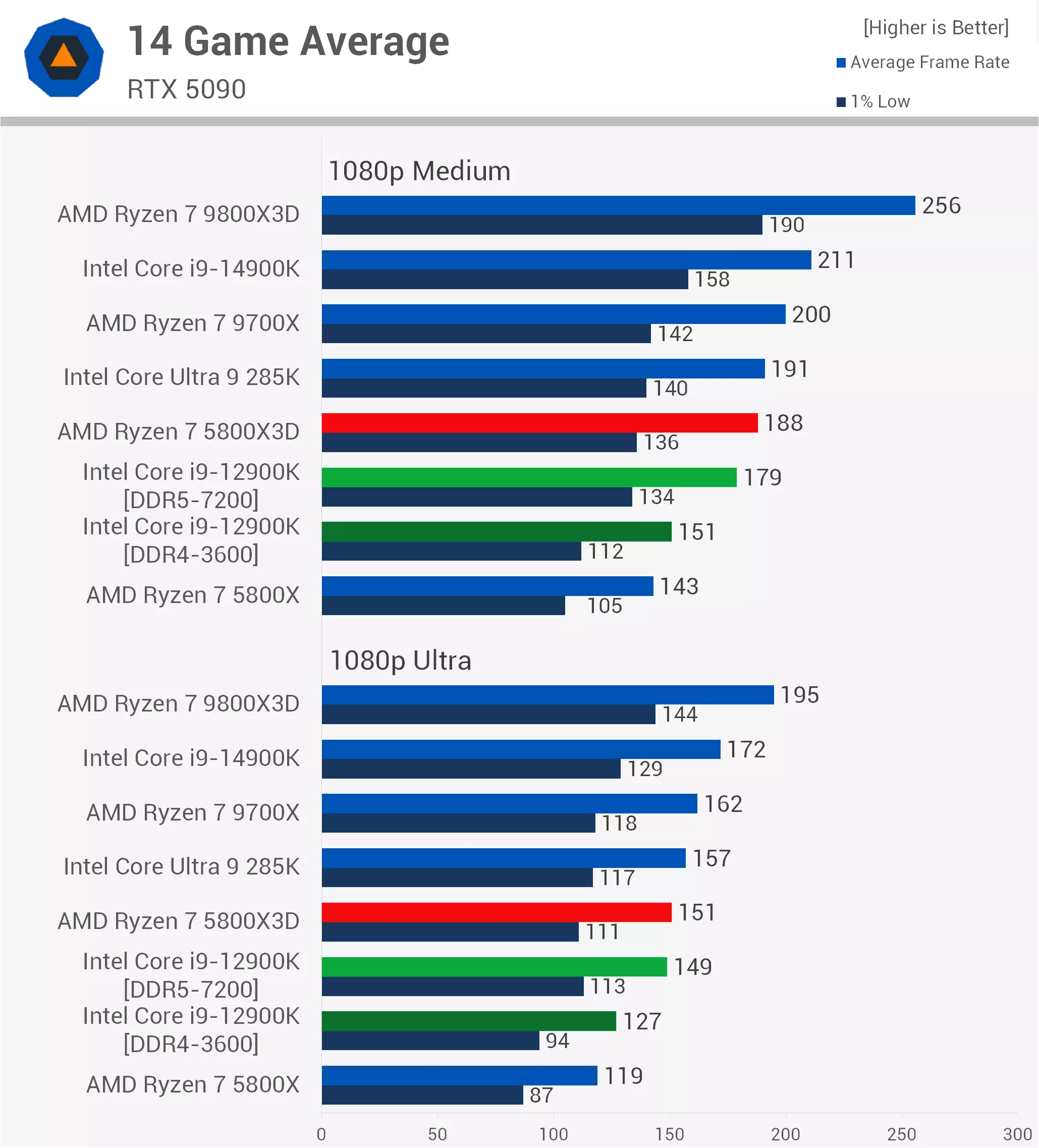
The claim that it was only "~5-10% slower in gaming" is also hogwash. TechSpot themselves re-tested exactly that very recently. Alder Lake chips only got close to the 5800X3D with DDR5 memory, but getting expensive DDR5 back in 2022 would completely erase the price advantage of going with the 12700F, since AM4 used much cheaper DDR4. If instead you used DDR4, you got nowhere close to the 5800X3D in gaming (the 5800X3D is 20% to 25% faster than the 12900K with DDR4 as per the chart above, and the 12700F was slower than that still).

And that's coming from someone who already owned Am4 - cause if you didn't the 5800x 3d was obscenely expensive for what it offered. So we are back to my point, upgradability in a lot of cases costs you a lot more money. It's not free launch.
Except none of that is true. If you already had AM4, the 5800X3D gave you flagship gaming performance for $450. It was impossible to get anything remotely similar to that with Intel. You could only get the same gaming performance with the 12900K + DDR5, but that's a $600 chip plus a new motherboard plus new expensive memory. If you were getting a 12700F and reusing the DDR4 you already had, you got nowhere close to the gaming performance of the 5800X3D, and nowhere close the MT performance of the 5900X (also a $450 AM4 upgrade).

How is Intel moving to long term platform support suddenly makes it positive for consumers? Oh kay, and nvidia is moving to higher prices for their GPUs, so that must also be positive for consumers, right?
What kind of moronic argument is this? Intel moving to long term platform support is positive because LGA 1954 users will be able to upgrade to new gen CPUs for cheap in the future just like AM4/AM5 users already could. How is that not going to be a massive benefit for Intel users?
 
Except the 5800X3D wasn't the only AM4 CPU you could get for $450. How convenient you neglected to mention that $450 also got you a 5900X, which was 30% faster than the 12700F in MT, huh?
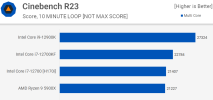
Except the 5900x isn't 30% faster than the 12700f. I mean techspot has tested it you know, you can go and take a look - but here ill make it easy for you.

1778232977744.png

It's only 30% faster if you power limit the 12700f to 65 watts.

The claim that it was only "~5-10% slower in gaming" is also hogwash. TechSpot themselves re-tested exactly that very recently. Alder Lake chips only got close to the 5800X3D with DDR5 memory, but getting expensive DDR5 back in 2022 would completely erase the price advantage of going with the 12700F, since AM4 used much cheaper DDR4. If instead you used DDR4, you got nowhere close to the 5800X3D in gaming (the 5800X3D is 20% to 25% faster than the 12900K with DDR4 as per the chart above, and the 12700F was slower than that still).
So you are PROVING the point!! Think exactly what you are saying. You are saying - YES, the 5800x 3d was slower in both ST and MT - but you don't need to change your mobo or your ram. Which is my freaking point all along, you are paying EXTRA on the CPU for the upgrdability.

I mean even if you exclude Intel chips completely, the 5800x 3d was at some point twice as expensive as the 7600x, the 7600x was at least as fast or faster in games, and faster in ST performance. So why was the 5800x 3d twice as expensive as a CPU that was better in every aspect?

What kind of moronic argument is this? Intel moving to long term platform support is positive because LGA 1954 users will be able to upgrade to new gen CPUs for cheap in the future just like AM4/AM5 users already could. How is that not going to be a massive benefit for Intel users?
Because it will drive CPU prices high the same way it drives AMD prices high.
 
Except the 5900x isn't 30% faster than the 12700f. I mean techspot has tested it you know, you can go and take a look - but here ill make it easy for you.

View attachment 90854

It's only 30% faster if you power limit the 12700f to 65 watts.
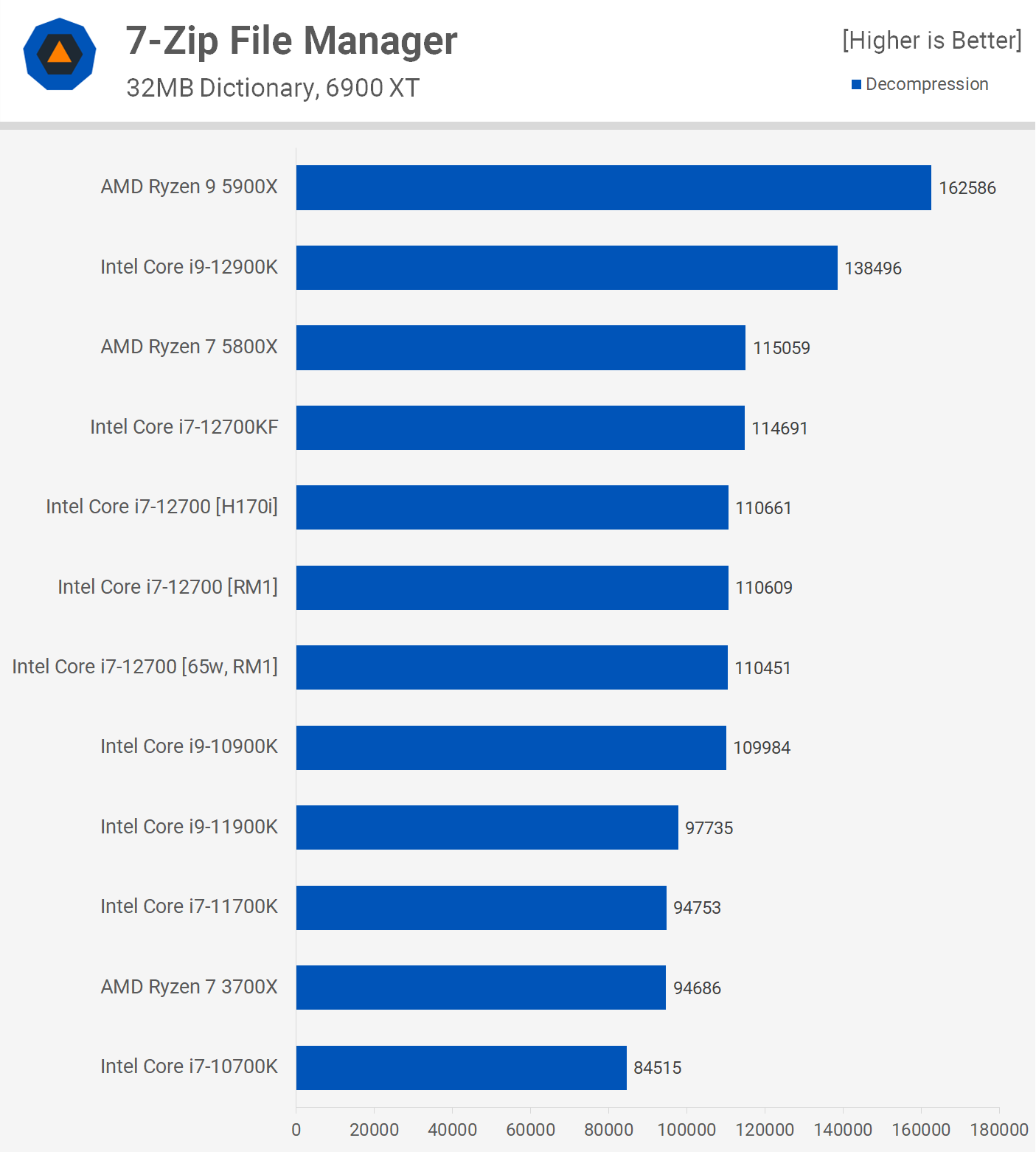
If we're cherry-picking single benchmarks, then I can do the same and give you this one.

7zip-2.png


The reason I linked you to Passmark and not a single benchmark of a single application like you did was exactly to avoid this. Passmark is a benchmark suite, not a single app.

So you are PROVING the point!! Think exactly what you are saying. You are saying - YES, the 5800x 3d was slower in both ST and MT - but you don't need to change your mobo or your ram. Which is my freaking point all along, you are paying EXTRA on the CPU for the upgrdability.
No, you dim. You're acting as if the 5800X3D was the only chip AMD had at that price point. The X3D chips were never made to offer good ST or MT performance, that's what the non-X3D chips are for. X3D are SKUs made specifically for gaming. And it wiped the floor with the 12700F in gaming.
If instead you needed typical performance, the 5900X was also available for the same $450, and smoked the 12700F there as well.

I mean even if you exclude Intel chips completely, the 5800x 3d was at some point twice as expensive as the 7600x, the 7600x was at least as fast or faster in games, and faster in ST performance. So why was the 5800x 3d twice as expensive as a CPU that was better in every aspect?
First of all, the 5800X3D was never twice as expensive as the 7600. By the time the 7600 launched (at $230), the 5800X3D was down to $360.
Second, the 7600 did match the 5800X3D in performance, but also required new expensive AM5 boards and new expensive DDR5 RAM. Which meant that for someone already on AM4 upgrading to the 7600 was way more expensive than just getting a 5800X3D for $360 (or later a 5700X3D for even cheaper). If you were building new, then sure, going with AM5 was viable, but motherboard and RAM costs offset the fact that the 7600 was cheaper.

Because it will drive CPU prices high the same way it drives AMD prices high.
That's complete nonsense. Even with platform longevity, AMD prices were never higher than Intel's. The 3600 and the 10400F/11400F were the same performance and the same price. The 3900X was better than the 10900K for the same price (and the 11900K, which was supposed to be Intel's answer, was a disaster). The 5600 and the 12400F were the same performance and the same price. The 12900K and 5950X were the same performance and the same price. The 7950X and the 14900K were the same performance and the same price. The 9950X and the 285K were the same performance and the same price. And so on and so fourth. Literally the only time Intel undercut AMD during the entire existance of AM4 and AM5 was the 250K/270K.
Platform longevity is only positive for the consumer, there are zero downsides.
 
Last edited:
If we're cherry-picking single benchmarks, then I can do the same and give you this one.
The only cherrypicking here is done by you though - cause in 7zip the 5900x is faster than the 12900k - which is not on average. The 12700 is as fast as the 5900x - usually faster in most applications. I mean the review conclusion from techspot is that it obliterates what AMD has at the pricepoint so yeah, why are you arguing about obvious things?
No, you dim. You're acting as if the 5800X3D was the only chip AMD had at that price point. The X3D chips were never made to offer good ST or MT performance, that's what the non-X3D chips are for. X3D are SKUs made specifically for gaming. And it wiped the floor with the 12700F in gaming.
If instead you needed typical performance, the 5900X was also available for the same $450, and smoked the 12700F there as well.
The 5900x never smoked the 12700 in anything though - unless you limit it to 65w. You are clearly making things up my dude.
First of all, the 5800X3D was never twice as expensive as the 7600. By the time the 7600 launched (at $230), the 5800X3D was down to $360.
Second, the 7600 did match the 5800X3D in performance, but also required new expensive AM5 boards and new expensive DDR5 RAM. Which meant that for someone already on AM4 upgrading to the 7600 was way more expensive than just getting a 5800X3D for $360 (or later a 5700X3D for even cheaper). If you were building new, then sure, going with AM5 was viable, but motherboard and RAM costs offset the fact that the 7600 was cheaper.
So you are admitting that the 5800x 3d was more expensive due to upgradability (you get to keep your mobo and ram - assuming you even have an am4 and ddr4). Isn't that my ENTIRE point? That you pay MORE on the CPU due to upgradability? You are arguing against it while proving the point, LOL.

Now imagine the scenario where I was NOT on Am4 and didn't have ddr4. Boom, the 5800x 3d is obscenely expensive. Which is why I don't want Intel to follow this upgradabiltiy nonsense, cause unless you are already in their platform - costs are going to skyrocket.

That's complete nonsense. Even with platform longevity, AMD prices were never higher than Intel's. The 3600 and the 10400F/11400F were the same performance and the same price. The 3900X was better than the 10900K for the same price (and the 11900K, which was supposed to be Intel's answer, was a disaster). The 5600 and the 12400F were the same performance and the same price. The 12900K and 5950X were the same performance and the same price. The 7950X and the 14900K were the same performance and the same price. The 9950X and the 285K were the same performance and the same price. And so on and so fourth. Literally the only time Intel undercut AMD during the entire existance of AM4 and AM5 was the 250K/270K.
Platform longevity is only positive for the consumer, there are zero downsides.
I already gave you 3 examples where platform upgradability cost you more (12700, 250k, 270k). There are tens more. I mean you admitted it yourself, the 5800x 3d was a lot more expensive than the 7600x even though it was overall slower cause you get to keep your ram and mobo. Which is the freaking point, lol.


If you didn't pay extra for it then the 5800x 3d should have been ~200$ - cheaper than the 7600x which as you just admitted was 230$ - cause it's a worse CPU. Instead it was 360$. Point proven...?
 
Facts:
1) If you are gaming above 1080P the AMD X3D CPUs are irrelevant.
2) If you are gaming AT 1080P but not using a $4500.00 Nvidia RTX 5090 series the AMD X3D CPUs the performance differences are miniscule.
You should not push your personal opinions as "facts"

4k highest quality and not rtx 5090:
- 7900XT + 5800X
- 7900XT + 5800x3D

3) "More cores" myth: unless you need to run niche applications that can actually use multiple cores you are throwing money away with your CPU AND electricity bill. More cores above 6 will not noticeably improve your game, productivity, and internet.
Find some CPU tests in those pages showing CPU heavy games performance.
Even e-cores can help with modern games. The games where "new" Intel 270K gives better performance than "old" 5800x3D.
 
The only cherrypicking here is done by you though - cause in 7zip the 5900x is faster than the 12900k - which is not on average.
That is exactly as useful as taking Cinebench alone and acting as if it's an accurate representation of CPU performance as a whole.
Passmark isn't the perfect flawless CPU test either, but it's certainly much better than Cinebench alone.

The 12700 is as fast as the 5900x - usually faster in most applications.
Passmark proves otherwise.

I mean the review conclusion from techspot is that it obliterates what AMD has at the pricepoint so yeah, why are you arguing about obvious things?
The review conclusion didn't even know what the price was, because it was made before the official announcement. They were estimating it was going to be $330, it launched at $350.
Also, "what AMD has at the price point" is nonsense, because AMD had nothing at that price point. We had the 5800X at $300-ish and the 5900X at $500-ish. The 12700 variants all fit right in between that (pretty big) range. It was faster than the 5800X and slower than the 5900X. It didn't "obliterate" anything, it has exactly the expected performance for that price.

The 5900x never smoked the 12700 in anything though - unless you limit it to 65w. You are clearly making things up my dude.
I literally provided you the link to the benchmark showing the 5900X being 30% faster in MT. It's right there in my comment, you can still click it. You cannot be this dense.

So you are admitting that the 5800x 3d was more expensive due to upgradability (you get to keep your mobo and ram - assuming you even have an am4 and ddr4).
No? Where did you get that ridiculous idea from? The replacement for the 5800X3D, the 7800X3D, launched at the exact same $450.
It was more expensive than the 7600, a newer but smaller chip with fewer cores and no stacked 3D cache, that happened to match it in gaming performance. That's how new generations work, just like the 12600K was cheaper and faster than the 11900K. Or how the RTX 3080 and cheaper and faster than the RTX 2080 Ti. Are you really asking me why new products are cheaper and faster than old products?
That doesn't change the fact that, when the 7600 launched, it still required a more expensive board and more expensive memory, because it was a new platform.

Isn't that my ENTIRE point? That you pay MORE on the CPU due to upgradability? You are arguing against it while proving the point, LOL.
Again, no. Like I literally just said in the last comment and you failed to comprehend, AMD CPUs were not any more expensive than the equivalent Intel CPUs, despite the fact that AMD had long platform support and Intel didn't. There was no downsides, only upsides. And now Intel will have it too, again with only upsides and no downsides.

Now imagine the scenario where I was NOT on Am4 and didn't have ddr4. Boom, the 5800x 3d is obscenely expensive.
How was it expensive? It was much cheaper than Intel. You could only match the 5800X3D by using the 12900K with DDR5, but that meant buying a more expensive chip (the 12900K for $600), more expensive memory (because without DDR5 it didn't match the 5800X3D), plus a new motherboard anyway because 10th/11th gen boards couldn't upgrade to 12th gen. Even if you were not already on AM4, going for the 5800X3D was still much cheaper than going for Intel.

I mean you admitted it yourself, the 5800x 3d was a lot more expensive than the 7600x
And why are you comparing two completely different products from two different generations?
The 5800X3D was the same price as the 7800X3D and 9800X3D. Just like the 7600 was the same price as the 3600, 5600, and now the 9600X.
Are you somehow under the impression that the 5800X3D and the 7600 launched together on the same generation?

If you didn't pay extra for it then the 5800x 3d should have been ~200$ - cheaper than the 7600x which as you just admitted was 230$ - cause it's a worse CPU. Instead it was 360$. Point proven...?
Buddy, the 7600 launched 1 year after the 5800X3D, on a completely different platform. The 5800X3D was discontinued shortly after (replaced by the 7800X3D). It was just leftover stock. It seems you really don't comprehend how those two CPUs are from two different generations, on two different platforms.
 
That is exactly as useful as taking Cinebench alone and acting as if it's an accurate representation of CPU performance as a whole.
Passmark isn't the perfect flawless CPU test either, but it's certainly much better than Cinebench alone.


Passmark proves otherwise.


The review conclusion didn't even know what the price was, because it was made before the official announcement. They were estimating it was going to be $330, it launched at $350.
Also, "what AMD has at the price point" is nonsense, because AMD had nothing at that price point. We had the 5800X at $300-ish and the 5900X at $500-ish. The 12700 variants all fit right in between that (pretty big) range. It was faster than the 5800X and slower than the 5900X. It didn't "obliterate" anything, it has exactly the expected performance for that price.


I literally provided you the link to the benchmark showing the 5900X being 30% faster in MT. It's right there in my comment, you can still click it. You cannot be this dense.
At this point you are trolling. There is no way you don't understand what a 65w power limit is. This is childish.

How was it expensive? It was much cheaper than Intel. You could only match the 5800X3D by using the 12900K with DDR5, but that meant buying a more expensive chip (the 12900K for $600), more expensive memory (because without DDR5 it didn't match the 5800X3D), plus a new motherboard anyway because 10th/11th gen boards couldn't upgrade to 12th gen. Even if you were not already on AM4, going for the 5800X3D was still much cheaper than going for Intel.
Uhm, it was massively slower in both ST and MT than any CPU launched before or after it at the same or lower price point. I mean the 13600k launched 5 months later for cheaper and dwarfed it. It was super expensive cause you get to keep your motherboard.

Buddy, the 7600 launched 1 year after the 5800X3D, on a completely different platform. The 5800X3D was discontinued shortly after (replaced by the 7800X3D). It was just leftover stock. It seems you really don't comprehend how those two CPUs are from two different generations, on two different platforms.
The 7600x launched what, 4 months later? Was still cheaper and faster. Why is that?
 
Last edited:
At this point you are trolling. There is no way you don't understand what a 65w power limit is. This is childish.
The Passmark tests I linked you were not done with a 65W power limit, I don't know where you got that ridiculous idea from. In fact, you can see on that page that the score is the average score of the 3954 samples for that CPU that were submitted to their website, not one single test.

Uhm, it was massively slower in both ST and MT than any CPU launched before or after it at the same or lower price point. I mean the 13600k launched 5 months later for cheaper and dwarfed it.
Do I really have to explain to you again that X3D CPUs are not made for ST and MT performance, but rather just for gaming performance, and that if you need ST/MT performance you have the non-X3D chips? If you needed MT performance, you had the 5900X at $450 and the 5950X at $600.

And then you claim I'm the one who's "trolling" lmao

It was super expensive cause you get to keep your motherboard.
No, it was expensive because every X3D CPU is expensive, because there's a whole second die of 3D cache stacked on top of the CPU die. It's the same price as the 7800X3D and the 9800X3D, the 5800X3D was just the first X3D chip ever.

The 5900X and 5950X were not any more expensive than the 3900X and 3950X they replaced.


The 7600x launched what, 4 months later? Was still cheaper and faster. Why is that?
Different generation (Zen 3 vs Zen 4), different platform (AM4 vs AM5), and different market segment (high-end gaming vs entry-level). JFC, how are you this dense?
The 7600 was the replacement for the 5600, not the 5800X3D. The replacement for the 5800X3D was the 7800X3D.
 
Last edited:
The Passmark tests I linked you were not done with a 65W power limit, I don't know where you got that ridiculous idea from. In fact, you can see on that page that the score is the average score of the 3954 samples for that CPU that were submitted to their website, not one single test.
Pretty obvious by the fact that the 12700k is much faster - which it shouldn't be if power limits were removed, since they are identical CPUs.

relative-performance-cpu.png


Different generation (Zen 3 vs Zen 4), different platform (AM4 vs AM5), and different market segment (high-end gaming vs entry-level). JFC, how are you this dense?
The 7600 was the replacement for the 5600, not the 5800X3D. The replacement for the 5800X3D was the 7800X3D.
The 7600x was faster in ST, MT, and slightly faster in games while costing a crapload LESS money. Which means that if hypothetically the 5800x 3d was released for am5 it would HAVE to be cheaper than the 7600x. AMD couldn't have possibly priced it higher than the 7600x, since it was a worse CPU. Therefore, the actual reason it was priced so much higher was none other than that you could keep your mobo. Which is my point all along..
 
Find some CPU tests in those pages showing CPU heavy games performance.
Even e-cores can help with modern games. The games where "new" Intel 270K gives better performance than "old" 5800x3D.
He is actually right on the 6-core thing. You can see here on the 9600X review that, even though it was a disappointing chip, it still regularly outperforms the 7700X, 7900X and 7950X in games despite having fewer cores. Even on the heavy/ray-tracing ones.
That has always been a thing, new gen chip with low core count outperforms every previous gen chip. The 12400F outperformed every CPU Intel had before, even the 10-core 10900K and 8-core 11700K/11900K. The 3600 outperformed every 1000/2000 chip, even the 1800X/2700X. The 5600 outperformed every 3000 chip, even the 3900X/3950X. The 7600 outperformed every non-X3D 5000 chip, even the 5900X/5950X.
 
Pretty obvious by the fact that the 12700k is much faster - which it shouldn't be if power limits were removed, since they are identical CPUs.
You think all 4 thousand people who submitted their test scores to the website were going out of their way to set up a 65W power limiter? Do you think those 4 thousand people were conspiring against you to make you lose an argument on the internet?

A portion of them might be. But a portion of them are also using DDR5 instead of DDR4, which offsets the results upwards.

Also, bad news for you, even when compared to the 12700K, the 5900X is still quite a bit faster. There is no circunstance in which choosing a 12700 variant + a motherboard would give you more performance than an in-place upgrade on AM4 for the same price.

Which means that if hypothetically the 5800x 3d was released for am5 it would HAVE to be cheaper than the 7600x.
I'm now fully convinced you have no understanding whatsoever of what CPU generations are.

This is a meaningless hypothetical. You cannot simply "release the 5800X3D for AM5". It's a Zen 3 chip, made on TSMC 7N, with a DDR4 memory controller, with a whole second die of 3D cache stacked on top (which greatly increases costs). Meanwhile the 7600 is a different architecture (Zen 4), made on a different process (TSMC 5N), with a DDR5 memory controller, no 3D cache, and binned (2 cores out of 8 disabled to salvage defective dies). They are completely different products.

AMD did release a version of the 5800X3D for AM5. Do you know what it was? That's right, the 7800X3D! And would you look at that, it cost the exact same $450 that the 5800X3D cost at launch!
 
Last edited:
You think all 4 thousand people who submitted their test scores to the website were going out of their way to set up a 65W power limiter? Do you think those 4 thousand people were conspiring against you to make you lose an argument on the internet?
No I think most people buying a 12700 / 12700f had bought a prebuild which has those limits enforced by default. The k chips are more popular in the DIY space.

Also, bad news for you, even when compared to the 12700K, the 5900X is still quite a bit faster. There is no circunstance in which choosing a 12700 variant + a motherboard would give you more performance than an in-place upgrade on AM4 for the same price.
The 5900x was a lot slower in ST performance. The 5900x was 540$ at the time with the 12700f being at 330$. It's funny you mentioned the motherboard - cause you are proving the freaking point - repeatedly!!! EXACTLY, you get to keep your motherboard - which is why the 5900x was 200$ more expensive than the 12700f. But if you did not have a motherboard, you get to pay 200$ extra anyways for no reason. Which is why I don't want Intel to follow amd into that upgradability nonsense. Even the 5800x was 370$ at the time, lol.

This is a meaningless hypothetical. You cannot simply "release the 5800X3D for AM5". It's a Zen 3 chip, made on TSMC 7N, with a DDR4 memory controller, with a whole second die of 3D cache stacked on top (which greatly increases costs. Meanwhile the 7600 is a different architecture (Zen 4), made on a different process (TSMC 5N), with a DDR5 memory controller, no 3D cache, and binned (2 cores out of 8 disabled to salvage defective chips). They are completely different products.

AMD did release a version of the 5800X3D for AM5. Do you know what it was? That's right, the 7800X3D! And would you look at that, it cost the exact same $450 that the 5800X3D cost at launch!
The 7800x 3d was the same price but it was faster at least in games than cheaper CPUs (like the 7600x and the 7700x) and wasn't majorly lagging behind in ST and MT. The 5800x 3d was lagging behind in all aspects. Yes, it was more expensive to manafacture than the 7600x, which is why they wouldn't have done it if they couldn't charge you 450$ for it cause you get to keep your motherboard.

Simply put, it made sense to buy the 7800x 3d even if you didn't have an am5 mobo. It did not make any sense to buy the 5800x 3d if you didn't have an am4 mobo. Do you see the difference?
 
Okay just read your other posts, you are flip floping depending on what might suit your "Amd is great" attitude. In another thread you were talking about how useless gaming is and productivity is all that matters and that zen 1 obliterated Intel, in this topic you are trying to convince me how important gaming is and how MT performance doesn't matter. LOL, you can't make this up. AMD fans are just the worst

 
He is actually right on the 6-core thing. You can see here on the 9600X review that, even though it was a disappointing chip, it still regularly outperforms the 7700X, 7900X and 7950X in games despite having fewer cores.
Yes and No.
7600x with 6 cores and 32MB of L3 cache can give gaming results similar to 5800x3D with 8 cores and extra L3 cache (depends on game which one is better).
But it does not mean 7700x gives no advantage over 7600x.

PS: 7900 is (for gaming) more like 6+6 core. Where the latency using cores from second die may put it behind 7600x and definitely behind 7700x in most cases.

Why is 7600x better than any Ryzen 5000?
Big IPC gain AND big frequency hop between Zen3 and Zen4 cores.
Going from DDR4 to DDR5 gives some performance too. Just check Intels 12th~14th gen CPUs using DDR4 vs DDR5

Even on the heavy/ray-tracing ones.
Ray tracing or not. There are more CPU heavy games.
Multiplayer FPS and MMOs.
And simulation games (like Factorio) are different story where every bit of CPU power counts.
 
Last edited:
This is a meaningless hypothetical. You cannot simply "release the 5800X3D for AM5". It's a Zen 3 chip, made on TSMC 7N, with a DDR4 memory controller, with a whole second die of 3D cache stacked on top (which greatly increases costs). Meanwhile the 7600 is a different architecture (Zen 4), made on a different process (TSMC 5N), with a DDR5 memory controller, no 3D cache, and binned (2 cores out of 8 disabled to salvage defective dies). They are completely different products.
Memory controller is not a part of compute die of Ryzen 5000 neither Ryzen 7000 CPUs. There

Without exact technical specification no one (not included in AMD developer team) can say how would Zen3 perform with DDR5 ram.


AMD did release a version of the 5800X3D for AM5. Do you know what it was? That's right, the 7800X3D! And would you look at that, it cost the exact same $450 that the 5800X3D cost at launch!
Except ...
7800x3D is Zen4.
Better IPC (thank to architecture) and higher frequency (thank to litography) than 5800x3D.
 
Back