Intel confirms "Nova Lake" Core Ultra 400 CPUs are coming in late 2026

Daniel Sims

Posts: 2,469   +74
Staff
Something to look forward to: Intel has revealed little about its next-generation socketed desktop CPUs. However, rumors suggest the company is preparing to challenge AMD's high-end, gaming-focused X3D processors after several years of stagnation. During a recent conference call, Intel confirmed its upcoming lineup remains on track for a launch later this year.
During Intel's fourth-quarter 2025 earnings call, CEO Lip-Bu Tan confirmed the company plans to introduce Nova Lake desktop processors – presumably labeled Core Ultra 400 – by the end of the year. Prior reports from trusted leakers indicate the high-end CPUs will include significant architectural overhauls.

While Intel has not disclosed official performance targets for Nova Lake, Tan said the company aims to strengthen its desktop and laptop market share in the coming years. The comment likely reflects Intel's gradually declining control over both segments amid the rise of AMD's Zen processors and Apple's M-series chips over the past eight years.

AMD's market share gains have accelerated since the introduction of 3D V-Cache, which raised the L3 cache ceiling for Ryzen processors to 128MB and delivered substantial gaming performance improvements. Intel's Raptor Lake and Arrow Lake lineups have yet to challenge recent Zen CPUs, but rumors indicate that both Nova Lake and Zen 6 will bring major upgrades later this year.
While Arrow Lake's top-end Core Ultra 9 285HX and Zen 5's flagship Ryzen 9 9950X3D top out at 36MB and 128MB of L3 cache, respectively, their successors could reach an unprecedented 288MB. As AMD upgrades 3D V-Cache, Nova Lake is expected to respond with large Last-Level Cache, a feature Intel previously introduced in its Clearwater Forest server processors.

The top-end Nova Lake CPU, possibly called the Core Ultra 9 485K, is expected to feature 52 cores: 16 Coyote Cove performance cores, 32 Arctic Wolf efficiency cores, four low-power island cores, Xe3 Celestial integrated graphics cores, and a 150W power rating – making it likely the most ambitious desktop processor in Intel's history. The Core Ultra 7 configuration includes 42 cores, while Core Ultra 5 chips will feature up to 28. Industry analysts expect Nova Lake to include high-end laptop processors, rumored to top out at 28 cores.

The desktop CPUs will also transition to Intel's new LGA 1954 socket and 900-series motherboard chipset. They will natively support DDR5 memory speeds up to 8,000 – or possibly 10,000 – MT/s, 48 PCIe lanes (including 24 PCIe 5 lanes), and additional USB and SATA connections. Although Intel recently introduced its 18A semiconductor node with Panther Lake notebook processors, Nova Lake will rely on TSMC's N2 process.

Permalink to story:

 
Intel has been out of the game so long, it took me a few seconds to remember what chipzilla is.
They haven't been out of the game, it's just the AMD hype train has been blowing its whistle for for awhile. People forget that AMD didn't beat Intel in gaming until the 5800X3D, they just killed them on price and features to the point it was hard to justify the performance difference. AMD didn't legitimately beat Intel until AM5. Intel would be wise to issue a price drop to make their products more competitive but they still think these are the Conroe days for some reason.
 
They haven't been out of the game, it's just the AMD hype train has been blowing its whistle for for awhile. People forget that AMD didn't beat Intel in gaming until the 5800X3D, they just killed them on price and features to the point it was hard to justify the performance difference. AMD didn't legitimately beat Intel until AM5. Intel would be wise to issue a price drop to make their products more competitive but they still think these are the Conroe days for some reason.
You are very wrong, AMD started crushing Intel with the 2XXX's and the 5XXX's extended that lead. To match AMD Intel needed to pump hundreds of Watts into their chips, causing them to die early. That alone is a crushing defeat. The X3D's only extended the lead that AMD already had with, as you said yourself, features and a fantastic price for higher than 4 core CPU's.

The 7 and 9 series have just solidified AMD's lead, worsening Intel's loss in the one area that matters most: servers. The consumer market is a very small share of their profit, compared with what they make from their corporate clients and Intel keeps losing client.
 
You are very wrong, AMD started crushing Intel with the 2XXX's and the 5XXX's extended that lead. To match AMD Intel needed to pump hundreds of Watts into their chips, causing them to die early. That alone is a crushing defeat. The X3D's only extended the lead that AMD already had with, as you said yourself, features and a fantastic price for higher than 4 core CPU's.

The 7 and 9 series have just solidified AMD's lead, worsening Intel's loss in the one area that matters most: servers. The consumer market is a very small share of their profit, compared with what they make from their corporate clients and Intel keeps losing client.
You got a source for that, bud? Techspot has plenty of benchmarks on the subject for you to reference if you need one.
 
I haven't bought an Intel in quite awhile I no longer even know their naming schemes. I would probably have a hard time picking a high end chip over a mid range chip just based on naming alone.
 
People forget that AMD didn't beat Intel in gaming until the 5800X3D, they just killed them on price and features to the point it was hard to justify the performance difference. AMD didn't legitimately beat Intel until AM5.
That is just not correct. AMD wiped the floor with Intel on day 1 of Zen's launch. Your mistake is thinking gaming performance is what matters for the market, which is very naive. Gaming is a niche compared to professional/workstation, enterprise and mobile markets.
The day the Ryzen 1800X launched, it wiped the floor with everything Intel had in the mainstream platform (which was quad-core Kaby Lake at the time) in everything except gaming. It sent Intel scrambling to release a rushed 8700K six months later, the first time in almost a decade Intel bothered to increase core counts beyond 4 on mainstream.
On workstation and enterprise it was even worse. Threadripper completely obliterated Intel's HEDT platform and made it obsolete overnight, it was absolutely comical how much worse, more expensive and more power hungry Xeon chips were. Intel got destroyed on HEDT so hard it's 8 years later and Intel's HEDT platform is still dead. They never managed to compete with Epyc on enterprise either, it's a slower moving market but it has been nothing but steady continuous decline for Intel ever since Zen 1 came out.
They clung to "best gaming performance" on DIY desktop because it was literally all they had, they were worse on literally everything else. Then Zen 3 came and they didn't even have that anymore. Complete bloodbath. The only reason Intel didn't go under is because they had good relationships with OEMs while AMD doesn't seem to care about supporting OEMs properly, so they managed to cling to the mobile market even when their chips were significantly worse (which was until very recently with lunar lake).
 
That is just not correct. AMD wiped the floor with Intel on day 1 of Zen's launch. Your mistake is thinking gaming performance is what matters for the market, which is very naive. Gaming is a niche compared to professional/workstation, enterprise and mobile markets.
The day the Ryzen 1800X launched, it wiped the floor with everything Intel had in the mainstream platform (which was quad-core Kaby Lake at the time) in everything except gaming. It sent Intel scrambling to release a rushed 8700K six months later, the first time in almost a decade Intel bothered to increase core counts beyond 4 on mainstream.
On workstation and enterprise it was even worse. Threadripper completely obliterated Intel's HEDT platform and made it obsolete overnight, it was absolutely comical how much worse, more expensive and more power hungry Xeon chips were. Intel got destroyed on HEDT so hard it's 8 years later and Intel's HEDT platform is still dead. They never managed to compete with Epyc on enterprise either, it's a slower moving market but it has been nothing but steady continuous decline for Intel ever since Zen 1 came out.
They clung to "best gaming performance" on DIY desktop because it was literally all they had, they were worse on literally everything else. Then Zen 3 came and they didn't even have that anymore. Complete bloodbath. The only reason Intel didn't go under is because they had good relationships with OEMs while AMD doesn't seem to care about supporting OEMs properly, so they managed to cling to the mobile market even when their chips were significantly worse (which was until very recently with lunar lake).
Please tell me more about how the ryxen 1800 executed the 9700k. AMD beat Intel on price and features, not speed. Zen 1, 2 and 3 was not better than anything Intel had. AMD has a great come back game, but they're weren't beating Intel during zen 1 with the 1800x.
 
That is just not correct. AMD wiped the floor with Intel on day 1 of Zen's launch. Your mistake is thinking gaming performance is what matters for the market, which is very naive. Gaming is a niche compared to professional/workstation, enterprise and mobile markets.
The day the Ryzen 1800X launched, it wiped the floor with everything Intel had in the mainstream platform (which was quad-core Kaby Lake at the time) in everything except gaming. It sent Intel scrambling to release a rushed 8700K six months later, the first time in almost a decade Intel bothered to increase core counts beyond 4 on mainstream.
On workstation and enterprise it was even worse. Threadripper completely obliterated Intel's HEDT platform and made it obsolete overnight, it was absolutely comical how much worse, more expensive and more power hungry Xeon chips were. Intel got destroyed on HEDT so hard it's 8 years later and Intel's HEDT platform is still dead. They never managed to compete with Epyc on enterprise either, it's a slower moving market but it has been nothing but steady continuous decline for Intel ever since Zen 1 came out.
They clung to "best gaming performance" on DIY desktop because it was literally all they had, they were worse on literally everything else. Then Zen 3 came and they didn't even have that anymore. Complete bloodbath. The only reason Intel didn't go under is because they had good relationships with OEMs while AMD doesn't seem to care about supporting OEMs properly, so they managed to cling to the mobile market even when their chips were significantly worse (which was until very recently with lunar lake).
The irony of this post is so think you can taste it.

The gaming industry is a multi billion dollar one, and it's the one that made Zen shine. Zen has been built on the back of consumers this entire time. Most workstations are STILL xeons, not Threadrippers, and most office desktops are Intel, not Zen.

It wasnt until zen 3 that AMD began to win in productivity suites, and it wasnt until zen 4 that AMD had a definitive lead. One that they then LOST to Intel with raptor lake. Intel's E cores are not exciting but in multi core productivity intel took the crown back years ago. AMD was competitive in gaming with zen 3, but it wasnt until the x3d came around that they really stole the crown. Even now, outside the x3d chips, AMD's zen 5 is not consistently faster then Arrow lake in games.

You are, in fact, totally incorrect.
You are very wrong, AMD started crushing Intel with the 2XXX's and the 5XXX's extended that lead. To match AMD Intel needed to pump hundreds of Watts into their chips, causing them to die early. That alone is a crushing defeat. The X3D's only extended the lead that AMD already had with, as you said yourself, features and a fantastic price for higher than 4 core CPU's.

The 7 and 9 series have just solidified AMD's lead, worsening Intel's loss in the one area that matters most: servers. The consumer market is a very small share of their profit, compared with what they make from their corporate clients and Intel keeps losing client.
It wasnt until zen2 3000 series that AMD "crushed" intel, and that was only in multi threaded productivity. In gaming they still lost across the board, and in core sensitive productivity like Adobe they also lost.

The biggest change for AMD wasn't their cores, it was Adobe getting off their butts and finally supporting large numbers of cores correctly.
 
Alright, end of 2026 then...
Intel MUST do well with these or they're gonna be even more dead on desktops and the stock might lose another 3rd again...
... though the narrative now is in fabs and AI.
 
Last edited:
The last Intel cpu I bought was Ivy Bridge 3570K. However, I'm excited about the looming Nova Lake vs Zen 6 battle. I'm not a big gamer, so productivity is more important, and to me it seems like it will be tough for AMD to match Intel in productivity unless Zen 6 has some massive improvemenst given it will still have vastly lower core counts with 10950X only having 24 cores. SMT on average only delivers ~40-60% performance uplift, but even Ultra 7 will have 16P + 24E, let alone Ultra 9 with 16P+32E.

But this is all hypothetical at this stage, and I will pick the best overall cpu. I honestly don't even see a problem with Arrow for gaming, just because it can't beat AMD, my problem it was a 1 generation product. If I could have used Nova Lake on socket 1851 it would have probably been my choice.
 
Please tell me more about how the ryxen 1800 executed the 9700k. AMD beat Intel on price and features, not speed. Zen 1, 2 and 3 was not better than anything Intel had. AMD has a great come back game, but they're weren't beating Intel during zen 1 with the 1800x.
WTF are you smoking, my dude? The Ryzen 1800X launched in march 2017. The i7-9700K launched in october 2018, a whole 1 year and a half later.

When the 1800X launched, the best CPU intel had on the market for the mainstream platform was the i7-7700K, a quad-core. By the time the 9700K launched, it was competing with the Ryzen 2700X, and lost (though the i9-9900K did beat the 2700X slightly). Six months later Zen 2 (Ryzen 3000) came out with 12-core and 16-core variants and obliterated Intel again.
 
The gaming industry is a multi billion dollar one, and it's the one that made Zen shine. Zen has been built on the back of consumers this entire time. Most workstations are STILL xeons, not Threadrippers, and most office desktops are Intel, not Zen.
You have no clue what you're talking about.
The "gaming industry" is huge on the back of mobile gaming and, to a lower extent, console gaming. The DIY PC gaming industry is a small fraction of the size of enterprise and mobile PC markets. Companies like Dell, HP, Lenovo and such completely dwarf PC gaming brands like MSI, Gigabyte, Corsair, etc.
Zen was not "built on the back of consumers". What made Zen successful was Epyc (and to a lower extent Threadrippers). It had a big impact on DIY PCs too, but that's not the money maker for AMD. Hell, it wasn't even the high-end chips that made Zen popular with consumers, it was how good and affordable the 1600/2600/3600 tier chips were.

It wasnt until zen 3 that AMD began to win in productivity suites, and it wasnt until zen 4 that AMD had a definitive lead.
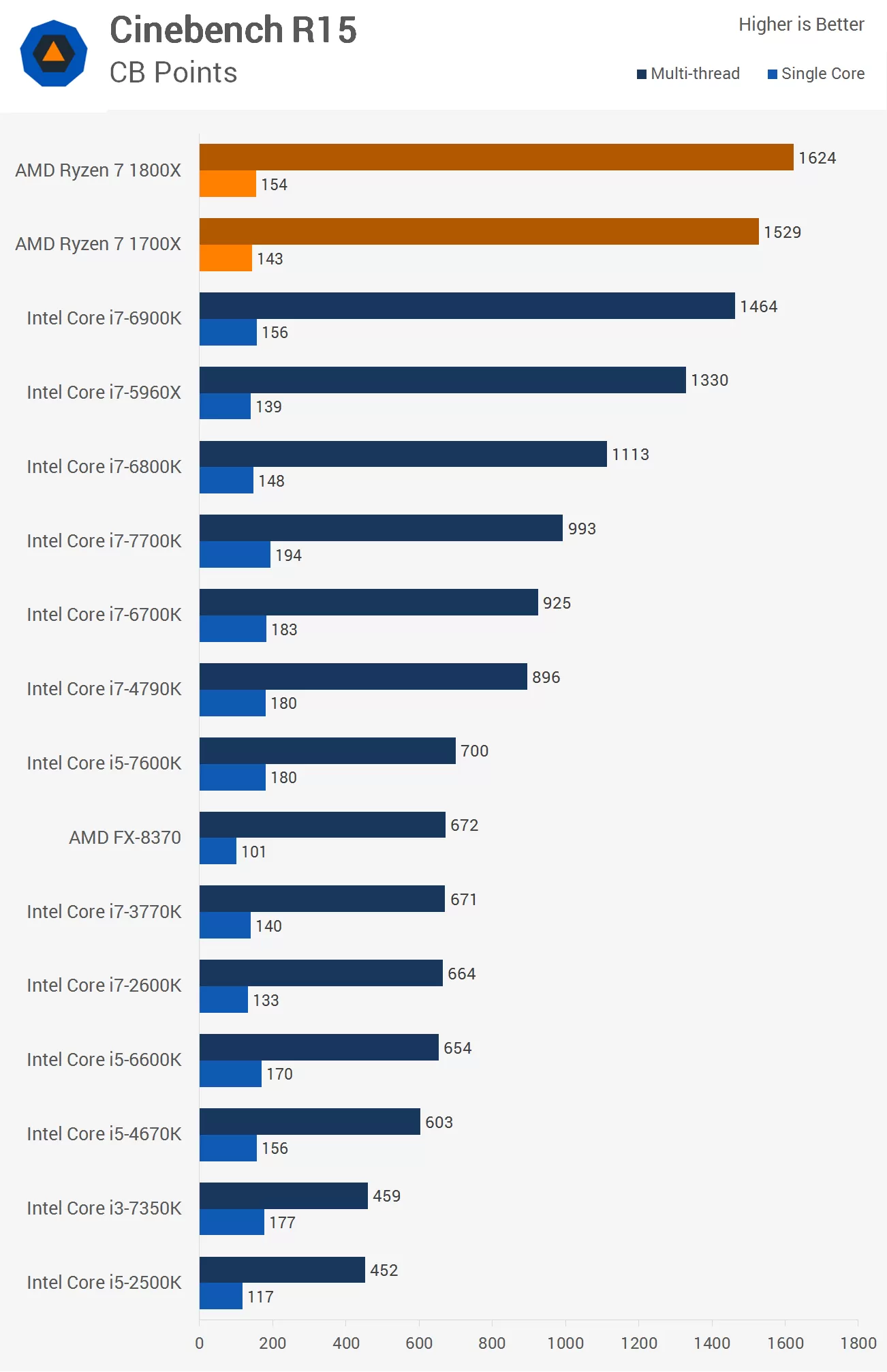
From TechSpot's own Zen 1 review:
Cinebench-p.webp


A reminder that the 5960X, 6800K and 6900K in this graph were Intel's HEDT CPUs, being beaten by AMD's mainstream platform chips, even before Threadrippers launched. Intel's best mainstream chip was the 7700K. This was completely humiliating for Intel.

Intel's E cores are not exciting but in multi core productivity intel took the crown back years ago.
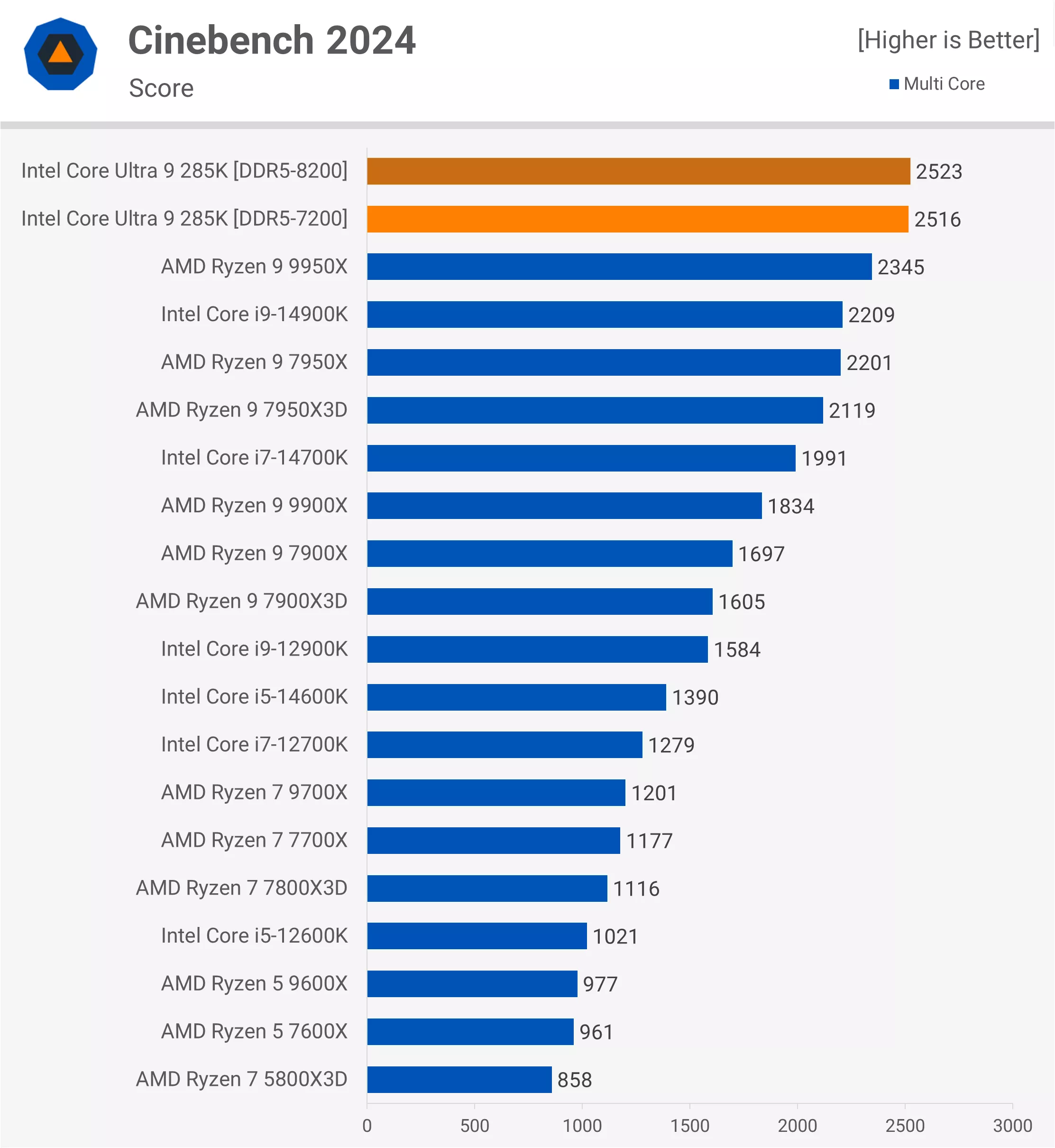
Again, no clue what you're talking about. Even with E-cores, Intel never surpassed AMD in productivity until the 285K. The fastest CPUs in MT were the Ryzen 7950X, and then the 9950X. If you want to be generous with Intel, you can say that the 14900K sometimes tied with the Ryzen flagships, at the cost of drastically higher power consumption.
CineMulti-p.webp


Even now, outside the x3d chips, AMD's zen 5 is not consistently faster then Arrow lake in games.
As you can see in this review, the Ryzen 9600X, a $200 6-core Zen 5 chip, ties with the 285K (the Arrow Lake flagship) in gaming and outperforms the 265K and 245K.
Why do you even bother making false claims that are this easy to debunk?

The irony of this post is so think you can taste it.
It's hilarious for someone to start a comment with this, just to proceed to be completely wrong across the board in everything they say.
 
You have no clue what you're talking about.
The "gaming industry" is huge on the back of mobile gaming and, to a lower extent, console gaming. The DIY PC gaming industry is a small fraction of the size of enterprise and mobile PC markets. Companies like Dell, HP, Lenovo and such completely dwarf PC gaming brands like MSI, Gigabyte, Corsair, etc.
Zen was not "built on the back of consumers". What made Zen successful was Epyc (and to a lower extent Threadrippers). It had a big impact on DIY PCs too, but that's not the money maker for AMD. Hell, it wasn't even the high-end chips that made Zen popular with consumers, it was how good and affordable the 1600/2600/3600 tier chips were.


From TechSpot's own Zen 1 review:
Cinebench-p.webp


A reminder that the 5960X, 6800K and 6900K in this graph were Intel's HEDT CPUs, being beaten by AMD's mainstream platform chips, even before Threadrippers launched. Intel's best mainstream chip was the 7700K. This was completely humiliating for Intel.


Again, no clue what you're talking about. Even with E-cores, Intel never surpassed AMD in productivity until the 285K. The fastest CPUs in MT were the Ryzen 7950X, and then the 9950X. If you want to be generous with Intel, you can say that the 14900K sometimes tied with the Ryzen flagships, at the cost of drastically higher power consumption.
CineMulti-p.webp


As you can see in this review, the Ryzen 9600X, a $200 6-core Zen 5 chip, ties with the 285K (the Arrow Lake flagship) in gaming and outperforms the 265K and 245K.
Why do you even bother making false claims that are this easy to debunk?


It's hilarious for someone to start a comment with this, just to proceed to be completely wrong across the board in everything they say.
They beat them on multi threaded performance alone. Intel was still beating AMD I'm single threaded performance all the way to the 14000 series. Unless you were doing productivity work, AMD has very little to offer. I say this as someone who owns 9, 1800Xs and 3n1700Xs.

AMD didn't beat Intel in single threaded performance until the 5800X3D
 
Who will be buying when RAM would be the price of a CPU + M/B combined?

Unless these new chips are targeted at AI and data centers again.
 
They beat them on multi threaded performance alone. Intel was still beating AMD I'm single threaded performance all the way to the 14000 series. Unless you were doing productivity work, AMD has very little to offer.
Saying "unless you were doing productivity" as if it's some edge case is wild lmao

Buddy, 99% of instances where CPU performance matters for workstations/enterprise is multithreaded productivity work. That is exactly why AMD obliterated Intel with Zen.

Single threaded performance is largely inconsequential to productivity. It only matters in a few niche situations (like SolidWorks which is still notoriously single-threaded, some specific audio processing work, or old versions of some Adobe programs), and it's all short tasks where more ST performance saves you a couple seconds (as opposed to MT performance, which saves you hours in work like rendering, enconding, compiling, data analysis, physics simulations, heavy VM usage, etc). Not to mention large servers, where MT is also king. Outside of consumer gaming, ST performance is not anywhere remotely near as important as you're suggesting it is.
 
Last edited:
Back