The "Crash Clock" shows how close we are to the next satellite collision

Skye Jacobs

Posts: 1,910   +58
Staff
Yikes! The race to fill Earth's orbit with satellites has reached a point where a single misstep could trigger a chain reaction. At 550 kilometers above the planet – a region now dominated by SpaceX's Starlink network – researchers say orbital safety is so precarious that if every satellite suddenly lost maneuverability, the first major collision could occur in just 5.5 days.
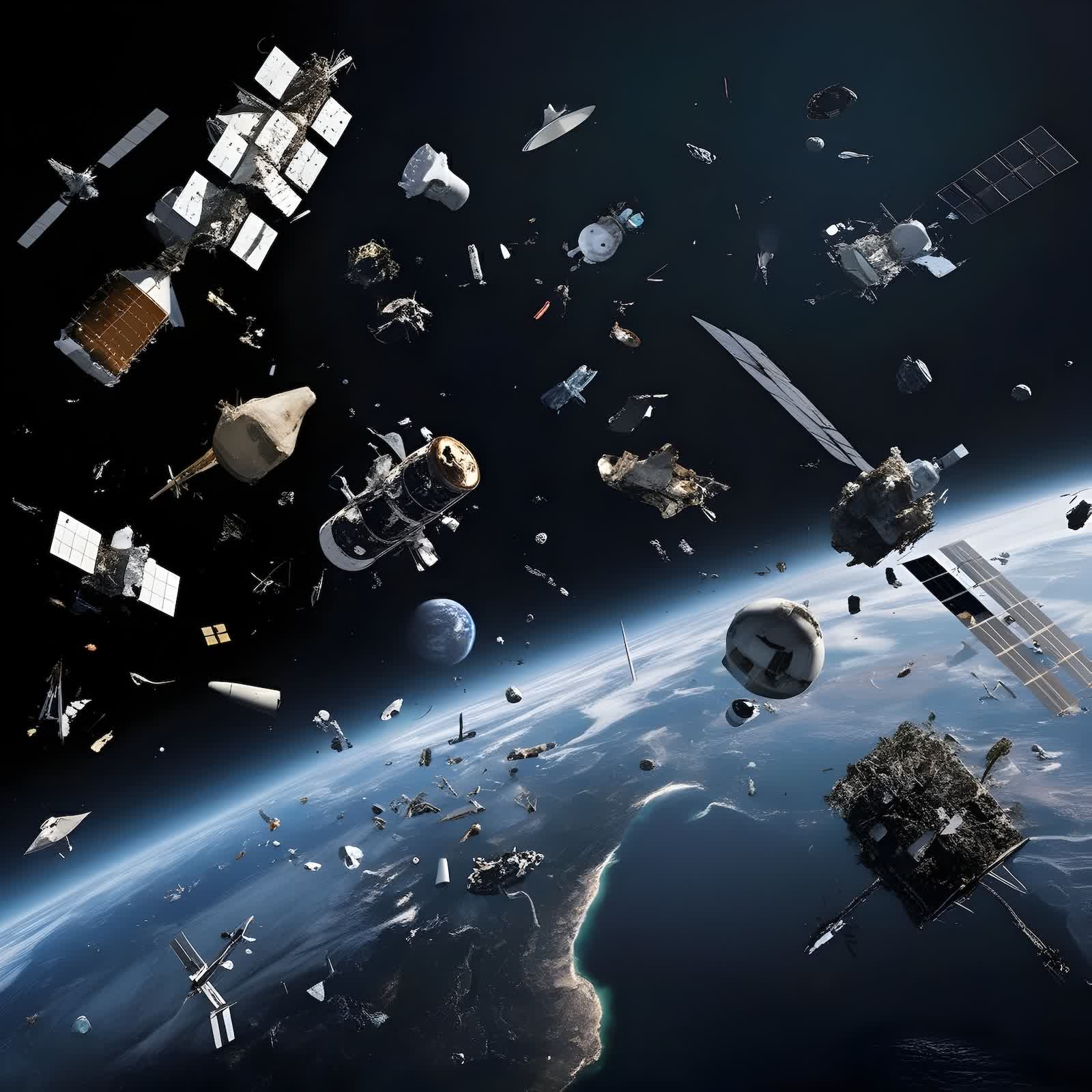
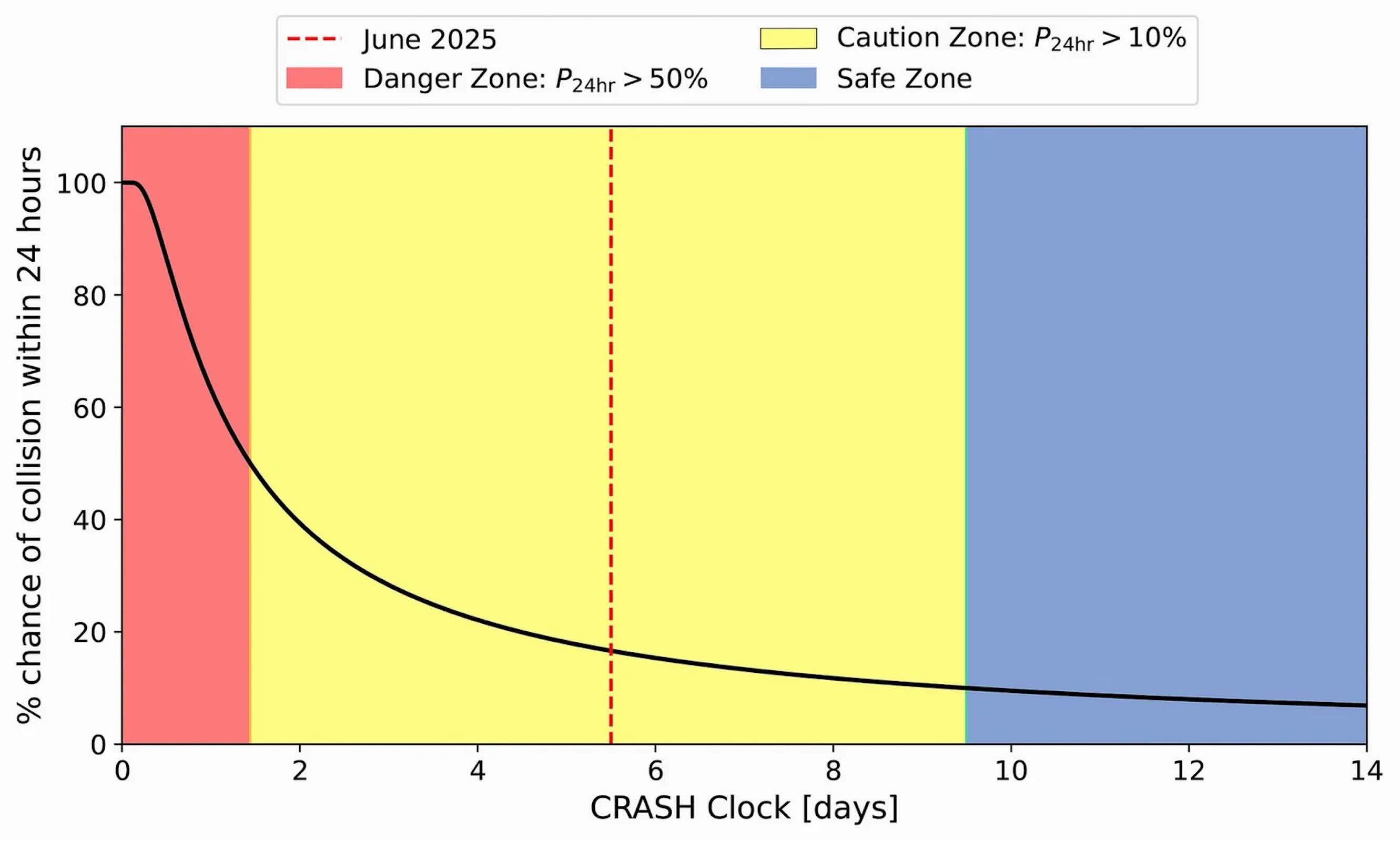
Astrophysicists are warning that low Earth orbit is reaching a critical tipping point, where satellite collisions could happen faster than previously imagined. A new metric, the CRASH Clock, developed by Sarah Thiele of Princeton University, Aaron Boley of the University of British Columbia, and Samantha Lawler of the University of Regina, quantifies how fragile the crowded orbit has become. The number estimates how long it would take for a collision if all satellites in LEO suddenly froze in their current paths.

Thiele, the study's lead author, describes the CRASH Clock as a measure of "stress" in orbit. At 5.5 days, it highlights just how dependent today's orbital environment is on flawless performance: every maneuver, software update, and communication link must function perfectly to avoid collisions.

"It's not that we're days away from Kessler syndrome," Thiele told IEEE Spectrum, referring to the self-sustaining chain reaction of orbital debris famously dramatized in the movie Gravity. "Instead, it shows how close we are to conditions where any significant loss of control could have rapid consequences."

The number provides a sobering benchmark: in 2018, the CRASH Clock read 164 days. In just seven years, dense megaconstellations and failed deorbiting have shrunk that margin more than thirtyfold.

Low Earth orbit, which extends roughly 2,000 kilometers above Earth, now holds more than 10,000 active satellites along with countless debris fragments. The most congested layer – around 550 kilometers – contains the bulk of SpaceX's Starlink fleet.
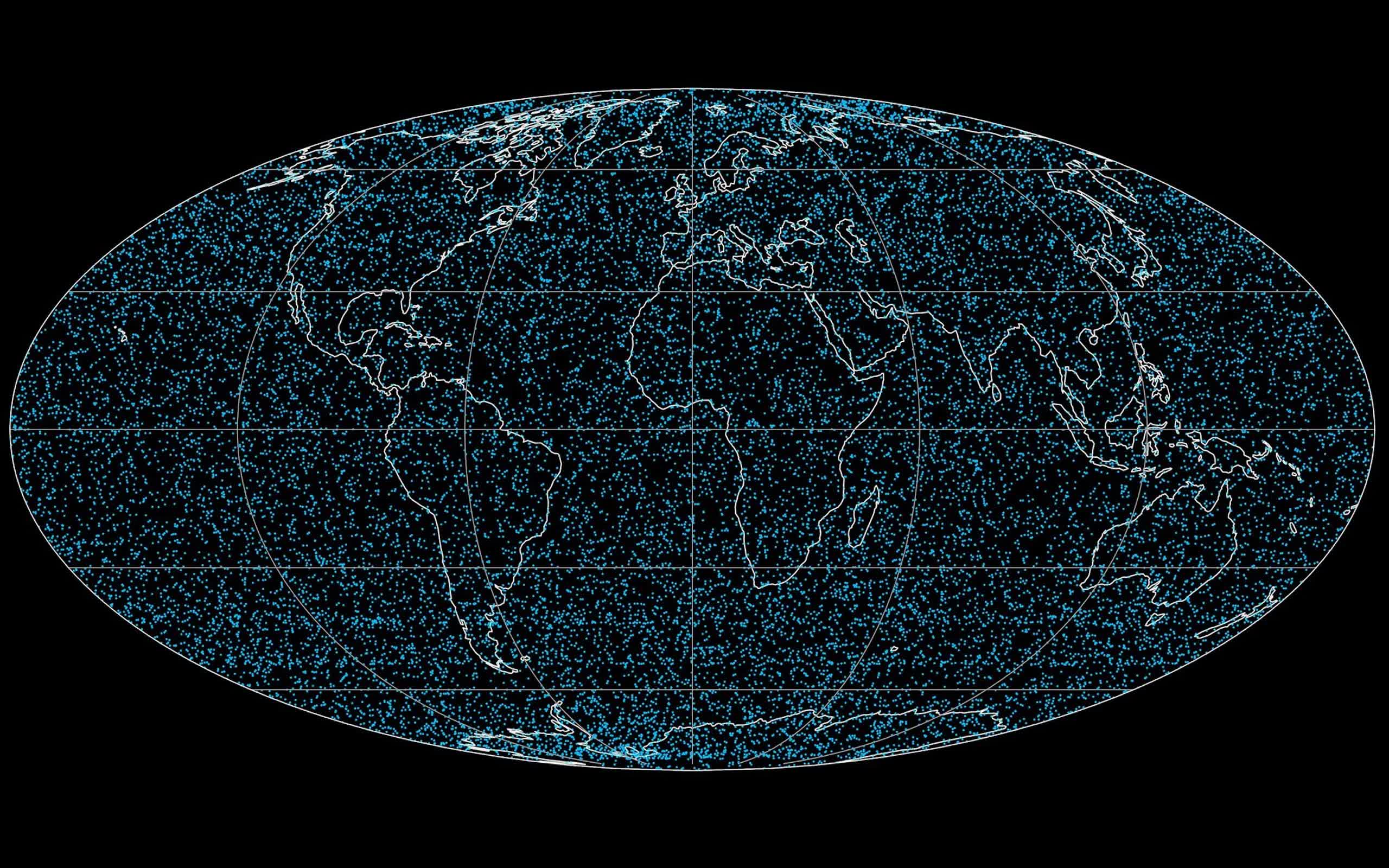
Lawler calls it "a bottleneck for the rest of the world's satellites," since any spacecraft aiming for higher orbits must pass through the Starlink layer. That density creates collision risks not only for emerging Chinese constellations but also for the International Space Station and other crewed missions.

While the public often worries about stray debris, Boley points out that the more insidious threat lies in lethal, non-trackable debris: fragments too small to detect yet large enough to disable a spacecraft on impact.

"We often frame the risk in terms of object counts," he said, "but what matters just as much is collisional area. As you increase satellite surfaces, you raise the odds of encountering these untracked fragments."

According to Starlink's most recent operations report, its satellites perform collision-avoidance maneuvers roughly once every two minutes. That high activity keeps the CRASH Clock from reaching zero but also highlights just how narrow the margin for error has become. A zero on the CRASH Clock would indicate that any loss of control – caused by a massive solar storm, software outage, or sudden communication blackout – could trigger an immediate collision.

Thiele notes that during extreme solar events, atmospheric drag can rise quickly, swelling Earth's upper atmosphere and shifting orbital paths by several kilometers.

"When you have thousands of satellites all adjusting at once, uncertainty multiplies," she said. "Even small shifts at seven kilometers per second are dangerous."
During the May 2024 solar storm, some satellites' predicted positions shifted by kilometers within hours. Lawler describes those periods as "terrifying," since every operator must execute avoidance maneuvers nearly simultaneously, compounding the risk.

Not all orbits face the same risks. Below 600 kilometers, atmospheric drag acts as a natural cleanup mechanism, gradually pulling debris back toward Earth. Above that line, debris can persist for decades or even centuries. The 800-kilometer region, scarred by the 2007 Chinese anti-satellite test and the 2009 Iridium-Cosmos collision, still contains debris that will outlive the satellites currently in use.

However, at 550 kilometers – the altitude of most Starlink satellites – any major collision would temporarily produce clouds of fragments that linger for several years.

"It wouldn't make the orbit permanently unusable," Thiele explained, "but it would mean a lot more collision-avoidance maneuvers and downtime."

Thiele hopes the CRASH Clock will become a common language for astrophysicists, satellite operators, and regulators. Though the paper is still under peer review, its public preprint release drew extensive community feedback that strengthened the model.

"Sometimes the internet actually works," Lawler said. "We received thoughtful, expert critiques that improved the analysis."

Image credit: IEEE Spectrum

Permalink to story:

 
Humans have a knack for ignoring and downplaying long term danger for short term profit.
We're great at avoiding immediate threats, but if we can make a few bucks by pushing it off on another generation to worry about, we'll do it every time. It's almost like we've no room left in the budget for silly things like the future of every child on the planet and instead we work so hard to burn every bridge, lock every door, pull up every ladder behind us. Otherwise we'd be leaving money on the table and leaving money on the table is the opposite of 21st century winning.
 
Humans have a knack for ignoring and downplaying long term danger for short term profit.
We're great at avoiding immediate threats, but if we can make a few bucks by pushing it off on another generation to worry about, we'll do it every time. It's almost like we've no room left in the budget for silly things like the future of every child on the planet and instead we work so hard to burn every bridge, lock every door, pull up every ladder behind us. Otherwise we'd be leaving money on the table and leaving money on the table is the opposite of 21st century winning.
It'll be a new industry in the future to detect and deflect any space garbage into the sun - if there was a stock that I could invest in that is going to do that, now would be the best time
 
It'll be a new industry in the future to detect and deflect any space garbage into the sun - if there was a stock that I could invest in that is going to do that, now would be the best time

Deflecting into the sun sounds easy enough, except that you need enough energy to add about 3km/s to floating debris in low earth orbit for it to reach escape velocity. It is much easier to slow things down so that it deorbits - falls back down to earth.
 
Kessler syndrome

Maybe we will have so much space debris in x years that we can't leave the planet
 
Humans have a knack for ignoring and downplaying long term danger for short term profit.
We're great at avoiding immediate threats, but if we can make a few bucks by pushing it off on another generation to worry about, we'll do it every time. It's almost like we've no room left in the budget for silly things like the future of every child on the planet and instead we work so hard to burn every bridge, lock every door, pull up every ladder behind us. Otherwise we'd be leaving money on the table and leaving money on the table is the opposite of 21st century winning.

Not wrong.

We all know how this will end: Once the problem becomes too large to ignore, we'll spend crazy money to try and clean up the mess, year after year, rather then spending just a little bit now to prevent the problem in the first place.

Yay Capitalism.
 
Another doomsday clock, what a huge surprise!
The authors should be reminded that space is not only kinda big, but also 3-dimensional.

I'll put that next to "climate change".
Recycle bin.
 
The authors should be reminded that space is not only kinda big, but also 3-dimensional.
Satellites move at around 17,000 mph and so cover a lot of ground. For comparison bullets move at around 1,500 mph. The article clearly states that currently satellites need to be rerouted to avoid collisions so, at these speeds, space isn't all that big . If any satellites do collide then they could produce 1000's of bits flying in all directions which will not only knock out other satellites but produce yet more bits etc etc. That's the Kessler effect. There's also the possibility of an enemy nation just firing something into space and exploding it in LEO. If they don't have much in LEO then it would only hurt countries, like America, that do.

I'll put that next to "climate change".
What's the weather like outside where you are?
 
Not wrong.

We all know how this will end: Once the problem becomes too large to ignore, we'll spend crazy money to try and clean up the mess, year after year, rather then spending just a little bit now to prevent the problem in the first place.

Yay Capitalism.
As stated in the article, most satellites operate in LEO where there is atmospheric drag. That causes all satellites in that orbit to gradually decrease altitude until it burns in denser atmosphere. Realistically, it would be a waiting/self-cleaning process that would span weeks or maybe months.
Another doomsday clock, what a huge surprise!
The authors should be reminded that space is not only kinda big, but also 3-dimensional.

I'll put that next to "climate change".
Recycle bin.
Yeah, bad news always gets clicks!

The article mentions that Starlink satellites perform avoidance maneuvers, and this is done autonomously. It says every two minutes this is happening, but that's talking about the whole fleet. With 9,500 satellites in orbit, that 2 minutes turns into one maneuver every two weeks lol. And apparently Starlink satellites are extremely eager to adjust their trajectory. SpaceX satellites will maneuver if the probability of collision is greater than 1 in a million chance of collision, 100x the industry standard. Realistically any satellite put into LEO is also prepared to make collision avoidance maneuvers.

And it's dead simple to deploy satellites going beyond that; there is plenty of time to plan the safest path for a rocket launch in advance. The vast majority of satellites in space have all changes in trajectories published online, and the few that China doesn't published have their changes tracked independently and published anyways: https://www.space-track.org/
 
Not wrong.

We all know how this will end: Once the problem becomes too large to ignore, we'll spend crazy money to try and clean up the mess, year after year, rather then spending just a little bit now to prevent the problem in the first place.

Yay Capitalism.
But reign in the "Polluters" and alleviate the problem? NFW!!!!!!
 
As stated in the article, most satellites operate in LEO where there is atmospheric drag. That causes all satellites in that orbit to gradually decrease altitude until it burns in denser atmosphere. Realistically, it would be a waiting/self-cleaning process that would span weeks or maybe months.

Yeah, bad news always gets clicks!

The article mentions that Starlink satellites perform avoidance maneuvers, and this is done autonomously. It says every two minutes this is happening, but that's talking about the whole fleet. With 9,500 satellites in orbit, that 2 minutes turns into one maneuver every two weeks lol. And apparently Starlink satellites are extremely eager to adjust their trajectory. SpaceX satellites will maneuver if the probability of collision is greater than 1 in a million chance of collision, 100x the industry standard. Realistically any satellite put into LEO is also prepared to make collision avoidance maneuvers.

And it's dead simple to deploy satellites going beyond that; there is plenty of time to plan the safest path for a rocket launch in advance. The vast majority of satellites in space have all changes in trajectories published online, and the few that China doesn't published have their changes tracked independently and published anyways: https://www.space-track.org/
Says a known fElon disciple trying their best to contradict professional experts, and not the only one replying to this thread.

Damn the torpedoes!!! Full speed ahead. Who GAS as long as fElon makes his $1Trillon wealth.
 
Says a known fElon disciple trying their best to contradict professional experts, and not the only one replying to this thread.

Damn the torpedoes!!! Full speed ahead. Who GAS as long as fElon makes his $1Trillon wealth.
I can't find anywhere where I attempted to contradict a professional expert. In fact I referred to the article and expanded on it.

As for labeling me a "fElon disciple" I think your own comment rebuts that claim just by the way your write. You didn't even try to argue with any of the claims I made. If you disagree with me, you should address the points I make. Your comment is so lazy that you only attack credibility.
 
Another doomsday clock, what a huge surprise!
The authors should be reminded that space is not only kinda big, but also 3-dimensional.
Thanks for reminding all of us who come to a tech site to read articles that space is 3-dimensional. I don't think any of the readers of this article would have known that without your pointing it out.

As the article points out the layer in question is becoming so full of crap that it becomes difficult for any spacecraft to get to a higher orbit. Not all dangerous particles are detectable. Some are too small to be tracked and those are the most dangerous. A particle's kinetic energy increases as the speed of its velocity - meaning even a grain of sand at a high enough velocity is capable of causing great damage.
I'll put that next to "climate change".
Recycle bin.
You're certainly free to do that.
 
I can't find anywhere where I attempted to contradict a professional expert. In fact I referred to the article and expanded on it.

As for labeling me a "fElon disciple" I think your own comment rebuts that claim just by the way your write. You didn't even try to argue with any of the claims I made. If you disagree with me, you should address the points I make. Your comment is so lazy that you only attack credibility.
Uh-huh.

You seem to continue to think that all particles will decay from this orbit at the same rate. It's simply not true due to the physics of drag. I've pointed this out to you before, but you apparently have failed to learn from that.

In addition, fElon's satellites will not be able to avoid colliding with something that is too small to be tracked. Though I suppose you think, in that case, fElon's satellites will employ magic to avoid such particles.

You may have read the article, but I think you missed the point. Read it again. The point being that LEO is becoming so cluttered that it is becoming more and more difficult for any spacecraft to fly. Spacecraft have to go though the junk field to get to higher orbits - such as the upcoming Artemis flight. In that case, who GAF whether fElon's satellites can avoid collisions autonomously? Artemis, and many, many, many future flights will be carrying humans to space. As far as I am concerned, if fElons and others, satellites are making it more difficult for humans to explore space, they are impeding humanity's progress. Personally, I think humanity's progress is worth far more than the profit that Starlink is pursuing.

And finally, go look it up. As I said above, the kinetic energy of a particle quadruples with every doubling of velocity. Even a grain of sand, at orbital velocities, can cause a great deal of damage if it collides with a spacecraft or other object.
 
As far as I am concerned, if fElons and others, satellites are making it more difficult for humans to explore space, they are impeding humanity's progress. Personally, I think humanity's progress is worth far more than the profit that Starlink is pursuing.

Starlink and the Falcon 9 rocket are the primary drivers in space technology development and commercialization. If you think that Starlink is "impeding humanity's progress", then I'd love to hear what you think would be a good real-world approach to rapidly furthering space exploration and tech. I'm curious where you think the money will come from.
 
Uh-huh.

You seem to continue to think that all particles will decay from this orbit at the same rate. It's simply not true due to the physics of drag. I've pointed this out to you before, but you apparently have failed to learn from that.

In addition, fElon's satellites will not be able to avoid colliding with something that is too small to be tracked. Though I suppose you think, in that case, fElon's satellites will employ magic to avoid such particles.

You may have read the article, but I think you missed the point. Read it again. The point being that LEO is becoming so cluttered that it is becoming more and more difficult for any spacecraft to fly. Spacecraft have to go though the junk field to get to higher orbits - such as the upcoming Artemis flight. In that case, who GAF whether fElon's satellites can avoid collisions autonomously? Artemis, and many, many, many future flights will be carrying humans to space. As far as I am concerned, if fElons and others, satellites are making it more difficult for humans to explore space, they are impeding humanity's progress. Personally, I think humanity's progress is worth far more than the profit that Starlink is pursuing.

And finally, go look it up. As I said above, the kinetic energy of a particle quadruples with every doubling of velocity. Even a grain of sand, at orbital velocities, can cause a great deal of damage if it collides with a spacecraft or other object.
1. That's wrong lol, I did not argue against that. If I did, why would I specify orbital decay would happen "weeks or months"?
2. I did not say that satellites would avoid colliding into objects too small to be tracked.

As for your main point about passing LEO, you're wrong. Earth's surface area is about 510 million kilometers, and with 9,500 Starlinks that would make the distance between them 230 km apart if they were all one orbital plane (which they're not, so the distance is higher). If a rocket can't aim to avoid an 4 meter object 115 km away, then there's something wrong with the rocket, not the satellites. In fact, the author seems to used a fake quote to make the following statement (I couldn't not find the source of it):
Lawler calls it "a bottleneck for the rest of the world's satellites," since any spacecraft aiming for higher orbits must pass through the Starlink layer.
The article mentions changes of trajectory during solar storms, but CME's take 3 days to reach earth and are thus highly avoidable. In 2024 the largest solar storm in decades occurred, but Starlink and all modern satellites' trajectories were essentially unaffected besides avoidance maneuvers, meaning the article's claim to the contrary must've been for isolated satellites: https://www.pcmag.com/news/spacex-heres-how-starlink-satellites-weathered-mays-major-solar-storm
 
Back