Recap: The last memory industry boom of comparable scale occurred between 2017 and 2019, when cloud data center expansions pushed RAM prices to record highs and widened the gap between memory and foundry revenues. Today, the AI boom is driving even greater supply shortages, resulting in higher prices and a more acute market crunch.
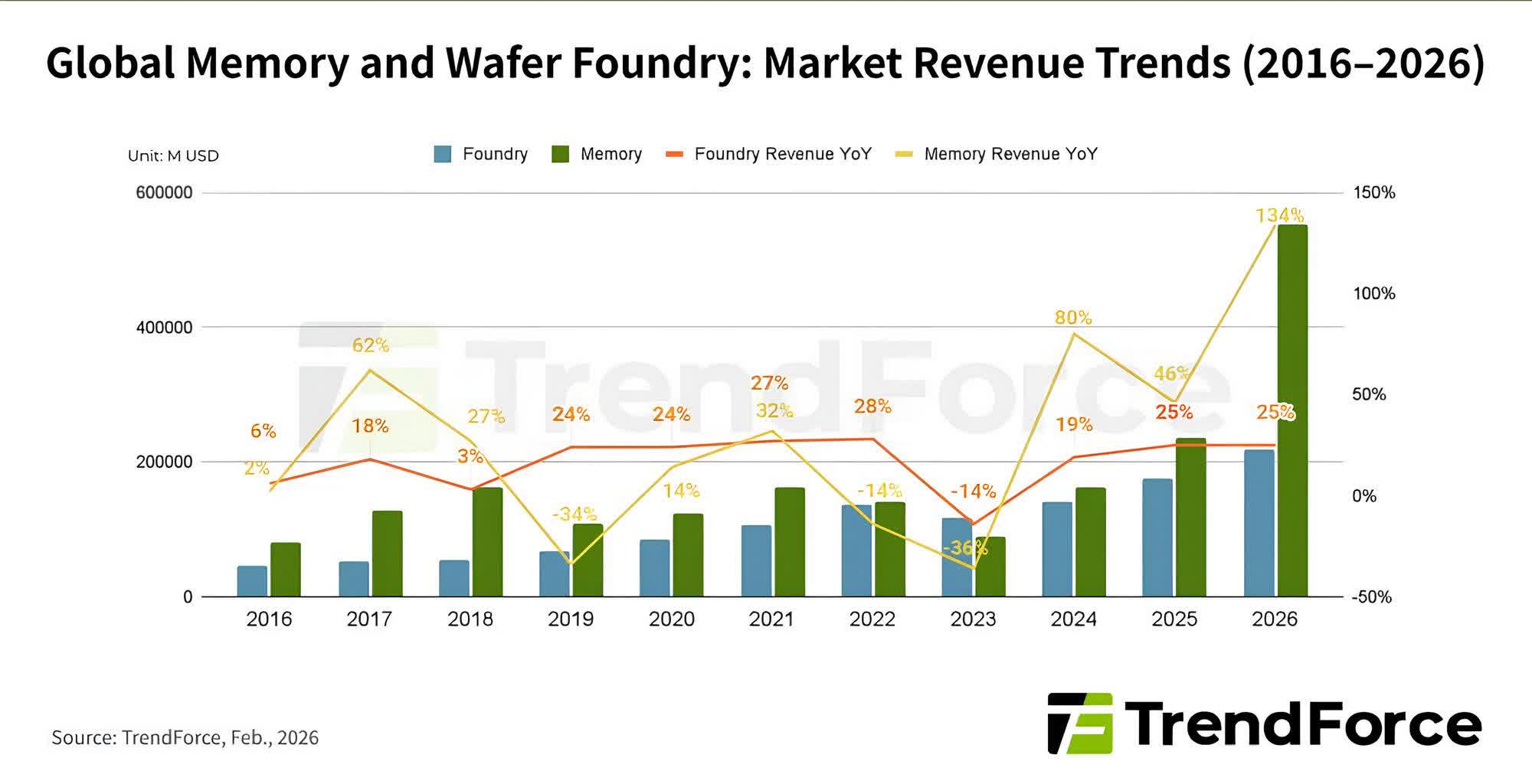
Fueled by the AI boom, the global foundry and memory sectors are expected to hit record highs in 2026. However, the memory market is projected to grow much faster than the foundry industry, generating roughly 2.5 times more revenue.
According to market research firm Trendforce, total revenue for the global memory semiconductor market is projected to reach $551.6 billion in 2026, representing a 134 percent year-on-year increase driven by rapid price hikes amid unprecedented demand from AI data centers. Over the same period, foundry market revenue is expected to grow a more modest 25 percent, reaching $218.7 billion.
The explosive demand for high-capacity, high-bandwidth memory and the increasing per-server memory configurations at AI data centers can be attributed to a shift from model training to large-scale inference, as the AI industry emphasizes real-time responsiveness and efficient data access.
Nvidia's new Vera Rubin platform is also driving demand for high-performance, high-capacity enterprise SSDs, as AI firms prioritize token-generation performance and power efficiency. According to industry sources, most of the SSDs deployed in AI data centers are lower-cost QLC models, allowing operators to keep costs under control.
Compared with the memory industry, wafer foundries are experiencing a steadier growth trajectory, despite benefiting from the same AI boom. This is partly due to long-term contracts that reduce price volatility and partly because only a limited number of advanced-node processes are favored by cutting-edge AI data centers.
To cope with soaring memory prices, consumer electronics companies are either raising prices or delaying product launches. Valve has reportedly delayed the Steam Machine and Steam Deck amid the ongoing crisis, while Raspberry Pi prices have jumped nearly 100 percent in recent weeks. PC and smartphone vendors are also expected to raise prices this year as the memory crunch intensifies.
The memory boom is back: Global revenue to reach $551 billion in 2026 as prices skyrocket