There is a solitary black hole wandering near the center of our galaxy, astronomers confirm

Alfonso Maruccia

Posts: 2,587   +973
Staff
Invisible Dark: Lone black holes passing through the galaxy should be a pretty common occurrence in the Milky Way, but they are notoriously hard to spot. According to recently published research, we have now confirmed the existence of the first-ever lone black hole. And it's essentially in our neighborhood.
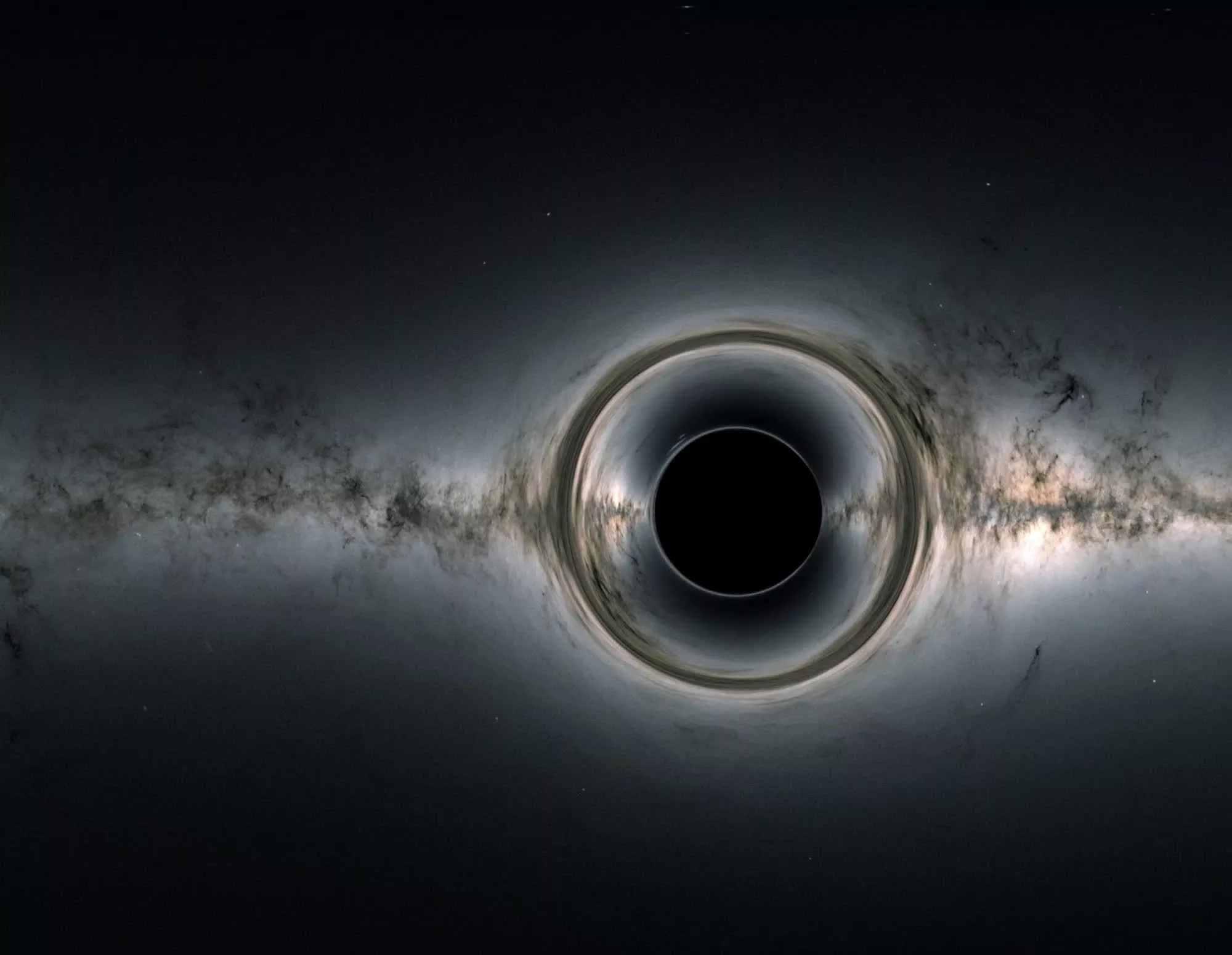
A team of US astronomers led by Kailash Sahu said they have finally discovered the first isolated stellar-mass black hole traveling through space by itself. The researchers initially spotted this dark object in 2022, in the Sagittarius constellation, but their claim was disputed by a different team. However, the two groups are now in agreement: this particular black spot in the vastness of space really is a black hole.

Supermassive black holes are traditionally located at the center of large galaxies, like the well-known Sagittarius A* lying at the center of the Milky Way. Potential candidates for "wandering" supermassive black holes, moving through space after being ejected from their original location, have been considered as well.

The black hole described in the recently published research was discovered thanks to precise stellar observations made through the Hubble Space Telescope. The researchers made their original discovery by analyzing Hubble measurements recorded between 2011 and 2017, while their latest work relies on more Hubble data taken between 2021 and 2022. Additional observations by the orbiting Gaia telescope were also used.
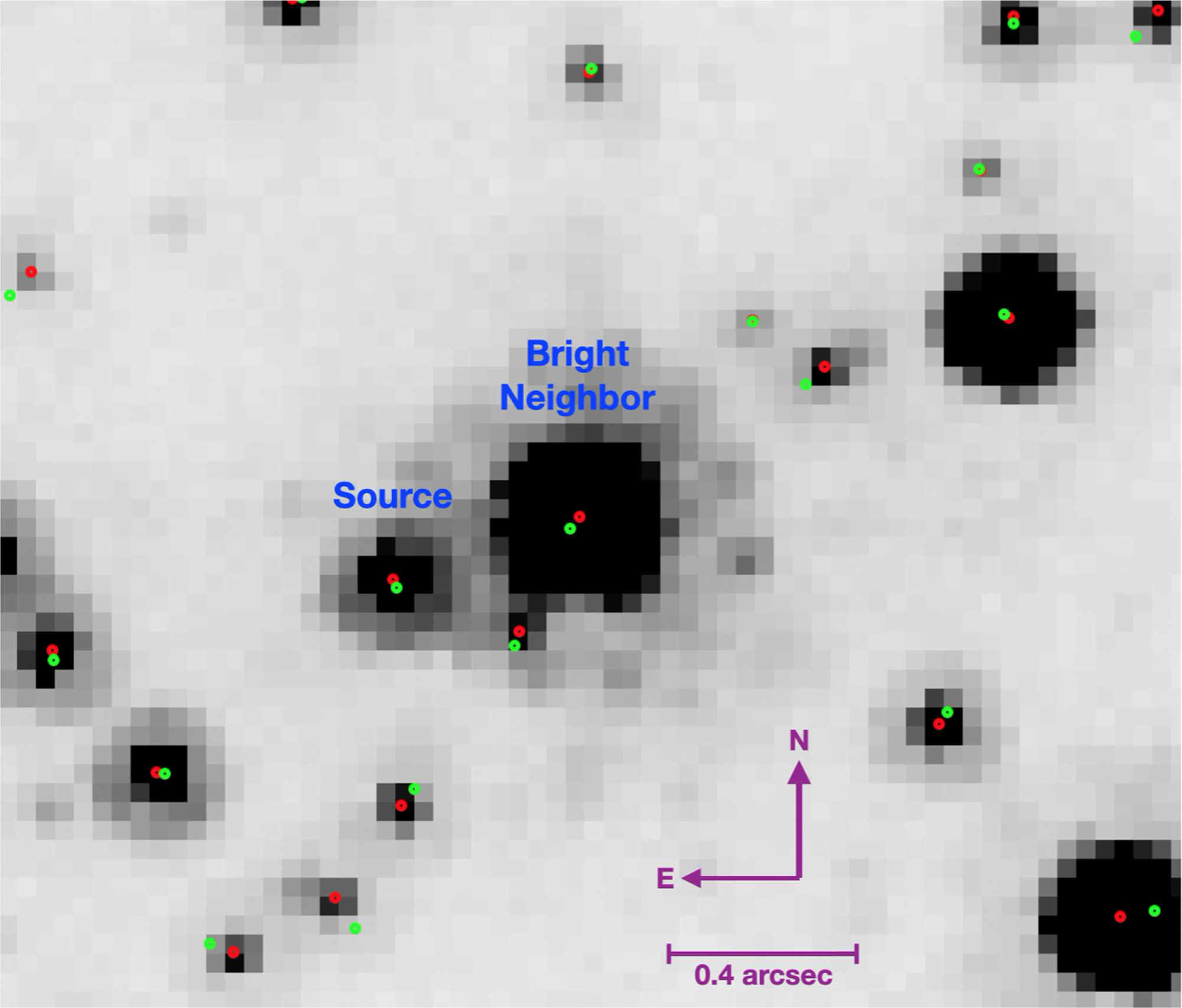
The wandering black hole was discovered thanks to the object's influence on surrounding stars. The black hole has no "companion" star, but it made itself known while passing in front of a dim background star. The "gravitational lens" effect magnified that star's light, shifting its position in space as well. The black hole passed the star in 2011, the researchers explain, but the star's position is still changing to this day.

"It takes a long time to do the observations," Sahu stated, adding that "everything is improved if you have a longer baseline and more observations." The latest data confirms that the wandering black hole is around seven times the mass of our Sun. Based on the new observations, the second team of researchers revised their original hypothesis about the dark object, which they thought could be a neutron star. They now estimate the object has around six times the mass of the Sun, which is consistent with the new research by Sahu's team.

The first wandering black hole ever discovered currently lies 5,000 light-years from Earth, so it should be much closer to our planet than Sagittarius A* (27,000 light-years). New solitary black holes could be discovered thanks to the Nancy Grace Roman Space Telescope, which is expected to launch in 2027 – if the current US administration does not cut all "unnecessary" funds from space exploration projects and NASA before then.

Permalink to story:

 
Planck vs Einstein
To my understanding, a black hole can be described as a neutron star with an escape velocity exceeding the speed of light. The confusion often arises from the fact that the mathematical models of general relativity behave abnormally and break down near the edge cases, such as the speed of light and infinite density. However, in physical reality the most logical approach suggests that a black hole is simply a neutron star with a higher density, demanding an escape velocity greater than the speed of light.
So in reality, there is no singularity with infinite density as described by the mathematical models of General Relativity. Instead, a black hole is just a more dense neutron star. Here is why, if we consider the Planck mass divided by the Planck volume, we obtain a constant representing the "Planck" density, which is not infinite but a finite value around 5.155 × 10^96 kg/m^3. This means that there is no singularity with infinite density and without such a singularity there is no collapse too.
Consequently without collapse, the neutron degeneracy pressure, which is the side effect of the fundamental Pauli exclusion principle acting on neutrons, remains intact within the black hole. This pressure is what defines a neutron star and it persists even when the escape velocity exceeds the speed of light. Therefore, we cannot say anything different; the General Relativity prediction of infinite density is incorrect because there is a finite "Planck" density.
In essence, a black hole is a neutron star with an escape velocity surpassing the speed of light, governed by the finite density of the Planck scale, rather than an infinite singularity. This perspective aligns our understanding with the physical reality, where the elegance of mathematics contradicts with the tangible limits of the universe.
 
However, in physical reality the most logical approach suggests that a black hole is simply a neutron star with a higher density, demanding an escape velocity greater than the speed of light.
It's far more likely that a black hole is quark star instead of a neutron star.
 
It's far more likely that a black hole is quark star instead of a neutron star.
There is a principle that states you cannot cut something with something softer; you need something harder to do so. There is a common belief that gravity is a fundamental force, rooted in its wide-scale appearance. However, there is no direct scientific evidence confirming its fundamental nature.
Gravity without be fundamental, cannot disrupt or cancel the expression of a fundamental force like the strong force within the group of quarks that form the nucleus. Practically, this means there is likely a physical upper limit to gravity's strength (my speculative theory suggests that quantum entanglement would be disrupted over a certain threshold), which prevents the formation of quark stars. Additionally, an extreme strength of gravity could potentially disrupt quantum fluctuations and the uncertainty principle.
Quarks, as fermions are compatible with the Pauli exclusion principle, theoretically allowing them to produce degeneracy pressure. However, in the extreme state inside a quark star, their "equation of state," determined by quantum chromodynamics, is impossible to solve. Some models even suggest that color superconductivity occurs in quark matter, making it unstable and unable to form a stable star.
So while it's not impossible in a strict sense, my understanding is that it is highly unlikely for quarks to become solo under the force of gravity. Let's hope that in the future, when we better understand gravity's underlying physical mechanism, we can definitively determine if there is a hard upper limit to the strength of gravity.
 
I wonder who actually observed it...
Who touched it and saw it.... you know science is all about facts and evidence, otherwise it would be faith based...just asking for a friend
 
So while it's not impossible in a strict sense, my understanding is that it is highly unlikely for quarks to become solo under the force of gravity.
What's more likely, a singularity of exotic mystery force/energy/matter or a state of compression so intense that quarks are forced to change their "traditional" behavior? Seems far more plausible the later rather than the former.
 
What's more likely, a singularity of exotic mystery force/energy/matter or a state of compression so intense that quarks are forced to change their "traditional" behavior? Seems far more plausible the later rather than the former.

I find it more likely unoficialoficial speaks accurate, as they use [specific] scientific language in a scientific way.
 
I find it more likely unoficialoficial speaks accurate, as they use [specific] scientific language in a scientific way.
You say that like you think your opinion will sway me. It will not. I side with theories that make logical sense and are based on confirmed observations instead of radical thinking that observations can't support.
 
You say that like you think your opinion will sway me. It will not. I side with theories that make logical sense and are based on confirmed observations instead of radical thinking that observations can't support.

Hah. I don't argue. I express. What others do with it lies with them. I live alone, yo, I get my way.
 
Back