Thermaltake built a PSU that splits in two, so you never have to redo cable management again

DragonSlayer101

Posts: 989   +14
Staff
Something to look forward to: Power supply units are not usually the most exciting part of a PC build, which is why they are often overshadowed by other components. Thermaltake is looking to change that with its new Dockpower PSU series, which reimagines the humble power supply through a unique modular design that allows users to upgrade their PSU without having to redo their cable management.
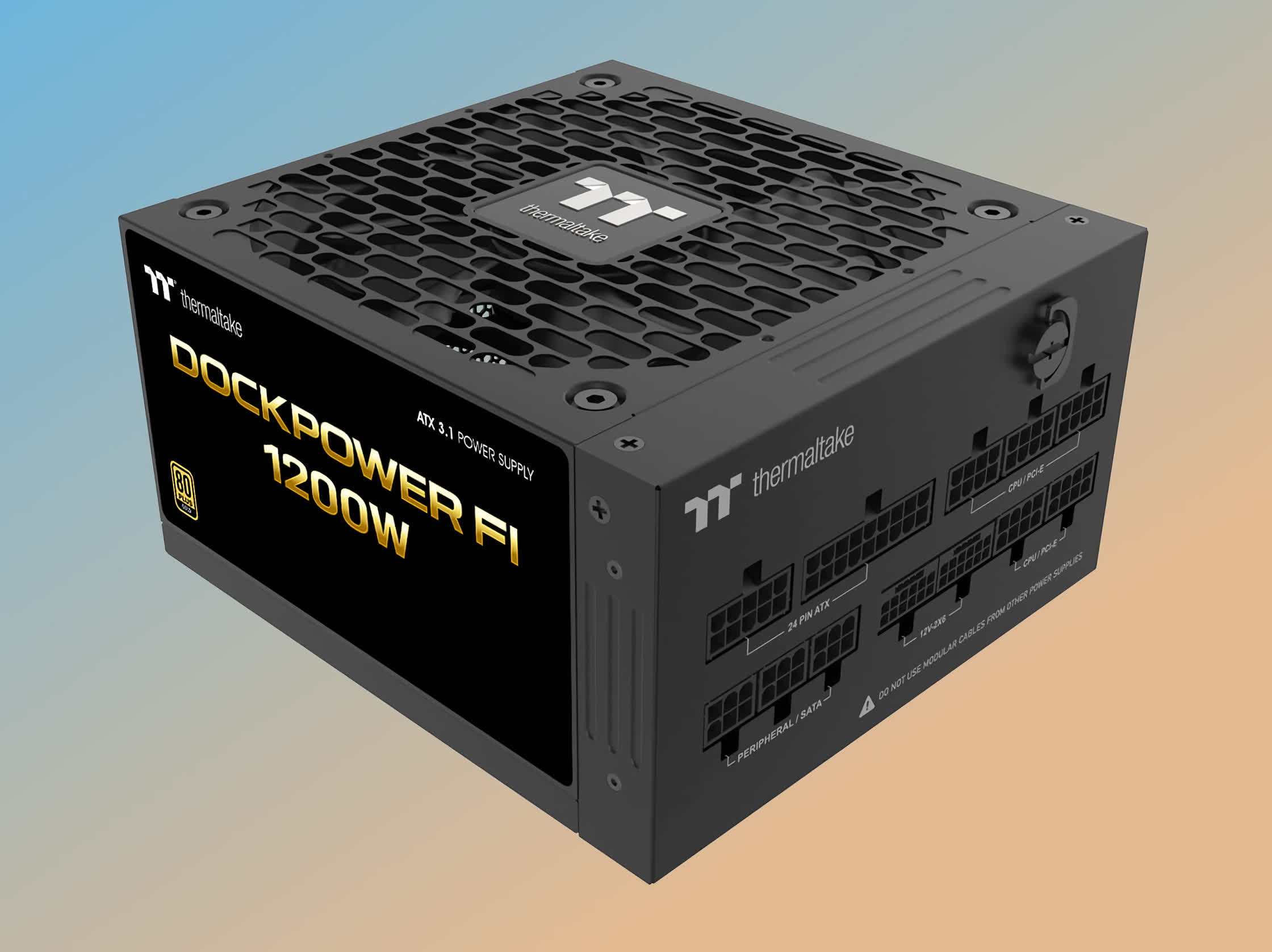
Taiwanese PC hardware and peripherals manufacturer Thermaltake showcased its Dockpower PSUs at Computex 2026 in Taiwan this week, describing them as the "next generation of PSU architecture."

At first glance, the units look like standard power supplies. In reality, however, they consist of two separate modules secured by a single screw as part of a modular design intended to simplify future upgrades.

The main unit supplies power to the PC, while the secondary unit – which Thermaltake calls the dock module – houses the cable connectors. The dock module is attached to the main unit with a D-ring screw, allowing users to remove it easily when upgrading to a higher-wattage PSU to support a more powerful CPU or GPU.
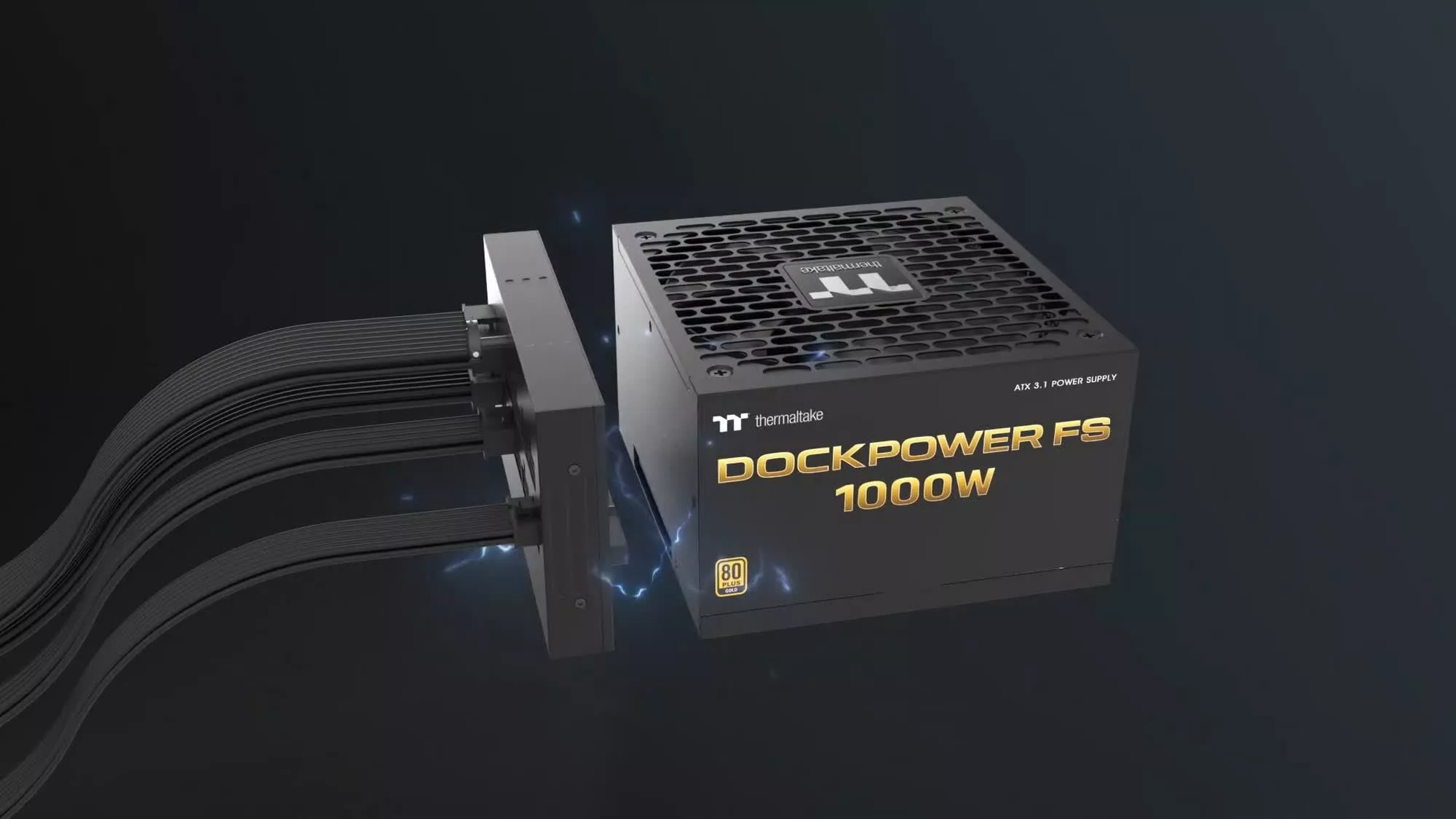
The two sections are connected through what Thermaltake says are server-grade, 30μ gold-plated contacts. This design allows users to upgrade their power supply by replacing only the main unit, eliminating the need to rewire the entire PC. To perform an upgrade, users simply detach the two sections, remove the existing PSU, install the new unit, reconnect it to the dock module, and secure the assembly in place.

Thermaltake claims its new modular approach represents the most significant innovation in power supply design since modular PSUs first appeared in the early 2000s. The company argues that the design could fundamentally change the way people upgrade their PCs by addressing one of the biggest pain points of upgrading an existing system: cable management.

Thermaltake's Dockpower PSUs are set to launch in Q3 2026 in 750W, 850W, 1000W, and 1200W capacities, priced at $120, $130, $160, and $180, respectively. All four models are 80+ Gold certified and will be available in black and white colorways. The company says additional models will be released in the future, but has not provided details on their power ratings or pricing.

Permalink to story:

 
Oh boy, now we can the 12VHPWR problem, but on all your cables, all at once.

Seems like the simpler standard would be for ATX to standardize the connectors and pin-outs on the PSU-side, so that you can simply re-use the cables. Then you're buying cables that suit your case (assuming you buy custom at all), and upgrade the PSU as needed. 4x SATA connector cables are all rated to the same power. 8-pin PCIe are all rated for the same power. 6+2 and 8-pin CPU connectors are all rated for the same power. All these connectors are standardized on the component-side, and they only differ on the PSU-side.
 
Let's say the PSU fails and you have to replace it. You get the same model, or another model from thermaltake that uses the same standard and you just swap the main unit and plug the brick into the back.

That seems like the best case scenario for this.

Without the brick, you would do the same exact thing but you would just plug the cables into the back of the PSU 1 by 1, which would take maybe 1 minute, maybe 2 max.

I think only a crazy person would think this is worth the extra cost and engineering, not to mention an extra failure point. I am a big fan of thermaltake and I use them almost exclusively when I do custom builds, but this is a really, really stupid product and they should feel embarrassed for thinking people would want this.

Not to mention the fact that it is attached with screws; seems like that would actually make it harder to replace the PSU because the screws would most likely be hard to get to without taking the whole thing out, meaning you would have to unplug the cables anyway.

All and all, an extremely dumb product in a market where hardware manufacturers making things that aren't being hit by AI demand are desperate to maintain sales.
 
Last edited:
Not sure how often PSUs fail that paying a significant premium for this gimmick, even to save maybe 5 minutes of assembly time over a modular PSU, is justified.
 
" describing them as the "next generation of PSU architecture."
I think 'architecture' is a tad generous. Then again, they have invented 'a plug'

Still...nice to know that Thermaltake has invented a problem I I didn't know I had, and promptly provided a solution with a built in problem they can solve.

' Thermaltake... a lot less better than it never wasn't before'
 
"... so you never have to redo cable management again"

Redo Cables takes no more than One minute...!

So you save 1 Minute of your Gold Precious Time...!
 
I really don't see this going anywhere... Sez the guy that said SMS would never go anywhere.....

SMS brought a hole new world of possibilities and value in different ways.

What Thermaltake proposes is to me a solution to a first world problem. It also locks you into their range of PSU's. And they better make sure that the cables they provide with the lowest-end PSU are of the same specification than the cables of the highest capacity PSU.
 
This have some goods, lets say the cable management is implemented in the case, and that become standard
brick itself is brick :)
 
I really don't see this going anywhere... Sez the guy that said SMS would never go anywhere.....
We all get it wrong sometimes.
I thought tablets would never succeed as a new market.

Who wants the limitations of a smartphone but (back then) without a mobile connection. Who'd want a laptop without a keyboard and a much more limited OS, not to mention drastically worse performance?
Apparently some people did, definitely a lot that bought into the initial hype without ever getting another after the first one though. Kinda overlooked the market they seem to be used for a lot now - a cheap device to consume video content on / something to hand over to kids so they stop bothering you.
 
The screws attaching that box are going to be impossible to unscrew when it's in the case. I think they should redesign that part and make a clip that you pull to detach the unit. Also, they should get all power supply companies onboard with this design so that if you find a cheaper power supply from a different company you can save some money. It needs to be a standard on all power supplies being build going forward.
 
I haven't needed to replace a power supply in a system that's already built before. I usually buy a new power supply when I build a new computer and sell off my old computer as a single unit. I usually buy quality power supplies with around double the capacity as my use case.
 
The screws attaching that box are going to be impossible to unscrew when it's in the case. I think they should redesign that part and make a clip that you pull to detach the unit. Also, they should get all power supply companies onboard with this design so that if you find a cheaper power supply from a different company you can save some money. It needs to be a standard on all power supplies being build going forward.
If you were going to swap power supplies, you'd have to remove the power supply from your system anyway making clips unnecessary. Also the fiction fit the connector will likely be difficult to remove while the main power supply body is in place so you'd have to remove the entire unit to detach the cable part anyway.
 
Sounds like a great idea for those who upgrade their computer's innards frequently. But with the price of RAM, storage and GPUs these days, who's doing that?
 
The screws attaching that box are going to be impossible to unscrew when it's in the case. I think they should redesign that part and make a clip that you pull to detach the unit. Also, they should get all power supply companies onboard with this design so that if you find a cheaper power supply from a different company you can save some money. It needs to be a standard on all power supplies being build going forward.
Maybe, but then again maybe not. Adapting automotive tools to the purpose could prove to be a solution.
Very simply, were Thermal Take to have the foresight to provide hex socket bolts instead of the typical phillips heads, then a 1/4" drive ratchet, a u-joint, and a long extension bar, could very likely easily reach the back two bolts on the PSU block.

The subbing out of hex socket bolts in place of Phillips heads, has long been a tradition in motorcycle case bolts. In that situation the OEM bolts were Phillips heads. The steel bolts vs aluminum the of the engine cases, caused dissimilar metal corrosion. Which they then required an impact screwdriver to dislodge .Since the case bolts were made from crap soft steel, the Phillips heads stripped out easily, and you were left, "up Schitt's Creek without a paddle'. Correspondingly, after market distributors provided sets of hex socket bolts as replacements for most motorcycle models. Problem solved.

It's reasonable and logical to borrow tools and techniques from other technologies. After all, my heavy leather welding gloves make wonderful oven mitts.

(Too much information maybe, but AI never) :rolleyes:
 
SMS brought a hole new world of possibilities and value in different ways.

What Thermaltake proposes is to me a solution to a first world problem. It also locks you into their range of PSU's. And they better make sure that the cables they provide with the lowest-end PSU are of the same specification than the cables of the highest capacity PSU.
The problem, (as I currently understand it), is the fact that different PSU makers sometimes use the same connector for an entirely different purpose.

I seems that "modular PSU connections", are not included under the umbrella of Universal PnP. So, were you disposed of changing PSU brands, you can't simply plug the existing harness into the new PSU, and not be certain that, "Fourth of July won't come early to your home this year.".

Disclaimer: I haven't dealt with this issue in more than a year. So, IDK if the situation has been rectified or not.

Were modular plug configuration specs to become part of the Universal PnP guidelines, then Thermal Take's solution would become irrelevant
 
were you disposed of changing PSU brands, you can't simply plug the existing harness into the new PSU, and not be certain that, "Fourth of July won't come early to your home this year.".
Not just changing brands, but even changing product lines within the same brand. Or even changing models within the same product line. Hell, I know of at least one Corsair PSU where even changing model years within the same model & product line can get you into trouble.

PSU manufacturers are under no obligation to be consistent with their pin layouts on the PSU. It is a massive blind spot in the ATX standards. The only thing they have to pay attention to are pin outs on the component-end of the cables; the voltages on each pin, plus/minus a certain percentage; and current limits of the molex pins, connectors, and wires they used in their cables. That is it.
 
@mbrowne5061 I can see a couple of drawbacks in introducing universality into full ATX compliance I's twofold.
1: User error. Putting a much larger PSU onto a harness designed for a much smaller PSU. (Fire Hazard)
2: Conceivably forcing manufacturers to supply wire harnesses with low power PSUs, to provide them with harnesses capable of handling the current delivery from PSUs up to 1500 watts. This would provide true universality, at what be a considerable expense to makers, and across the board price hikes to consumers. (That said, across the board price hikes are almost a daily occurrence these days anyway.)

This happens routinely anyway. The 8 pin connector for a 6 pin VGA, or the 6 pin still present when a pure plug-in card, or IGP in being used.

Possible solutions: Pin out and standardized plug configurations could be supplied for a range of wattages. Say 600 to 850 watts, with a stern warning in the directions to avoid liability on the part of manufacturers. But instructions, who reads that crap anyway? Point taken.
 
Neat.
I am a long time Thermaltake fan since their p3 p5 series. It was my first case for a full
waterloop project with hard tubing. Their CTE 550 (I might have spelled it wrong) are also extremely nice cases. It is my current case.
 
@mbrowne5061 I can see a couple of drawbacks in introducing universality into full ATX compliance I's twofold.
1: User error. Putting a much larger PSU onto a harness designed for a much smaller PSU. (Fire Hazard)
2: Conceivably forcing manufacturers to supply wire harnesses with low power PSUs, to provide them with harnesses capable of handling the current delivery from PSUs up to 1500 watts. This would provide true universality, at what be a considerable expense to makers, and across the board price hikes to consumers. (That said, across the board price hikes are almost a daily occurrence these days anyway.)

This happens routinely anyway. The 8 pin connector for a 6 pin VGA, or the 6 pin still present when a pure plug-in card, or IGP in being used.

Possible solutions: Pin out and standardized plug configurations could be supplied for a range of wattages. Say 600 to 850 watts, with a stern warning in the directions to avoid liability on the part of manufacturers. But instructions, who reads that crap anyway? Point taken.
Yeah, forcing all harnesses to meet the upper power standards of ATX would solve the issue... but I think that might already be the case? I haven't read the ATX 3.x standard recently, though.

AFAIK, the difference between a 500W modular supply and a 1500W modular supply is the number of available of hookups. The 24-pin mobo cable in a 1500W supply isn't carrying more power than the one from the 500W supply because mobos using 24pins all use the same voltages and are staying within the same current limits. Ditto for things like SATA cables, 4-pin Molex, PCIe 6/6+2/8-pin cables, CPU cables, etc. Compared to the 500W, the 1500W supply just can run a few extra SATA cables (which all top-out at 4 devices per cable, each, as far as I know), some extra PCIe cables, etc. A PSU vendor doesn't know if you're hooking up an i9 or an i3, using 1 stick of RAM or 4, a single NVMe or an 8x HDD RAID array, an old GT 1030 you had kicking around or a 5090. So they size their cables to handle a certain amount of power or devices (e.g. SATA power cables never supporting more than 4 devices; GPUs using multiple 8-pin connectors) and let vendors make design decisions around the ATX standard and builders just need to make sure everything is "plugged in". The only time I have seen cables get overloaded was those 12VHPWR cables (which were/are fundamentally flawed in their design standards), and those PCIe cables that have two connectors on the device side, but share a connector on PSU side.

And even if they had to mandate thicker wires so all cables could handle 1500W, I don't really see that as a problem. It would likely only be a minor gauge bump in most cases to handle the increased current. And after a while, the PSU vendors could just pull the same move as the smart phone industry did with including USB-C cables and phone charges with new phones: once everyone has their own cables that can be re-used across all PSUs, they can just stop including cables all together. Then if anyone wants or needs new cables, they can just buy their own off the shelf, a la carte. Just an order off the internet, or a trip to Best Buy or Microcenter to get a standard cable; no need to hunt on eBay for a replacement cable for an otherwise fine 10yo PSU.
 
Back